Best Retail ERP Software in 2026: 9 Systems Compared
Compare the best retail erp software in 2026, with POS, inventory, omnichannel and finance tools for single stores and retail chains alike, with expert picks.
- Editor's choice
 Oracle NetSuite
Multi location and omnichannel retail
Starts atSee websiteVisit netsuite.comFull review - Great alternative
 Microsoft Dynamics 365 Business Central
Microsoft ecosystem retailers
Starts at$80 per user per monthVisit microsoft.comFull review - Also consider
 SAP S/4HANA
Large enterprise retail
Starts atSee websiteVisit sap.comFull review
TL;DR:
- Oracle NetSuite and SAP S/4HANA lead for large, multi location retailers, while Odoo and Lightspeed give smaller retailers a faster, cheaper start.
- Acumatica and Microsoft Dynamics 365 Business Central suit growing mid sized retailers that need strong finance and inventory without enterprise weight.
- Most retail ERP pricing is quote based, so compare implementation, POS hardware, and integration costs, not just a licence figure.
- Omnichannel stock accuracy is the test that matters: online, in store, and warehouse stock must agree in real time, or the ERP will create more work.
Quick comparison
| Tool | Best for | Starts at | Free plan? | |
|---|---|---|---|---|
| Oracle NetSuite | Multi location and omnichannel retail | See website | No | Visit |
| Microsoft Dynamics 365 Business Central | Microsoft ecosystem retailers | $80 per user per month | Free trial | Visit |
| SAP S/4HANA | Large enterprise retail | See website | No | Visit |
 Odoo | Growing retailers, customisable modules | See website | Yes | Visit |
 Acumatica | Mid sized retailers, usage based pricing | See website | No | Visit |
 Lightspeed Retail | Small retail stores, simple POS | $89 per month | Free trial | Visit |
 Epicor | Multi store retail and supply chain | See website | No | Visit |
 Infor CloudSuite Retail | Enterprise retail forecasting | See website | No | Visit |
 Brightpearl by Sage | Retail and wholesale, Shopify focused | See website | No | Visit |
The best retail erp software
Retail ERP software, also called the best ERP software for retail, ties point of sale, inventory, purchasing, finance, and ecommerce into one system, so a sale in store updates stock, accounts, and online availability together. We compared official feature pages, pricing information, and public reviews, and we focused on systems with real retail features rather than generic ERP tools with a retail label.
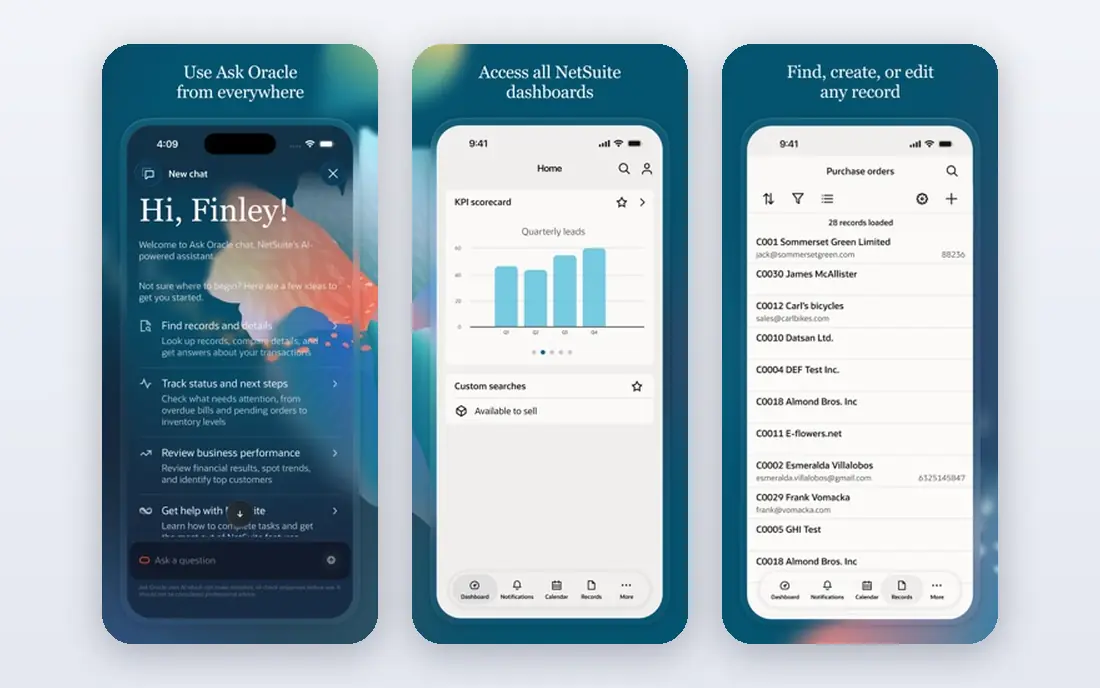
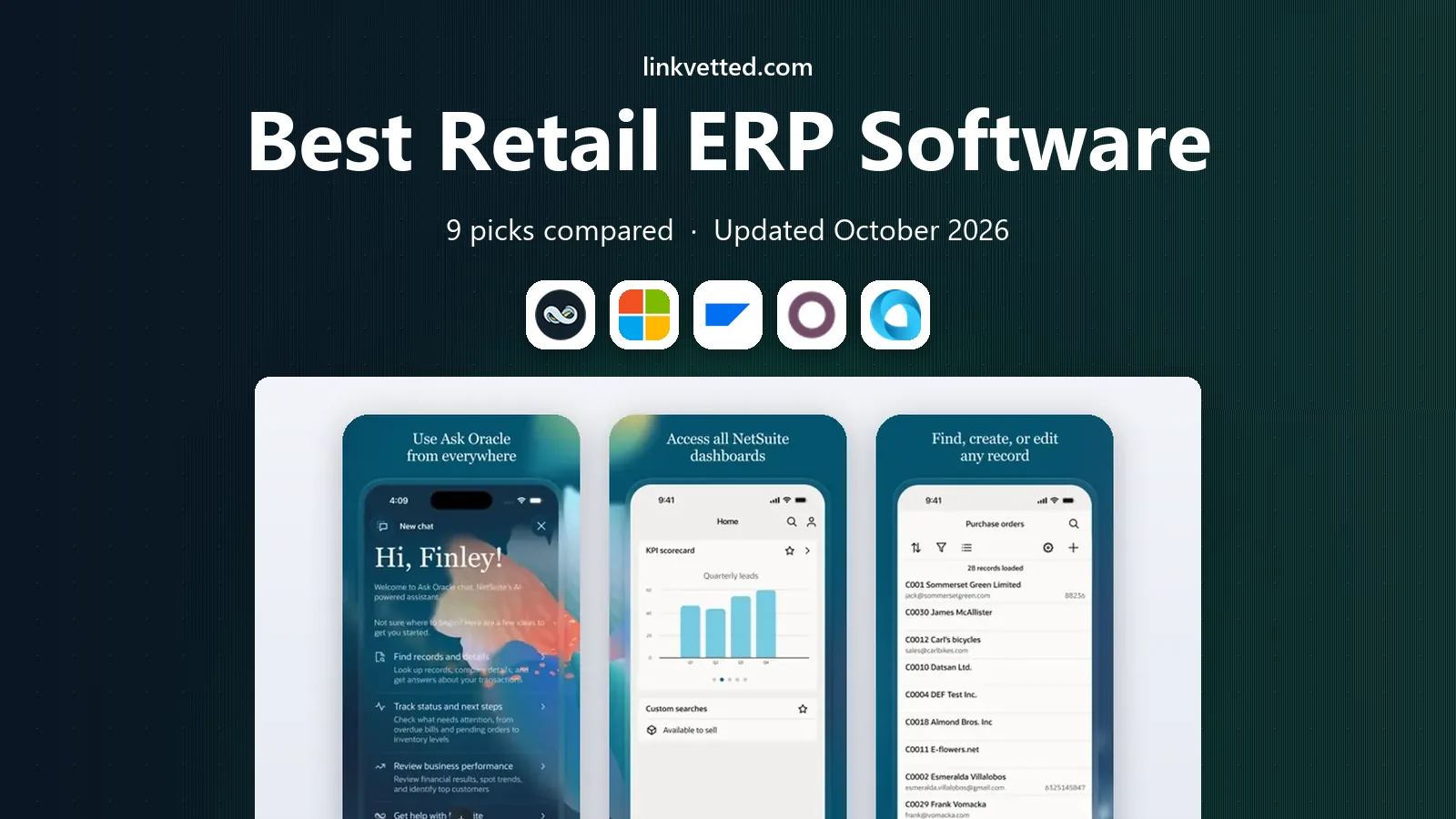
Oracle NetSuite is a cloud ERP trusted by tens of thousands of customers, with retail features that cover point of sale, inventory, order management, finance, and ecommerce in one suite. Its SuiteCommerce tools link online and in store sales, and its dashboards give managers real time visibility across locations. For a retailer growing from a few stores to a chain, or from domestic to international sales, NetSuite scales without a system change.
The catch is cost and complexity. NetSuite prices by quote, with a base licence plus per user fees, and published reports put mid market deployments far above the base fee once implementation is included. The interface also feels dated next to newer tools. For a growing multi location retailer that needs one system for finance and operations, NetSuite remains our pick for most people at that scale.
- Unified finance, inventory, CRM, and ecommerce
- Strong multi location and multi currency support
- Large partner ecosystem
- Quote based pricing
- Implementation can be costly and time consuming

Microsoft Dynamics 365 Business Central is a cloud ERP for small and mid sized businesses, with finance, inventory, purchasing, sales, and warehouse features that suit retailers with multiple locations. Essentials pricing is published at $80 per user per month, with Premium at $110, which makes budgeting clearer than with quote only rivals. Its links to Microsoft 365, Teams, and Power BI help staff who already work in Microsoft tools.
Retail specific POS and ecommerce features often come through partners or add ons, so confirm what is included in your quote. A retailer that already runs Microsoft tools, and that wants strong finance and inventory control, will find Business Central a solid and scalable choice.
- Essentials from $80 and Premium from $110 per user per month in published pricing
- Strong finance and inventory
- Microsoft 365 links
- Retail POS depth depends on add ons and partners
- Implementation needs a Microsoft partner for larger rollouts

SAP S/4HANA Retail is built for large retailers with complex supply chains, global operations, and high transaction volumes. It offers real time inventory and sales data, intelligent forecasting, assortment planning, and deep integration across finance, logistics, and merchandising. For a national or international chain, that depth is difficult to match.
The trade off is scale and cost. S/4HANA prices by quote, needs skilled implementation partners, and typically takes many months to deploy. Small and mid sized retailers will find it too heavy and too expensive. For a large enterprise retailer that needs global, real time operations, SAP remains the benchmark.
- Real time data and forecasting at enterprise scale
- Deep supply chain and assortment features
- Global multi entity support
- Enterprise pricing by quote
- Implementation often takes 6 to 12 months
Odoo is a modular ERP with apps for point of sale, inventory, sales, purchasing, accounting, and ecommerce, which lets a retailer start small and add modules as it grows. One app is free on Odoo Online with unlimited users, and published pricing for Standard plans is around $24.90 to $31.10 per user per month, with Custom plans higher. That flexibility makes Odoo popular with startups and growing retailers.
The catch is setup. Odoo needs configuration, and complex retail workflows such as multi warehouse stock, promotions, and loyalty may need a partner or custom work. A retailer with technical staff, or a good Odoo partner, can build a system that fits closely at a lower licence cost than enterprise rivals. A retailer that wants everything ready out of the box should look at Lightspeed or NetSuite instead.
- Modular apps for POS, inventory, sales, and accounting
- Free single app option
- Low entry price for full access
- Needs configuration or a partner for complex retail workflows
- Quality varies by module and partner
Acumatica is a cloud ERP for growing mid sized businesses, with retail features covering inventory, order management, POS connections, finance, and customer management. Its pricing model is unusual: it charges on transaction volume and resources used, rather than per user, which suits retailers with many occasional users such as seasonal staff. Multi location and multi currency support helps chains and cross border sellers.
The drawback is price transparency. Acumatica does not publish a standard price, so buyers must work through a partner for a quote. Implementation quality also depends on the partner. For a mid sized retailer that wants enterprise style depth without per seat pricing, Acumatica is a strong contender.
- Priced on usage rather than per seat
- Strong inventory and omnichannel features
- Multi location and multi currency support
- No published price
- Implementation through partners
Lightspeed Retail is a cloud POS and retail platform for small stores, with inventory, sales, customer, and ecommerce tools in one place. Published pricing starts at $89 per month, which makes it accessible for a single store or a small chain. Staff learn the POS quickly, and the platform handles multi location stock, payments, and reporting without a heavy ERP project.
The limit is depth. Lightspeed is a retail platform with ERP style features, not a full enterprise ERP, so a large chain with complex finance, warehousing, and supply chain needs will outgrow it. For a small retailer that wants a simple, reliable POS plus inventory and online sales, Lightspeed is an excellent starting point.
- Easy to use POS
- Inventory and ecommerce tools
- Dedicated retail support reported around the clock
- Less ERP depth than NetSuite or SAP
- Higher tiers needed for advanced reporting
Epicor offers retail and ERP solutions for multi store retailers, with omnichannel order management, inventory, merchandising, and supply chain features. It suits retailers that need tight control over stock across stores, warehouses, and online channels, plus finance and purchasing in the same system. Cloud and on premises deployment options give larger retailers flexibility.
The catch is cost and effort. Epicor prices by quote, and implementation for a multi store chain is a serious project. Smaller retailers will find Lightspeed or Odoo faster and cheaper. For a mid sized to large retailer with complex supply chain needs, Epicor is a proven and capable choice.
- Strong omnichannel and supply chain features
- Multi store inventory control
- Cloud and on premises options
- Quote based pricing
- Implementation can be complex
Infor CloudSuite Retail is a cloud ERP for enterprise retailers, with forecasting, assortment, inventory, and finance features designed for chains with many stores and product lines. Its forecasting tools help buyers plan stock by location and season, which matters when a wrong buy ties up cash for months. Infor also offers industry specific tools for fashion, grocery, and general retail.
The downside is scale. Infor prices by quote and targets larger retailers, so a small store will find it too heavy. For an enterprise retailer that needs strong forecasting and assortment planning, Infor is a credible alternative to SAP and NetSuite.
- AI driven forecasting and assortment tools
- Strong enterprise retail depth
- Cloud based delivery
- Enterprise pricing by quote
- Best suited to larger retailers
Brightpearl by Sage is a retail operations platform for retail and wholesale teams, with inventory, order management, purchasing, warehousing, and accounting in one system. Its native Shopify and Shopify Plus integrations suit brands that sell mainly online plus a few stores, and it handles multi currency and multi store stock in a way that pure accounting tools do not. Implementation partners help tailor it to each business.
The weakness is price transparency. Brightpearl does not publish a standard price, so buyers need a quote based on order volume and stores. For a Shopify led retailer or wholesaler that has outgrown separate inventory and accounting tools, Brightpearl offers a focused and practical step up.
- Native Shopify and Shopify Plus integrations
- Retail operations, inventory, and accounting in one
- Per store currency pricing
- No published price
- Implementation partner recommended
How we picked these
We compared official feature pages, pricing information, and public reviews, and we kept systems with real retail features such as POS, inventory, order management, and omnichannel stock control. Where pricing is published, we used the vendor figure or a recent published report. Where pricing is quote based, we said so rather than inventing a number. We did not claim hands on testing.
How to choose retail ERP software
Start with stock accuracy, not feature count. List your sales channels, stores, warehouses, and fulfilment methods, then test whether a sale, return, or transfer updates every channel in real time. Next, check POS hardware, payment providers, and ecommerce integrations, because a system that cannot talk to your checkout will fail on day one. Finally, compare total cost: licences, implementation, training, hardware, and ongoing support, over three years, not just year one.
Implementation risks to plan for
Data migration is the most common risk. Clean product, customer, and stock data before migration, and agree who owns that cleanup. Plan a pilot in one store or one channel before a full rollout, and keep the old system running in parallel until stock counts reconcile. Train floor staff on the POS early, because a slow checkout on launch day will damage trust faster than any back office feature can repair it.
FAQ
What is the best retail ERP software for a small retailer?
Lightspeed Retail and Odoo are strong starting points for small retailers. Lightspeed starts at $89 per month with an easy POS, while Odoo offers a free single app option and low cost full access. Larger retailers with multiple locations usually need NetSuite, Business Central, or Acumatica instead.
How much does retail ERP software cost?
Small retail platforms start around $89 per month, while mid sized ERP plans such as Business Central Essentials are $80 per user per month. Enterprise systems such as NetSuite, SAP, Epicor, and Infor price by quote, and total cost including implementation is often far higher than the licence alone. Always ask for a three year total cost.
What is the difference between retail ERP and retail POS software?
POS software handles checkout, payments, and basic inventory. Retail ERP adds finance, purchasing, warehousing, order management, and reporting across all stores and channels in one system. A single store may only need POS, while a chain or omnichannel brand usually needs ERP to keep stock and accounts in sync.
Does retail ERP software work with Shopify?
Yes, many systems on this list connect to Shopify, including Brightpearl with native Shopify integration, NetSuite through its connector, Odoo through its ecommerce apps, and Business Central through Microsoft connectors. Confirm the exact connector, sync direction, and fees for your store before signing.
How long does retail ERP implementation take?
Small retail platforms can go live in weeks, while mid sized ERP rollouts often take 1 to 3 months, and enterprise systems such as SAP can take 6 to 12 months. Data cleanup, POS setup, and staff training are usually the longest parts, so plan a pilot store before a full chain rollout.