Best Resume Parsing Software in 2026: 8 Tools Compared
Compare the best resume parsing software for recruiters and hiring teams, with accuracy, ATS links, pricing and honest trade-offs for each tool in 2026.
- Editor's choice
 Affinda
Pay-as-you-go parsing API
Starts at$0.20 per pageVisit affinda.comFull review - Great alternative
 Daxtra
Staffing and enterprise parsing
Starts atSee websiteVisit daxtra.comFull review - Also consider
 Textkernel
Multilingual enterprise parsing
Starts atSee websiteVisit textkernel.comFull review
TL;DR:
- Affinda is our pick for teams that want a focused parsing API with clear pay-as-you-go pricing.
- Daxtra and Textkernel suit large staffing and enterprise teams that need multilingual parsing and deep ATS links.
- Zoho Recruit and Manatal suit small teams that want parsing inside a full ATS, not a separate API.
- Test parsing on your own resumes, since accuracy varies by format, language and layout.
Quick comparison
| Tool | Best for | Starts at | Free plan? | |
|---|---|---|---|---|
| Affinda | Pay-as-you-go parsing API | $0.20 per page | Free trial | Visit |
| Daxtra | Staffing and enterprise parsing | See website | No | Visit |
| Textkernel | Multilingual enterprise parsing | See website | Free trial | Visit |
 RChilli | Taxonomy and ATS parsing | $75 per 500 credits | No | Visit |
 HireAbility | Configurable parsing output | See website | No | Visit |
 Zoho Recruit | Budget ATS with parsing | $25 per recruiter per month | Yes | Visit |
 Manatal | Small agency ATS with parsing | $15 per user per month | Free trial | Visit |
 Superparser | Small-scale transparent parsing | $40 per month | Yes | Visit |
The best resume parsing software
Resume parsing software turns an unstructured resume into structured fields such as name, contact details, work history, education and skills, so recruiters can search and compare candidates without retyping data. Some tools are APIs for developers, while others are full hiring platforms with parsing built in. We compared official vendor pages, pricing information and public reviews to build this list.

Affinda is a document parsing API that extracts structured data from resumes, with a free 14-day trial and pay-as-you-go pricing at $0.20 per page. That clear pricing makes it easy to estimate cost at your volume, and the API model suits teams building parsing into an ATS, job board or internal tool. Affinda also handles other document types, which helps teams that parse more than resumes.
The catch is that Affinda is an API, not a finished recruiter product. Your team needs developers to send files, handle output and build the interface recruiters use. If you want a dashboard out of the box, choose an ATS with parsing instead. Pick Affinda when you have engineering support and want transparent, volume-based parsing.
- Clear pay-as-you-go pricing
- Fast API for resumes and other documents
- Free trial for testing
- Developer setup required
- No recruiter dashboard on its own
Daxtra Parser is built for staffing firms and large recruitment teams that need speed, scale and multilingual parsing. It extracts candidate and job data in more than 40 languages and returns rich structured output, including work history, education, skills and contact details. Its ATS and CRM integrations help large teams keep parsed data flowing into the systems recruiters already use.
The drawback is access. Daxtra pricing is quote only, and the sales-led process fits larger teams better than a solo recruiter. You will need a demo and a quote to judge total cost at your volume. Choose Daxtra when you parse high volumes, work across languages or run a staffing agency with deep ATS needs.
- Parsing in more than 40 languages
- More than 150 extracted fields
- Strong ATS and CRM links
- Pricing is quote only
- Sales-led process suits larger teams
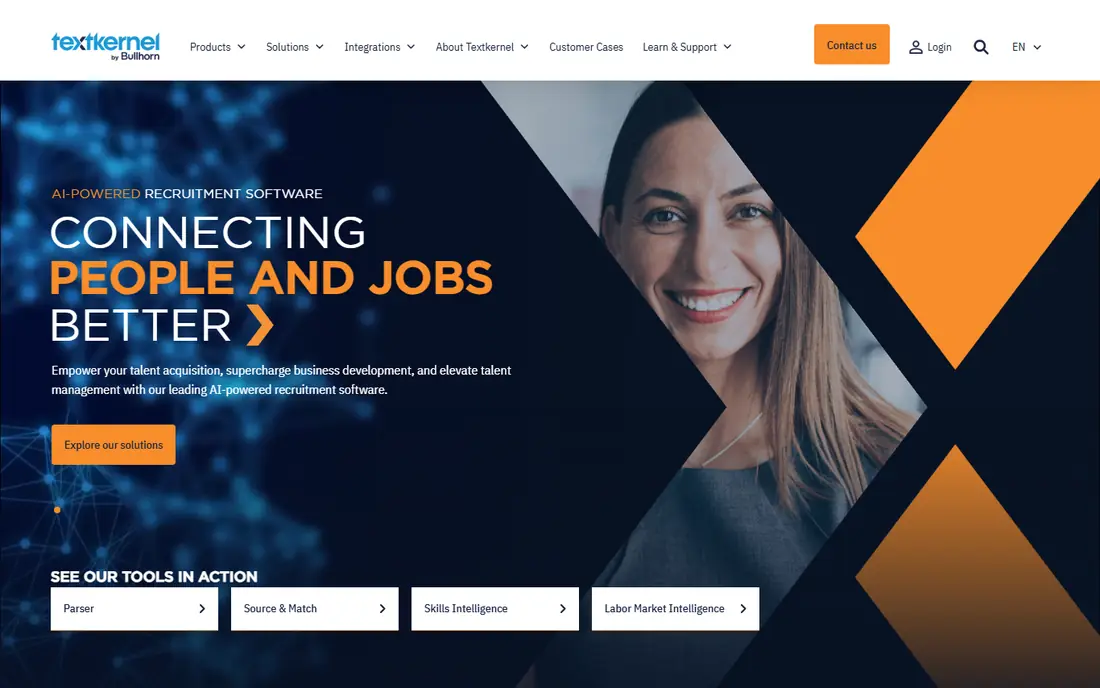
Textkernel, now part of Bullhorn, offers an intelligent parser that extracts and enriches candidate and job data, with multilingual support and taxonomy features that map raw skill names to searchable terms. That enrichment matters for large teams, since it improves search and matching beyond simple keyword extraction. Textkernel also supports fair hiring by focusing on relevant details rather than unrelated personal data.
The trade-off is price and complexity. Textkernel pricing is quote only, and its enterprise focus may be more than a small team needs. A free trial helps you test parsing on your own resumes. Pick Textkernel when you run a large hiring operation, work across languages or need strong taxonomy and matching alongside parsing.
- Enterprise multilingual parsing
- Skill taxonomy and enrichment
- Strong search and matching links
- Pricing is quote only
- Enterprise focus can be heavy for small teams
RChilli is a resume parsing and enrichment tool with credit-based pricing starting at $75 per 500 credits, which suits teams that want to pay for parsing volume rather than a large subscription. Its taxonomy enrichment maps skills and job titles to structured terms, improving search inside an ATS. Wide ATS integrations help teams add parsing without changing their hiring system.
The catch is planning. Credit use depends on resume volume and features, so you need to estimate monthly parses before committing. Setup also varies by ATS, so confirm your integration early. Choose RChilli when you want parsing plus taxonomy enrichment inside your existing ATS, with volume-based pricing.
- Credit-based pricing from $75 per 500 credits
- Taxonomy enrichment
- Wide ATS integration options
- Credit model needs volume planning
- Setup varies by ATS
HireAbility is a resume parsing API known for configurable output, so teams can shape parsed fields to match their own ATS or database schema. Per-parse pricing falls as volume rises, which helps larger teams control cost. That flexibility suits companies building a custom hiring system or integrating parsing into an existing platform.
The drawback is that HireAbility is a developer tool, not a recruiter dashboard, and pricing is quote only. Small teams without engineering support will find an ATS with built-in parsing easier. Pick HireAbility when you need parsing output tailored to your system and you have developers to integrate it.
- Configurable output schemas
- Per-parse pricing that falls with volume
- Strong fit for custom hiring systems
- Pricing is quote only
- Developer setup required
Zoho Recruit is a full applicant tracking system with AI resume parsing built in, and it is the cheapest full-featured option on this list for small teams. The free plan covers one active job and one recruiter, while Standard costs $25 per recruiter per month on annual billing. Two editions serve corporate HR and staffing agencies separately, with integrations across the Zoho ecosystem.
The catch is job caps. Standard allows 10 active jobs per license and Enterprise allows 20, so scaling means buying more licenses. Past about five users, flat-rate tools may be cheaper. Choose Zoho Recruit when you want parsing inside a budget ATS and your team is small enough for the job caps to work.
- Full ATS with AI resume parsing
- Free plan for one job and one recruiter
- Two editions for corporate and staffing teams
- Active job caps per license
- Per-seat pricing grows with team size
Manatal is a recruiting CRM and ATS with published pricing from $15 per user per month on annual billing, including AI-powered candidate matching and resume parsing. That price makes it an easy first choice for a small agency or solo recruiter moving off spreadsheets. A 14-day free trial lets you test parsing and matching with your own resumes before paying.
The trade-off is depth. Manatal covers sourcing through placement well, but agencies with complex temp staffing, pay-and-bill or multi-entity needs will find larger tools more complete. Advanced features also sit on higher tiers. Pick Manatal when you want a low-cost ATS with parsing and matching for a small team.
- Lowest published per-seat price on this list
- AI matching and resume parsing
- 14-day free trial
- Less staffing depth than enterprise ATS tools
- Advanced features sit on higher tiers
Superparser is a parsing API with transparent pricing at small scale, including a free tier of 50 credits per month and a Starter plan at $40 per month for 500 parses. That clarity suits startups, job boards and small hiring tools that need predictable parsing costs without a sales call. Its simple API model also makes integration straightforward for small teams.
The limit is scale and depth. Superparser will not match the enterprise taxonomy, language coverage or ATS ecosystem of Daxtra or Textkernel. For a small product or a modest hiring volume, that may not matter. Choose Superparser when you want a clear, low-cost parsing API for small-scale use.
- Transparent small-scale pricing
- Free 50 credits per month
- Starter plan at $40 for 500 parses per month
- Less enterprise depth than Daxtra or Textkernel
- Smaller vendor footprint
How we picked these
We compared official vendor pages and public pricing comparisons, and we kept only tools that parse resumes into structured fields, whether as an API or inside an ATS. We favored a mix of developer APIs and full hiring platforms, so both builders and recruiters have options. Where pricing was not published, we wrote See website, and we noted free trials and free plans where they exist.
What to check before you buy
Start with a parsing test on your own resumes. Use a sample that includes PDFs, Word files, scanned resumes, varied layouts and more than one language if you hire across regions. Check how well each tool extracts names, contact details, dates, job titles, skills and education, and how it handles gaps, short roles and unusual formats. A demo with clean sample resumes will flatter every vendor.
Next, check what happens after parsing. Confirm how parsed fields map to your ATS, how duplicates are handled, how search uses parsed skills, and how you correct errors. Also confirm data handling, since resumes contain personal data: check storage, retention, security and privacy terms, and make sure your process follows the hiring laws that apply to you. A parser that extracts well but maps poorly will still slow your team down.
Finally, price parsing at your real volume. Compare per-page, per-credit and per-seat models at your monthly resume count, including any enrichment or matching fees. For an API, add developer time. For an ATS, check job caps and tier limits. Trial the top two tools with the same resume set, then choose the one with the best accuracy and the cleanest fit for your workflow.
FAQ
What is the best resume parsing software?
The best resume parsing software depends on how you hire. Affinda and Superparser fit teams building with an API, Daxtra and Textkernel fit large staffing and enterprise teams, and Zoho Recruit and Manatal fit small teams that want parsing inside an ATS. Test each tool on your own resumes before deciding.
What is a top rated resume parsing software for staffing agencies?
Daxtra and Textkernel are strong choices for staffing agencies, thanks to multilingual parsing, deep ATS links and high-volume handling. RChilli is also a good fit when taxonomy enrichment matters. For a small agency, Manatal offers parsing plus a full ATS at a lower published price.
How accurate is resume parsing software?
Accuracy varies by resume format, layout, language and scan quality. Clean PDFs and Word files parse well, while scanned or heavily designed resumes can lose data. Always test with your own resumes and keep a human review step for key fields, especially contact details and work dates.
Do I need an API or an ATS with parsing?
Choose an API if you build your own hiring tool, job board or ATS integration and have developers to support it. Choose an ATS with parsing if you want a ready-made recruiter dashboard, pipelines and candidate search in one product. Many teams start with an ATS and move to an API only when volume or custom needs grow.
How much does resume parsing software cost?
Prices range from $15 per user per month for Manatal and $25 per recruiter per month for Zoho Recruit, to $0.20 per page for Affinda and $40 per month for Superparser. Enterprise APIs such as Daxtra, Textkernel and HireAbility are quote only. Compare cost at your real monthly resume volume.