Best Qualitative Software in 2026: 9 Tools Compared
We compared the best qualitative software for interview coding, themes and mixed methods research, with prices, free trials and tips for students and teams.

- Editor's choice
 NVivo
Large interview and mixed methods projects
Starts atSee websiteVisit lumivero.comFull review - Great alternative
 ATLAS.ti
Coding plus AI assisted analysis
Starts atSee websiteVisit atlasti.comFull review - Also consider
 MAXQDA
Mixed methods and team research
Starts atSee websiteVisit maxqda.comFull review
TL;DR:
- The best software for qualitative data analysis helps you code interviews, find themes and keep an audit trail, not just store transcripts.
- NVivo, ATLAS.ti and MAXQDA lead for large academic and professional projects, while Dedoose and Quirkos suit smaller teams and budgets.
- Check file support, collaboration and export options before buying, since switching tools mid project is painful.
- For a single small project, a free or low cost tool may be enough, while a team project needs shared coding and clear permissions.
Quick comparison
| Tool | Best for | Starts at | Free plan? | |
|---|---|---|---|---|
| NVivo | Large interview and mixed methods projects | See website | Free trial | Visit |
| ATLAS.ti | Coding plus AI assisted analysis | See website | Free trial | Visit |
| MAXQDA | Mixed methods and team research | See website | Free trial | Visit |
 Dedoose | Affordable web based coding | $14.95 per month | Free trial | Visit |
 Quirkos | Simple visual coding for beginners | See website | Free trial | Visit |
 Taguette | Free open source coding | Free | Yes | Visit |
 Dovetail | UX research and insight sharing | See website | Free trial | Visit |
 HyperRESEARCH | Coding and theory building | See website | Free trial | Visit |
 QDA Miner | Text analysis and coding | See website | Free trial | Visit |
The best qualitative software
Qualitative research means reading interviews, notes and open survey answers closely, then coding them into themes you can defend. The tools below help with coding, searching, visualizing and sharing those themes.
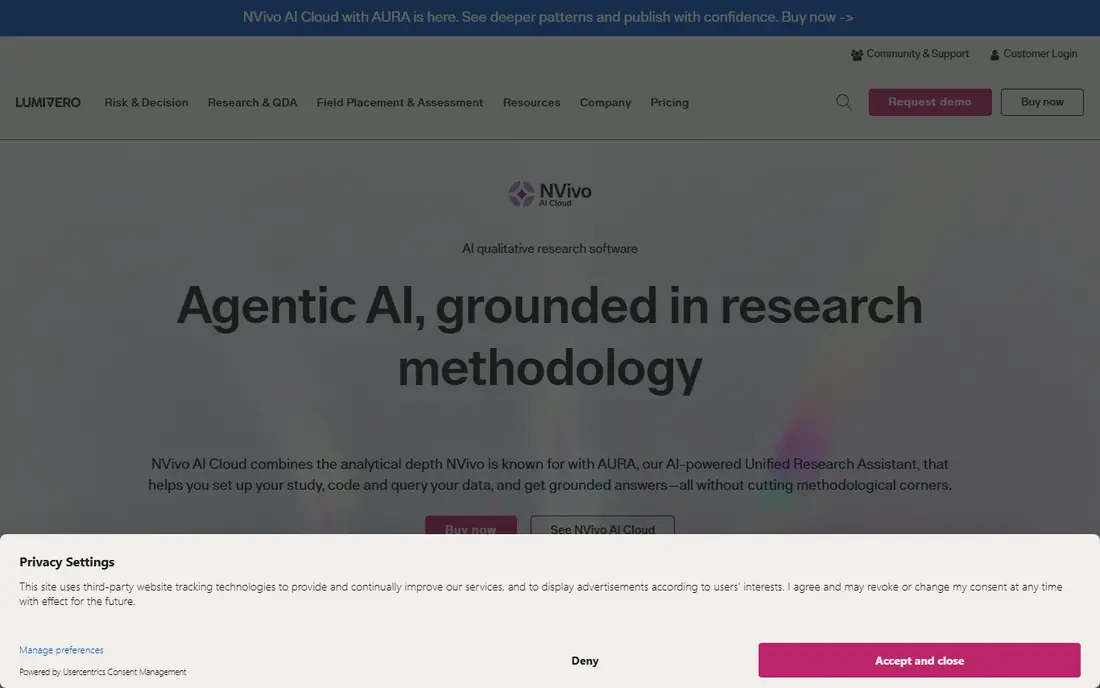
NVivo, from Lumivero, is the most widely used tool for large qualitative projects, and its strength is handling many kinds of data in one project: interview transcripts, audio, video, images, surveys and social media extracts. Its coding, query and visualization tools let a researcher test whether a theme holds across cases, not just in one interview. For a thesis, evaluation or multi site study, that depth matters.
New users face a learning curve, and the interface has many panels to master. Pricing also varies by academic, student or commercial licence, so get a quote for your type. For a large or long term project, NVivo remains our pick for most researchers because of its range and its audit trail.
- Broad file support
- Strong queries and visualizations
- Mixed methods tools
- Steep learning curve
- Pricing varies by licence
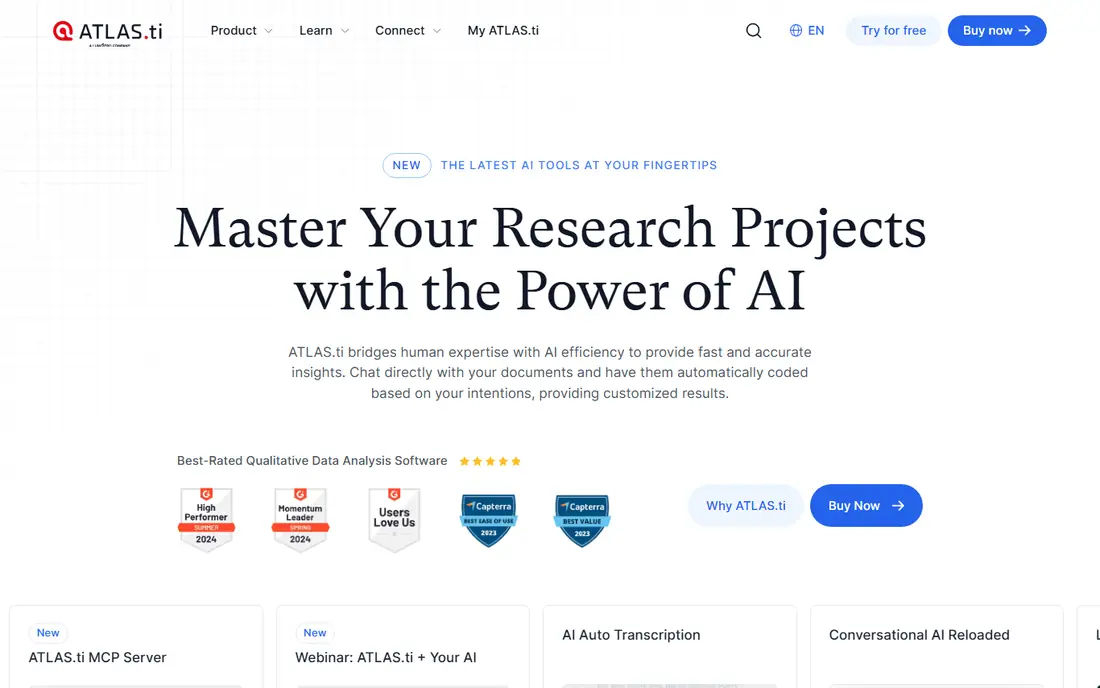
ATLAS.ti combines classic coding with newer AI assisted features that can suggest codes and summarize documents, which speeds up early exploration of a large dataset. Its network views also help show how codes and themes link, which is useful when presenting findings to a team or a client. The tool works on desktop and web, so teams can collaborate without being tied to one machine.
AI suggestions must be checked by a human researcher, since they can miss nuance or invent a theme that the data does not support. Treat AI as a starting point, not a result. For teams that want modern AI help alongside solid coding, ATLAS.ti is a strong choice.
- AI coding assistance
- Good network views
- Works on desktop and web
- AI suggestions need human checking
- Pricing by licence
MAXQDA is known for mixed methods work, where qualitative coding sits alongside survey numbers and statistical summaries. Its team features support shared coding, agreement checks and merged projects, which matter when several researchers code the same data. Visual tools such as code matrices and document portraits help teams compare cases quickly.
The interface is dense for a first time user, and pricing depends on licence type, so students and academics should check discounted options. For a team project that mixes interviews with survey data, MAXQDA is one of the best options available.
- Strong mixed methods tools
- Team coding features
- Clear visualizations
- Licence pricing varies
- Interface is dense at first
Dedoose is a web based tool that keeps costs low with a monthly price, which suits small research teams, students and nonprofits. It handles interview coding, excerpting and mixed methods charts in a browser, and team members can work on the same project without installing software. That simplicity is a real benefit for a short project or a distributed team.
Being web only means you need a reliable connection, and its depth for very large, complex projects is less than NVivo or MAXQDA. For a modest project with a tight budget, Dedoose offers good value and a gentler learning curve than the big desktop tools.
- Low monthly price
- Web based collaboration
- Mixed methods charts
- Web only
- Less depth for very large projects
Quirkos is designed for beginners, with colorful bubbles for codes that grow as you code more text. That visual approach makes coding feel less abstract, which helps students, community researchers and small teams who are new to qualitative work. It also offers one time purchase options, which some users prefer to subscriptions.
Advanced queries and mixed methods tools are fewer than in NVivo or MAXQDA, so a large academic project may outgrow it. For a first qualitative project, a teaching setting or a small evaluation, Quirkos is a friendly and capable starting point.
- Very visual coding interface
- Easy for beginners
- One time purchase options
- Fewer advanced queries
- Smaller feature set
Taguette is a free, open source tool for basic qualitative coding, which makes it ideal for students, independent researchers and anyone with no budget. You can import documents, highlight and code passages, and export results, all without a licence fee. A self hosting option also appeals to teams with strict data control needs.
Features are basic compared with commercial tools, with fewer queries, visualizations and collaboration options. For a single researcher with a small dataset, though, Taguette covers the core job well. If your project grows, you can export and move to a larger tool later.
- Free and open source
- Simple coding
- Self hosting option
- Basic features
- Smaller support community
Dovetail is built for user experience and product research teams that need to turn interviews into insights stakeholders will actually read. It links transcripts, highlights and tags to a searchable insight library, so a product manager can find evidence for a decision without reading every interview. That sharing focus sets it apart from academic tools.
Academic researchers may miss some advanced coding and mixed methods features, and team pricing is by quote. For UX, product and market research teams, Dovetail is a strong pick, since its value lies in making research usable across a company, not just in coding it well.
- Great for sharing insights with product teams
- Good transcription links
- Clean interface
- More UX focused than academic
- Pricing by quote for teams
HyperRESEARCH offers coding and theory building tools for researchers who want to build themes from cases and test how codes link. It supports case based analysis, so a team can compare interviews by participant group or setting, and it has a long track record in academic research. Its interface feels older than newer web tools, but its focus on building theory from coded data is clear.
The feature set is smaller than NVivo or MAXQDA for mixed methods work, and the interface takes some learning. HyperRESEARCH fits best for researchers who want case based coding and theory building rather than a large visual suite. For that job, it remains a capable option.
- Code and theory building tools
- Case based analysis
- Long track record
- Older interface
- Smaller community than NVivo
QDA Miner, from Provalis Research, pairs qualitative coding with text mining, which helps when a project includes large volumes of open ended survey answers or documents. Its coding, retrieval and statistical tools let researchers move from themes to counts and comparisons, which suits mixed methods and content analysis work. It also links to statistical tools for deeper analysis.
It is mainly Windows focused, and its text mining features take time to learn well. For teams with large text datasets or a content analysis focus, QDA Miner is a capable and distinctive option. For simple interview coding, a lighter tool may be faster to learn.
- Strong text mining and coding
- Good for open survey data
- Statistical links
- Windows focused
- Learning curve for text mining features
How we picked these
We compared official product pages, pricing pages and researcher reviews for tools that code and analyze qualitative data, not just transcription or survey tools. We favored tools still sold in 2026, with clear coding, search and export features, and we covered academic, UX and budget needs. Where pricing varies by licence, we said so rather than inventing a single figure.
What to check before you buy
Start with your data and your team. A solo researcher with twenty interviews needs a different tool than a team coding hundreds of open survey answers. Check file support for your transcripts, audio and images, and test importing a real file during a trial. Also check collaboration: can two people code the same project, and can you measure agreement between coders.
Data security matters too, especially for sensitive interviews. Ask where data is stored, who can access it, and how it can be deleted. Finally, check export options. You should be able to export coded data, codebooks and reports in a form you can use if you change tools later, since research projects often outlive a single licence.
FAQ
What is the best software for qualitative data analysis for beginners?
For beginners, Quirkos or Dedoose are good starting points, since they are visual, affordable and easier to learn than NVivo. Taguette is free for a very small project. Start with a trial on a few real interviews, and move to a larger tool only if you need deeper queries or team features.
What is the best qualitative software for a large research team?
For a large team, NVivo, ATLAS.ti or MAXQDA lead, since they offer shared coding, agreement checks and strong queries. MAXQDA is strong for mixed methods, ATLAS.ti for AI assisted coding, and NVivo for broad file support. Trial all three with your actual data before committing.
Can qualitative software transcribe interviews?
Some tools link to transcription, including Dovetail, but most coding tools focus on analysis, not transcription accuracy. Many researchers transcribe with a separate tool, then import the transcript for coding. Check transcription support and accuracy before assuming one tool covers both jobs.
Is there free qualitative analysis software?
Yes, Taguette is free and open source for basic coding. Some commercial tools offer free trials and student licences, which can cover a term project. Free tools suit small datasets, while large team projects usually need a paid tool for collaboration and support.
How does qualitative software help with themes?
It helps by letting you code passages, group codes into themes, search across cases, and keep a record of how themes were built. That audit trail makes findings easier to defend than notes in separate documents. Software does not create themes for you; the researcher still interprets the data.
Should I use AI coding in qualitative research?
AI coding can speed up early exploration, but it should not replace human reading, especially for sensitive topics. Check AI suggestions against the original text, keep a record of what was AI suggested versus human coded, and follow your institution or journal guidance on AI use in research.