Best Procurement Software in 2026: 8 Platforms Compared
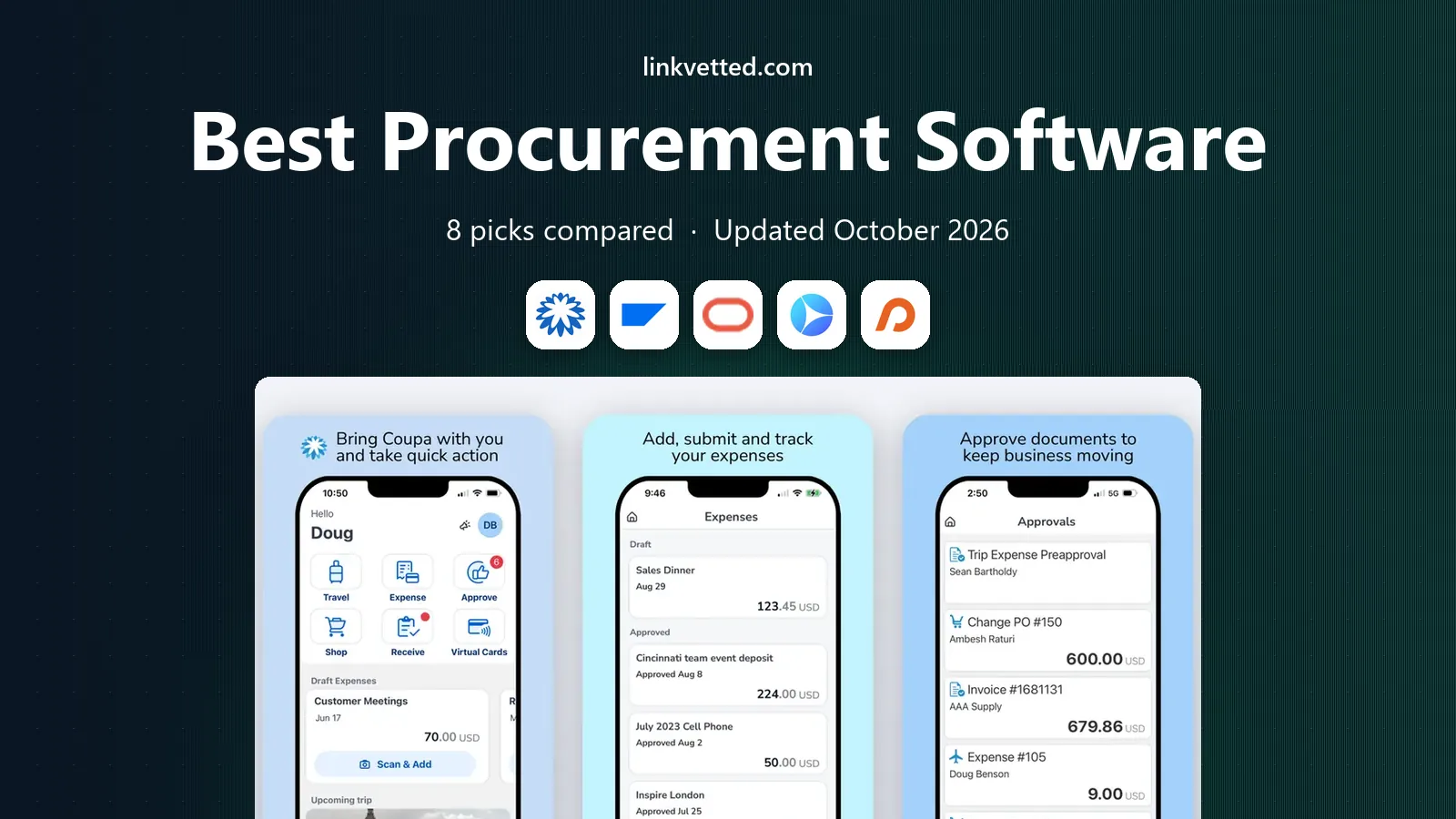
We compared the best procurement software, including Coupa, SAP Ariba, Precoro and Procurify, on approvals, budgets, sourcing and pricing and team size.
- Editor's choice
 Coupa
Large enterprises with complex spend
Starts atSee websiteVisit coupa.comFull review - Great alternative
 SAP Ariba
Global enterprises already running SAP
Starts atSee websiteVisit sap.comFull review - Also consider
 Oracle Procurement Cloud
Large Oracle ERP customers
Starts atSee websiteVisit oracle.comFull review
TL;DR:
- Coupa and SAP Ariba suit large enterprises with complex, global spend and sourcing needs.
- Precoro and Procurify suit mid-sized teams that want clear approvals and live budget visibility.
- Zip suits companies whose main problem is messy purchase intake and approval routing.
- Ramp suits smaller US teams that want free core spend tools with procurement as a paid add-on.
Quick comparison
| Tool | Best for | Starts at | Free plan? | |
|---|---|---|---|---|
| Coupa | Large enterprises with complex spend | See website | No | Visit |
| SAP Ariba | Global enterprises already running SAP | See website | No | Visit |
| Oracle Procurement Cloud | Large Oracle ERP customers | See website | No | Visit |
 Precoro | Mid-market teams wanting transparent pricing | $499 per month | Free trial | Visit |
 Procurify | Mid-sized teams needing live budget visibility | See website | No | Visit |
 Zip | Companies whose bottleneck is intake and approvals | See website | No | Visit |
 Ramp | Smaller US teams wanting free core tools | Free | Yes | Visit |
 Airbase | Mid-market teams wanting purchasing plus AP | See website | No | Visit |
The best procurement software
We compared procurement software on purchase requests, approvals, budgets, supplier management, invoicing and pricing, for small teams to large enterprises.
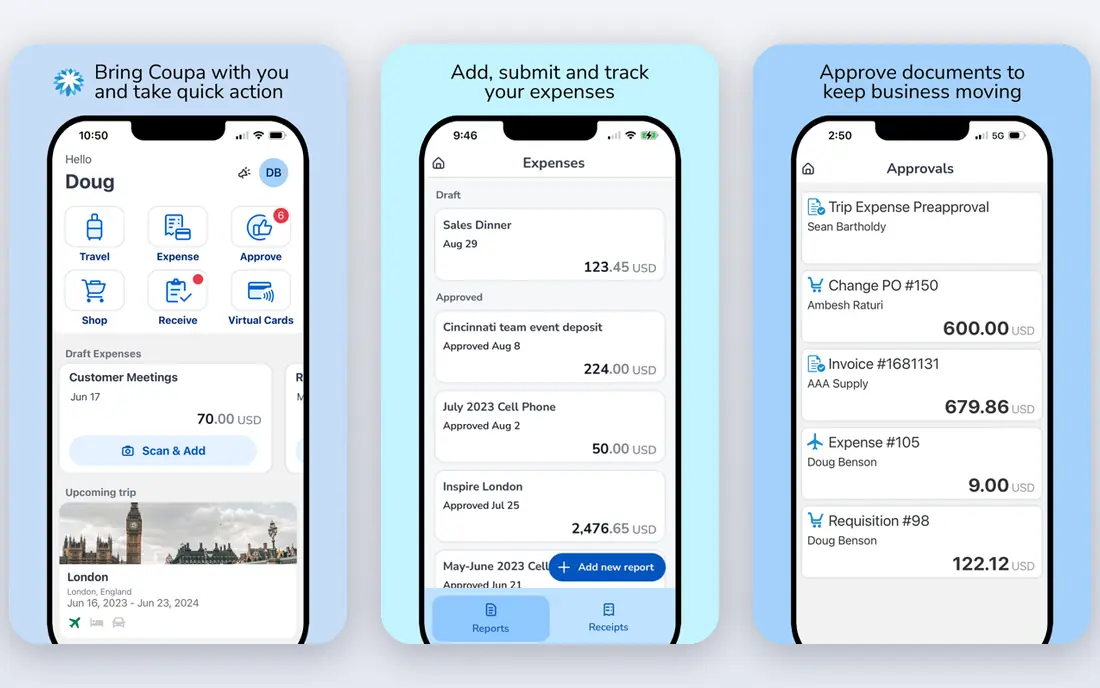
Coupa fits large enterprises that want one platform for sourcing, procurement, invoicing, expenses and payments. Its strength is breadth, with spend analytics and community benchmarking that help finance teams spot savings opportunities. That scope suits companies replacing several systems at once, with complex spend across many business units.
The catch is scale, since pricing is quote-based, rollouts can take months, and smaller teams will pay for depth they never use. Our view is that Coupa is a leading enterprise pick, best for large companies ready for a full spend transformation.
- Full source-to-pay suite
- Spend analytics and benchmarking
- Procurement, invoicing and expenses
- Enterprise pricing and long rollout
- More than smaller teams need
SAP Ariba fits global enterprises already running SAP, especially those with large direct and indirect spend. Its strength is the supplier network and sourcing depth, which help large buyers run sourcing events and manage suppliers at scale. Integration with SAP systems is a major advantage for companies that already rely on SAP for finance and operations.
The catch is complexity, since non-SAP companies face a steeper setup, and enterprise rollouts can take many months. Our view is that SAP Ariba is the natural pick for SAP enterprises, while other large companies should also shortlist Coupa.
- Large supplier network
- Sourcing and supplier management
- Deep SAP integration
- Complex for non-SAP companies
- Enterprise rollout can be long
Oracle Procurement Cloud fits large organizations already running Oracle Cloud ERP who want a native procurement layer. Its strength is integration, since purchasing, sourcing, supplier management and contracts sit inside the Oracle ecosystem. That native fit can reduce custom integration work and keep finance, procurement and supplier data consistent.
The catch is dependence, since companies outside Oracle Cloud get less benefit, and implementation still needs careful planning. Our view is that Oracle Procurement Cloud is the logical pick for Oracle customers, and a weaker pick for other ERP users.
- Native Oracle ERP integration
- Purchasing, sourcing and contracts
- Supplier portal
- Best value needs Oracle Cloud ERP
- Implementation can be involved
Precoro fits small to mid-sized teams that want clear purchase control with published pricing. Its strength is transparency, with a $499 per month starting price that makes budgeting easier than quote-only rivals. Purchase requests, approvals, purchase orders and budget tracking give finance teams control without enterprise complexity.
The catch is that there is no free plan, and deeper AP automation sits in a higher tier. Our view is that Precoro is the best mid-market pick for teams that value clear pricing and straightforward procure-to-pay work.
- Purchase orders and approvals
- Live budget tracking
- AP automation and matching
- No free plan
- Advanced automation needs a higher plan
Procurify fits mid-sized finance and procurement teams replacing informal purchasing with structured workflows. Its strength is budget visibility, since requesters see live budgets at request time, which reduces overspending before it happens. PunchOut catalogs, automated purchase orders and invoice capture help teams move from email approvals to a controlled process.
The catch is pricing, since Procurify uses modular quote-based pricing, so total cost depends on modules and user count. Our view is that Procurify is a strong mid-market pick, especially when live budget control is the main goal.
- Purchase requests and approvals
- Real-time budget tracking
- PunchOut catalogs and invoice capture
- Quote-based pricing
- Implementation needs planning for larger teams
Zip fits companies whose main problem is messy purchase intake, with requests scattered across email, chat and forms. Its strength is orchestration, since it routes requests, approvals and documents in one intake flow, even on top of an existing ERP. That focus can fix the employee experience quickly, without replacing finance systems that already work.
The catch is scope, since Zip is not a full sourcing suite, so companies needing deep sourcing will need another tool. Our view is that Zip is the best pick when intake and approvals are the bottleneck, rather than sourcing or invoicing.
- Intake and approval orchestration
- Works on top of ERP systems
- Spend visibility
- Full sourcing needs another tool
- Enterprise pricing is quote-based
Ramp fits smaller US teams that want spend control without paying for a full procurement suite on day one. Its strength is the free core plan, which covers cards, expenses, travel and basic accounts payable at no cost. Procurement workflows sit as a paid add-on, so teams can start free and upgrade only when formal purchasing controls are needed.
The catch is scope, since full procurement depth is not in the free plan, and the best fit is US-based companies. Our view is that Ramp is the best starting point for small teams, with Precoro or Procurify as the next step up.
- Free core spend platform
- Cards, expenses and bill pay
- Procurement as a paid add-on
- Procurement features need a paid add-on
- Best fit is US companies
Airbase fits mid-market companies that want purchasing, accounts payable, cards and bill pay in one system. Its strength is consolidation, since buying, approvals, invoicing and payments share one workflow and one set of controls. That can reduce duplicate data entry and give finance a clearer view of committed versus paid spend.
The catch is pricing and scope, since Airbase is quote-based and does not match enterprise suites for deep sourcing. Our view is that Airbase is a strong mid-market pick for teams that want purchasing and AP together, without a full enterprise suite.
- Purchasing and AP in one system
- Approvals and budget controls
- Cards and bill pay
- Quote-based pricing
- Best fit is mid-market, not large enterprise sourcing
How we picked these
We compared official product and pricing pages for each platform, with attention to procure-to-pay versus source-to-pay scope, approval workflows, budget controls and integration options. We favoured platforms with a clear fit for a stated company size. We did not claim hands-on testing, and we treated enterprise pricing as quote-based, since published prices rarely cover implementation and modules.
How to pick procurement software that fits your size
Map your buying process first
List how purchases start, who approves them, how purchase orders are created and how invoices are matched. A mid-sized team with simple approvals does not need a full source-to-pay suite, while a global enterprise with sourcing and contracts does. Buying the larger system first often leads to a long rollout for features you never use.
Check budgets, approvals and ERP fit
Confirm that budgets are visible at request time, approvals route correctly for different spend levels, and the system connects to your ERP or accounting tool. Three-way matching between purchase order, receipt and invoice matters for finance teams. Test the approval flow with real roles, not only with an admin account.
Price implementation, not just licences
Enterprise procurement pricing is usually quote-based, and implementation, training and supplier onboarding can cost as much as licences. Ask for total first-year cost, contract length and what happens if you add users or modules. Mid-market tools with published pricing, such as Precoro, make this comparison much easier.
FAQ
What is the best procurement software for small businesses?
Ramp is a strong small-business starting point, since its core spend platform is free and covers cards, expenses and basic procurement. Precoro suits small to mid-sized teams that need stronger purchase-order and budget controls. Enterprise suites such as Coupa and SAP Ariba are usually too large and costly for small teams.
What is the best e-procurement software for mid-sized companies?
Precoro and Procurify are strong mid-sized picks, with purchase requests, approvals, purchase orders and budget visibility in one system. Airbase also suits mid-sized teams that want purchasing plus accounts payable together. Choose based on ERP fit, budget controls and whether you need cards or sourcing tools.
What is the difference between procure-to-pay and source-to-pay?
Procure-to-pay covers requests, approvals, purchase orders, invoicing and payment, which fits most growing companies. Source-to-pay adds strategic sourcing, supplier management and contracts on top, which suits large enterprises. Coupa and SAP Ariba are source-to-pay suites, while Precoro and Procurify focus mainly on procure-to-pay.
How much does procurement software cost?
Mid-market tools such as Precoro start at about $499 per month, while Procurify and Airbase use quote-based pricing. Enterprise suites such as Coupa, SAP Ariba and Oracle are usually quote-based and can run into six figures per year for mid-sized deployments. Ramp is the exception, with a free core plan.
Do I need procurement software if I already have an ERP?
You may not need a full suite if your ERP already handles purchase orders and invoicing well. Many companies add Zip for intake and approvals on top of an ERP, which fixes the employee experience without replacing the system. Consider a suite only when sourcing, supplier management or global compliance outgrows ERP tools.