Best POS Software Mobile Compatible in 2026: 8 Systems Compared
We compared the best pos software mobile compatible options for phones and tablets, with current prices, mobile checkout features, and honest trade-offs.

- Editor's choice
 Square
Small shops and mobile sellers
Starts atFreeVisit squareup.comFull review - Great alternative
 Shopify POS
Shopify stores selling in person
Starts at$39 per monthVisit shopify.comFull review - Also consider
 Lightspeed Retail
Inventory-heavy retail shops
Starts at$89 per monthVisit lightspeedhq.comFull review
TL;DR:
- Square is the easiest free starting point for small shops that want a phone or tablet POS today.
- Shopify POS is the natural pick for stores that already sell online through Shopify.
- Lightspeed suits inventory-heavy shops, while Toast suits restaurants with tables and kitchen workflows.
- Processing fees matter more than the subscription once monthly card volume grows.
Quick comparison
| Tool | Best for | Starts at | Free plan? | |
|---|---|---|---|---|
| Square | Small shops and mobile sellers | Free | Yes | Visit |
| Shopify POS | Shopify stores selling in person | $39 per month | No | Visit |
| Lightspeed Retail | Inventory-heavy retail shops | $89 per month | No | Visit |
 Toast | Restaurants and cafes | See website | Free trial | Visit |
 Clover | Shops that want hardware choice | See website | No | Visit |
 SumUp | Market stalls and pop-up sellers | Free | Yes | Visit |
 Helcim | Shops that want interchange-plus pricing | Free | Yes | Visit |
 Zettle by PayPal | Small retailers and food sellers | Free | Yes | Visit |
The best mobile-compatible POS software
A mobile POS should let you take a payment anywhere in the shop, at a market stall, or at a table, without a fixed counter. The eight systems below all run on phones or tablets, but they differ a lot on hardware, processing cost, and inventory depth.

['Square turns a phone or tablet into a checkout in minutes, and its free plan covers the basics that many new sellers need.'] Its strengths include free POS app for iOS and Android, a wide range of readers and terminals, and built-in inventory, invoicing, and online selling. The trade-offs are paid plans are needed for deeper inventory controls and restaurant depth is lighter than Toast. Pricing starts at Free, with a free plan status of Yes. For buyers where small shops and mobile sellers matters most, it is worth a short trial on real work before you commit, so you can see how setup, speed, and support feel in daily use. In short, Square fits small shops and mobile sellers better than it fits a buyer who only wants the lowest entry price and is willing to accept a weaker fit elsewhere.
- Free POS app for iOS and Android
- A wide range of readers and terminals
- Built-in inventory, invoicing, and online selling
- Paid plans are needed for deeper inventory controls
- Restaurant depth is lighter than Toast

['Shopify POS makes sense when the online store is already the centre of the business, because in-person sales draw on the same products and stock.'] Its strengths include stock stays in sync between online and in-store sales, a polished tablet app with staff permissions, and a large app store for add-ons. The trade-offs are you need a Shopify plan to use it and POS Pro costs extra per location. Pricing starts at $39 per month, with a free plan status of No. For buyers where shopify stores selling in person matters most, it is worth a short trial on real work before you commit, so you can see how setup, speed, and support feel in daily use. In short, Shopify POS fits shopify stores selling in person better than it fits a buyer who only wants the lowest entry price and is willing to accept a weaker fit elsewhere.
- Stock stays in sync between online and in-store sales
- A polished tablet app with staff permissions
- A large app store for add-ons
- You need a Shopify plan to use it
- POS Pro costs extra per location
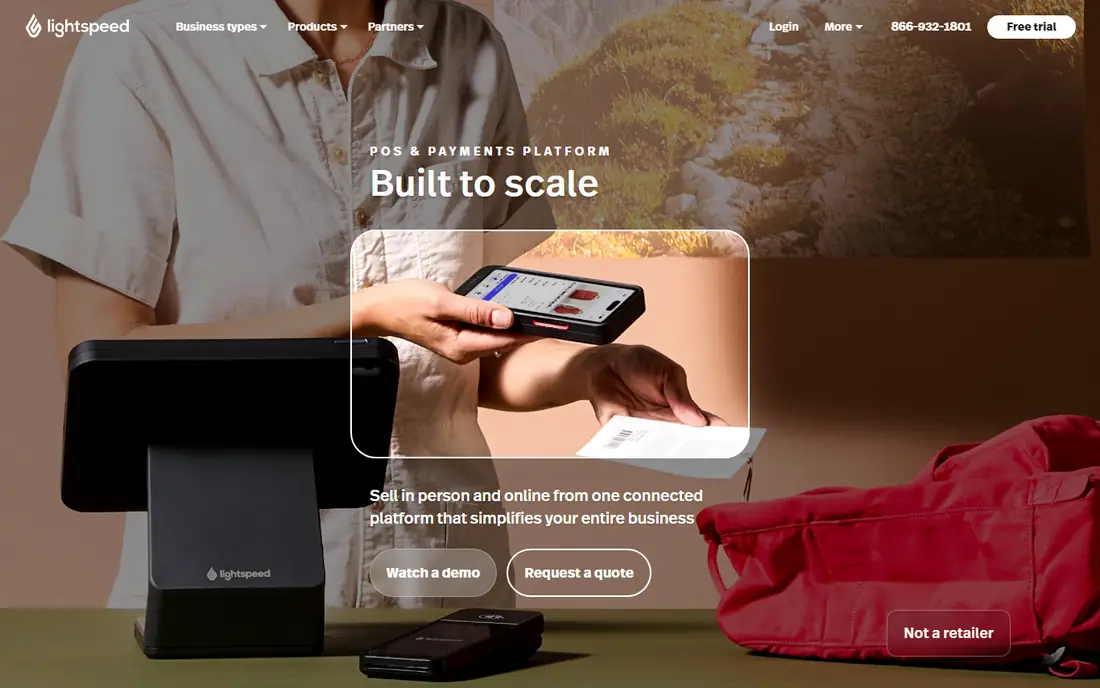
['Lightspeed Retail is built for shops with many variants, suppliers, and locations, and its mobile app keeps that stock picture in staff hands on the floor.'] Its strengths include strong matrix inventory for sizes and colours, multi-location stock control, and detailed sales reporting. The trade-offs are the entry price is high for a single small shop and setup takes more time than simpler POS apps. Pricing starts at $89 per month, with a free plan status of No. For buyers where inventory-heavy retail shops matters most, it is worth a short trial on real work before you commit, so you can see how setup, speed, and support feel in daily use. In short, Lightspeed Retail fits inventory-heavy retail shops better than it fits a buyer who only wants the lowest entry price and is willing to accept a weaker fit elsewhere.
- Strong matrix inventory for sizes and colours
- Multi-location stock control
- Detailed sales reporting
- The entry price is high for a single small shop
- Setup takes more time than simpler POS apps
['Toast is a restaurant system first, so its mobile tools are shaped around tables, courses, and kitchen tickets rather than general retail.'] Its strengths include handheld ordering and tableside payments, kitchen display and menu tools, and restaurant reporting and online ordering. The trade-offs are pricing is quoted rather than fully published and hardware is tied to the Toast system. Pricing starts at See website, with a free plan status of Free trial. For buyers where restaurants and cafes matters most, it is worth a short trial on real work before you commit, so you can see how setup, speed, and support feel in daily use. In short, Toast fits restaurants and cafes better than it fits a buyer who only wants the lowest entry price and is willing to accept a weaker fit elsewhere.
- Handheld ordering and tableside payments
- Kitchen display and menu tools
- Restaurant reporting and online ordering
- Pricing is quoted rather than fully published
- Hardware is tied to the Toast system
['Clover appeals to owners who care about the counter setup as much as the software, because the hardware range is broader than most rivals.'] Its strengths include a wide range of countertop and handheld devices, an app market for extra functions, and support for retail and restaurant setups. The trade-offs are pricing varies by reseller, so quotes are hard to compare and contracts and fees need careful reading. Pricing starts at See website, with a free plan status of No. For buyers where shops that want hardware choice matters most, it is worth a short trial on real work before you commit, so you can see how setup, speed, and support feel in daily use. In short, Clover fits shops that want hardware choice better than it fits a buyer who only wants the lowest entry price and is willing to accept a weaker fit elsewhere.
- A wide range of countertop and handheld devices
- An app market for extra functions
- Support for retail and restaurant setups
- Pricing varies by reseller, so quotes are hard to compare
- Contracts and fees need careful reading
['SumUp keeps mobile selling simple, which suits sellers who move between markets, fairs, and pop-up locations.'] Its strengths include no monthly fee on the basic POS, small, portable card readers, and simple invoicing and online payment links. The trade-offs are inventory tools are lighter than Lightspeed or Square Plus and advanced restaurant features are limited. Pricing starts at Free, with a free plan status of Yes. For buyers where market stalls and pop-up sellers matters most, it is worth a short trial on real work before you commit, so you can see how setup, speed, and support feel in daily use. In short, SumUp fits market stalls and pop-up sellers better than it fits a buyer who only wants the lowest entry price and is willing to accept a weaker fit elsewhere.
- No monthly fee on the basic POS
- Small, portable card readers
- Simple invoicing and online payment links
- Inventory tools are lighter than Lightspeed or Square Plus
- Advanced restaurant features are limited
['Helcim is worth a look when processing cost is the main concern, because its pricing model is more open than a flat-rate quote.'] Its strengths include interchange-plus pricing with no monthly fee on the basic plan, a mobile app for in-person payments, and invoicing and online checkout in the same account. The trade-offs are hardware choice is narrower than Clover and some advanced POS features sit on paid tiers. Pricing starts at Free, with a free plan status of Yes. For buyers where shops that want interchange-plus pricing matters most, it is worth a short trial on real work before you commit, so you can see how setup, speed, and support feel in daily use. In short, Helcim fits shops that want interchange-plus pricing better than it fits a buyer who only wants the lowest entry price and is willing to accept a weaker fit elsewhere.
- Interchange-plus pricing with no monthly fee on the basic plan
- A mobile app for in-person payments
- Invoicing and online checkout in the same account
- Hardware choice is narrower than Clover
- Some advanced POS features sit on paid tiers
['Zettle by PayPal gives a small shop a fast mobile checkout with very little upfront cost, and its reports are clear enough for daily decisions.'] Its strengths include no monthly fee for the basic POS app, compact readers that pair with a phone, and sales reports and product library included. The trade-offs are multi-location controls are lighter than Lightspeed and it is tied to the Zettle and PayPal payment setup. Pricing starts at Free, with a free plan status of Yes. For buyers where small retailers and food sellers matters most, it is worth a short trial on real work before you commit, so you can see how setup, speed, and support feel in daily use. In short, Zettle by PayPal fits small retailers and food sellers better than it fits a buyer who only wants the lowest entry price and is willing to accept a weaker fit elsewhere.
- No monthly fee for the basic POS app
- Compact readers that pair with a phone
- Sales reports and product library included
- Multi-location controls are lighter than Lightspeed
- It is tied to the Zettle and PayPal payment setup
How we picked these
We compared official feature pages, pricing pages, and app store listings for tools that are live and supported in October 2026. We kept only products that truly fit best pos software mobile compatible, and we dropped tools that were discontinued, vague about pricing, or built for a different job. We weighed mobile checkout, offline handling, hardware choice, inventory, and payment processing, plus ease of setup and support for small teams. Where a price was not published, we wrote See website rather than guessing, and we noted free plans and trials exactly as vendors state them.
How to choose a mobile POS
Start with the job, not the brand. For best pos software mobile compatible, the factors that matter most are phone and tablet apps, card reader choice, offline mode, inventory sync, and processing fees. Write those down before you look at pricing, because vendors describe the same feature in very different ways. Look past the monthly fee and add up processing charges, hardware, and any paid add-ons. A free plan can still be costly at high volume if the card rate is high, while a paid plan can pay for itself when it lowers that rate or saves staff time. Run a trial with real work, real staff, and a clear deadline. Check how long setup takes, how quickly support replies, and whether the reports you need are easy to find without help. If the trial feels like work to maintain, that is a useful warning, because daily use will not get easier after you pay.
FAQ
What is best pos software mobile compatible?
The best starting point is to list what you must do every week with best pos software mobile compatible, then test two or three tools on that exact work. A free plan or trial will show fit faster than a feature list alone, and it keeps you from paying for depth you never use.
How much does best pos software mobile compatible cost?
Cost depends on seats, volume, and add-ons, so compare the total monthly bill, not only the headline plan price. Check what is included at the entry tier, what triggers an upgrade, and whether annual billing changes the rate.
Can I switch later if I pick the wrong tool?
Most tools on this list let you export core data or connect to other apps, but the ease varies a lot. Ask about export formats, migration help, and contract length before you move a whole team onto one platform.
Which option is best for a small team?
For a small team, the simplest tool that covers the core job usually wins, because setup and training stay light. Larger teams should weigh admin controls, permissions, and reporting more heavily than a low entry price.
Should I use a free plan or a trial first?
Trials are worth using with real data and a real deadline, not a demo account. Give one owner the test, set the tasks you will judge, and decide on that evidence rather than on a sales call alone.