Best Portfolio Software in 2026: 8 Tools Compared
Compare the best portfolio software in 2026 for application and investment portfolio management, with inventory, costs, risks, and planning tools included.

- Editor's choice
 SAP LeanIX
Enterprise application inventory and transformation
Starts atSee websiteVisit leanix.netFull review - Great alternative
 ServiceNow Strategic Portfolio Management
Teams already running ServiceNow
Starts atSee websiteVisit servicenow.comFull review - Also consider
 Ardoq
Visual, data-driven portfolio decisions
Starts atSee websiteVisit ardoq.comFull review
TL;DR:
- In this guide, portfolio software means application portfolio management and investment portfolio management software for organizations, not personal portfolio websites.
- The best portfolio platforms give leaders one inventory of applications, with owners, costs, risks, and dependencies in one place.
- SAP LeanIX and ServiceNow suit large enterprises, while Ardoq and OrbusInfinity offer faster, more visual routes for mid-size teams.
- Almost all enterprise portfolio tools are quote only, so budget for implementation and data cleanup as well as licenses.
- Our pick for most large teams is SAP LeanIX for ease of use, with ServiceNow as the choice for teams already running ServiceNow.
Quick comparison
| Tool | Best for | Starts at | Free plan? | |
|---|---|---|---|---|
| SAP LeanIX | Enterprise application inventory and transformation | See website | Free trial | Visit |
| ServiceNow Strategic Portfolio Management | Teams already running ServiceNow | See website | No | Visit |
| Ardoq | Visual, data-driven portfolio decisions | See website | Free trial | Visit |
 Bizzdesign Horizzon | Enterprise architecture modeling | See website | Free trial | Visit |
 OrbusInfinity | Mid-size enterprise architecture and portfolios | See website | Free trial | Visit |
 Planview | Portfolio planning across IT and business | See website | No | Visit |
 Alfabet | IT portfolio governance and compliance | See website | No | Visit |
 Mega HOPEX | Regulated enterprises needing formal portfolios | See website | No | Visit |
The best portfolio software
These tools help organizations decide which applications to keep, modernize, replace, or retire. They are planning and governance tools for IT leaders, not website builders for showcasing creative work.
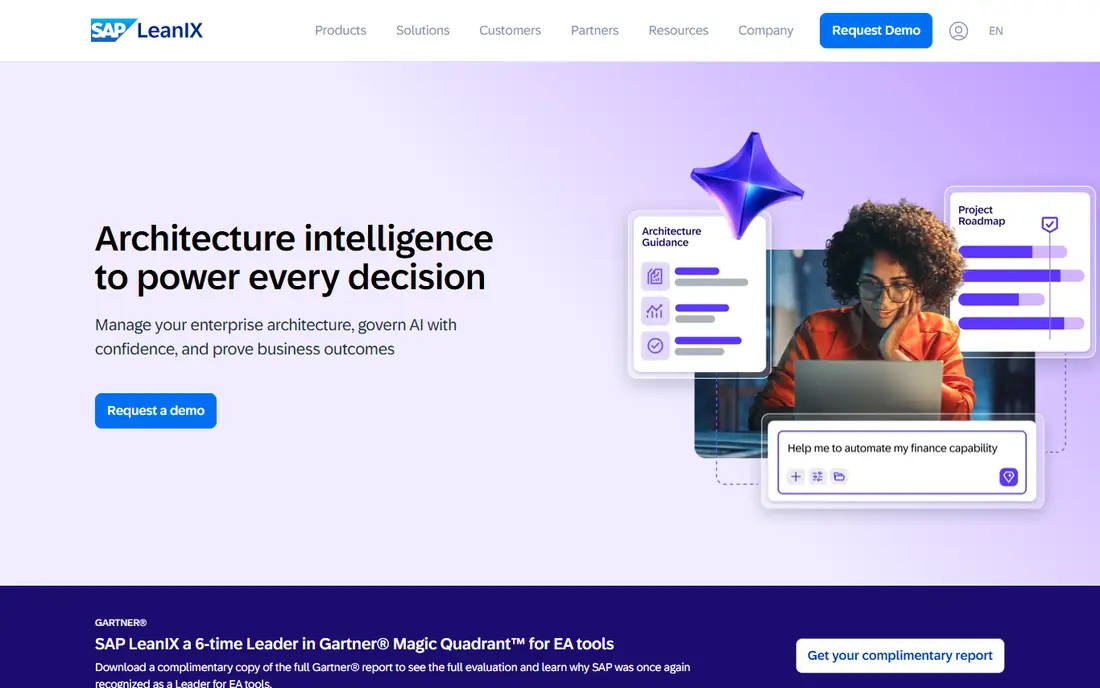
SAP LeanIX gives companies a single source of truth for their software estate, covering purchased, planned, and in-house applications. Leaders can see owners, costs, risks, and dependencies, then plan modernization and ERP transformation work from that inventory rather than from spreadsheets. AI-assisted inventory building reduces manual data entry, which is often the slowest part of starting a portfolio program.
Pricing is quoted and the platform is aimed at enterprises, so smaller firms may find it costly. Reviewers also note that value depends on keeping the inventory current, which needs an owner and a process. For large teams that want a usable, well-integrated portfolio tool, LeanIX is our top pick.
- Easy to use for an enterprise tool
- AI-assisted inventory building
- Strong integrations
- Quote-only pricing
- Costs can be high for mid-size firms
ServiceNow Strategic Portfolio Management
Best for: Teams already running ServiceNow
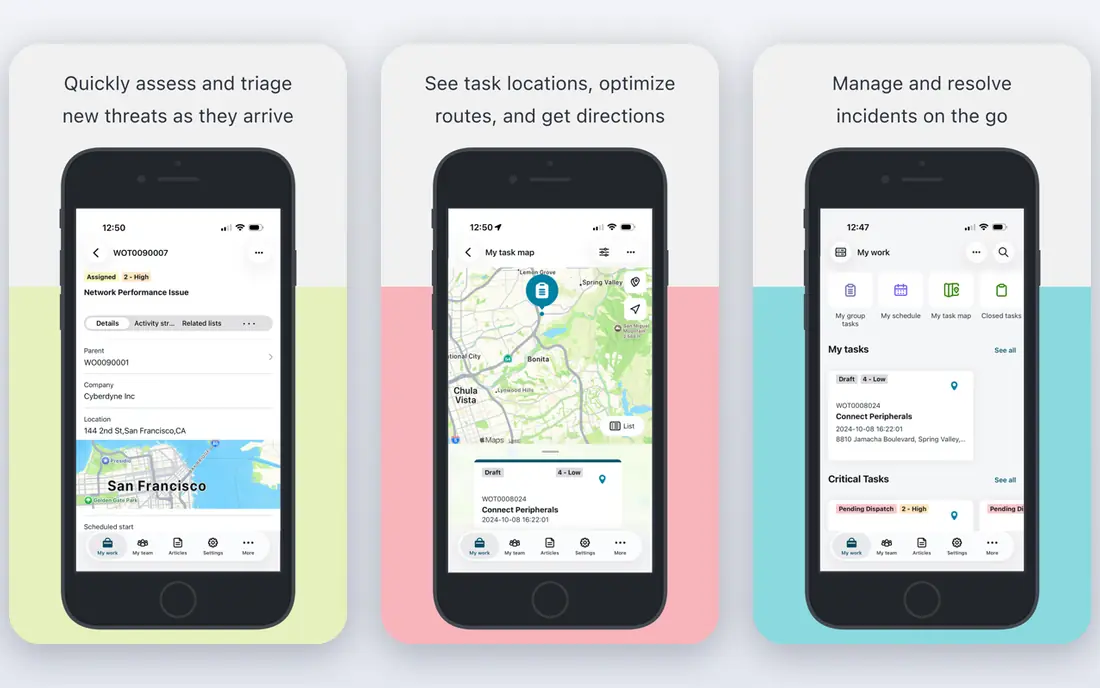
ServiceNow Strategic Portfolio Management connects application portfolios with project, resource, and financial planning in the same platform many IT teams already use for service management. That link helps leaders move from a portfolio decision, such as retiring an app, to the project and service changes that make it happen. Centralized planning also helps large firms coordinate demand across many teams.
The trade-off is cost and complexity. Pricing is quoted, reviewers cite add-on charges, and implementation can take several months. Teams that do not already use ServiceNow may find a standalone portfolio tool faster to adopt. ServiceNow shops, however, get strong value from keeping portfolio and service data together.
- Centralized project and resource planning
- Ties portfolio work to ITSM data
- Strong enterprise scale
- Quote-only pricing with add-on costs
- Implementation often takes months
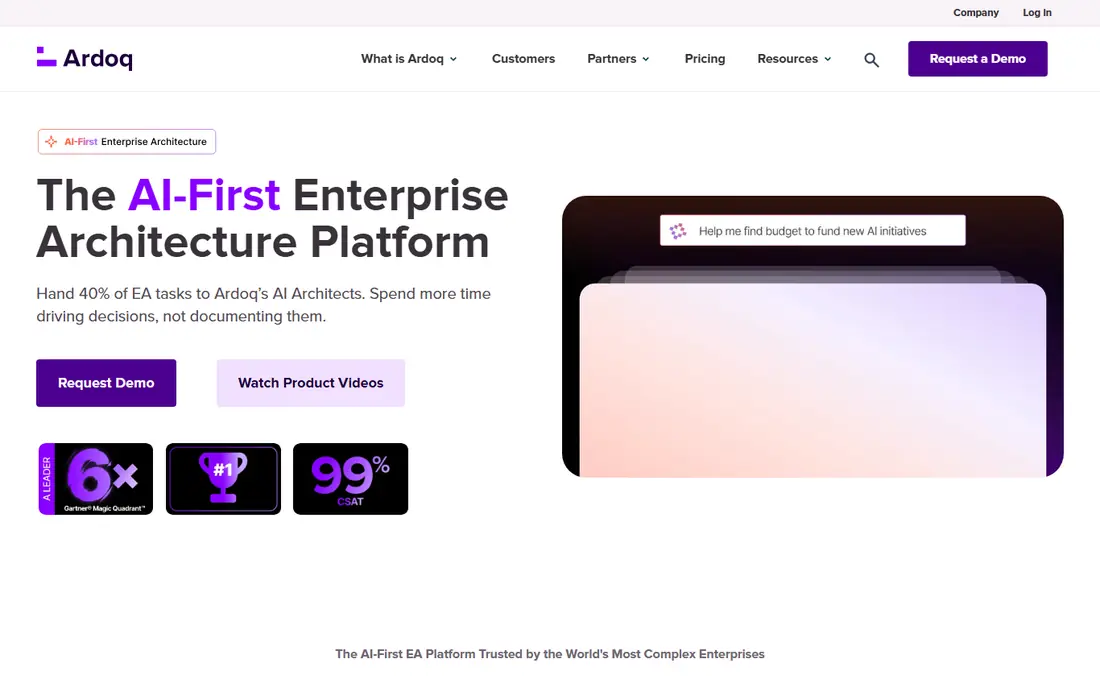
Ardoq turns portfolio data into live visualizations rather than static diagrams, so leaders can explore dependencies, costs, and risks interactively. It connects live data from applications, teams, and processes, and it supports crowdsourced updates that keep the picture current. That approach suits firms that need evidence for rationalization decisions, such as which duplicate tools to cut.
Ardoq is still an enterprise purchase with quoted pricing, and some reviewers note cost concerns for mid-size firms. Its flexibility also needs governance, or models can grow messy. For teams that want a visual, data-driven portfolio platform, Ardoq is one of the strongest options here.
- Interactive visualizations
- Automated data updates
- Flexible modeling
- Quote-only pricing
- Enterprise focus means smaller teams pay enterprise rates
Bizzdesign Horizzon suits architecture teams that want formal modeling alongside portfolio management. It supports standard diagram types, including ArchiMate and BPMN, and it lets teams build portfolio views from the same models used for architecture decisions. That rigor helps in large firms where consistency across teams matters.
Formal modeling is also its catch. Casual users may find it heavier than LeanIX or Ardoq, and pricing is quoted. If your team already works in architecture frameworks and needs portfolio views built on those models, Horizzon is a strong fit. If you mainly need a simple app inventory, a lighter tool will move faster.
- Strong ArchiMate and BPMN modeling
- Good for formal architecture teams
- Useful portfolio views
- Quote-only pricing
- Modeling depth can slow casual users
OrbusInfinity, from Orbus Software, gives mid-size and large firms a practical route into application portfolio management without the heaviest enterprise overhead. It offers portfolio inventories, dependency views, and reporting that help leaders plan rationalization and cloud migration work. Its focus on usability suits teams that are new to formal portfolio management.
The ecosystem is smaller than the biggest vendors, so check integrations for your specific tools during a trial. Pricing is also quoted, which makes budgeting less transparent. For mid-size firms that want a capable but approachable portfolio platform, OrbusInfinity deserves a shortlist spot.
- Clear portfolio views
- Good for mid-size firms
- Strong reporting
- Quote-only pricing
- Smaller ecosystem than SAP LeanIX or ServiceNow
Planview covers portfolio planning well beyond a simple app list, linking applications, projects, capacity, demand, and financials in one planning view. That breadth suits large organizations that must balance many initiatives, teams, and budgets at once. Its project linkage also helps turn portfolio decisions into funded work.
Breadth is also the catch. Onboarding takes time, and teams that only need an application inventory may pay for planning features they rarely use. Planview fits best when portfolio management is part of a wider planning discipline, not a standalone inventory project.
- Broad planning and capacity features
- Suits large portfolios
- Strong project linkage
- Quote-only pricing
- Broad scope can mean longer onboarding
Alfabet, from Software AG, is built for IT portfolio governance in complex estates, with views for applications, technologies, costs, and risks that support audit and compliance work. It suits firms with many applications, strict controls, and a need to show how IT supports business capabilities. Its governance strength is the main reason to choose it over a simpler inventory tool.
Alfabet needs architecture expertise to implement well, and pricing is quoted, so it is not a quick purchase for small teams. For large, regulated, or complex IT organizations that need defensible portfolio governance, it is a credible and proven option.
- Strong governance and compliance views
- Suits complex IT estates
- Software AG backing
- Quote-only pricing
- Implementation needs architecture expertise
Mega HOPEX is a formal enterprise architecture platform that includes application portfolio management as part of a wider governance suite. It suits banks, insurers, government bodies, and other regulated firms that need documented architecture, risk views, and audit trails. Its structured approach helps large teams keep portfolio data consistent across divisions.
That formality makes it heavyweight for small teams or firms that just need a quick inventory. Pricing is quoted and implementation is a project, not a signup. For regulated enterprises with formal architecture programs, HOPEX is a strong and established choice.
- Formal enterprise architecture platform
- Strong governance
- Good for regulated sectors
- Quote-only pricing
- Heavyweight for small or informal teams
How we picked these
We compared official product pages and independent 2026 application portfolio management comparisons for tools with real enterprise deployments. We favored tools that cover application inventory, ownership, cost, risk, and dependency views, and we kept a mix of usability-led and modeling-led platforms. We did not claim hands-on testing. Where vendors do not publish prices, we say so plainly, since quoted enterprise pricing is the norm in this category.
What to check before you buy
Start with your inventory, not the demo. Count your applications, note who owns each one, and check how each tool imports that data from existing sources such as service management, cloud consoles, and finance systems. A tool that needs months of manual entry will stall before it delivers value, while one with good integrations and AI-assisted import will get you to first decisions faster.
Next, test the decisions you actually need to make. Can you rank applications by cost, risk, and business value, can you model what happens if you retire a system, and can you report that view to finance and business leaders in plain terms. Finally, assign an owner and a refresh rhythm before you sign. Portfolio data goes stale quickly, and even the best platform fails without someone responsible for keeping it current.
Application portfolios versus investment portfolios
Application portfolio management tracks software: what you run, what it costs, and what to keep or retire. Investment portfolio management tracks financial holdings: assets, returns, and risk. This guide focuses on application portfolios for organizations, with planning and governance features that also help leaders weigh costs and returns across the whole estate.
FAQ
What is the best portfolio platform for application management?
SAP LeanIX is our pick for most large teams, thanks to ease of use and integrations. ServiceNow suits ServiceNow shops, Ardoq suits visual and data-driven teams, and OrbusInfinity suits mid-size firms. The best choice depends on your existing stack and your modeling style.
What is the best tool for application portfolio management on a smaller budget?
None of the enterprise tools here publish low self-serve prices, so smaller firms should trial LeanIX, Ardoq, and OrbusInfinity and ask for scoped quotes based on a small application count. Starting with a clean spreadsheet inventory and a clear owner can also delay a purchase until the case for a platform is clear.
How is portfolio software different from project management software?
Project software tracks work, dates, and resources for a single initiative. Portfolio software tracks the whole estate of applications, their costs, risks, and dependencies, and helps leaders decide which projects to fund. Planview and ServiceNow bridge both worlds by linking portfolio decisions to project plans.
How long does portfolio software take to implement?
Timelines vary from weeks for a focused inventory to several months for a governed enterprise rollout. Ardoq reports faster implementation than ServiceNow in some comparisons, but your data quality matters more than the vendor. Clean ownership and cost data shorten every implementation.
Do I need enterprise architecture skills to use these tools?
Formal modeling tools such as Bizzdesign Horizzon and Mega HOPEX benefit from architecture skills, while LeanIX and Ardoq are more approachable for IT leaders without a modeling background. Either way, appointing one portfolio owner and setting simple standards will improve results more than any feature.
Can portfolio software help cut IT costs?
Yes, when the data is current. A clear inventory often reveals duplicate tools, unused licenses, and high-cost low-value applications that can be retired or consolidated. Savings come from acting on those findings, not from buying the tool alone, so pair the platform with a rationalization plan.