Best Policy Compliance Management Tools in 2026: 9 Tools Compared
Compare the best policy compliance management tools for policies, controls, and audits, with pricing, frameworks, and team fit explained clearly for teams.
- Editor's choice
 Vanta
Automated compliance at scale
Starts atSee websiteVisit vanta.comFull review - Great alternative
 Drata
Multi-framework monitoring
Starts atSee websiteVisit drata.comFull review - Also consider
 Secureframe
Guided small-team setup
Starts at$7,500 per yearVisit secureframe.comFull review
TL;DR:
- Vanta and Drata lead for automated evidence collection across common security frameworks.
- Secureframe suits smaller teams that want guided setup and training bundled in.
- LogicGate, ZenGRC, and Hyperproof fit larger programs that need flexible policy and risk workflows.
- Budget for the audit itself, since platform prices usually exclude the external auditor's fee.
Quick comparison
| Tool | Best for | Starts at | Free plan? | |
|---|---|---|---|---|
| Vanta | Automated compliance at scale | See website | No | Visit |
| Drata | Multi-framework monitoring | See website | No | Visit |
| Secureframe | Guided small-team setup | $7,500 per year | No | Visit |
 LogicGate | Flexible GRC workflows | See website | No | Visit |
 ZenGRC | Policy and risk programs | See website | No | Visit |
 Hyperproof | Framework breadth | See website | No | Visit |
 AuditBoard | Enterprise audit and risk | See website | No | Visit |
 OneTrust | Privacy and governance breadth | See website | No | Visit |
 NAVEX | Policy management and training | See website | No | Visit |
The best policy compliance management tools
Policy compliance management tools help an organization write policies, map them to controls, collect evidence, and prove compliance to auditors and customers. The best compliance policy management software options below differ in whether they automate evidence, how many frameworks they cover, and how much structure they impose on your program.
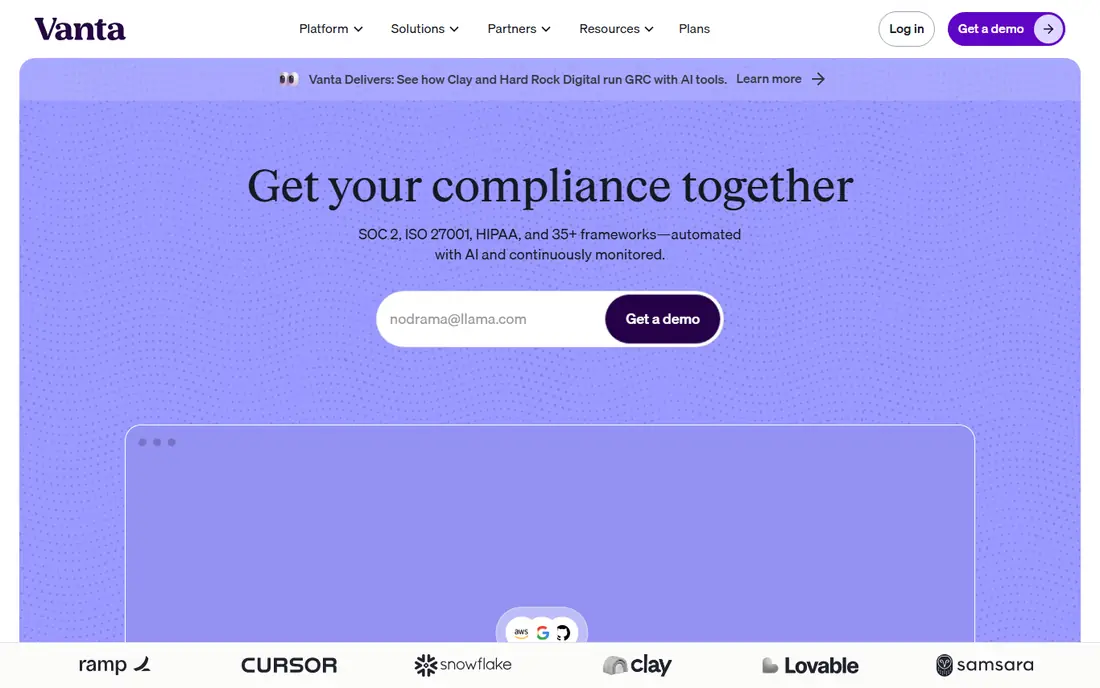
Vanta automates much of the busywork in a compliance program. It connects to your cloud, identity, and HR tools, collects evidence continuously, and maps controls across frameworks such as SOC 2, ISO 27001, and HIPAA, so one piece of evidence can serve several standards. That automation is why many SaaS companies pick it for a first attestation and for renewals.
Pricing is the main friction. Published comparisons cite an Essentials package near $14,000 per year for small teams on marketplace listings, with larger teams paying far more, so we list See website and recommend a quote for your headcount and frameworks. Audit fees are separate. If you need broad automation and a large integration set, Vanta is a strong default.
- Broad integration library for evidence
- Cross-framework mapping
- Auditor network
- Pricing is largely quoted
- Costs rise with headcount and frameworks
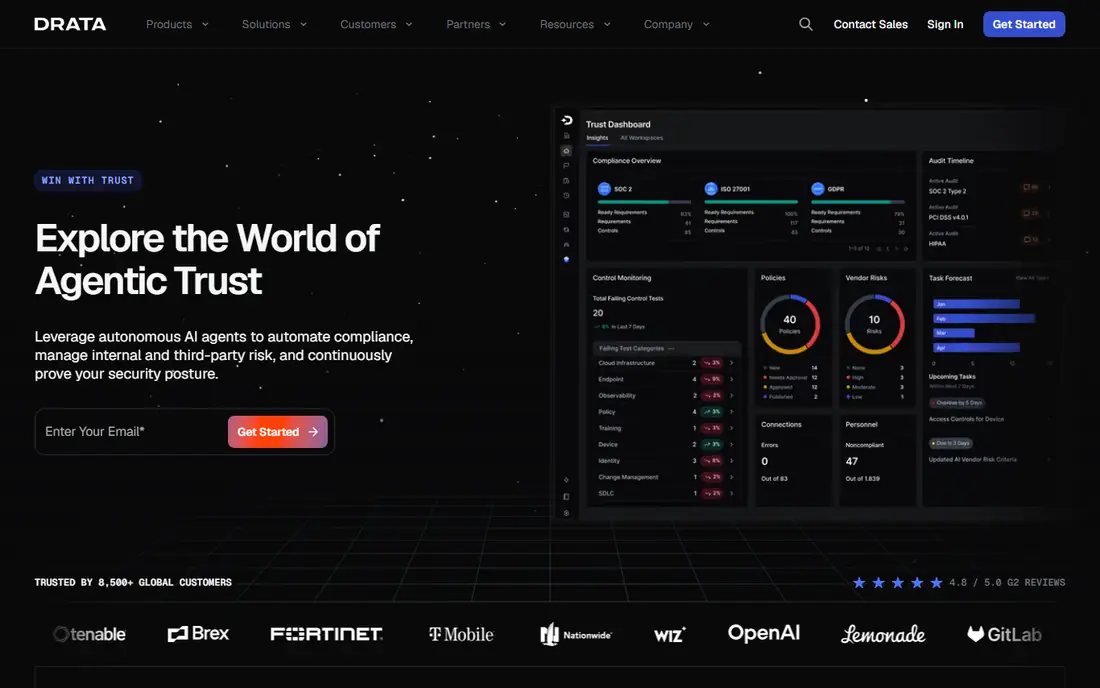
Drata also focuses on continuous monitoring, with integrations that pull evidence automatically and alert you when a control drifts. Unlimited users on its tiers is a real advantage for growing teams, since you do not pay per seat as headcount rises. Framework coverage is broad, and cross-framework mapping reduces duplicate work when you add a second standard.
Published comparisons cite a Foundation package near $15,000 per year for small teams, with Advanced higher, but direct quotes vary, so we list See website. Like Vanta, Drata excludes the external audit fee. Teams that value transparent user pricing and steady monitoring should compare Drata and Vanta side by side on the same framework list.
- Continuous control monitoring
- Unlimited users on tiers
- Strong framework coverage
- Pricing is largely quoted
- Framework fees can add up
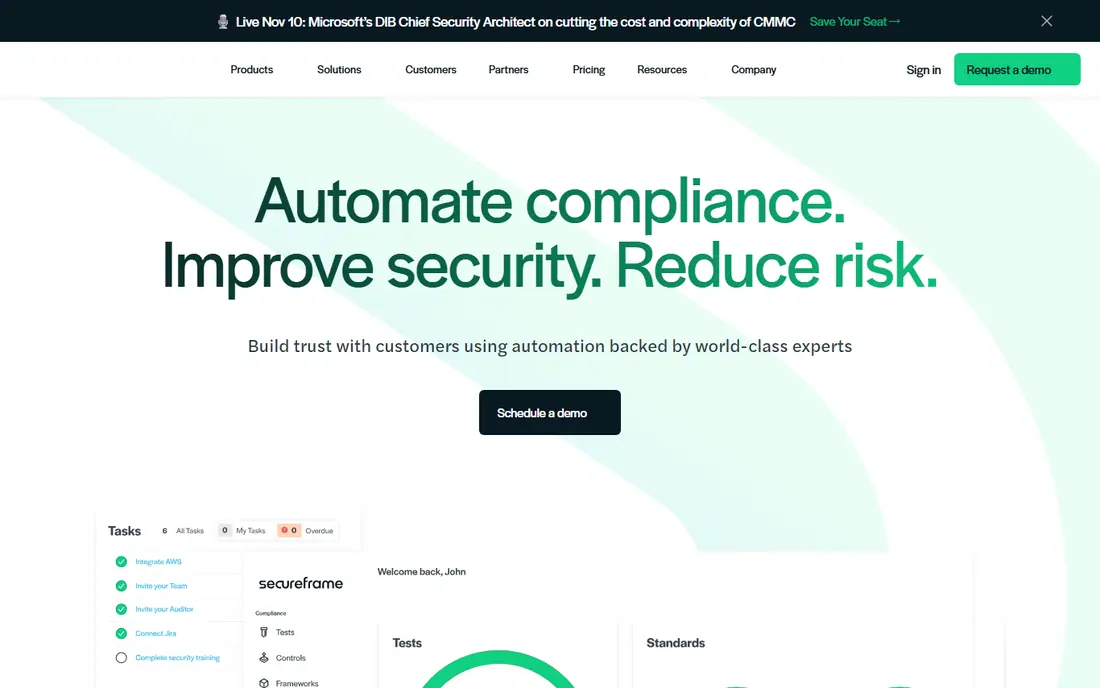
Secureframe suits smaller teams that want guidance, not just a dashboard. Its workflows walk you through each framework step, and bundled training helps staff complete security awareness requirements without a separate vendor. Published comparisons put a Fundamentals tier at $7,500 per year for one framework, with higher tiers for more frameworks and larger teams.
That guided approach is the selling point, but also the limit for larger programs that want deep customization. Secureframe's audit support comes through a partner network rather than an in-house audit, so budget the audit separately. For a startup pursuing its first SOC 2, Secureframe's clarity and entry price make it an easy shortlist pick.
- Guided workflows and bundled training
- Published entry price
- Audit partner network
- Costs rise with frameworks and headcount
- Some advanced features need higher tiers
LogicGate, now part of the Risk Cloud family, is a flexible governance, risk, and compliance platform. You can build policy management, risk assessments, control testing, and issue tracking around your own processes, rather than fitting into a fixed compliance template. That flexibility suits organizations with mature programs that span several risk areas.
The trade-off is implementation. LogicGate needs configuration to match your workflows, and pricing is quoted, so we list See website. Teams that want a fast, opinionated path to SOC 2 will get there quicker with Vanta or Drata. Teams that need one platform for policy, risk, and audit across the business will value LogicGate's breadth.
- Highly configurable risk and compliance workflows
- Policy management
- Good reporting
- Quote-only pricing
- Needs setup time to match your processes
ZenGRC focuses on the core GRC job: managing policies, controls, risks, and audits in one place, with workflows that keep owners, evidence, and deadlines visible. Mid-market teams that need a structured program without enterprise complexity often find it a good fit. It covers common frameworks and supports internal audit work alongside compliance.
Evidence automation is less extensive than Vanta or Drata, so teams should expect more manual uploads. Pricing is quoted, so we list See website. If your program centers on policy ownership and audit readiness rather than continuous cloud evidence, ZenGRC's clarity is an advantage.
- Clear policy and control management
- Audit-ready workflows
- Good for mid-market teams
- Quote-only pricing
- Less automation than Vanta or Drata for evidence collection
Hyperproof offers a broad library of frameworks and strong control mapping, so a control built for one standard can be reused across others. That breadth helps mid-market teams that must answer to several frameworks at once, from SOC 2 to ISO 27001 to industry-specific standards. Its workflows cover evidence collection, control testing, and audit preparation.
Pricing is not published, so we list See website, and published comparisons cite entry figures near $12,000 per year without a vendor-confirmed rate card. Get a quote tied to your framework list and user count. If framework breadth is your main need, Hyperproof deserves a demo alongside AuditBoard and LogicGate.
- Broad framework library
- Control mapping across standards
- Mid-market focus
- Pricing is not published
- Implementation support varies by plan
AuditBoard is an enterprise platform for audit, risk, and compliance, used by large companies that need connected workflows across internal audit, SOX, risk, and third-party management. Its reporting and analytics suit boards and audit committees, and its scale fits organizations with dedicated compliance staff.
That enterprise focus is also its limit for smaller buyers. Pricing is quoted, implementation is a project, and small teams will find Vanta, Drata, or Secureframe faster and cheaper. For a large company consolidating audit and compliance onto one platform, AuditBoard's breadth and reporting are the reason to shortlist it.
- Strong audit, risk, and compliance suite
- Enterprise reporting
- Large-company fit
- Quote-only pricing
- More than small teams need
OneTrust is best known for privacy, but its platform also covers governance, policy management, and compliance across global regulations. Organizations that must manage privacy notices, consent, data subject requests, and policy attestations alongside security compliance will find that breadth useful. It supports many regulatory frameworks and regions.
For a team that only needs SOC 2, OneTrust is more than required, and pricing is quoted, so we list See website. For a company juggling privacy law, security frameworks, and AI governance at once, OneTrust's combined platform can reduce the number of vendors to manage. Scope the modules you need, since the full suite is large.
- Very broad privacy and governance coverage
- Policy and consent tools
- Global regulation support
- Quote-only pricing
- Breadth can feel complex for a single-framework program
NAVEX focuses on the human side of compliance: policy creation, distribution, attestation, and training, plus ethics reporting and third-party risk tools. That makes it a strong pick for organizations where policy acknowledgment, employee training, and a speak-up channel matter as much as technical controls. Its policy lifecycle tools keep versions, owners, and attestations organized.
Security evidence automation is less central here than in Vanta or Drata, so technical teams may pair NAVEX with a security compliance tool. Pricing is quoted, so we list See website. If your compliance program starts with people and policies, NAVEX is a natural fit. If it starts with cloud evidence, start with Vanta or Drata instead.
- Strong policy lifecycle and attestation
- Ethics and training content
- Whistleblowing tools
- Quote-only pricing
- Security automation is less central than Vanta or Drata
How we picked these
We compared vendor feature pages, framework coverage, and independent compliance comparisons, keeping tools that manage policies and controls for compliance programs. We checked starting prices where vendors publish them and wrote See website where pricing is quoted. We did not claim hands-on testing; our comparison rests on vendor documentation and public comparisons. This is general information, not legal advice, and framework requirements should be confirmed with your auditor.
How to scope a compliance program before you buy
List the frameworks you must meet in the next 12 months, not the ones you might meet one day, and count the controls each requires. Then check which tools map those controls to each other, since mapping can cut duplicate work sharply. Finally, budget three lines: platform, audit, and internal time. Most buyers underestimate the third line, and a tool that saves staff hours is often worth more than a cheaper tool that needs constant manual evidence.
Policy ownership matters more than software
Assign an owner to every policy and control, with a review date, before you buy. Software can remind owners and store evidence, but it cannot decide what your policy should say. Start with a short policy set that staff can actually follow, then expand. A long policy library that no one reads will fail an audit and frustrate employees, whatever tool holds it.
FAQ
What are the best policy compliance management tools for a small SaaS company?
Vanta, Drata, and Secureframe are the usual shortlist, because they automate evidence and guide a first SOC 2 or ISO 27001 program. Secureframe is the easiest entry point on published price, while Vanta and Drata offer broader automation. Get quotes for your headcount and framework list, and budget the audit fee separately.
What is the best compliance policy management software for policy attestation?
NAVEX leads for policy distribution, attestation, and training, with a clear lifecycle for versions and owners. LogicGate and ZenGRC also handle policy management well within broader GRC programs. If attestation is your main need, test how easily staff acknowledge policies and how clearly managers see who has not yet done so.
How much do policy compliance management tools cost?
Entry prices range from $7,500 per year for Secureframe's Fundamentals tier to roughly $14,000 to $15,000 per year for small-team Vanta and Drata packages in marketplace comparisons, with larger teams paying more. Many enterprise tools are quoted. Add audit fees, which commonly run $10,000 to $50,000 depending on scope, to get the true first-year cost.
Do these tools replace an auditor?
No. They collect evidence, track controls, and prepare you for an audit, but an independent auditor still performs the attestation. Some vendors offer auditor networks or partner firms, while others leave you to choose your own. Confirm whether your vendor's auditor network fits your framework and timeline before you rely on it.
How long does it take to get compliant with one of these tools?
A first SOC 2 Type 2 commonly takes several months, including a monitoring period, even with automation. Tools shorten evidence collection and preparation, but they cannot shorten the observation period an auditor requires. Plan for setup, control operation, and audit review as separate phases, and start earlier than you think you need to.