Best Place to Hire Software Developers in 2026: 9 Platforms Compared
Looking for the best place to hire software developers? We compare 9 vetted networks and marketplaces on price, vetting, speed, and fit for your next hire.
- Editor's choice
 Toptal
Senior contractors for critical work
Starts atSee websiteVisit toptal.comFull review - Great alternative
 Upwork
Flexible budgets and defined tasks
Starts atFreeVisit upwork.comFull review - Also consider
 Arc
Fast freelance or full-time remote hires
Starts atFrom $15 per hourVisit arc.devFull review
TL;DR:
- Vetted networks such as Toptal, Arc, and Lemon.io do most of the screening for you, but they charge higher hourly rates than open marketplaces.
- Open marketplaces such as Upwork and Freelancer give you the widest choice and the lowest entry cost, yet you must run interviews and quality checks yourself.
- Wellfound is the strongest free route for startups hiring full-time engineers who actively want startup roles.
- For a single senior contractor this week, a curated network usually beats a long open posting, even at a higher rate.
Quick comparison
| Tool | Best for | Starts at | Free plan? | |
|---|---|---|---|---|
| Toptal | Senior contractors for critical work | See website | Free trial | Visit |
| Upwork | Flexible budgets and defined tasks | Free | Yes | Visit |
| Arc | Fast freelance or full-time remote hires | From $15 per hour | No | Visit |
 Lemon.io | Startups needing a senior developer fast | See website | No | Visit |
 Gun.io | Senior US and Canada contractors | See website | No | Visit |
 Andela | Enterprise teams and AI projects | See website | No | Visit |
 Wellfound | Startups hiring full-time engineers | Free | Yes | Visit |
 Freelancer | Fixed-price bids and contests | Free | Yes | Visit |
 Fiverr | Small, tightly scoped development gigs | Free | Yes | Visit |
The best places to hire software developers
Hiring a developer is less about finding a coder and more about finding the right screening, price, and working model for your project. The platforms below cover both ends of that choice, from fully vetted networks to open marketplaces where you stay in control.
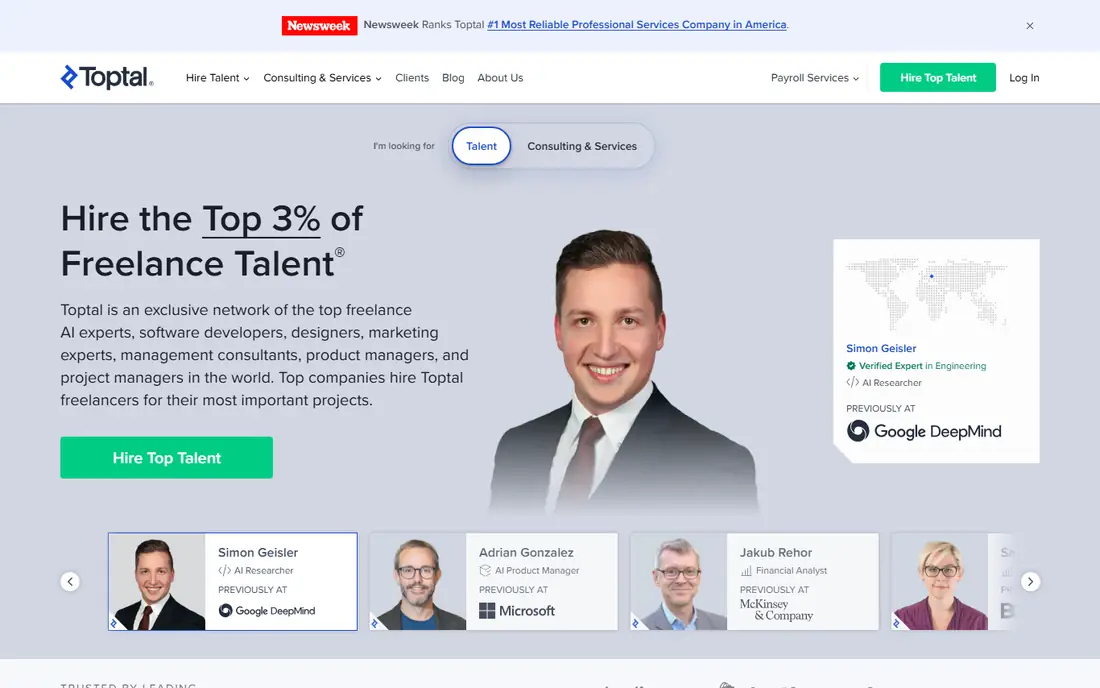
Toptal is our pick when a project cannot afford a weak hire. Its screening covers language skills, technical tests, live coding, a test project, and an interview, and the company says only a small share of applicants pass. That depth is why teams use it for work where a missed deadline or a poor architecture choice would cost far more than the hourly rate.
The catch is cost and transparency. Rates are quoted per engagement rather than listed on a public price page, and clients also pay a monthly subscription fee. If your budget is tight or your task is simple, that premium is hard to justify. For a senior hire on a high-stakes build, though, the trial period lowers the risk of committing.
- Strict multi-stage vetting
- Fast introductions
- Trial period where you pay only if satisfied
- Premium pricing
- Rates are quoted, not published
- Monthly subscription fee applies

Upwork remains the largest open marketplace for freelance developers, and that scale is its main strength. You can post a job for free, compare profiles, ratings, and work history, and hire for anything from a one-day WordPress fix to a months-long app build. Hourly and fixed-price contracts, plus escrow releases tied to approved work, give you control over payment.
The trade-off is time. Nobody vets developers for you, so you must read proposals, run interviews, and test candidates before you trust them with production code. Developers who look strong on paper can still miss deadlines or write code that is hard to maintain. Upwork works best when you know exactly what you want built and you can judge the work.
- Huge pool across many skills
- Free job posting
- Escrow-backed hourly and fixed-price contracts
- You do all vetting yourself
- Quality varies widely
- Client fees apply on top of freelancer rates
Arc suits teams that want vetted talent without waiting weeks for a recruiter. Freelance developers are listed from $15 per hour upward, with senior developers typically charging far more, and full-time hires involve a fee equal to 20 percent of first-year salary. Matching is fast, often within days for freelance roles, which helps when a roadmap is blocked by one missing skill.
Arc is less appealing if you plan to convert a freelancer to a permanent hire later, because that conversion fee can be large. It is also a marketplace in the end: the platform screens, but your interview still decides fit, communication style, and code quality. Use Arc when speed matters and you can brief a role clearly.
- Published hourly range
- Freelance and permanent hiring in one place
- Quick matching
- Full-time hires carry a placement fee
- Senior rates rise well above the entry range
- Quality still needs your own interview
Lemon.io focuses on one job: getting a senior developer into a startup team quickly. Its vetting is human-led, with technical checks and communication review, and the company says only a small share of applicants pass. For a founder who needs a React, Python, or mobile developer this week, that focus beats wading through hundreds of open applications.
Pricing is quoted per developer rather than published, so you will need a call to get a firm number. Lemon.io is also less useful for very small one-off tasks, where an open marketplace would be cheaper. If you need one strong contractor for several months, it is one of the most direct options on this list.
- Fast matching, often within days
- Senior-focused vetting
- No upfront fee for many engagements
- Quoted pricing only
- Mainly suited to startups and scaleups
- Minimum engagement terms can apply
Gun.io targets companies that want senior engineers working in US and Canadian time zones. Its vetting and matching process aims to cut the usual back-and-forth of sourcing, and it adds delivery oversight that open marketplaces do not provide. That combination suits teams that need a developer to join standups, review code, and ship with little hand-holding.
The main drawback is that pricing is quoted, so budgeting takes a sales conversation. Gun.io is also not the cheapest route for a short task, since its model is built around serious, longer engagements. If timezone overlap and senior experience matter more than the lowest hourly rate, it earns a place on your shortlist.
- Vetted senior engineers
- North America time zone coverage
- Delivery oversight on engagements
- Quote-based pricing
- Smaller pool than global marketplaces
- Better for longer engagements than tiny gigs
Andela began with engineering talent in Africa and now serves global enterprise teams, including AI-focused work. Its model suits companies that need several engineers, consistent process, and support for compliance and payroll across countries. Teams building AI features or data pipelines will find relevant depth here.
Andela is not built for a founder hiring one freelancer for a weekend fix. Pricing is enterprise and quoted, and the process is more involved than posting a job on Upwork. For a larger team that wants a managed talent partner rather than a simple job board, Andela is a solid choice.
- Large global talent network
- Enterprise-grade process
- Strong fit for AI and data engineering teams
- Quote-based enterprise pricing
- Slower fit for tiny projects
- Onboarding is heavier than a marketplace hire
Wellfound, formerly AngelList Talent, is the most cost-effective way for a startup to hire a full-time developer. Posting jobs is free, and the candidates you reach are people who have chosen to look for startup work, which often means they accept startup pace, equity, and ambiguity. You hire directly, so there is no placement fee eating into your budget.
The catch is that Wellfound does no screening for you. You still need a strong job post, a fair interview process, and a technical check that matches the role. It is also weaker for short freelance work, since most candidates want permanent roles. For a startup making its next full-time engineering hire, it should be the first free channel you try.
- Free job postings for startups
- Candidates who actively seek startup roles
- Direct hiring with no placement fee
- No vetting service
- Best for full-time roles, not freelance gigs
- Smaller pool than general job boards
Freelancer works on competitive bidding, which makes it useful when you have a fixed budget and a clearly defined project. Developers bid on your brief, you compare proposals and past work, and milestone payments release funds only as work is approved. For a defined website, plugin, or small app feature, that structure keeps costs visible.
Quality control is the risk. Low bids can look tempting but often come from developers who cut corners or disappear mid-project. You need a detailed brief, a small paid test task, and clear acceptance criteria before you commit. Used that way, Freelancer can deliver good value, especially for work you can judge quickly.
- Free to post
- Competitive bidding can lower project cost
- Milestone payments protect both sides
- Bidding can push quality down
- You screen every candidate
- Fees apply to projects
Fiverr is best for small, well-defined development tasks: fixing a bug, building a landing page section, setting up a plugin, or creating a simple script. Sellers list packages with prices and delivery times, so you can compare offers without a long hiring process. Reviews and past work samples help you filter quickly.
Fiverr is a poor fit for hiring a developer to own a product for months. The gig model rewards speed and low prices, which can work against careful architecture and maintenance. Keep the scope tight, ask for the code and documentation as deliverables, and use a vetted network instead when the work is central to your business.
- Clear gig packages and prices
- Fast turnaround for small tasks
- Reviews help you compare sellers
- Built for gigs, not long-term hires
- Quality varies
- Larger projects need careful scoping
How we picked these
We compared official pricing pages, hiring models, and public documentation for each platform, plus third-party pricing comparisons published in 2026. We favored platforms that are live today, clearly explain how they vet or do not vet developers, and serve a distinct hiring need, from a one-day gig to an enterprise team. We did not claim hands-on hiring tests, and we treated quoted pricing as quoted, not as a published rate.
What to decide before you post a job
Start with the engagement type, because it narrows the list fast. A one-off task belongs on Upwork, Freelancer, or Fiverr. A senior contractor for several months belongs on Toptal, Arc, Lemon.io, or Gun.io. A full-time startup hire belongs on Wellfound first, with a vetted network as a backup if the search drags.
Write a brief a developer can price
State the stack, the deliverable, the deadline, and how you will judge done. Vague briefs attract vague bids and slow interviews. Include access, existing code, and any compliance needs up front, so candidates can spot a mismatch before you both invest time.
Test before you commit
Use a small paid task that mirrors real work, such as fixing a real bug or reviewing a piece of your code. A short trial reveals communication, code quality, and reliability far better than a resume alone. On vetted networks, use the trial period; on open marketplaces, use a milestone.
Compare total cost, not just hourly rate
Add platform fees, subscription fees, placement fees, and your own screening time to the hourly rate. A cheaper developer who needs constant review can cost more than a senior contractor who ships clean work. Agree on hours, time zone overlap, and who owns the code before work starts.
FAQ
How much does it cost to hire a software developer?
It depends on seniority, location, and model. Open marketplace developers can charge from under $25 per hour for simple work to over $100 per hour for senior specialists, while vetted networks typically quote higher rates. Add platform fees and your screening time to get the true cost.
Is Toptal worth it for a small business?
Toptal can be worth it for a high-stakes, senior role where a bad hire would be expensive, thanks to its strict vetting and trial period. For simple or low-budget work, Upwork or Fiverr will usually deliver better value, since you pay less for the same defined task.
What is the best place to hire software developers for a startup?
Wellfound is the best free starting point for a full-time startup hire, since candidates there actively seek startup roles. If you need a senior contractor fast, Lemon.io or Arc are strong second options, because they screen candidates before you interview them.
Should I hire a freelancer or a full-time developer?
Hire a freelancer when the work is defined, temporary, or needs a skill your team lacks for a short time. Hire full-time when the work is core to your product, ongoing, and needs deep knowledge of your codebase, customers, and roadmap.
How do I check a developer before hiring?
Review past work, ask for code samples, and run a small paid test task that mirrors real work. Check references where possible, confirm time zone overlap, and agree in writing on deliverables, hours, code ownership, and how you will handle changes.