Best Open Source SEO Software in 2026: 8 Tools Compared
Best open source SEO software compared for crawling, rank tracking, analytics, and audits, so you can build a free SEO stack you fully control in 2026.

- Editor's choice
 SiteOne Crawler
Desktop technical crawling
Starts atFreeVisit siteone.ioFull review - Great alternative
 LibreCrawl
Web-based team crawling
Starts atFreeVisit librecrawl.comFull review - Also consider
 SerpBear
Self-hosted rank tracking
Starts atFreeVisit github.comFull review
TL;DR:
- SiteOne Crawler and LibreCrawl suit technical audits, while SerpBear suits self-hosted rank tracking.
- Matomo suits privacy-focused analytics, while Lighthouse suits performance and Core Web Vitals checks.
- No open source tool matches the backlink index size of paid tools like Ahrefs or Semrush, so budget for one paid tool if link data is central.
- Self-hosting gives you data ownership and no subscription, but it also means you handle updates, backups, and server costs.
- The best stack combines a crawler, a rank tracker, analytics, and Search Console, rather than relying on one tool alone.
Quick comparison
| Tool | Best for | Starts at | Free plan? | |
|---|---|---|---|---|
| SiteOne Crawler | Desktop technical crawling | Free | Yes | Visit |
| LibreCrawl | Web-based team crawling | Free | Yes | Visit |
| SerpBear | Self-hosted rank tracking | Free | Yes | Visit |
 Matomo | Privacy-focused analytics | Free | Yes | Visit |
 Lighthouse | Performance and Core Web Vitals | Free | Yes | Visit |
 LinkChecker | Broken link checking | Free | Yes | Visit |
 Apache Nutch | Large-scale crawling | Free | Yes | Visit |
 Crawlee | Developer crawling workflows | Free | Yes | Visit |
The best open source seo software
We compared open source SEO tools on license, crawling, rank tracking, analytics, audit depth, and ease of self-hosting. The best open source SEO tools are not a single replacement for a paid suite, but a stack you can assemble for crawling, tracking, analytics, and audits without a monthly subscription.

SiteOne Crawler is a cross-platform desktop crawler that provides detailed technical SEO crawling, broken link detection, and website structure analysis. It renders JavaScript, reports titles, meta descriptions, headings, canonicals, and link data, and exports raw data for further analysis. That makes it the closest open source alternative to a paid desktop crawler for many technical SEOs.
As a desktop tool, SiteOne suits individual SEOs and small teams better than large teams that need a shared web dashboard. It also lacks a paid backlink index or rank tracking, so pair it with other tools on this list for a full stack. For technical audits on a desktop, SiteOne is the strongest open source pick.
- Close open source alternative to desktop crawlers
- JavaScript rendering
- Detailed reports and exports
- Desktop app, so team sharing needs extra setup
- Less polished than paid crawlers

LibreCrawl is a web-based, open source SEO crawler that runs as a web application with multi-user support, which suits teams better than a desktop-only tool. It extracts titles, descriptions, headings, links, response codes, and structured data, supports JavaScript rendering, configurable crawl depth, URL filtering, and proxies, and exports to CSV, XLSX, JSON, and XML. That combination covers most technical audit needs for small and mid-size sites.
LibreCrawl is a younger project than SiteOne, and independent tests have found crawl accuracy can vary by site type, with some false errors on complex stores. Self-hosting also needs a server and basic setup. For teams that want a shared, browser-based crawler without a subscription, LibreCrawl is a promising choice, especially when paired with a second crawler for cross-checking.
- Web-based multi-user crawling
- JavaScript rendering
- CSV, JSON, and XML exports
- Younger project
- Crawl accuracy can vary by site type
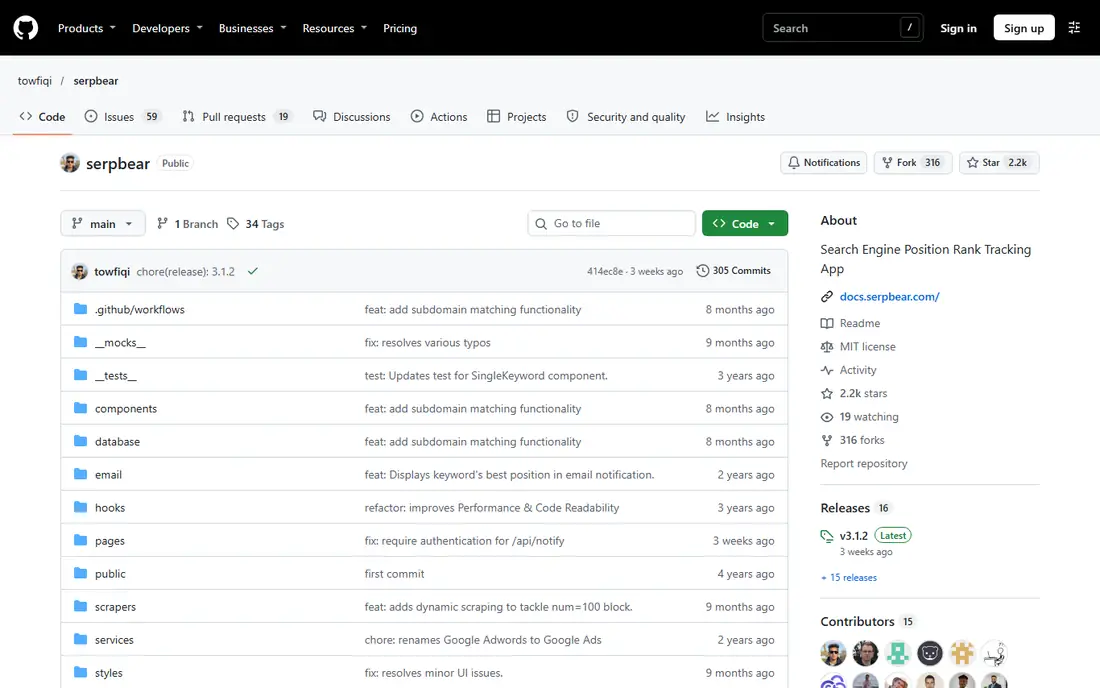
SerpBear is an open source, self-hosted rank tracker that lets you monitor keyword positions, track competitors, and view ranking history without paying a monthly rank tracking subscription. It suits agencies and site owners who want to own their ranking data and avoid per-keyword fees. The interface covers domains, keywords, locations, and devices, with insights for content and optimization work.
SerpBear needs a source for search results data, such as a scraping setup or a search API, which adds setup complexity and possible API costs. Self-hosting also means you handle updates and backups. For rank tracking on a budget, with control over data, SerpBear is the best open source option on this list.
- Self-hosted rank tracking
- Keyword insights
- No subscription for core tracking
- Needs a scraping source or API for search data
- Setup needs technical skill
Matomo is the best-known open source alternative to Google Analytics, offering traffic, behavior, conversion, and campaign reporting while keeping data on your own server. That ownership suits privacy-focused businesses, European sites, and teams that want full control over analytics data. The self-hosted edition is free, with a cloud hosted option for teams that prefer not to run a server.
Self-hosting needs updates, backups, and server monitoring, and some advanced features, such as heatmaps and A/B testing, are paid plugins. Matomo also lacks search ranking and backlink data, so pair it with SerpBear and a crawler for a full SEO stack. For privacy-first analytics you control, Matomo is the clear pick.
- Full analytics without sharing data with Google
- Self-hosted option
- Detailed traffic insights
- Self-hosting needs server care
- Some advanced features are paid plugins
Lighthouse, from Google, audits performance, accessibility, best practices, and SEO for a single page, with detailed Core Web Vitals results. It runs in Chrome DevTools, as a browser extension, or from the command line, which makes it easy to add to a development workflow. Scores and diagnostics help developers fix slow pages, layout shifts, and accessibility issues that affect search and user experience.
Lighthouse audits one page at a time, so it does not replace a site crawler for finding issues across hundreds of pages. It also provides lab data rather than real-user field data, though PageSpeed Insights adds field data from Chrome users. For page-level performance and technical checks, Lighthouse is essential and free.
- Google-backed performance audits
- Core Web Vitals scoring
- Free in Chrome and as CLI
- Audits one page at a time
- No rank tracking or crawling
LinkChecker is a simple, open source tool for finding broken internal and external links, which helps maintain site health and avoid dead ends for users and crawlers. It runs from the command line, checks link status, and reports errors in a clear list. That narrow focus makes it fast and reliable for a task that larger tools sometimes bury in reports.
LinkChecker does not audit titles, headings, structured data, or performance, so it is a complement to a crawler, not a replacement. Its interface also feels dated compared with modern web tools. For a quick, free broken link check, especially in scripts and CI workflows, LinkChecker remains useful.
- Simple broken link detection
- Checks internal and external links
- Command-line use
- Narrow scope, only link checking
- Interface feels dated
Apache Nutch is an open source web crawler built for large-scale crawling and search indexing, used by projects that need to crawl millions of pages. It is highly customizable, with plugins for parsing, indexing, and data storage, and it integrates with search platforms like Solr and Elasticsearch. That scale suits enterprises, research projects, and custom search engines.
Setup is very technical, requiring Java, Hadoop or similar infrastructure, and configuration expertise, so it is overkill for a small business site audit. Nutch also lacks a friendly SEO dashboard, so results need custom analysis. For large-scale crawling projects where control and scale matter more than ease, Apache Nutch is unmatched in open source.
- Enterprise-scale crawling
- Highly customizable
- Built for search indexing
- Very technical setup
- Overkill for small sites
Crawlee is an open source crawling library for developers who want to build custom SEO workflows in Python or JavaScript. It handles JavaScript-heavy sites, anti-blocking features, proxies, sessions, and data storage, letting developers build crawlers tailored to a specific site or audit. That flexibility suits agencies and engineering teams that want SEO checks inside their own code and pipelines.
Crawlee needs coding skill and offers no built-in SEO dashboard, so non-developers should pick SiteOne or LibreCrawl instead. Results also need custom reporting, unless you build it yourself. For developer-led SEO automation, custom audits, and data pipelines, Crawlee is the most flexible open source tool on this list.
- JavaScript-heavy site support
- Highly customizable workflows
- Python and JavaScript libraries
- Needs coding skill
- No built-in SEO dashboard
How we picked these
We compared open source licenses, maintenance activity, crawling and tracking features, self-hosting options, and public comparisons of open source SEO tools in 2026. We favored tools that are actively maintained, free to self-host, and cover a real SEO need, from crawling to rank tracking to analytics. We mixed desktop, web-based, and developer tools, so technical SEOs, small teams, and developers can each find a fit.
Building a free SEO stack that works
Start with Google Search Console, which is free and remains the most accurate source for your own search performance, clicks, and indexing issues. Add a crawler like SiteOne or LibreCrawl for technical audits, SerpBear for rank tracking, Matomo for analytics, and Lighthouse for page performance. That stack covers most SEO needs without a paid suite, apart from large backlink data.
Self-host with a plan
Choose a server size that fits your site count and crawl frequency, and set up updates, backups, and monitoring from day one. A small virtual server can run LibreCrawl, Matomo, and SerpBear for early testing, with upgrades as usage grows. Document login details, update schedules, and data retention, since self-hosted tools depend on you for security and maintenance.
Know the honest gaps
No open source tool matches the backlink index size of Ahrefs or Semrush, and most lack keyword difficulty, content gap analysis, and large-scale competitor data. If link building or competitor research is central to your work, budget for one paid tool alongside your open source stack. For technical audits, rank tracking, and first-party analytics, open source tools have caught up well by 2026.
FAQ
What is the best open source SEO software overall?
There is no single winner, since SEO needs differ by task. SiteOne Crawler suits technical audits, SerpBear suits rank tracking, Matomo suits analytics, and Lighthouse suits performance checks. The best approach is a small stack of these tools, plus Google Search Console, rather than one tool for everything.
What are the best open source SEO tools for technical audits?
SiteOne Crawler and LibreCrawl are the best open source crawlers for technical audits, with title, description, heading, link, and status code data. Lighthouse adds page-level performance and Core Web Vitals checks, while LinkChecker finds broken links quickly. Use two crawlers to cross-check results on complex sites.
Is there a free open source alternative to Screaming Frog?
Yes, SiteOne Crawler is the closest open source alternative to Screaming Frog for desktop crawling, and LibreCrawl is a web-based alternative with multi-user support. Both cover core crawl data, though paid crawlers offer more polish, integrations, and support. For small and mid-size sites, either open source option covers most audit needs.
Can open source SEO tools replace Ahrefs or Semrush?
For crawling, rank tracking, and analytics, open source tools can replace much of a paid suite, especially for small teams. For large backlink indexes, keyword difficulty, and competitor content analysis, paid tools still lead by a wide margin. Many teams use open source tools for audits and tracking, plus one paid tool for backlink and competitor data.
Is self-hosted SEO software hard to set up?
Desktop tools like SiteOne are easy to install, while web tools like LibreCrawl, Matomo, and SerpBear need a server, domain, and basic maintenance. Docker setups simplify installation for many of these tools, though updates and backups remain your responsibility. Start with one tool, learn its setup, then add others as needed.
What is the best open source rank tracker?
SerpBear is the best open source rank tracker, with self-hosted keyword tracking, competitor tracking, and history. It needs a search data source, such as a scraping setup or API, which adds setup complexity. For teams that want owned ranking data without per-keyword fees, SerpBear is worth the setup effort.