Best New AI Tools Updates in 2026: 9 Sources Compared
We compared the best new ai tools updates sources, from Product Hunt to free daily AI newsletters, so you can follow new releases without drowning in hype.
- Editor's choice
 Product Hunt
Launch-day discovery
Starts atFreeVisit producthunt.comFull review - Great alternative
 There's An AI For That
Searching tools by task
Starts atFreeVisit theresanaiforthat.comFull review - Also consider
 Toolify
Large searchable catalog
Starts atFreeVisit toolify.aiFull review
TL;DR:
- Product Hunt is still the best launch-day source, while There's An AI For That and Toolify are better for searching tools by task afterwards.
- Newsletters such as TLDR AI and The Rundown AI save time by summarizing the day's releases, but they cover only a fraction of new tools.
- Futurepedia and Future Tools add curation, which cuts noise but also means some good tools never get listed.
- Our pick for most readers is one directory for search, one launch board for discovery, and one newsletter for a daily digest.
- Check a tool's own site before trusting a directory listing, since listings can be outdated or written by the vendor.
Quick comparison
| Tool | Best for | Starts at | Free plan? | |
|---|---|---|---|---|
| Product Hunt | Launch-day discovery | Free | Yes | Visit |
| There's An AI For That | Searching tools by task | Free | Yes | Visit |
| Toolify | Large searchable catalog | Free | Yes | Visit |
 Futurepedia | Curated tool discovery | Free | Yes | Visit |
 Future Tools | Curator picks and newsletter | Free | Yes | Visit |
 TopAI.tools | Quick reviewed listings | Free | Yes | Visit |
 TLDR AI | Daily AI newsletter digest | Free | Yes | Visit |
 The Rundown AI | Daily AI news briefing | Free | Yes | Visit |
 BetaList | Startup and pre-launch tools | Free | Yes | Visit |
The best new ai tools updates
The best new ai tools updates come from sources that track releases every day, not from a single article that goes stale in a week. This list covers directories, launch boards and newsletters that publish best ai tools updates as their core job. We compared official feature pages, pricing pages and public descriptions, and we only listed sources that are actively publishing in October 2026.

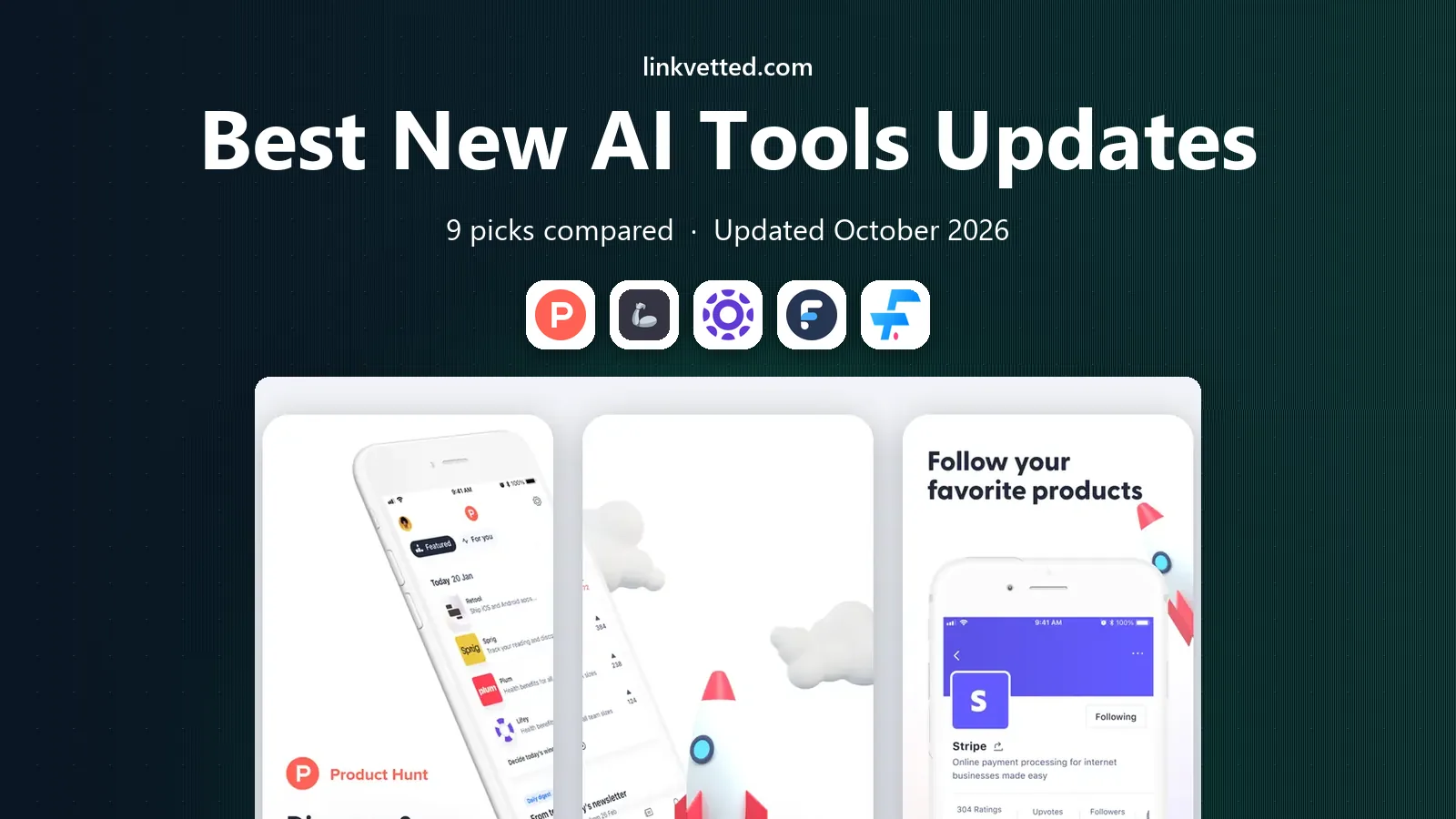
Product Hunt is where many AI tools launch first, and that timing is its main value. Each day brings a ranked list of new products, with descriptions, screenshots and maker comments, so you can spot a new writing, coding or image tool on the day it ships. The comment threads are useful too, since early users ask blunt questions and makers answer them in public.
The catch is that votes reward marketing as much as quality. A tool with a large mailing list can top the day over a quieter but better tool, and launch-day buzz fades fast. Use Product Hunt for discovery, then check the tool's own site, pricing and reviews before adopting it. It is the best starting point for best ai tools updates, not the final verdict.
- Largest launch-day community
- Daily rankings surface what builders are shipping
- Comments reveal early user reactions
- Launch-day spikes favor tools with an existing audience
- Ranking reflects votes, not quality testing

There's An AI For That is the catalog to search when you have a job in mind and want to know which AI tools claim to do it. With tens of thousands of tools organized by task, you can search for invoice processing, podcast editing or slide design and get a list in seconds. That task-first search is more useful than browsing a general feed when you need a tool now.
The size is also the weakness. Listings vary in quality, and some entries are thin or outdated, since the catalog grows faster than any team can review it. Paid listing options exist for tool makers, so treat placement as a signal to investigate, not as a ranking. For finding tools by task, though, no other free directory on this list is as broad.
- Huge catalog organized by task
- Strong search for specific jobs
- Newsletter reaches millions of readers
- Size means quality varies
- Paid listings can push some tools higher
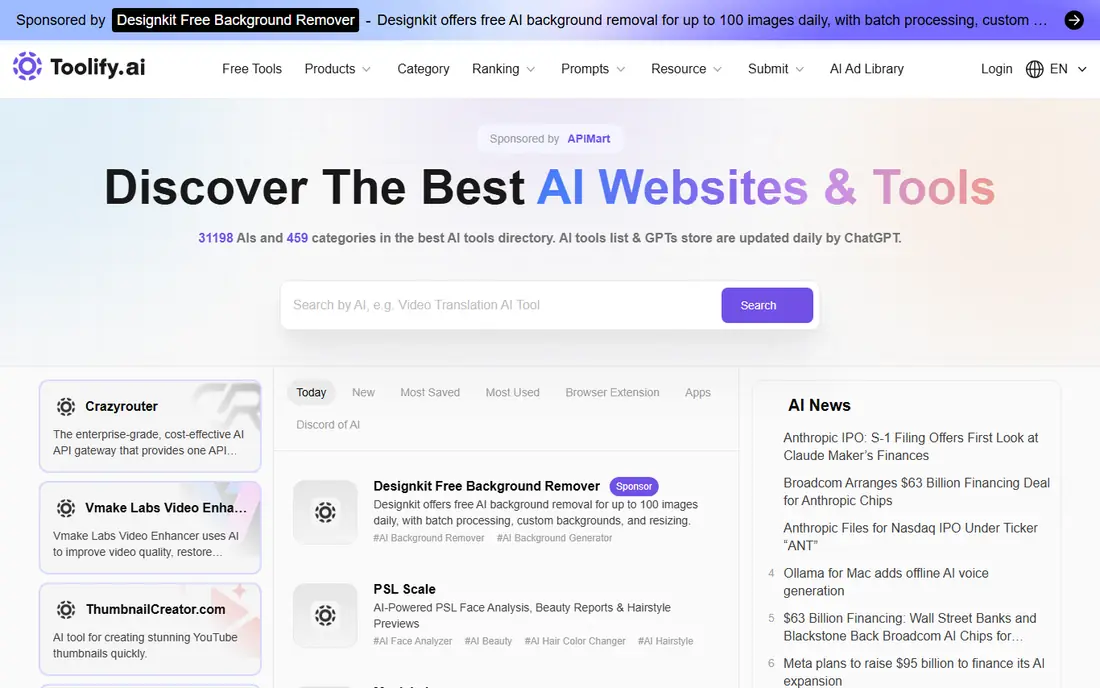
Toolify is another large AI tool directory, with millions of monthly visits and a catalog that covers most categories, from chatbots to image generators. Its category pages and search make it easy to compare several tools that do the same job, and new tools can get listed quickly, which keeps the catalog fresh. For a reader tracking best ai tools updates, Toolify is a good second search stop after There's An AI For That.
The same caution applies: a large catalog means uneven listings, and vendor-supplied traffic or feature claims should be checked on the tool's own site. Toolify charges tool makers for fast or featured listings, so a prominent listing is not proof of quality. Use it to build a shortlist, then verify pricing, features and reviews directly.
- Very large catalog with traffic data and categories
- Fast listing for new tools
- Useful for comparing similar tools
- Listing quality varies
- Traffic claims on listings need independent checking
Futurepedia takes the opposite approach from the big catalogs: editors review tools before listing them, which keeps the catalog smaller and cleaner. With a few thousand curated tools, a newsletter audience and video content, it suits readers who want a filtered feed rather than an endless list. Its move into HubSpot in 2026 may widen its reach, though the editorial model remains its main draw.
The trade-off is coverage. A smaller, reviewed catalog will miss some new tools, and there is currently no public route to buy a listing, so inclusion depends on editorial choice. If you prefer quality over completeness, Futurepedia is a good daily or weekly check. If you need every new tool in a niche, pair it with a larger directory.
- Editorial review keeps listings cleaner
- Newsletter and courses add context
- Part of HubSpot since 2026
- No public paid submission route at present
- Smaller catalog than the largest directories
Future Tools is curated by Matt Wolfe, and that single-curator model is both its strength and its limit. The site lists a few thousand tools, and the newsletter highlights a small number of new picks each week, which makes it easy to keep up without feeling flooded. Makers can submit tools free, and featured slots are limited, so the feed stays readable.
Because one curator shapes the picks, the selection reflects his interests, which lean toward creator and productivity tools. That is fine if those match yours, and less useful if you follow a niche such as legal or medical AI. Use Future Tools as a trusted filter for general AI news, and add a task directory for niche searches.
- Human curation by a known creator
- Newsletter highlights a small number of tools
- Free submission for makers
- Small number of featured slots each week
- Curation reflects one person's taste
TopAI.tools is a mid-size directory with editorial review and a straightforward browsing experience. Makers can pay for a fast-track listing or a featured slot, with a refund if the tool is not accepted, which keeps the catalog from filling with unchecked entries. For readers, the categories and search are simple, and the site is a handy place to check whether a tool you heard about is listed with a clear description.
The audience is smaller than Product Hunt or There's An AI For That, so it works better as a secondary source than as your only feed. Its value is in quick, reviewed listings rather than launch-day buzz. Add it to your rotation when you want a clean second opinion on a new tool category.
- Reviewed listings with fast-track options for makers
- Clean category browsing
- Refund if a tool is not accepted
- Smaller audience than the biggest directories
- Featured placements can skew visibility
TLDR AI is the newsletter pick for readers who want best ai tools updates in their inbox without opening five sites a day. The TLDR network reaches millions of tech readers, and the AI edition summarizes new tools, research and industry news in a short daily format. That brevity is the point: you can scan it in minutes and click only on what matters.
The limit is selection. A daily digest cannot cover every new tool, so TLDR AI is a filter, not a catalog. Sponsored placements also appear, so check whether an item is editorial or sponsored before treating it as a recommendation. Pair TLDR AI with a directory for searches, and you get both a daily digest and a place to look things up.
- Concise daily digest of AI news and tools
- Large tech audience
- Free to subscribe
- Covers only a selection of releases
- Sponsored placements sit alongside editorial picks
The Rundown AI is another daily briefing, aimed at a broad audience that follows AI news rather than only developers. It covers new tool releases alongside model updates, company news and research, which gives context that a pure directory lacks. If you want to know why a new tool matters, not just that it launched, a briefing like this helps.
As with TLDR AI, the coverage is selective, and sponsorships support the operation, so read with that in mind. The free edition is enough for most readers, and the daily cadence suits people who want to stay current without checking launch boards. Use it as your morning briefing and a directory as your search tool.
- Daily briefing on AI news and new tools
- Broad appeal beyond developers
- Free edition available
- News focus means tool coverage is selective
- Paid sponsorships fund part of the operation
BetaList is the place to look before a tool is famous. It lists startups and pre-launch products, including AI tools in beta, so you can spot trends months before they reach Product Hunt or a big directory. For founders, investors and early adopters, that early view is valuable, and browsing is free.
The risk is obvious: many pre-launch startups never ship, pivot, or shut down within a year. Treat BetaList as a watchlist, not a buying guide, and wait for a real product, pricing page and user reviews before depending on a beta tool. For tracking what is coming next in AI, though, it is a useful early signal alongside the larger directories.
- Surfaces pre-launch startups and betas
- Good for spotting trends early
- Free to browse
- Many listed startups never ship or shut down
- Paid plans for makers affect visibility
How we picked these
We compared official feature pages, about pages and public descriptions for each source, and we only listed directories, launch boards and newsletters that are actively publishing in October 2026. We favored sources with a clear update cadence, a real audience, and a distinct role, such as launch-day discovery, task search, curation or daily briefing. We left out directories that had gone stale or that only listed tools for paid placement without editorial review. Prices for readers are free across this list, while tool makers may pay for listings or sponsorships, which we note where it affects placement.
How to follow new AI tools without drowning
Pick a system with three parts and no more. Choose one directory for searching by task, such as There's An AI For That or Toolify, one launch board for discovery, such as Product Hunt or BetaList, and one newsletter for a daily digest, such as TLDR AI or The Rundown AI. That trio covers search, discovery and briefing without five overlapping feeds.
Then set a rule for trying tools. Bookmark interesting releases, but only trial one or two a week, with a real task in mind. Check the tool's own pricing page, privacy policy and recent reviews before signing up, since directory listings can be outdated. Most new AI tools will not earn a permanent place in your workflow, and that is fine. The goal of following best ai tools updates is to find the few that do, not to try them all.
FAQ
What is the best source for best new ai tools updates?
Product Hunt is best for launch-day discovery, There's An AI For That is best for searching tools by task, and TLDR AI or The Rundown AI are best for a daily digest. Most readers do best with one of each, rather than following every directory. That combination covers discovery, search and briefing with minimal time.
What are the best ai tools updates newsletters?
TLDR AI and The Rundown AI are the strongest free daily options here, with concise briefings on AI news and new tools. Future Tools also runs a newsletter with curator picks, which suits readers who prefer a small number of recommendations. All three are free to subscribe, so try each for a week and keep the one you actually read.
Is Product Hunt still useful for finding AI tools?
Yes, for launch-day discovery. Product Hunt surfaces new AI tools on the day they ship, with maker comments and early user reactions. It is less useful as a quality ranking, since votes reward marketing reach. Use it to discover tools, then verify pricing, features and reviews on the tool's own site.
How do I find AI tools for a specific task?
Search a task directory such as There's An AI For That or Toolify by the job you need done, such as transcribing meetings or designing slides. Compare three or four tools on the same task, check their pricing pages, and trial the top two with a real assignment. Task search beats browsing a general feed when you need a tool now.
Are AI tool directories trustworthy?
They are useful starting points, not verdicts. Listings can be vendor-written, outdated or boosted by paid placement, so verify claims on the tool's own site. Directories with editorial review, such as Futurepedia and Future Tools, tend to be cleaner, but even they reflect curator taste. Treat every listing as a lead to check.
How often should I check for new AI tools?
A daily newsletter plus a weekly directory browse is enough for most people. Checking launch boards every day leads to trying too many tools and finishing none of them. Set aside one short session a week to trial a new tool with a real task, and drop it quickly if it does not save time.