Best Monthly Graphic Design Service in 2026: 8 Services Compared
Compare the best monthly graphic design service options for steady ad, social, print and web work, with flat pricing, turnaround times and scope limits.

- Editor's choice
 Penji
Marketing teams with steady volume
Starts at$995 per monthVisit penji.coFull review - Great alternative
 ManyPixels
Daily design output
Starts at$699 per monthVisit manypixels.coFull review - Also consider
 Design Pickle
Mid-market marketing teams
Starts atSee websiteVisit designpickle.comFull review
TL;DR:
- Count how much design you need each week, since most plans limit active requests.
- Check whether video, web design and copy are included or cost extra.
- Confirm turnaround, revision rules and who owns source files.
- Pause or cancel terms matter for seasonal teams, so read them before signing.
Quick comparison
| Tool | Best for | Starts at | Free plan? | |
|---|---|---|---|---|
| Penji | Marketing teams with steady volume | $995 per month | Free trial | Visit |
| ManyPixels | Daily design output | $699 per month | Free trial | Visit |
| Design Pickle | Mid-market marketing teams | See website | No | Visit |
 Kimp | Graphics plus video | $699 per month | Free trial | Visit |
 Flocksy | Mixed creative needs | $1,199 per month | Free trial | Visit |
 Superside | Enterprise creative teams | See website | No | Visit |
 Kapa99 | Tight fixed budgets | $349 per month | Free trial | Visit |
 Designity | Managed creative team | See website | Free trial | Visit |
The best monthly graphic design services
A monthly design service works when you need steady creative output without hiring a full-time designer. The services below offer flat monthly pricing, a request queue and revisions, with different strengths for ads, branding and video.
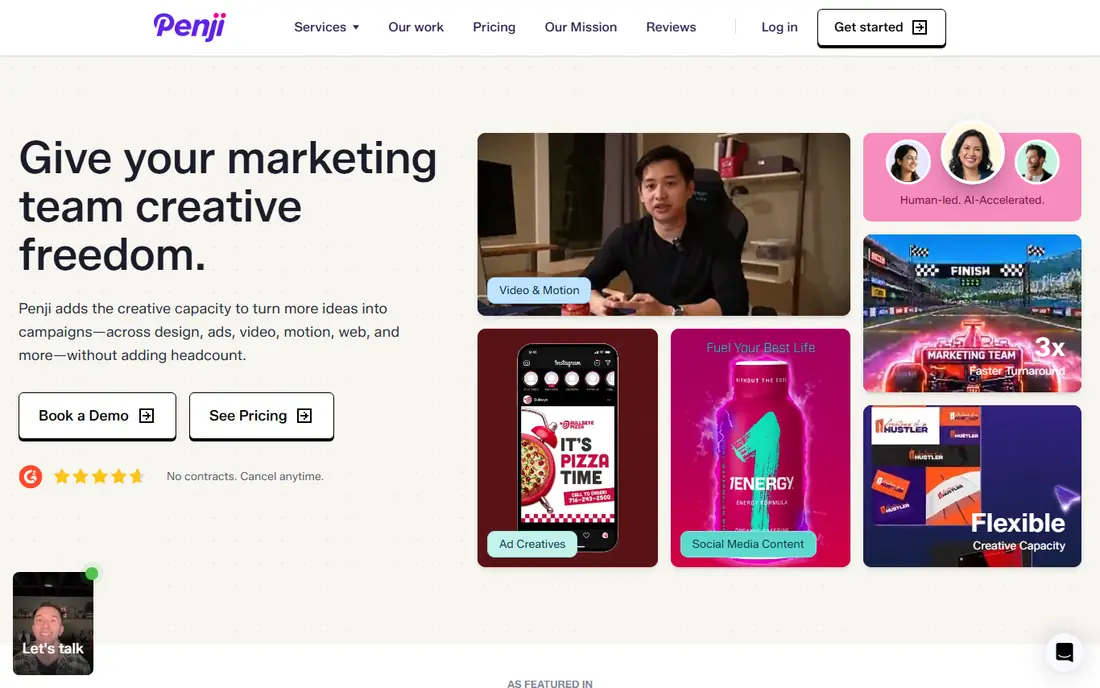
Penji fits a marketing team that sends a steady stream of ads, social posts, print and presentation work. Requests move through a managed queue with quality checks, and most arrive within one business day on the entry plan.
The limits are video and consistency. Video and motion sit on higher plans, and the entry plan may rotate designers. Teams with mostly graphic work and a regular cadence will still find the value clear.
- Wide design scope
- One-day turnaround on many requests
- Managed quality checks
- Video needs higher plans
- Designer may rotate on entry plan

ManyPixels suits a team that wants a predictable daily batch of design work rather than counting requests. Each business day brings a finished batch or clear progress on a larger project, which helps plan campaigns.
The queue model is the trade-off. A large batch needed by one morning may not fit, and complex projects take several days. For steady, planned output, the daily rhythm is easy to manage.
- Daily output model
- Broad scope
- Low-cost pause option
- Complex projects take several days
- Queue model needs planning

Design Pickle fits a mid-market marketing team that wants a mature managed service with a named account contact. Daily creative hours cover graphics, illustration and video editing, with support for repeatable campaign work.
The main friction is pricing. Public pricing was removed, so buyers must go through a sales call and commit to a quarter or a year. Teams that need a published price or month-to-month terms should check that point early.
- Mature managed service
- Illustration and motion options
- Account support
- No public pricing
- Quarterly or annual commitment
Kimp appeals to a team that needs both graphics and video under one monthly plan. Social graphics, ads and short video work can move through the same queue, which suits content-heavy brands.
Designer quality can vary, so teams should use clear briefs, brand guides and revision notes. For a team that would otherwise pay separately for graphics and video, the combined plan can still save time and money.
- Graphics and video in one plan
- Fast standard turnaround
- Month-to-month
- Quality can vary by designer
- Scope limits need checking
Flocksy fits a team whose needs cross design, copy and sometimes video or web work. A broad creative scope in one subscription reduces the need to manage several freelancers for different tasks.
The hour-based model and higher monthly cost are the drawbacks. Teams should track hours used each week and confirm rollover rules, so the plan matches real output rather than hoped-for output.
- Wide creative scope including copy
- 30-day rollover on some plans
- Hour-based model
- Higher monthly cost than rivals
Superside suits an enterprise or high-growth team that needs creative strategy as well as production. A dedicated team can handle campaigns, brand systems and high-volume work with more direction than a simple request queue.
The cost puts it out of reach for small businesses, and enterprise terms need a careful contract review. For a large team with steady, complex creative demand, the strategy layer is the reason to pay more.
- Creative strategy plus production
- Dedicated team model
- High-volume capacity
- Enterprise pricing
- Not suited to small budgets
Kapa99 fits a small business or startup with a tight monthly budget and regular but simple design needs. Social posts, ads and basic print work can move quickly at a price well below larger services.
The scope is narrower than premium rivals, so complex branding or web projects may not fit. For routine marketing design, the low price and simple model are the main attractions.
- Low entry price
- Simple subscription
- Fast turnaround on many tasks
- Narrower scope than larger services
- Support depth varies
Designity fits a business that wants a managed creative team with direction, not only a task queue. A creative director can help shape briefs, keep brand consistency and guide revisions.
Pricing is quote-based, so small teams should ask for a clear monthly figure and scope before committing. Teams that value direction and consistency over the lowest price will gain the most.
- Managed creative direction
- US-based team focus
- Flexible plans
- Quote-based pricing
- Less suited to very small budgets
How we picked these
Our method was practical. We checked official pricing and feature pages, plan scope, turnaround claims, revision and pause terms, and public reviews for each service. We favored services that are sold and supported in October 2026, that offer a true monthly subscription, and that publish or clearly state scope limits. Where pricing was removed or quote-based, we used See website rather than guessing a figure.
How to choose a monthly design service
Start with volume and type. List the design tasks you needed in the last month, by type and by week, and note which ones were urgent. A service that limits active requests works well for steady work, but a team with frequent same-day rush jobs will need a higher tier or a freelancer for those peaks. Be honest about video and web needs, since many graphic plans exclude them.
Next, test the brief and revision loop. Send a real brief with your brand guide, colors, fonts and examples of work you like. Check how the first draft matches the brief, how clear revision comments feel, and whether source files are included. A service that needs three rounds for every task will cost more in staff time than the monthly fee suggests.
Finally, read the commercial terms. Confirm pause, cancellation and rollover rules, who owns the final files, and what happens to unfinished work if you cancel. For seasonal businesses, a low-cost pause option can save hundreds of dollars a year. Start with one month, measure output and revision time, and only then commit to a longer term.
A one-month trial with real work is the safest way to judge a design service. Send the same mix of tasks you handle in a normal month, including one urgent job and one complex job, and track turnaround, revision rounds and staff time spent on briefs. Check whether the designer followed your brand guide without repeated reminders, and whether final files arrived in the formats your website, printer and social channels need. If the trial month produces steady, usable work with few revisions, a longer term makes sense. If every task needs heavy correction, a different service or a dedicated designer may serve you better, even at a higher monthly price.
Brand consistency is another point to test during the first month. Share your logo files, color codes, fonts and a short list of words and images to avoid, then check whether drafts follow those rules without repeated correction. A service that asks good questions about brand use will usually produce more consistent work than one that treats each request as a standalone task. If your brand needs strict control, ask whether you can keep the same designer or creative director, and whether feedback on brand issues is stored for future requests. Consistency saves revision time, and it keeps ads, social posts and print work looking like they came from one business.
File organization is a small detail that saves real time. Ask the service to deliver files with clear names, correct sizes for each channel, and a short note on fonts and colors used. Store final files in folders by campaign and month, so a future designer or printer can find the right version without asking for a resend. That habit matters most when a service rotates designers, since a clear file history helps a new designer match past work without guessing. A tidy handover also protects you if you pause or cancel, because you keep a usable archive of everything you paid for.
FAQ
How much design work can I get per month?
It depends on the plan model. Some plans limit active requests, some offer daily output, and some sell creative hours. Count your weekly tasks and match them to that model before signing.
Are unlimited design services truly unlimited?
No, in practice. Most services limit active requests, daily output or hours, and complex projects take several days. Read the scope and queue rules, not only the headline word unlimited.
Do I own the design files?
Usually you receive final files, but source file access varies by service and plan. Confirm source files, fonts and brand assets in writing before you start a large project.
Can a monthly service replace a full-time designer?
For steady marketing and content work, often yes. For product design, deep brand strategy or daily in-house collaboration, a full-time or dedicated designer may still be a better fit.
What should a good design brief include?
Goal, audience, size and format, brand colors and fonts, text, examples you like, and what to avoid. A clear brief reduces revisions and helps a rotating designer match your brand.
What happens to unfinished work if I cancel?
That depends on the service terms. Ask before signing whether in-progress requests finish, whether you keep drafts and source files, and how long you can download completed work after cancellation.