Best Marketing Project Management Software in 2026: 8 Tools Compared
We compared the best marketing project management software for campaigns, content, and creative work, covering views, approvals, deadlines, and team size fit.

- Editor's choice
 Asana
Structured marketing campaigns
Starts atFreeVisit asana.comFull review - Great alternative
 Monday.com
Visual boards and custom workflows
Starts atFreeVisit monday.comFull review - Also consider
 Wrike
Large marketing departments
Starts atFreeVisit wrike.comFull review
TL;DR:
- Our top pick for most buyers is Asana, because it balances features, price, and ease of use for the main use case.
- Monday.com is the stronger second choice when visual boards and custom workflows matters more than a single all round score.
- Price alone is a poor guide here, because free plans, seat costs, and quote based pricing change the total cost a lot.
- Check integrations, limits, and trial terms before you commit, and test the tool with a real project, not just a demo.
Quick comparison
| Tool | Best for | Starts at | Free plan? | |
|---|---|---|---|---|
| Asana | Structured marketing campaigns | Free | Yes | Visit |
| Monday.com | Visual boards and custom workflows | Free | Yes | Visit |
| Wrike | Large marketing departments | Free | Yes | Visit |
 ClickUp | All in one work hub for marketers | Free | Yes | Visit |
 Airtable | Content calendars and campaign data | Free | Yes | Visit |
 Notion | Docs, wikis, and light project work | Free | Yes | Visit |
 Basecamp | Simple flat price team work | $15 per user per month | Free trial | Visit |
 Teamwork | Client facing marketing agencies | Free | Yes | Visit |
The best marketing project management software
We compared official feature pages, pricing pages, and public reviews to find tools that fit best marketing project management software in October 2026. The list below mixes well known leaders with strong smaller options, and each pick earns its place for a different kind of buyer.

If your main need is structured marketing campaigns, Asana is a natural shortlist pick. It suits marketing teams that want structured campaigns, and its campaign templates with timelines and workload gives it a clear role in a busy workflow. We placed it here because that focus matches a common buyer need, not because it tries to do everything for everyone.
What stands out in daily use is how campaign templates with timelines and workload fits real work. Asana helps marketing teams plan campaigns as projects with tasks, dates, and owners. Templates for launches and content calendars speed setup, and the workload view shows overload early. That practical fit matters more than a long feature list, because tools only help when staff actually use them week after week.
The honest catch is this: Reporting and portfolios sit on higher plans. Small teams should start on the free or starter plan and upgrade only when reporting becomes a need. Run a small pilot with your own data before you roll it out to a full team.
- Campaign templates and timelines
- Workload view
- Many integrations
- Advanced reporting needs higher plans
- Setup takes care
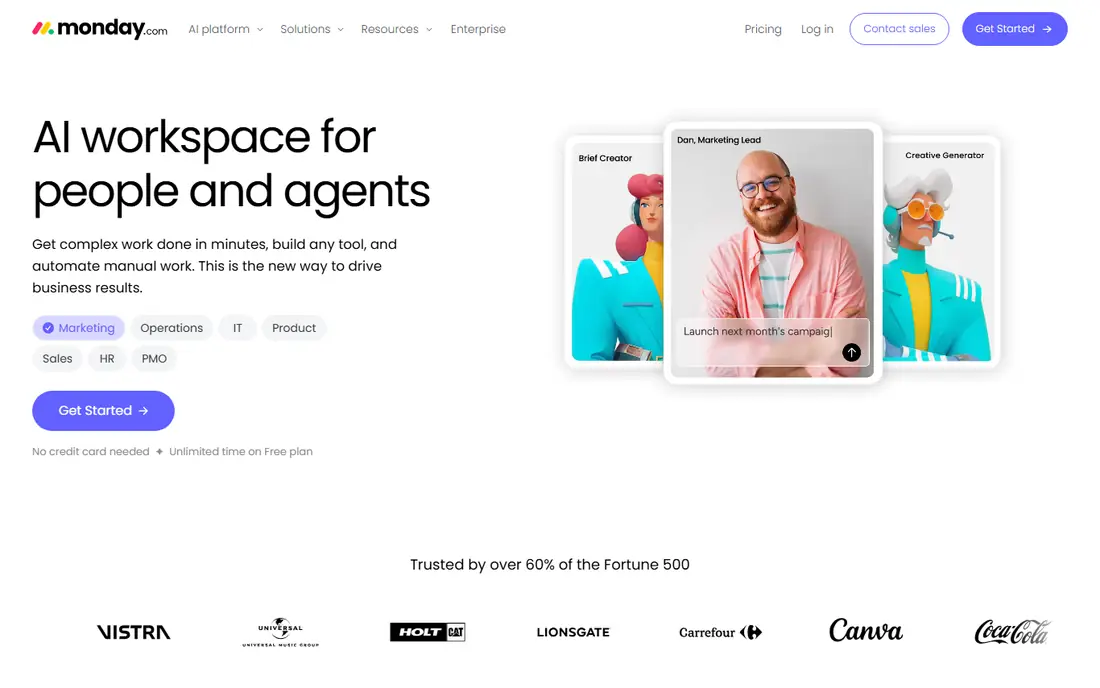
Teams that need visual boards and custom workflows, Monday.com is a natural shortlist pick. It suits teams that want visual custom workflows, and its visual boards with custom automations gives it a clear role in a busy workflow. We placed it here because that focus matches a common buyer need, not because it tries to do everything for everyone.
What stands out in daily use is how visual boards with custom automations fits real work. Monday.com lets teams build boards for campaigns, content, and social work, with dashboards that show progress at a glance. Automations move tasks and send reminders without manual chasing. That practical fit matters more than a long feature list, because tools only help when staff actually use them week after week.
The honest catch is this: Seat costs add up for large teams. Audit who needs a full seat versus a viewer role before you buy. Run a small pilot with your own data before you roll it out to a full team.
- Visual boards and dashboards
- Custom automations
- Many templates
- Costs grow with seats
- Some views need higher plans

Buyers who value large marketing departments, Wrike is a natural shortlist pick. It suits large marketing departments, and its approval workflows with proofing gives it a clear role in a busy workflow. We placed it here because that focus matches a common buyer need, not because it tries to do everything for everyone.
What stands out in daily use is how approval workflows with proofing fits real work. Wrike suits larger marketing teams that need formal approvals, proofing, and resource planning. Creative assets can move through review steps with comments in one place. That practical fit matters more than a long feature list, because tools only help when staff actually use them week after week.
The honest catch is this: Setup is heavier than Asana or Monday.com. Assign an owner for templates and permissions, or the system can grow messy. Run a small pilot with your own data before you roll it out to a full team.
- Approval workflows and proofing
- Resource management
- Enterprise controls
- Complex setup
- Higher cost for full features
For buyers who want all in one work hub for marketers, ClickUp is a natural shortlist pick. It suits teams that want docs, tasks, and goals together, and its an all in one hub with docs and goals gives it a clear role in a busy workflow. We placed it here because that focus matches a common buyer need, not because it tries to do everything for everyone.
What stands out in daily use is how an all in one hub with docs and goals fits real work. ClickUp combines tasks, docs, whiteboards, and goals, which suits teams that want one place for briefs and delivery. The free plan is generous for small teams. That practical fit matters more than a long feature list, because tools only help when staff actually use them week after week.
The honest catch is this: The depth can overwhelm new users. Start with one view and a small set of templates, then add features as the team learns. Run a small pilot with your own data before you roll it out to a full team.
- Many views including docs and goals
- Generous free plan
- Automations
- Feature depth can overwhelm new users
- Performance varies on large workspaces
If your main need is content calendars and campaign data, Airtable is a natural shortlist pick. It suits content teams that think in tables, and its content calendars built on flexible bases gives it a clear role in a busy workflow. We placed it here because that focus matches a common buyer need, not because it tries to do everything for everyone.
What stands out in daily use is how content calendars built on flexible bases fits real work. Airtable works like a smart spreadsheet for content calendars, campaign trackers, and asset lists. Views for calendar, kanban, and gallery help different roles see the same data. That practical fit matters more than a long feature list, because tools only help when staff actually use them week after week.
The honest catch is this: Task dependencies and workload tools are lighter than dedicated project tools. Pair it with a task tool if complex campaign dependencies matter. Run a small pilot with your own data before you roll it out to a full team.
- Spreadsheet like bases with views
- Content calendar strength
- Integrations
- Project features are lighter than Asana
- Record limits on lower plans
Teams that need docs, wikis, and light project work, Notion is a natural shortlist pick. It suits small teams that want docs plus tasks, and its flexible docs linked to project tasks gives it a clear role in a busy workflow. We placed it here because that focus matches a common buyer need, not because it tries to do everything for everyone.
What stands out in daily use is how flexible docs linked to project tasks fits real work. Notion lets marketing teams keep briefs, brand guides, and tasks in linked pages. That link helps new team members find context without hunting through folders. That practical fit matters more than a long feature list, because tools only help when staff actually use them week after week.
The honest catch is this: Reporting and advanced project controls are lighter than Asana. Larger teams may need a dedicated project tool alongside Notion. Run a small pilot with your own data before you roll it out to a full team.
- Docs and wikis linked to tasks
- Flexible pages
- Good for small teams
- Project reporting is lighter
- Large workspaces need care
Buyers who value simple flat price team work, Basecamp is a natural shortlist pick. It suits teams that want simple flat priced work management, and its simple project work at a flat price gives it a clear role in a busy workflow. We placed it here because that focus matches a common buyer need, not because it tries to do everything for everyone.
What stands out in daily use is how simple project work at a flat price fits real work. Basecamp keeps projects simple with message boards, to dos, and schedules. The flat price and low learning curve suit small teams tired of complex tools. That practical fit matters more than a long feature list, because tools only help when staff actually use them week after week.
The honest catch is this: Complex campaigns with dependencies and automations will feel limited. It is a simplicity pick, not a power pick. Run a small pilot with your own data before you roll it out to a full team.
- Flat simple pricing
- Message boards and to dos
- Low learning curve
- Fewer automations and custom views
- Less suited to complex campaigns
For buyers who want client facing marketing agencies, Teamwork is a natural shortlist pick. It suits marketing agencies with client work, and its agency projects with time tracking gives it a clear role in a busy workflow. We placed it here because that focus matches a common buyer need, not because it tries to do everything for everyone.
What stands out in daily use is how agency projects with time tracking fits real work. Teamwork suits agencies that manage client projects, billable time, and workloads in one place. Client users can see progress without seeing internal work. That practical fit matters more than a long feature list, because tools only help when staff actually use them week after week.
The honest catch is this: The interface can feel busy for small internal teams. Agencies get the most value, while in house teams may prefer Asana or Monday.com. Run a small pilot with your own data before you roll it out to a full team.
- Client projects and time tracking
- Workload and reporting
- Agency focus
- Interface feels busy in places
- Some features need higher plans
How we picked these
We started with products that exist and work in October 2026 and truly fit best marketing project management software. We checked official vendor pages for features and pricing, looked at app store and review patterns where relevant, and removed products that did not fit the topic or that we could not verify. Where a price was not published, we wrote See website rather than guessing.
We ranked by fit for different buyers, not by a single score, and we note who each pick suits and where it falls short. We did not claim hands-on testing.
How marketing teams should choose project software
Match the tool to your team size
Small teams need simple setup and low cost, while larger teams need permissions, reporting, and integrations. A tool built for enterprise use can slow a small team down, and a simple tool can break under enterprise reporting needs.
Check total cost, not just the headline price
Seat costs, add ons, implementation, and contract terms all change the total. Ask for a quote that covers your full team and your must have features, and check what happens when you add users later.
Test integrations and limits
Confirm the tools you already use connect cleanly, and check limits on users, records, storage, or transactions. A missing integration can turn a good tool into extra manual work.
Run a short pilot before you commit
Use real data and a real deadline in the pilot, and ask the team that will use the tool daily for feedback. If adoption is low in the pilot, it will rarely improve after a full rollout.
FAQ
What is the best project management software for marketing teams?
Asana and Monday.com are strong starting points for most marketing teams. Asana suits structured campaigns, while Monday.com suits visual boards and custom workflows.
Do marketing teams need special project software?
Generic tools can work, but marketing teams benefit from campaign templates, content calendars, approvals, and asset links. Those features cut status meetings and missed deadlines.
Can small marketing teams use free plans?
Yes, several tools on this list offer free plans for small teams. Free plans usually limit guests, automations, or reporting, so check limits before you build a full workflow.
How do approvals work in these tools?
Most tools offer review steps, comments on assets, and approval statuses. Creative teams should test proofing and version handling with a real campaign before rollout.
Should we use one tool for all marketing work?
One tool helps visibility, but very large teams may pair a project tool with a separate asset or social tool. Start with one core tool, then add specialist tools only where gaps appear.