Best Loyalty Management Software in 2026: 8 Platforms Compared
Compare the best loyalty management software for points, tiers and rewards, with pricing, free plans and honest trade-offs for online and retail brands in 2026.
- Editor's choice
 Smile.io
Shopify stores launching a points program
Starts at$15 per monthVisit smile.ioFull review - Great alternative
 LoyaltyLion
Brands that want VIP tiers and segmentation
Starts at$199 per monthVisit loyaltylion.comFull review - Also consider
 Yotpo Loyalty
Brands already using Yotpo reviews
Starts at$199 per monthVisit yotpo.comFull review
TL;DR:
- Smile.io is the easiest starting point for Shopify stores, with a free plan and clear published tiers.
- LoyaltyLion and Yotpo suit larger brands that want VIP tiers, segmentation and managed support.
- Talon.One and Antavo suit companies that need a flexible promotion engine rather than a simple points widget.
- Price your program at peak order volume, not average volume, since most plans charge by orders or members.
Quick comparison
| Tool | Best for | Starts at | Free plan? | |
|---|---|---|---|---|
| Smile.io | Shopify stores launching a points program | $15 per month | Yes | Visit |
| LoyaltyLion | Brands that want VIP tiers and segmentation | $199 per month | Yes | Visit |
| Yotpo Loyalty | Brands already using Yotpo reviews | $199 per month | Yes | Visit |
 Talon.One | Companies that need custom promotion rules | See website | No | Visit |
 Antavo | Enterprise loyalty programs | See website | No | Visit |
 Annex Cloud | Large multi-brand loyalty programs | See website | No | Visit |
 Voucherify | Promotion, coupon and voucher logic | See website | Free trial | Visit |
 Gameball | Gamified loyalty for Shopify stores | $34 per month | Yes | Visit |
The best loyalty management software
A loyalty program should do more than hand out points. It should bring customers back, reward the right behavior, and give you data you can act on. The platforms below cover simple Shopify points programs through to enterprise engines, and the right one depends on your store size and complexity.
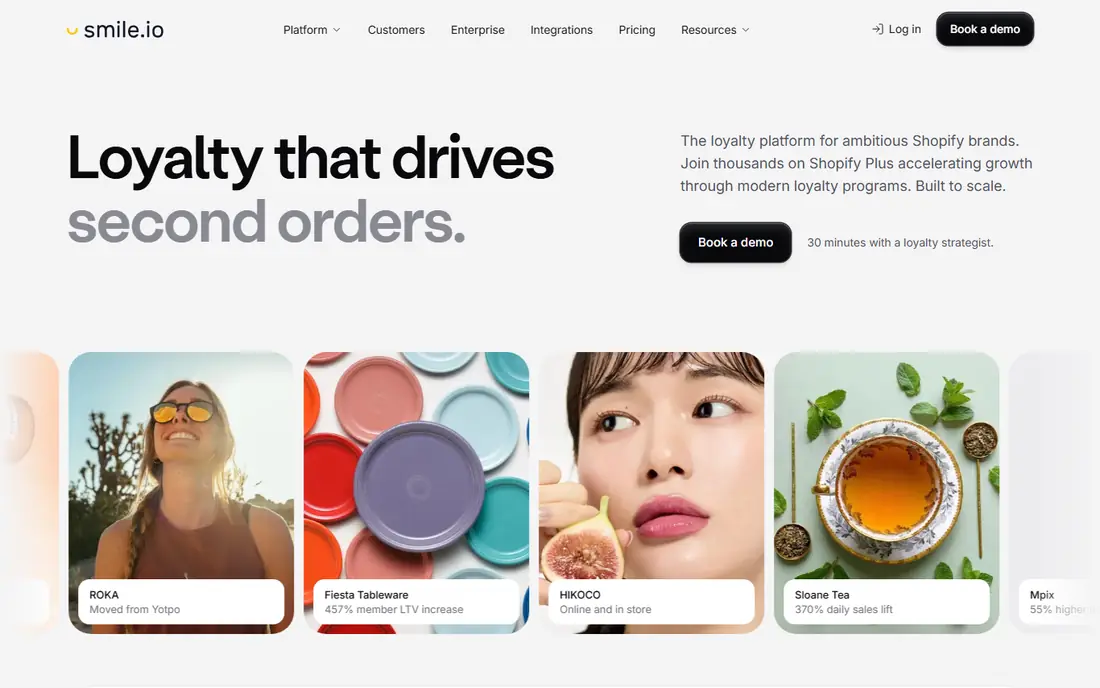
Smile.io is our pick for most small Shopify stores because it is easy to start and easy to price. The free plan covers points and referrals for up to 200 orders a month, and paid plans start at $15 per month for Essential, with Standard at $79 and Growth at $199 billed annually. That ladder lets a store see exactly what the next tier costs before growth forces an upgrade.
The limits appear as a program matures. VIP tiers begin on Growth, deeper reporting sits higher, and API access is reserved for the top Plus tier at $999 a month. For a new or growing store, those limits rarely matter at launch. Start free, learn which rewards customers actually redeem, and upgrade when order volume or tier needs justify it.
- Free plan for up to 200 orders a month
- Clear published pricing
- Easy Shopify setup
- VIP tiers start on higher plans
- API access sits on the top tier
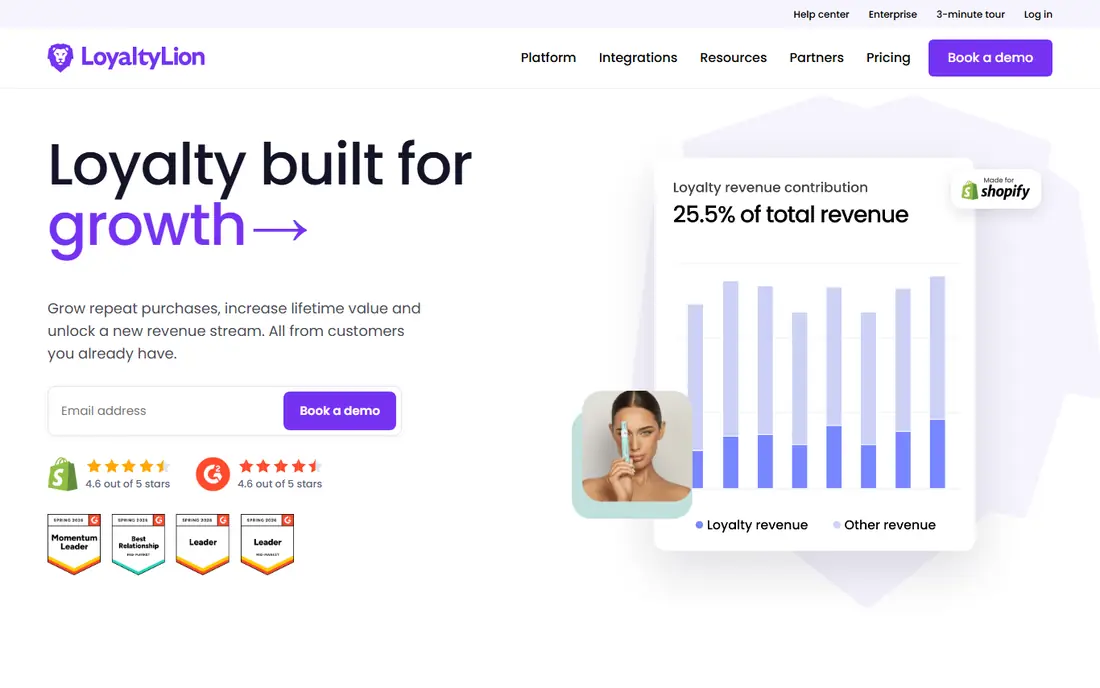
LoyaltyLion suits direct-to-consumer brands that want more than basic points. Its Classic plan, at $199 a month including 500 orders, adds a built-for-you loyalty page, pre-built earning rules and dedicated onboarding, while higher tiers add VIP tiers, multilingual support and strategy reviews. That managed layer matters when no one on your team owns loyalty full-time.
The price is the barrier for small stores, since $199 a month is a real commitment before a program proves itself. Upper tiers are also quote-only, so budgeting beyond Classic needs a sales conversation. Choose LoyaltyLion when you have steady order volume and want tiers, segmentation and support, not when you are testing whether loyalty works at all.
- Strong tier and segmentation tools
- Dedicated onboarding on Classic
- Good Shopify and Klaviyo sync
- Classic starts at $199 a month
- Upper tiers are quote-only
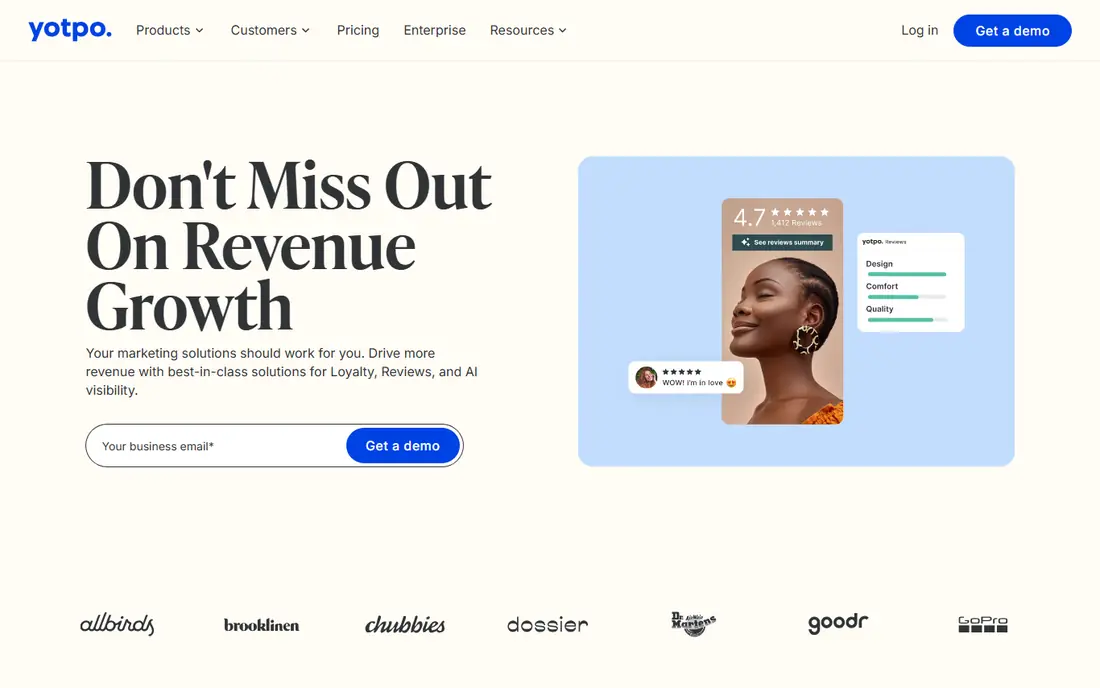
Yotpo Loyalty makes most sense for brands that already run Yotpo reviews or other Yotpo products. Consolidating loyalty with reviews simplifies data and billing, and rewards for verified reviews fit naturally into a loyalty program. The free plan covers under 100 monthly orders, and Pro starts at $199 a month, with per-order fees of $0.08 to $0.20 once you pass 500 orders a month.
Those per-order fees deserve a spreadsheet before you sign, since they add variable cost on top of the base rate at higher volumes. The wider Yotpo suite can also feel large for a team that only wants loyalty. If you already use Yotpo, the bundle is compelling. If you do not, compare Smile.io or LoyaltyLion first.
- Loyalty, reviews and marketing in one suite
- Free plan under 100 monthly orders
- Familiar for Yotpo users
- Per-order fees above 500 orders a month
- Broad suite can feel complex
Talon.One is not a simple points widget. It is a promotion and loyalty engine that lets companies build custom rules for discounts, coupons, referral rewards and loyalty benefits across web, app, store and other channels. That flexibility suits retailers, marketplaces and brands with complex offers that a standard loyalty app cannot express.
The trade-off is effort. Talon.One is priced by quote and needs engineering time to set up and maintain, so it suits companies with a technical team or an integration partner. A small Shopify store will find Smile.io far easier. A larger company with custom promotion logic will find Talon.One worth the build, since it can power offers no template program can match.
- Flexible API-first promotion engine
- Works across channels
- Strong rule and coupon logic
- Quote-only pricing
- Needs technical setup and ownership
Antavo builds enterprise loyalty programs for retail, travel, fashion and similar sectors, with support for points, tiers, challenges and omnichannel earning and redemption. Its strength is handling complex programs across stores, apps and partner channels, with the reporting and segmentation a large brand needs. For a company with millions of members or many locations, that depth matters.
Antavo is priced by quote and implemented as a project, so it is not a self-serve trial for a small store. Timelines, integration work and internal ownership all need planning. Choose Antavo when your program is a strategic investment with a dedicated owner. For a first program, start smaller and move up when volume justifies it.
- Enterprise-grade loyalty features
- Omnichannel programs
- Strong for retail and travel
- Quote-only pricing
- Implementation is a project, not a quick install
Annex Cloud combines loyalty, referrals and user-generated content tools for larger brands, including companies that run several brands or regions from one platform. That breadth helps when a customer should earn and redeem across brands, or when reviews and referrals should feed the same loyalty account. Its enterprise integrations support that kind of joined-up program.
Smaller companies will find Annex Cloud heavy and expensive, with quote-only pricing and a sales-led process. It fits best when a program spans brands, channels or countries and needs central control. If your need is a single-store points program, a Shopify-native tool will launch faster and cost less.
- Loyalty plus referral and review tools
- Multi-brand support
- Enterprise integrations
- Quote-only pricing
- Complexity suits larger teams
Voucherify is a promotion engine for coupons, vouchers, gift cards and loyalty-style rewards, built API-first for developers. It excels at validation rules, such as limiting a code to certain products, customers or times, and it can power promotions that a simple discount app cannot handle. Teams that build custom checkout or app experiences often use it as the rules layer behind their offers.
It is not a ready-made loyalty program with a customer widget and tier pages, so a non-technical team will need help to turn it into a full program. Pricing is published for some tiers with a trial available, and enterprise plans are quoted. Choose Voucherify when promotion logic is the hard part. Choose a loyalty suite when you want points, tiers and member pages without building them.
- Strong API for coupons and promotions
- Flexible validation rules
- 60-day trial reported
- Not a full loyalty suite out of the box
- Needs developer time for a complete program
Gameball adds game mechanics to loyalty, with challenges, badges and levels alongside points and referrals. That approach suits brands whose customers respond to goals and milestones rather than points alone, and its Shopify app makes setup straightforward. Pricing starts free on Shopify, with Starter at $34 and Pro at $159 a month, while direct enterprise plans start higher.
The Shopify focus is both a strength and a limit: stores on other platforms will need a different tool. Gamification also needs care, since challenges that feel gimmicky can annoy customers if rewards are weak. Test Gameball when your audience enjoys goals and your store runs on Shopify, and keep rewards simple enough that customers understand them at a glance.
- Gamification and challenges
- Free Shopify start
- Clear Starter and Pro tiers
- Shopify focus limits other platforms
- Enterprise plans are quote-based
How we picked these
We compared official pricing pages, Shopify listings and public reviews for loyalty platforms live today. We kept only products with a real loyalty or promotion function, and we mixed Shopify-native tools with enterprise engines so stores at different sizes can compare. Prices are starting paid prices where vendors publish them; where a vendor quotes by organization size or order volume, we direct you to the vendor site and warn about volume-based charges.
How to design a program customers actually use
Keep the first version simple. One way to earn points, one clear reward, and one way to redeem is enough to learn what customers value. Programs fail when earning rules are confusing, rewards feel out of reach, or points expire without warning. Publish the rules plainly, remind members of their balance, and make the first reward reachable after a few purchases, not fifty.
Measure what matters: repeat purchase rate, redemption rate and margin after rewards, not just sign-ups. A program that gives away margin to customers who would have bought anyway is a cost, not a loyalty tool. Test tiers, referral rewards and bonus events in small steps, and check your platform's order-based pricing at peak months before you commit to a tier. Finally, confirm you can export member data and balances, since switching loyalty vendors later is painful without a clean export.
FAQ
What is the best loyalty management platform?
Smile.io is the best starting point for small Shopify stores, while LoyaltyLion suits growing brands that want VIP tiers and segmentation. Talon.One and Antavo suit larger companies with custom or enterprise programs. The best platform is the one that matches your store size, order volume and technical resources, not the one with the longest feature list.
Is there free loyalty management software?
Yes. Smile.io, LoyaltyLion and Yotpo all offer free tiers with order limits, and Gameball starts free on Shopify. Free plans suit new programs testing whether customers engage. As order volume grows, paid plans add tiers, integrations and reporting, so budget for the tier your peak months will require.
How much does loyalty software cost?
Costs range from free to $199 a month for common mid-tier plans, and enterprise platforms are quote-only. Many plans charge by monthly orders, members or API calls, so the headline price is not always the full cost. Model your peak order volume, add per-order fees where they apply, and compare the total across two vendors.
What is the best loyalty platform for Shopify?
Smile.io is the strongest Shopify-first pick for simplicity and published pricing, with Gameball a good option for gamified programs. LoyaltyLion and Yotpo also integrate well with Shopify and Klaviyo for larger stores. Check the Shopify app listing for your store size, since order limits and review scores differ by plan.
Do loyalty programs work for small businesses?
They can, when rewards are simple, reachable and tied to repeat purchases. A small store should start with points and referrals, keep the first reward easy to reach, and track repeat purchases before adding tiers. Avoid a complex program that costs more in software and discounts than it returns in repeat sales.