Best LLM Visibility Analysis Software in 2026: 9 Tools Compared
Compare the best llm visibility analysis software for ChatGPT, Perplexity, and Gemini. We review tracking, citations, and pricing for 9 tools in 2026.

- Editor's choice
 Profound
Enterprise brands
Starts atSee websiteVisit tryprofound.comFull review - Great alternative
 Peec AI
SEO teams and agencies
Starts atSee websiteVisit peec.aiFull review - Also consider
 Otterly.ai
Small budgets
Starts atSee websiteVisit otterly.aiFull review
TL;DR:
- Profound suits large brands that need broad engine coverage and deep reporting.
- Otterly.ai is the lowest-cost entry point for small teams with a short prompt list.
- Peec AI and AthenaHQ balance agency use with clear prompt and seat rules.
- Prices change often in this new category, so confirm prompt limits on the vendor page before buying.
Quick comparison
| Tool | Best for | Starts at | Free plan? | |
|---|---|---|---|---|
| Profound | Enterprise brands | See website | Free trial | Visit |
| Peec AI | SEO teams and agencies | See website | Free trial | Visit |
| Otterly.ai | Small budgets | See website | Free trial | Visit |
 Scrunch AI | Crawler and citation analysis | See website | Free trial | Visit |
 AthenaHQ | Broad model coverage | See website | Free trial | Visit |
 Goodie AI | Small business action lists | See website | Free trial | Visit |
 PromptWatch | Agencies and mid-size teams | See website | Free trial | Visit |
 Brandlight | Brand sentiment | See website | Free trial | Visit |
 Rankscale | SEO teams moving to AI search | See website | Free trial | Visit |
The best llm visibility analysis software
We compared these tools on which AI engines they track, how they report mentions and citations, and how clear their prompt and pricing limits are.

Profound is built for brands that need to see how they appear across many AI answer engines, not just one chatbot. It tracks mentions, citations, and prompt trends, and it connects that data to broader analytics for larger teams. That depth helps when leadership asks why AI answers name a rival instead of you.
The trade is cost and complexity. Entry pricing is limited, and full coverage sits on higher tiers. Small teams with twenty prompts may find a simpler tool faster to use. For a large brand with many products and markets, Profound gives the widest view in this list.
- Broad engine coverage
- Citation and prompt volume analysis
- Enterprise reporting options
- Pricing is sales-led for larger plans
- May be more than small teams need
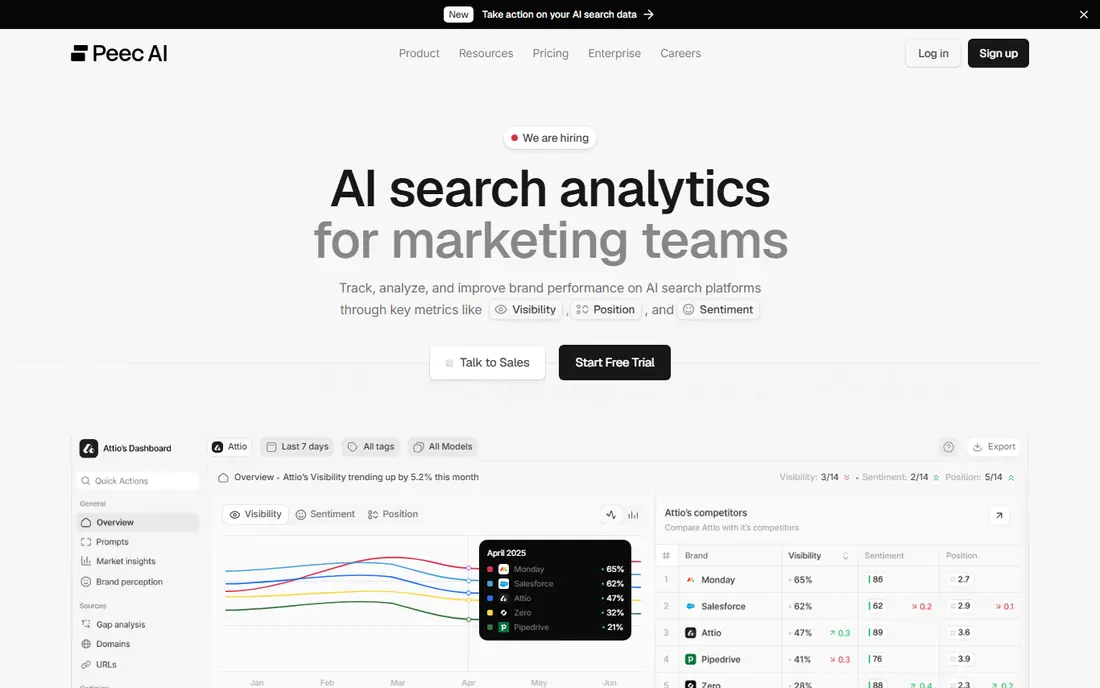
Peec AI appeals to SEO teams because its plans are easy to understand: a set number of prompts, checked daily, with unlimited seats for team use. That structure helps agencies that manage several clients without paying per seat. Citation and competitor views show which pages AI answers actually reference.
Engine coverage expands as you move up plans, so check that your buyers main engines are included before you subscribe. Peec AI is less of a content creation suite than some rivals, and more of a measurement tool. If measurement is your main job, that focus is a strength.
- Daily prompt tracking
- Unlimited seats on many plans
- Clear prompt ladders
- Engine choice varies by plan
- Some features sit on higher tiers
Otterly.ai is the friendliest starting point in this category for a small team or solo marketer. You can track a short list of prompts across major engines, including ChatGPT, Google AI Overviews, Perplexity, and Copilot, and see mentions and citations without a large contract. Setup is quick, which matters when AI visibility is a new task.
Limits appear as your prompt list grows. Entry plans cover fewer prompts, and adding engines or prompts raises cost. Treat Otterly.ai as a first measurement step: prove which prompts matter, then move up only when the data shows you need broader tracking.
- Low entry price
- Daily checks
- Simple setup for small prompt lists
- Smaller prompt limits on entry plans
- Fewer engines than enterprise tools
Scrunch AI goes beyond mention counts by looking at how AI crawlers interact with your site. That view helps technical teams fix pages that AI systems cannot read well, and citation views show which sources support your visibility. It also includes audit tools that link tracking data to concrete page fixes.
The entry price sits above budget options, and audit findings still need someone to act on them. A team without developer time may not use the deeper features. For brands that want to fix the source pages behind weak AI answers, Scrunch AI is a strong fit.
- AI crawler insights
- Citation graph views
- Site audit features
- Higher entry price than budget tools
- Audit features need technical follow-through
AthenaHQ stands out for covering many AI models on one plan, which helps teams that serve buyers across different chatbots and search features. Its credit system buys answers and tracking volume, and it pairs results with recommendations for pages to improve. That breadth suits mid-size brands with diverse audiences.
Credit-based pricing needs careful reading. Heavy prompt lists can use credits faster than expected, so model your monthly volume before subscribing. If you need many engines and clear action lists, AthenaHQ gives a wide view for the effort.
- Wide engine coverage
- Credit-based model
- Content recommendations
- Credit math can be confusing
- Costs rise with heavy tracking
Goodie AI targets smaller businesses that want a clear next step, not a wall of charts. Reports focus on visibility, competitors, and actions you can take on your site and content. That plain approach helps owners who do not have a dedicated SEO team.
Larger teams may want deeper segmentation, custom reporting, or broader engine coverage. Goodie AI trades some of that depth for clarity. If your team needs a weekly list of fixes rather than a research platform, it fits well.
- Simple reports
- Action-oriented recommendations
- Suited to smaller teams
- Less depth than enterprise platforms
- Prompt limits vary by plan
PromptWatch tracks how brands appear in answers from ChatGPT, Claude, Gemini, and Perplexity, with plans for agencies and mid-size teams. Its prompt tracking is structured and easy to segment by topic or competitor, which helps when reporting to clients. Agency options make multi-client work more practical.
It does not have the same name recognition as Profound or Peec AI, so buyers should test its reports against their own manual checks. A trial on your real prompt list is the best test. For agencies that need solid tracking without enterprise cost, PromptWatch is worth a trial.
- Covers major chatbots
- Agency plan options
- Structured prompt tracking
- Less known than larger rivals
- Pricing varies by volume
Brandlight focuses on how AI answers describe a brand, not just whether they name it. Sentiment and narrative views help communications teams spot negative framing or rival positioning early. That angle matters for brands where reputation shapes buying decisions.
Pricing and setup lean enterprise, so small teams may find it heavy. It also works best with a larger prompt set that captures real brand conversations. For reputation-focused teams, Brandlight adds a layer that pure rank-style trackers miss.
- Sentiment and narrative tracking
- Enterprise reporting
- Broad engine view
- Enterprise pricing
- Less suited to tiny prompt lists
Rankscale speaks the language of SEO teams that are adding AI search to existing work. Reports feel familiar, white-label options help agencies present results to clients, and tracking covers the main AI engines. That familiarity shortens onboarding for teams already doing rank tracking.
As a newer name in this space, it deserves the same trial test as any rival: run your prompts, check citation accuracy, and compare results with manual checks. For SEO teams that want AI visibility inside a familiar workflow, Rankscale is a practical choice.
- Familiar SEO-style reporting
- White-label options
- AI visibility tracking
- Newer category presence
- Feature depth varies by plan
How we picked these
We compared official feature pages, pricing pages, app and platform listings, privacy policies, and public reviews for each tool. We favored tools that were actively sold in October 2026, that tracked at least two major AI engines, and that published clear prompt or plan limits. We did not claim hands-on testing, and we left out tools that only offered a one-time audit with no ongoing tracking.
How to buy LLM visibility software wisely
Start with your prompt list, not with a vendor demo. Write down the twenty to fifty questions your buyers actually ask, plus the rivals they compare you with. Then ask each vendor which engines, regions, and check frequencies cover those prompts. A tool that checks weekly may miss fast-moving answers, while daily checks cost more.
Test before you scale
Run a two-week trial with the same prompts in two tools if you can. Compare mention counts, cited pages, and competitor gaps, and check a sample by hand in the chatbots themselves. Also confirm who owns the data, how long history is kept, and whether reports can be exported. The best tool is the one whose numbers you trust and whose reports your team actually reads each week.
FAQ
What is the best llm visibility analysis software for small teams?
Otterly.ai and Goodie AI are strong small-team starting points because entry costs are lower and reports stay simple. Start with a short prompt list, learn which questions drive visibility, and only expand when you have data that justifies a larger plan. Avoid buying enterprise coverage before you know your key prompts.
What are the best llm visibility analysis tools for agencies?
Peec AI, PromptWatch, and Rankscale suit agencies because they offer multi-client workspaces, unlimited or flexible seats, and client-ready reports. Check whether client data stays separated and whether white-label reporting is included or costs extra. Trial each tool with one real client before moving all clients over.
How often should LLM visibility be checked?
Daily checks suit fast-moving categories where AI answers change often. Weekly checks can be enough for stable, niche topics with little competition. Match frequency to how often your answers and rivals change, and review trends monthly rather than reacting to a single day of movement.
Does LLM visibility replace SEO rank tracking?
No, it adds a second view. Classic rank tracking shows where pages sit in search results, while LLM tools show whether AI answers name and cite your brand. Many brands need both, since a top search rank does not guarantee a mention in an AI answer. Use both views to decide where content fixes will help most.
What should I check in a trial?
Check engine coverage, prompt limits, citation accuracy, competitor views, and export options. Run your real prompts, verify a sample of results by hand, and confirm total monthly cost at your real volume. A trial that only uses vendor sample prompts will not show how the tool handles your market.