Best Link Building Services for Estate Planning Attorneys for 2026: Our 6 Vetted Picks
A practical guide to the best link building services for estate planning attorneys in 2026, compared from vendor documentation and public sources.
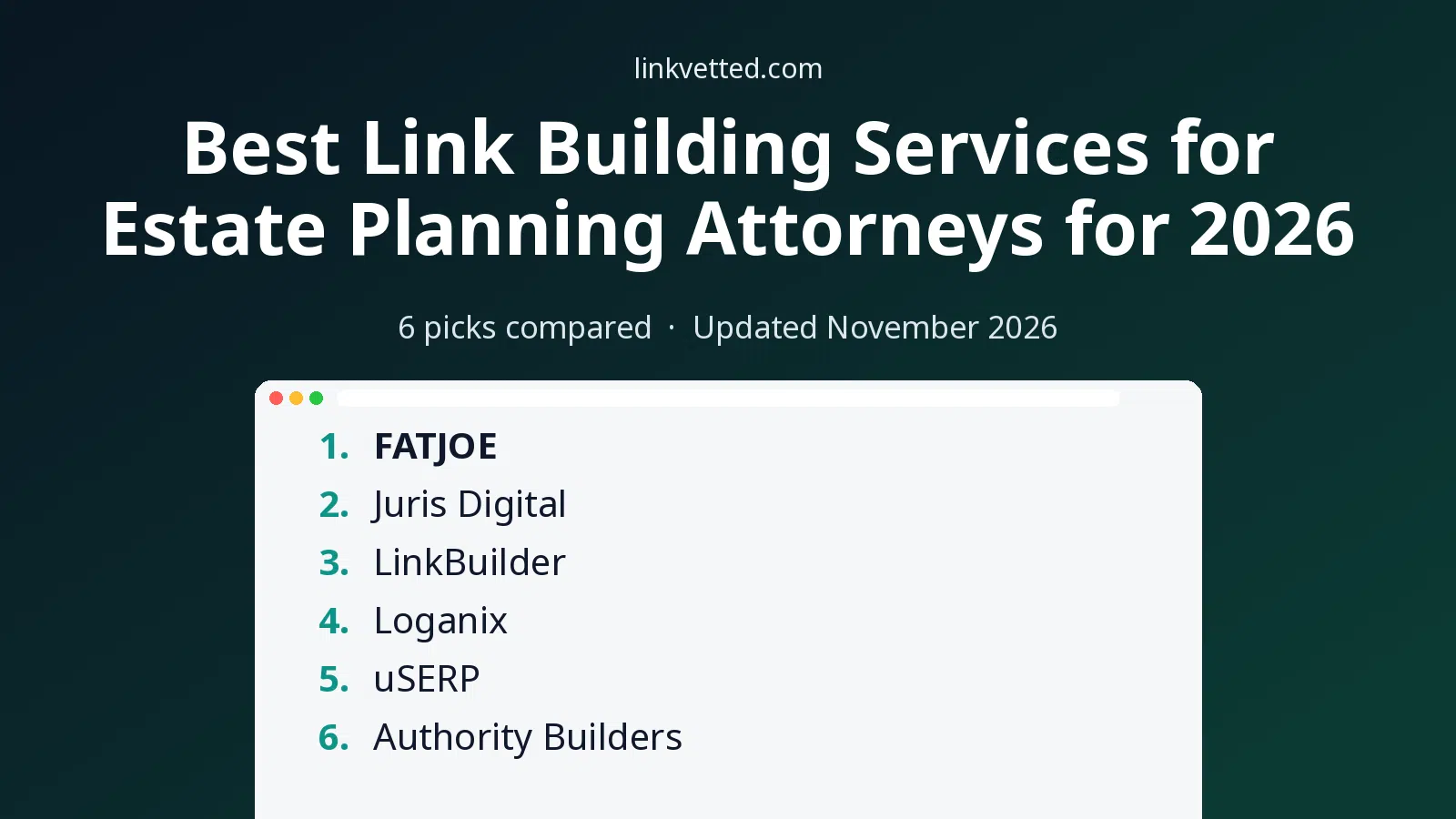
- Editor's choice
 FATJOE
Editorial links and digital PR
Starts atSee websiteVisit fatjoe.comFull review - Great alternative
 Juris Digital
Legal-niche link building for law firms
Starts atSee websiteVisit jurisdigital.comFull review - Also considerLinkBuilder
Managed outreach with real sites
Starts atSee websiteVisit linkbuilder.ioFull review
Direct answer
My top pick is FATJOE, because it publishes transparent link building and digital PR offerings that a small law firm site can use without a long contract. For attorneys who want editorial placements in legal and local publications, I point to Juris Digital. For firms that prefer a managed outreach team over a dashboard, I suggest LinkBuilder. All three are compared below from vendor documentation and public sources.
TL;DR:
- Estate planning is a local, trust-heavy niche, so links from legal directories, local news and bar-related publications matter more than generic guest posts.
- A service that can place content on real legal and finance sites is worth more to an attorney than one that only sells volume.
- You should ask any vendor how they vet sites, whether they use paid placements, and who writes the content.
- Managed services cost more time and money than self-serve tools, but they reduce the outreach work a solo attorney has to do.
- No link service can promise rankings, and any vendor that does should be treated with caution.
Last checked November 2026. Plan prices are not quoted in this guide because they change often; see each vendor's own pricing page for current figures before you buy.
Quick comparison
| Tool | Best for | Starts at | Free plan? | |
|---|---|---|---|---|
| FATJOE | Editorial links and digital PR | See website | Not stated | Visit |
| Juris Digital | Legal-niche link building for law firms | See website | Not stated | Visit |
| LinkBuilder | Managed outreach with real sites | See website | Not stated | Visit |
 Loganix | Productized link orders | See website | Not stated | Visit |
 uSERP | Vetted editorial placements | See website | Not stated | Visit |
 Authority Builders | Testing a few placements first | See website | Not stated | Visit |
The best link building services for estate planning attorneys compared
I compared these services from vendor documentation and public sources, not from hands-on tests. I looked at what each one publicly says it offers, how it describes its vetting, and where it fits a small estate planning practice. The list below is ordered by how useful I think each one is for this niche.
FATJOE is a link building and content marketplace that sells placements on publisher sites and also runs digital PR campaigns. For an estate planning attorney, the useful part is the mix: you can order a piece of content and a placement together, which saves you from writing outreach emails between client meetings. It fits solo attorneys and small firms that want a few solid placements rather than a large campaign.
In practice, you would pick a topic that matches your practice, such as trusts, probate or guardianship, and let the service handle the writing and placement. That keeps your site's link profile relevant to estate planning instead of pulling in unrelated links. The digital PR side can help if you have a local angle, like a change in state probate rules, that a regional outlet might cover.
The limits are worth knowing. FATJOE is a general marketplace, so you still need to review each site before you approve it. If you want a vendor that only works with law firms and knows legal publishers by name, look at the next option instead.
- Publicly lists placement options and content services
- offers digital PR alongside link building
- simple ordering process
- Not legal-specific
- catalog is smaller than some large marketplaces
Juris Digital is a marketing agency that works with law firms, including estate planning practices. Its link building sits inside a wider SEO offer, so you can get content, technical work and links from one team. That suits an attorney who would rather deal with one vendor than stitch together three.
For estate planning specifically, the value is that the team already knows the legal publishing landscape and the kind of content that gets cited, such as plain-language explainers on wills and powers of attorney. Outreach is handled for you, and you review the placements. This is a managed service, so expect a slower pace than a self-serve marketplace.
Skip it if you want to buy single links on demand or if your site is not a law firm. The legal focus is the point, and it also limits the catalog.
- Works specifically with law firms
- understands legal content and compliance
- offers broader SEO services if you need them
- Legal-only focus
- not a fit if you also run non-legal sites
LinkBuilder
Best for: Managed outreach with real sites
LinkBuilder is a managed link building service where the team runs outreach on your behalf and you approve the sites. It is aimed at businesses that want editorial links without running a campaign in-house. For an estate planning practice, that means you can hand over the prospecting and focus on clients.
The workflow is straightforward. You share your topics and target pages, the team builds a prospect list, and you review before anything goes live. Because outreach is manual, placements tend to come from sites that actually publish content rather than from link farms. That matters in a niche where trust is the whole product.
The trade-off is control. You are relying on the vendor's judgment about which sites fit, and you will not see every email. If you want to pick each target yourself, a marketplace like FATJOE gives you more say.
- Managed outreach model
- focuses on editorial placements
- handles prospecting and negotiation
- Less control over individual targets
- not legal-specific
Loganix sells link building and content as fixed products, which makes it easy to budget. You pick a package, and the team handles writing and placement. For an attorney who wants a predictable monthly task rather than a custom campaign, that simplicity helps.
The downside is that relevance. Loganix serves many industries, so you need to check that the sites in your package make sense for estate planning. A link from a general business blog is weaker for a law firm than a link from a legal or finance publication. Review the site list before you approve anything.
It is a reasonable starting point for a firm that has no links yet and wants to build a base. Firms with an established profile and specific targets may outgrow it.
- Clear productized packages
- content and links can be ordered together
- simple checkout
- General niches rather than legal
- placements vary by package
uSERP is a link building service that focuses on editorial placements on sites it vets. It is used widely by software and professional services companies. For an estate planning firm, the appeal is the quality bar: you are buying fewer, better links rather than a bulk order.
The service is a better match for firms that already have a content base and want to strengthen specific pages, such as a guide to revocable trusts. You will need to supply clear target pages and topics, because the team works from your brief. Expect a slower process than a self-serve tool.
Small firms on a tight budget may find the entry point high. If you are testing link building for the first time, start smaller and come back when you know which pages convert.
- Emphasis on vetting publisher sites
- editorial placements rather than directory links
- works with SaaS and professional services
- Higher entry point
- not built around legal publishing
Authority Builders is a marketplace-style service that lets you order individual placements from a published list of sites. That makes it useful for an estate planning attorney who wants to test two or three links before committing to a monthly service.
You choose the site, supply or order the content, and the placement is arranged. Because you see the list up front, you can screen for legal, finance and local outlets yourself. That control is the main benefit for a cautious buyer.
The downside is that you do the relevance screening. There is no legal specialist on the other side telling you which publishers matter for probate and trust content. Treat it as a tool for testing, not a full campaign.
- Lets you order individual placements
- transparent site lists
- simple process for small orders
- Limited customization
- not legal-specific
How I chose
I built this list from vendor documentation and public sources. I read each service's own pages describing what it offers, how it describes its vetting, and what kind of client it says it serves. I did not run hands-on tests, and I did not buy links to check delivery. Where a vendor's public material was thin, I said so rather than filling the gap with guesses.
The main filter was fit for an estate planning practice. That means relevance to legal, finance and local audiences, a process a small firm can actually run, and clear information about how sites are chosen. I also weighed limits: a general marketplace is useful for testing but weak on legal relevance, while a legal agency is relevant but narrow. I left out services I could not verify as currently operating.
What to check before you buy
- Ask whether placements are editorial or paid, and whether the site discloses sponsorship.
- Check that the vendor can name legal, finance or local publications it has worked with.
- Confirm who writes the content and whether you review it before publication.
- Ask how sites are vetted for spam signals and whether you see the full list before approval.
- Check the contract length and whether you can pause or cancel a monthly service.
- Make sure the vendor will not promise rankings or use private blog networks.
FAQ
Are links from legal directories worth it for estate planning attorneys?
Yes, when the directory is real and maintained. Bar association listings, avvo-style profiles and local chamber pages give you a baseline of citations that support trust. They are not a substitute for editorial links, but they are a sensible first step before you pay for outreach.
How many links does an estate planning firm need?
There is no fixed number, and any vendor who gives you one is guessing. A small firm usually benefits from a steady trickle of relevant links over time rather than a burst. Focus on pages that bring in client inquiries, such as your probate and trust pages, and build links to those.
Can I build links myself instead of hiring a service?
Yes. You can pitch local reporters, publish plain-language guides, and join legal directories on your own. The reason to hire a service is time: outreach takes hours each week, and most attorneys do not have those hours. A service buys you consistency, not a guarantee.
Is guest posting still useful for law firm SEO?
It can be, if the site is real and the content is useful to readers. The problem is low-quality guest post networks that sell placements on sites with no audience. Ask any vendor for the actual site list and check whether the publication covers legal topics for real readers.
What should I avoid when buying links for a law firm?
Avoid anyone selling bulk links, private blog networks, or guaranteed rankings. Avoid vendors who will not show you the sites before placement. Also check your state bar's advertising rules, since some jurisdictions have specific guidance on marketing claims and testimonials.
Sources
- https://fatjoe.com
- https://jurisdigital.com
- https://linkbuilder.io
- https://loganix.com
- https://userp.io
- https://authoritybuilders.co