Best Language Exchange Apps in 2026: 9 Apps Compared
Compare the best language exchange apps in 2026, from HelloTalk and Tandem to Speaky and Lingbe, with free plans, safety tips, and fit for learners compared.

- Editor's choice
 HelloTalk
Large community and varied practice
Starts atSee websiteVisit hellotalk.comFull review - Great alternative
 Tandem
Focused long-term partners
Starts atSee websiteVisit tandem.netFull review - Also consider
 Speaky
Simple free casual exchange
Starts atFreeVisit speaky.comFull review
TL;DR:
- HelloTalk suits learners who want a large community and many ways to practise, while Tandem suits focused one-to-one partnerships.
- Speaky and ConversationExchange keep costs low, while Lingbe suits learners who want an instant voice call.
- Partner quality varies by language pair and time zone, so trying two apps for a few weeks often beats picking one from a list.
- Keep early chats inside the app, and meet strangers only in public places after a longer online history if you choose to meet at all.
Quick comparison
| Tool | Best for | Starts at | Free plan? | |
|---|---|---|---|---|
| HelloTalk | Large community and varied practice | See website | Yes | Visit |
| Tandem | Focused long-term partners | See website | Yes | Visit |
| Speaky | Simple free casual exchange | Free | Yes | Visit |
 Lingbe | Instant voice calls | See website | Yes | Visit |
 HiNative | Quick native-speaker questions | See website | Yes | Visit |
 Slowly | Thoughtful pen-pal writing | Free | Yes | Visit |
 ConversationExchange | Free web partner matching | Free | Yes | Visit |
 italki | Community plus optional paid tutors | See website | Yes | Visit |
 Idyoma | Local and nearby exchanges | See website | Yes | Visit |
The best language exchange apps
We compared official feature pages, app store listings, pricing information, safety and privacy pages, and public reviews to weigh community size, matching, correction tools, and free limits. Safety note: keep early conversations inside the app, avoid sharing a home address or financial details, and prefer in-app chat first before any voice or video call with a new partner.

HelloTalk is the easiest place to start for many learners because there are several ways to practise in one app. One-to-one chat covers daily conversation, corrections inside the chat help with grammar, and group Voicerooms offer listening practice without the pressure of a private call. That range helps when a single partner is busy or in a different time zone. The social side is also the main drawback. A feed full of posts can pull attention away from a planned exchange, and partner quality still varies. Learners who set a clear routine, such as a short daily chat plus one weekly call, tend to get more from HelloTalk than learners who only browse the feed.
- Large community across many languages
- In-chat corrections, translation, and pronunciation tools
- Voicerooms and Moments give group practice options
- Free tier limits some daily features
- Social feed can distract from focused practice
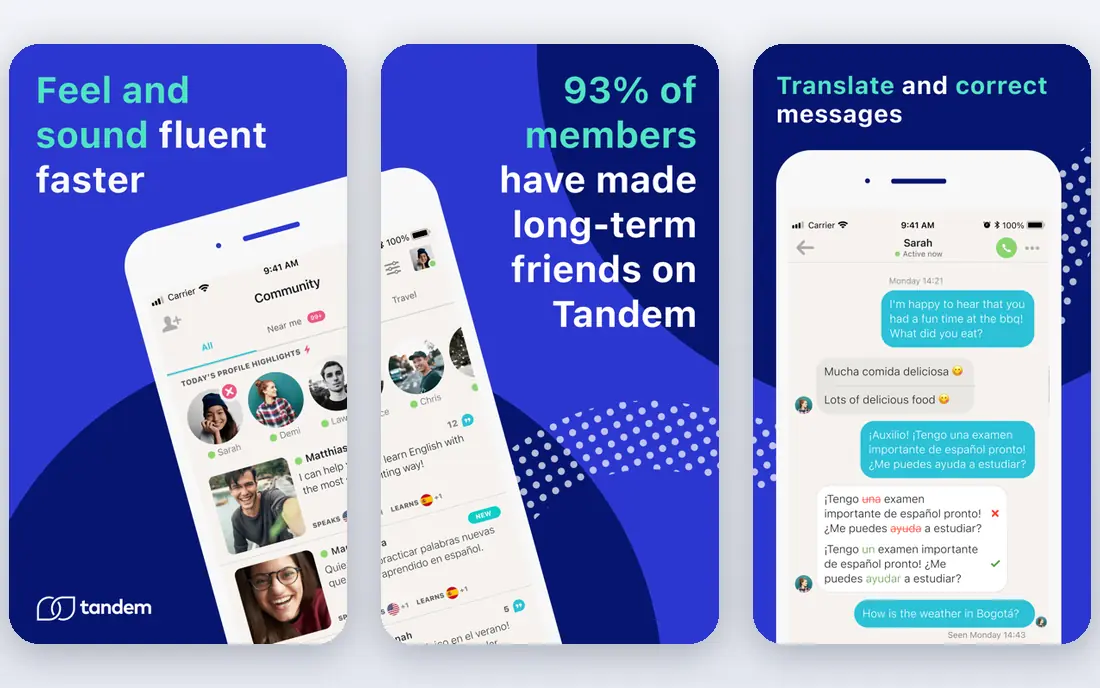
Tandem suits learners who want a steady partner rather than many short chats. Search filters for language, interests, and goals help narrow the field, and the app supports a natural progression from text to voice notes to calls. That structure makes it easier to split time fairly between two languages. Patience is still needed. Even with filters, some partners reply slowly or stop replying, which is normal in exchange apps. Writing a clear profile, stating your schedule and goals, and contacting a few suitable partners at once usually improves the result more than waiting for one perfect match.
- Profile and interest filters support better matching
- Text, voice, and video options in one place
- Application and moderation steps aim for serious learners
- Paid Pro opens some filters and tools
- Finding a good partner can still take time and patience
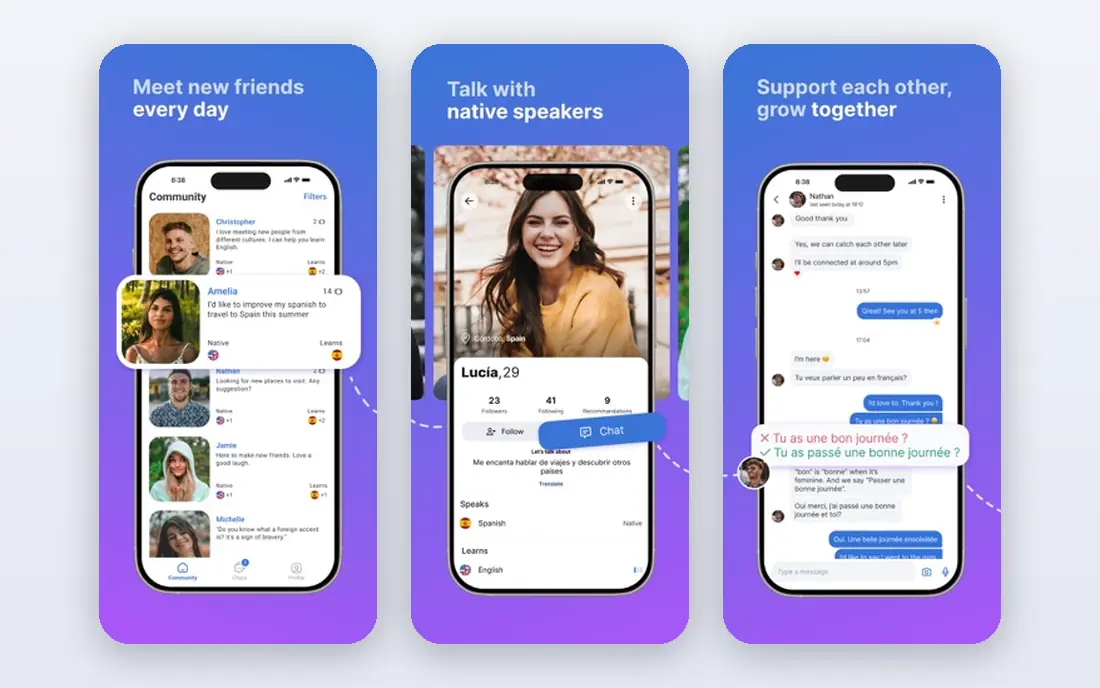
Speaky is a good choice for learners who want to start chatting quickly without paying or learning a complex app. The interface is plain, matching is fast, and the focus stays on conversation rather than social features. That simplicity can be a relief for shy learners or for a first exchange app. The trade-off is depth. Correction tools and structured features are lighter than in larger apps, so progress depends more on the partner and on your own routine. Speaky works best as a low cost way to get regular conversation, paired with a course or textbook for grammar and vocabulary.
- Free core messaging with quick matching
- Simple interface that suits beginners
- Text and voice chat without a complex setup
- Fewer learning tools than HelloTalk or Tandem
- Partner activity varies by language pair
Lingbe answers a common problem in exchange apps, which is waiting for a partner to reply. Instead of browsing profiles, you can start a voice call with a native speaker and practise speaking right away. That instant format suits intermediate learners who want fluency practice and can handle a live conversation. Writing practice is not the focus here, and call quality depends on who is online at the time. Learners who want grammar corrections or written feedback should pair Lingbe with a text-based app. For speaking confidence, though, the low friction of an instant call is hard to match.
- Instant voice calls without browsing many profiles
- Reward system can earn call time
- Good for speaking confidence and fluency practice
- Voice-only focus suits speaking more than writing
- Call availability varies by language and time of day
HiNative fills a gap that exchange apps often leave. When you are unsure about a phrase, a pronunciation, or a natural way to say something, you can ask native speakers and get short answers, often with audio. That quick check is useful for homework, writing, and exam preparation. It is not a replacement for regular conversation. HiNative is built around questions, not partnerships, so learners who want weekly speaking practice should use it beside Tandem, HelloTalk, or Lingbe. Used that way, it becomes a handy reference tool rather than a main study method.
- Fast answers to pronunciation, grammar, and usage questions
- Audio clips help with speaking checks
- Useful beside a course or exchange app
- Not a full exchange app for long conversations
- Answer quality varies by question and language
Slowly takes the pen-pal idea seriously. Letters take time to arrive, based on distance, which encourages longer messages and more careful writing. That pace suits learners who enjoy writing, culture exchange, and building a friendship over time, rather than rushing through short chats. Speaking practice is not the point here. Learners who need conversation fluency should add a voice app, while Slowly covers writing and cultural exchange. The delay can also frustrate impatient learners, but many users find that the slower rhythm leads to better letters and more lasting contacts.
- Letter format encourages longer, thoughtful writing
- Matching by interests and language
- Free core use with a calm, low pressure pace
- Delivery delay means no instant conversation
- Less suited to speaking practice or urgent questions
ConversationExchange suits learners who prefer a website to an app, or who want to find a local partner for face-to-face practice. Search filters cover language, country, and exchange type, and the service is free for basic matching. That makes it a practical starting point for less common language pairs too. The experience is less guided than HelloTalk or Tandem. You will need to arrange your own calls and agree on tools, and the interface feels dated. For learners who value free access and local matching over polish, those trade-offs are acceptable, and the site remains a useful directory.
- Free partner search by language, location, and type
- Supports text, voice, video, and face-to-face exchange
- No app download required for web use
- Older web design feels less polished than modern apps
- Users must arrange calls and tools themselves
italki is not a pure exchange app, but it earns a place here because its free community sits beside a large tutor marketplace. Learners can post writing, ask for corrections, and join community discussions for free, then book a tutor when they want structured feedback or regular lessons. That mix helps when exchange partners are unreliable. Cost is the catch. Community features are free, but consistent tutor help is paid per lesson, and prices vary by tutor. Readers should treat italki as a backup and a structured option, not as a free unlimited exchange service, and should check tutor reviews and trial lessons before committing.
- Free community posts and corrections beside paid lessons
- Large tutor marketplace for structured help
- Trial lessons can be low cost
- Best structured help is paid, not free exchange
- Tutor quality and price vary, so profiles need careful reading
Idyoma suits learners who want exchange partners nearby, whether for coffee chats, language meetups, or local events. Location filters make it easier to find people in the same city, which can turn an online exchange into a regular local habit. Profile controls also help learners who want a slower, more comfortable start. Local activity is the limit. In a large city with many learners, Idyoma can work well, while in a smaller town the pool may be thin. Safety still matters for any in-person meeting, so keep early chats in the app, meet in public places, and tell someone you trust where you are going if you do meet.
- Location based matching supports nearby partners and meetups
- Profile controls help learners set comfort levels
- Free core use with optional upgrades
- Community size varies a lot by city and language
- Meetup features depend on local activity
How we picked these
We compared official feature pages, app store listings, pricing and safety pages, and public reviews, with a focus on matching quality, correction tools, free limits, and community activity by language. We included both pure exchange apps and close alternatives, such as HiNative and italki, where they solve a real learner need that pure exchange apps handle poorly. We did not claim hands-on testing for every app, and community size varies by language pair and region. Safety was part of the method, not an afterthought. We favoured apps with reporting, blocking, and profile controls, and we note where free limits or paid features change the experience. Learners should check current pricing in the app store for their region, since subscription prices vary.
How to get a good exchange partner
Write a clear, honest profile
State the language you speak, the language you want to practise, your level, and your weekly availability. A short note about interests helps a partner start a real conversation, rather than a generic greeting. Profiles that look copied or empty tend to get fewer serious replies.
Agree on time split and routine
Decide how much time goes to each language, and whether you will meet by text, voice, or video. A regular slot, even 30 minutes twice a week, works better than random long chats. If a partner only wants to practise one language, it is fair to end the exchange politely and find a better match.
Use corrections and notes
Ask your partner to correct key mistakes, and keep a short note of new phrases after each session. That habit turns casual chat into study, and it gives the next session a starting point. If corrections feel too heavy, agree on a lighter style, such as correcting only repeated errors.
Stay safe with new contacts
Keep early chats inside the app, avoid sharing a home address, workplace details, or financial information, and use blocking and reporting tools if a contact becomes pushy or inappropriate. For any in-person meeting, choose a public place, keep the first meeting short, and tell someone you trust your plans.
FAQ
What is the best language exchange app?
HelloTalk is the best all-round pick for most learners because of its large community and varied practice options. Tandem is better for a focused long-term partner, while Speaky is better for a simple free start. The best app for you depends on your language pair, schedule, and whether you prefer text, voice, or group practice.
Is Tandem or HelloTalk better?
Tandem tends to suit serious one-to-one partnerships with clearer matching, while HelloTalk suits learners who want many contacts, group rooms, and social features. Try both for two weeks with the same routine, then keep the app where you found a reliable partner. Partner quality matters more than app features alone.
Are language exchange apps free?
Many exchange apps have a free core tier, including HelloTalk, Tandem, Speaky, Slowly, and ConversationExchange. Paid plans usually open filters, extra translations, or unlimited features. Check the free limits for your language pair before paying, since a free tier may already cover regular text and voice practice.
Are language exchange apps safe?
They can be safe with sensible habits, but they involve talking to strangers, so caution matters. Keep early chats inside the app, do not share personal or financial details, and use reporting and blocking tools when needed. For in-person meetings, meet in public, keep it short, and tell someone you trust where you are going.
How do I find a partner for a less common language?
Try more than one app, since community size varies by language and region. ConversationExchange and Tandem can help for less common pairs, and a clear profile with flexible times can improve replies. If exchange partners are scarce, a tutor marketplace such as italki can fill the gap while you keep searching.
How often should I practise with an exchange partner?
Two or three short sessions per week work well for most learners, with a clear time split between languages. Short, regular contact beats one long session per month, because it keeps vocabulary fresh and builds comfort. Add a few minutes of notes after each session to turn conversation into lasting learning.