Best Laboratory Software in 2026: 8 Systems Compared
We compared the best laboratory software for tracking, quality control and research, from enterprise LIMS platforms to affordable cloud tools for small labs.

- Editor's choice
 LabWare LIMS
Large regulated laboratories
Starts atSee websiteVisit labware.comFull review - Great alternative
 STARLIMS
Quality and compliance focused labs
Starts atSee websiteVisit starlims.comFull review - Also consider
 LabVantage
Enterprise labs with complex workflows
Starts atSee websiteVisit labvantage.comFull review
TL;DR:
- Enterprise LIMS platforms such as LabWare and STARLIMS suit regulated labs, but they are quote priced and take months to implement.
- LabCollector, at $35 per user per month in recent pricing, and QBench are the most accessible routes into real LIMS features for a small lab.
- Benchling and SciNote suit research teams that need notebooks, collaboration and sample tracking together.
- A laboratory information management system, or LIMS, is not the same as a clinical laboratory information system, so check which workflow a tool covers.
Quick comparison
| Tool | Best for | Starts at | Free plan? | |
|---|---|---|---|---|
| LabWare LIMS | Large regulated laboratories | See website | No | Visit |
| STARLIMS | Quality and compliance focused labs | See website | No | Visit |
| LabVantage | Enterprise labs with complex workflows | See website | No | Visit |
 Benchling | Research and biotech teams | See website | Yes | Visit |
 LabCollector | Small labs needing affordable LIMS | $35 per user per month | No | Visit |
 QBench | Growing labs wanting modern cloud LIMS | $275 per user per month | No | Visit |
 CloudLIMS | Labs without in-house IT staff | See website | No | Visit |
 SciNote | Research labs needing ELN and inventory | See website | Yes | Visit |
The best laboratory software
We compared vendor feature pages, pricing pages and public reviews, with attention to sample tracking, instrument connections, audit trails, regulatory support and implementation effort. Laboratory software covers several jobs, so we included LIMS, electronic lab notebook and inventory tools that a lab can actually run today.
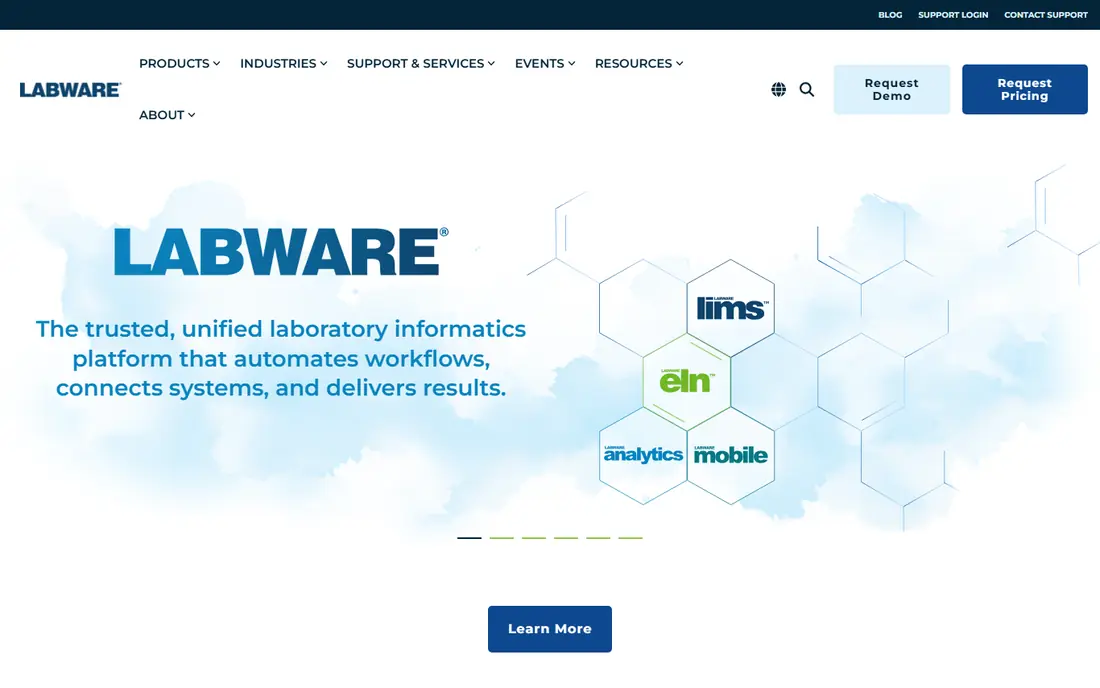
LabWare LIMS is the default shortlist name for a large laboratory that must prove, audit by audit, that every sample, test and result was handled correctly. It covers sample login, chain of custody, test assignment, result entry, review and approval, plus reporting and quality control tracking, and it can be configured for pharmaceutical, environmental, food, clinical research and industrial labs. Its configurability is the reason large labs choose it: workflows, fields, screens and reports can be shaped to a lab's own methods.
The cost is the reason small labs should look elsewhere. Pricing is quoted per project, service and setup fees are high, and a full implementation, including workflow analysis, instrument connections, validation and training, often takes 6 to 18 months. Choose LabWare when regulatory proof and scale matter more than speed or price.
- Very configurable sample, test and result workflows
- Long track record in regulated industries
- Broad instrument and system connections
- Quote only pricing with high service and setup costs
- Implementation can take many months
- Heavy for a small lab

STARLIMS, now part of the broader Abbott informatics family in public listings, serves quality control, public health, pharmaceutical and manufacturing labs that need tight control over samples, methods and results. It offers sample management, test scheduling, quality control charts, audit trails and reporting, with cloud or on-premise deployment. For a lab that must meet strict quality standards, that combination of control and traceability is the main draw.
The watch-out is fit for a specific lab type. Some analytical labs report that out-of-the-box workflows need customisation before they match daily work, such as sample ID search and trend reporting, so a demo with your own sample types and reports is essential. Budget for services as well as licences, since services often match or exceed licence cost on enterprise LIMS projects.
- Strong quality management and compliance features
- Cloud and on-premise options
- Configurable workflows and reporting
- Pricing is not published in a simple plan list
- Some users report that stock workflows need customisation for analytical labs

LabVantage combines LIMS, electronic lab notebook and laboratory execution in one platform, which suits a large organisation that wants research, quality control and manufacturing testing on shared data. It handles sample tracking, method execution, instrument data capture, stability studies and quality events, and it supports multi-site work with central control. For a pharmaceutical or contract lab with several sites, that breadth reduces the need for separate systems.
The trade-off is the same as other enterprise LIMS: quoted pricing, a long implementation, and a feature set that can overwhelm a team of 5 or 10 people. Smaller labs should compare LabCollector, QBench or CloudLIMS first, and return to LabVantage only when multi-site control or a combined notebook and LIMS requirement justifies the project.
- Full LIMS plus electronic notebook and laboratory execution features
- Strong for multi-site labs
- Configurable quality and stability workflows
- Enterprise pricing and implementation effort
- More than a small lab needs
Benchling is built for life science research, where the daily work is designing DNA sequences, tracking plasmids and cell lines, recording experiments in a notebook, and managing inventory. It brings those jobs into one cloud workspace with a modern interface that research teams adopt quickly, and it supports collaboration, permissions and search across projects. That research focus is its strength: a bench scientist can move from sequence design to experiment record without exporting data between tools.
The limit is scope. Benchling is not a direct replacement for a regulated quality control LIMS in a manufacturing lab, and full commercial pricing is quoted rather than published as a simple plan. Research teams, startups and academic groups should trial the free academic options where eligible and check commercial pricing early.
- Modern interface for sequences, plasmids, notebooks and inventory
- Strong collaboration for research teams
- Cloud based with regular updates
- Pricing for full commercial use is quoted
- Less focused on regulated quality control workflows than LabWare or STARLIMS
LabCollector is the most accessible true LIMS in this list for a small lab. At $35 per user per month in recent pricing, it covers sample tracking, storage management, equipment records, reagent inventory and document storage, with add-on modules for workflows such as quality control, animal facilities and clinical work. A small lab can start with core modules and add only the ones it needs, which keeps the first year cost far below an enterprise platform.
The catch is polish and scale. The interface is practical rather than sleek, and a very large multi-site lab may find reporting and validation support thinner than on LabWare or LabVantage. For a lab with up to a few dozen users that needs real sample control without an enterprise project, LabCollector is a strong value pick.
- Published pricing from $35 per user per month
- Covers samples, inventory, equipment and documents
- Add-on modules for specific lab types
- Interface is functional rather than modern
- Enterprise scale reporting is thinner than LabWare
QBench is a cloud LIMS aimed at testing, cannabis, environmental, food and materials labs that want a modern interface without running servers. Its published tiers start at $275 per user per month for Foundation, with Growth at $325 and Advanced at $425 in recent listings, and they cover sample login, test tracking, result reporting, invoicing support and customer portals. The cloud model means updates, backups and hosting are handled by the vendor.
The price is the main filter. At $275 per user per month, a team of 10 users faces a substantial annual bill, so QBench suits a growing commercial lab with steady testing revenue rather than a university group on a grant budget. Trial the workflow with your own sample types before committing, and confirm which tier includes the reporting and portal features you need.
- Modern cloud interface
- Published tier pricing
- Covers samples, tests, reporting and customer portals
- Starting price is high for a very small lab
- No free plan
CloudLIMS is a pure cloud LIMS for clinical research, biobanking, environmental and testing labs that do not want to manage servers, backups or upgrades. It covers sample receipt, tracking, storage, test assignment and reporting through a browser, and the vendor handles hosting and updates. For a lab without IT staff, that delivery model removes a whole category of work and risk.
The trade-off is control. CloudLIMS offers less deep customisation than LabWare or LabVantage, and pricing is confirmed by quote, so a small lab should ask for a written quote that includes user count, storage and support terms. It is a good fit when speed to go live matters more than a highly custom workflow.
- Pure software as a service delivery
- Covers sample, inventory and workflow tracking
- No server setup or maintenance
- Pricing is quoted rather than published as a simple plan
- Customisation depth is less than enterprise LIMS
SciNote combines an electronic lab notebook with inventory, protocol and project management, which suits academic, startup and research labs that need to record experiments and track samples and reagents in one place. Teams can create protocols, assign tasks, record results, link inventory items to experiments and search past work, which helps when staff change or when a result needs to be traced back to a method. A free plan lets a small team start without a purchase order.
The limit is regulatory depth. SciNote is not designed as a full manufacturing quality control LIMS, so a regulated production lab should choose LabWare, STARLIMS or LabVantage instead. For research use, however, SciNote gives a practical and affordable notebook and inventory combination.
- Electronic notebook plus inventory and protocol management
- Free plan for small teams
- Good for academic and research groups
- Not a full regulated quality control LIMS
- Advanced features need paid plans
How we picked these
We compared vendor feature pages, pricing pages and public reviews, and we kept only tools that are actively sold, cover sample or experiment tracking in a real lab workflow, and offer cloud or supported on-premise deployment. We included both enterprise LIMS and smaller cloud tools because a 5 person lab and a 500 person lab do not need the same product, and we flagged pricing as quoted where a vendor does not publish a plan price. We did not claim hands-on testing; our comparison rests on published features, prices and implementation guidance.
What to check before you buy laboratory software
A LIMS purchase fails when the demo uses generic samples and the real lab uses messy ones, so test with your own data, methods and reports. Ask for a written services estimate, not just a licence quote, before signing.
Match the tool to LIMS, LIS or ELN work
A LIMS manages samples, tests and data in research, pharmaceutical, environmental and industrial labs. A clinical laboratory information system manages patient test orders, specimen tracking and results reporting linked to health records. An electronic notebook records experiments and methods. Buying the wrong category is the most expensive mistake in this market, so confirm the category in writing.
Test instrument connections and audit trails
List your instruments and ask which ones connect directly, how results flow into the system, and whether manual entry is needed for any key instrument. Check the audit trail: who changed a result, when, and what the old value was. For a regulated lab, that trail is not optional.
Get the full implementation cost in writing
Enterprise LIMS services often match or exceed licence cost, and timelines of 6 to 18 months are common. Ask for a fixed scope for workflow analysis, configuration, instrument connections, validation, training and go-live support, plus annual maintenance terms. A SaaS tool such as LabCollector, QBench or CloudLIMS can go live in weeks, but still needs data migration time.
FAQ
What is the best laboratory software for a small lab?
LabCollector is a strong starting point for a small lab, with published pricing from $35 per user per month and real sample, inventory and equipment tracking. SciNote suits a research lab that mainly needs a notebook and inventory, while CloudLIMS suits a lab without IT staff that wants a pure cloud service.
What is the best lims software in india?
LabWare, STARLIMS and LabVantage all operate in India through partners and direct sales, and Indian labs also use LabCollector and CloudLIMS for smaller deployments. The best choice depends on lab type: a pharmaceutical quality control lab needs a regulated LIMS, while a research lab may only need a notebook and sample tracker. Check local support, data hosting and training availability before choosing.
What are the best laboratory software solutions for regulated labs?
LabWare LIMS, STARLIMS and LabVantage are the leading regulated options, with audit trails, quality control, method management and validation support. They are quote priced and need a formal implementation, so a regulated lab should budget for services, validation and training as well as licences.
How long does a LIMS implementation take?
SaaS tools such as LabCollector, QBench or CloudLIMS can go live in weeks for a standard workflow. Enterprise platforms such as LabWare, STARLIMS and LabVantage typically take 6 to 18 months, because workflow analysis, configuration, instrument interfacing, validation and training take longer than software installation.
How much does laboratory software cost?
Costs range from free plans for small research teams to $35 per user per month for LabCollector, $275 per user per month for QBench Foundation, and quoted six figure totals for enterprise LIMS licences plus services. Always get a written services estimate, since services often match or exceed licence cost.
Is a LIMS the same as an electronic lab notebook?
No. A LIMS tracks samples, tests, results and quality data across a lab, while an electronic notebook records experiments, protocols and observations. Some platforms, such as LabVantage and Benchling, combine both, but many labs run a LIMS for sample control and a notebook for experiment records side by side.