Best Investment Apps in 2026: 8 Apps Compared
Compare the best investment apps for beginners, with $0 stock and ETF commissions, fractional shares, IRAs, automated investing tips and fee guidance.
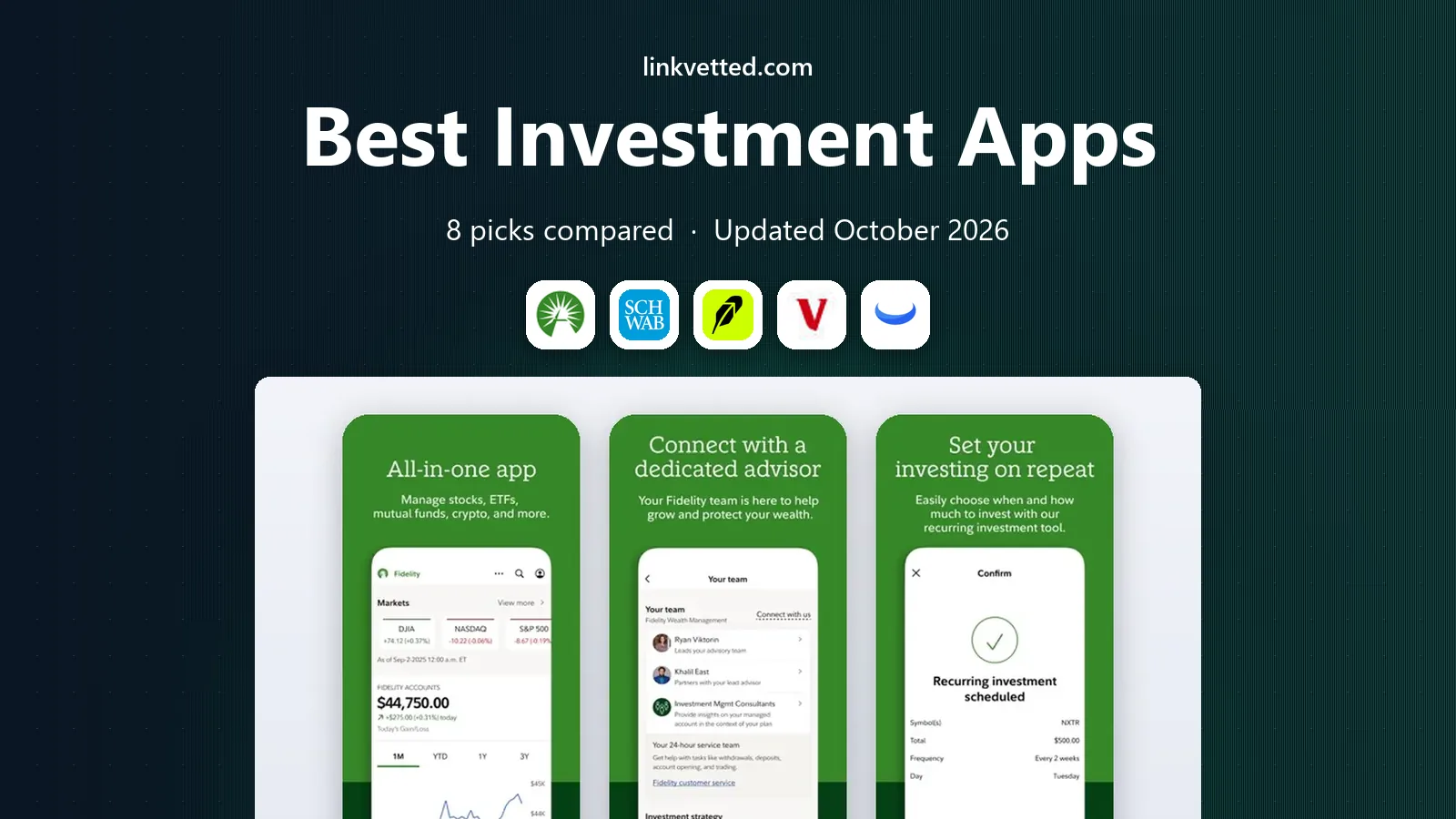
- Editor's choice
 Fidelity
All-round beginners
Starts atFreeVisit fidelity.comFull review - Great alternative
 Charles Schwab
Trading tools plus advice later
Starts atFreeVisit schwab.comFull review - Also consider
 Robinhood
Mobile-first trading
Starts atFreeVisit robinhood.comFull review
TL;DR:
- Fidelity is our pick for most beginners, because it pairs $0 stock and ETF commissions with strong research, IRAs and fractional shares.
- Robinhood suits mobile-first traders, while Schwab suits people who want strong trading tools and later access to human advice.
- Acorns and SoFi suit hands-off beginners who want small automatic investments rather than picking stocks.
- This is not financial advice, and investing carries risk, including losing money, so check fees and account terms before you invest.
Quick comparison
| Tool | Best for | Starts at | Free plan? | |
|---|---|---|---|---|
| Fidelity | All-round beginners | Free | Yes | Visit |
| Charles Schwab | Trading tools plus advice later | Free | Yes | Visit |
| Robinhood | Mobile-first trading | Free | Yes | Visit |
 Vanguard | Index fund and IRA simplicity | Free | Yes | Visit |
 Webull | Active beginners and paper trading | Free | Yes | Visit |
 SoFi Invest | Hands-off beginners | Free | Yes | Visit |
 E*TRADE | Options and active traders | Free | Yes | Visit |
 Acorns | Automatic micro-investing | See website | No | Visit |
The best investment apps
The best investment apps make it easy to start small, keep costs low and stick to a plan. They differ in research, retirement accounts, automated investing and trading tools, so the right app depends on how involved you want to be. We compared official fee pages, account features and app listings, and we focused on apps available to US investors.
This is not financial advice. Trading and investing carry risk, and you can lose money, including your original investment. Consider your goals, time horizon and risk tolerance, and talk to a qualified adviser if you need personal guidance.

Fidelity is the strongest all-round starting point for most new investors. It charges $0 commission on online US stock and ETF trades, offers fractional shares from $1, and supports IRAs, brokerage accounts and recurring investments. Its research, screeners and retirement planning tools also grow with you, so you are less likely to outgrow the app in a year.
The app can feel busy at first, because it packs a full brokerage into a phone screen. Beginners should start with the basic investing view, set up a recurring investment if that suits their plan, and explore research tools later. For long-term investors who want low costs and a wide range of accounts, Fidelity is hard to beat.
- $0 commissions on US stocks and ETFs
- Fractional shares from $1
- Strong research, IRAs and retirement tools
- App can feel dense for total beginners
- Some advanced tools take time to learn

Schwab suits beginners who want a broker that can also serve them as active traders or advice clients later. Its $0 stock and ETF commissions match Fidelity, and its thinkorswim platform gives serious charting and options tools without a separate subscription. Schwab also offers banking, retirement accounts and advisory services, which helps households that want many services in one place.
Watch the cash details. Uninvested cash in a default sweep can earn a low rate, so investors who hold large cash balances should check money market options and settlement rules. Fractional share eligibility also has limits, so check whether the stocks you want support small purchases. For a full-service broker at DIY prices, Schwab is a strong choice.
- $0 commissions on online US stocks and ETFs
- Thinkorswim trading platform included
- Access to advice and bank services as needs grow
- Fractional shares have limits on eligible stocks
- Cash sweep rates can be low on uninvested cash

Robinhood remains the easiest app to learn if you mainly trade on a phone. The interface is clean, orders are quick to place, and fractional shares, options and crypto sit alongside stocks in one account. For a beginner who wants to start with a few dollars and learn by doing, that simplicity is a genuine advantage.
The limits matter for long-term investors. Robinhood does not offer mutual funds in the same way as Fidelity or Schwab, and its research and planning tools are thinner. Its Gold subscription adds perks and an IRA match for some users, but check the terms and the holding requirements before paying for it. Robinhood is best for mobile-first traders, not for investors who want a full retirement planning suite.
- Very simple mobile app
- $0 commissions on stocks and ETFs
- Fractional shares, options and crypto in one app
- Limited mutual fund access
- Research and retirement tools are thinner than Fidelity or Schwab
Vanguard suits investors who want to keep things simple and low cost. Its index funds and ETFs have long appealed to long-term investors, and its IRA setup is straightforward for retirement savers who do not want to trade often. If your plan is regular contributions to a diversified fund, Vanguard gives you that with very little distraction.
Active traders will find the tools basic, and the app feels less polished than Fidelity or Robinhood. Vanguard is not trying to win on trading features, and that is fine for its audience. Choose Vanguard when low-cost index investing and retirement simplicity matter more than charts, options or crypto.
- Low-cost index funds and ETFs
- Simple IRA setup
- Long focus on long-term, low-cost investing
- Trading tools are basic
- App feels less modern than rivals
Webull is the best free pick for beginners who want to learn active trading without risking money first. Its paper trading mode lets you practise with virtual funds, while its charts, screeners and market data go deeper than most free apps. Stock, ETF and options commissions are $0 on eligible trades, which keeps practice and early trading affordable.
The app can overwhelm a total beginner, because it shows a great deal of market data at once. Retirement planning and advisory services are also thinner than Fidelity or Schwab. Webull suits learners who want to study charts and practise trading, and who will use a second app or adviser for long-term retirement planning if needed.
- $0 commissions on stocks, ETFs and options
- Free paper trading to practise
- Strong charts and market data for a free app
- Retirement and advice tools are thinner
- Interface can overwhelm new investors
SoFi Invest suits beginners who want investing alongside banking without juggling many apps. It offers $0 stock and ETF commissions, automated investing for people who prefer a managed portfolio, and fractional investing from small amounts. For a household that already uses SoFi for banking or loans, keeping investing in the same app reduces friction.
Research and advanced trading tools are basic compared with Fidelity, Schwab or Webull. Automated portfolios also work best for straightforward goals, such as long-term growth, rather than complex tax or estate needs. SoFi is a good pick for hands-off beginners who want a simple, low-cost start.
- $0 commissions on stocks and ETFs
- Automated investing portfolios available
- Banking, loans and investing in one app
- Research tools are basic
- Automated portfolios suit simple goals best
ETRADE, part of Morgan Stanley, suits investors who want to grow from basic stock investing into options and active trading. Its Power ETRADE platform offers charting, options chains and education that go beyond a simple mobile app, while its retirement accounts and managed portfolios cover longer-term needs as well.
Options traders should check contract fees, which apply on most trades even though stock and ETF commissions are $0. Beginners may also find the full platform complex at first, so start with the basic app view. E*TRADE is best for active learners who want strong tools and a large firm behind the account.
- $0 commissions on online US stocks and ETFs
- Strong options tools and education
- Retirement accounts and managed portfolios available
- Options contract fees apply on most trades
- Platform can feel complex for beginners
Acorns takes a different approach from the brokers above. Instead of asking you to pick stocks, it rounds up everyday purchases and invests the spare change, alongside recurring investments you set. That habit-building design helps people who struggle to save a lump sum, and its portfolios are diversified rather than concentrated in single stocks.
The monthly subscription is the catch. For very small balances, a flat monthly fee can eat a noticeable share of returns, so check the plan price against your balance and contribution rate. Acorns is best as a starter habit for new savers, and many users later move to a $0-commission broker once their balance grows.
- Automatic round-ups and recurring investments
- Simple diversified portfolios
- Good habit builder for new savers
- Monthly subscription fee
- Limited control over individual stocks
How we picked these
We compared official fee schedules, account types and app features for US brokers and investing apps, and we kept only apps that are available now with clear $0 stock and ETF commission terms or a clear subscription price. We favoured apps with fractional shares, IRAs and recurring investments, because those features matter most to beginners. We also included hands-off options such as Acorns and SoFi automated investing, because not every beginner wants to pick stocks.
How to choose an investing app
Decide how involved you want to be
Stock pickers need research, charts and low trading costs, while hands-off investors need automated portfolios and recurring investments. Fidelity and Schwab cover both styles, while Acorns and SoFi automated investing suit hands-off savers, and Webull and E*TRADE suit active learners.
Check the costs beyond commission
$0 commission does not mean $0 cost. Check options contract fees, account transfer fees, cash sweep rates and subscription fees, and read the fee schedule before you fund an account. A small fee on a small balance matters more than it looks, especially in the first year.
Start with an account type, not a stock
Decide first whether you need a taxable brokerage account, a Roth IRA, a traditional IRA or a managed portfolio, then pick the app that handles that account well. A good account structure and a steady contribution plan matter more than any single stock pick for most beginners.
FAQ
What is the best investment app for beginners?
Fidelity is our pick for most beginners, because it combines $0 stock and ETF commissions, fractional shares, IRAs and strong research. Schwab is a close alternative, while SoFi and Acorns suit hands-off beginners who prefer automation.
What is the best stock app for beginners?
Robinhood is the simplest mobile stock app, while Fidelity and Schwab give beginners more research, retirement accounts and long-term tools. Webull suits beginners who want paper trading and deeper charts before risking real money.
Are investment apps free?
Many brokers charge $0 commission on online US stock and ETF trades, but other fees can still apply, including options contract fees, transfer fees and subscription fees for premium tiers. Read the fee schedule for the app you choose.
What is the best investing app for small amounts?
Fidelity, Schwab, Robinhood, SoFi and Webull support fractional shares or small starting amounts, which lets you start with a few dollars. Acorns also suits small savers through round-ups, though it charges a monthly subscription, so compare that fee with your balance.
Is investing through an app safe?
Brokerage accounts at established US firms are typically covered by SIPC protection up to set limits for missing securities, but that protection does not cover market losses. Investing always carries risk, so only invest money you can afford to leave invested for your time horizon.