Best Inventory Optimization Software in 2026: 8 Tools Compared
We compared the best inventory optimization software for forecasting, replenishment, and stock levels, so you can cut stockouts without tying up cash.
- Editor's choice
 Netstock
ERP-driven mid-market planning
Starts at$900 per monthVisit netstock.comFull review - Great alternative
 StockTrim
SMBs needing AI forecasting
Starts at$199 per monthVisit stocktrim.comFull review - Also consider
 Prediko
Shopify brands starting with forecasting
Starts at$49 per monthVisit prediko.ioFull review
TL;DR:
- Netstock suits mid-market firms on an ERP, while StockTrim and Prediko suit smaller sellers with clearer pricing.
- RELEX, ToolsGroup, and Slimstock suit large networks where optimisation across sites matters more than a simple reorder point.
- Pricing ranges from $49 per month for Shopify tools to quote-only enterprise contracts, so count SKUs and locations first.
- The best tool is the one that reads your sales and ERP data cleanly, since a forecast is only as good as its inputs.
- Watch for annual commitments and activation fees, which can lift the first-year cost above the headline monthly rate.
Quick comparison
| Tool | Best for | Starts at | Free plan? | |
|---|---|---|---|---|
| Netstock | ERP-driven mid-market planning | $900 per month | No | Visit |
| StockTrim | SMBs needing AI forecasting | $199 per month | Free trial | Visit |
| Prediko | Shopify brands starting with forecasting | $49 per month | Free trial | Visit |
 Slimstock Slim4 | Demand sensing across channels | See website | No | Visit |
 RELEX Solutions | Enterprise retail network optimisation | See website | No | Visit |
 ToolsGroup | Service-driven supply planning | See website | No | Visit |
 Lokad | Programmable forecasting for data teams | See website | No | Visit |
 Inventory Planner by Sage | Multi-channel sellers on major platforms | See website | Free trial | Visit |
The best inventory optimization software
We compared vendor pages, pricing disclosures, and public reviews to find tools that optimise stock, not just track it. The list covers small sellers, mid-market distributors, and enterprise retailers, so start with your sales system and SKU count.
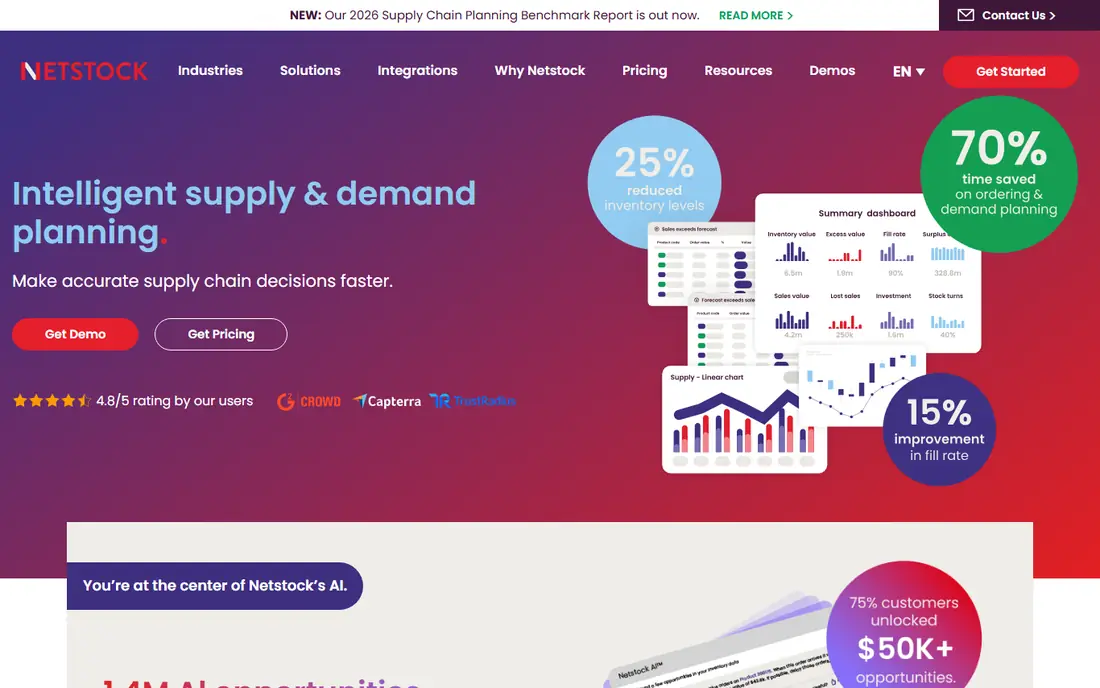
Netstock is the established choice for mid-market companies that already run on an ERP such as NetSuite, Sage, or Acumatica. It layers demand forecasting, order planning, and supplier performance tracking on top of ERP data, then adds dashboards that help planners manage by exception instead of checking every SKU by hand. Multi-location inventory, transfer orders, and constrained supply scenarios suit wholesalers and manufacturers with thousands of SKUs.
The official pricing FAQ puts the starting point at $900 per month, which places Netstock clearly above small seller apps, and there is no free trial. Setup also takes effort, since clean ERP data and correct lead times decide forecast quality. For an ERP-driven mid-market firm moving off spreadsheets, Netstock offers formal planning depth that store add-ons cannot match.
- Strong ERP integrations
- Demand forecasting plus order planning
- Supplier performance tracking
- High entry price
- Annual commitment
- No free trial
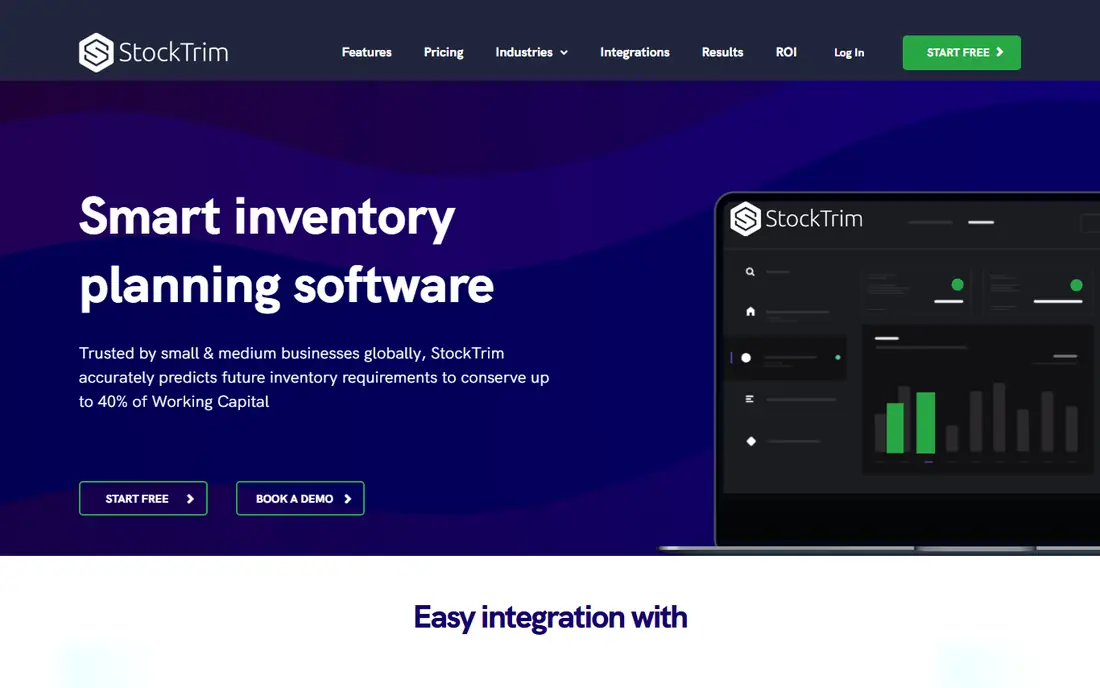
StockTrim sits in a sensible middle ground for small and mid-size firms in wholesale, manufacturing, retail, and ecommerce. It offers AI forecasting, order planning, new-product forecasting, manufacturing support, and multi-location handling, which covers more than a basic store app without enterprise complexity. Tier pricing at $199, $299, and $399 per month, with enterprise custom, makes budgeting straightforward.
The cost climbs as tiers rise, and public pages do not publish a numeric forecasting accuracy figure, so buyers should test accuracy on their own sales history during a trial. For a growing SMB that needs more than a spreadsheet but cannot justify Netstock, StockTrim is a strong practical pick.
- AI forecasting plus order planning
- Manufacturing and multi-location support
- Clear tier pricing
- Monthly cost climbs with tiers
- No published accuracy figure
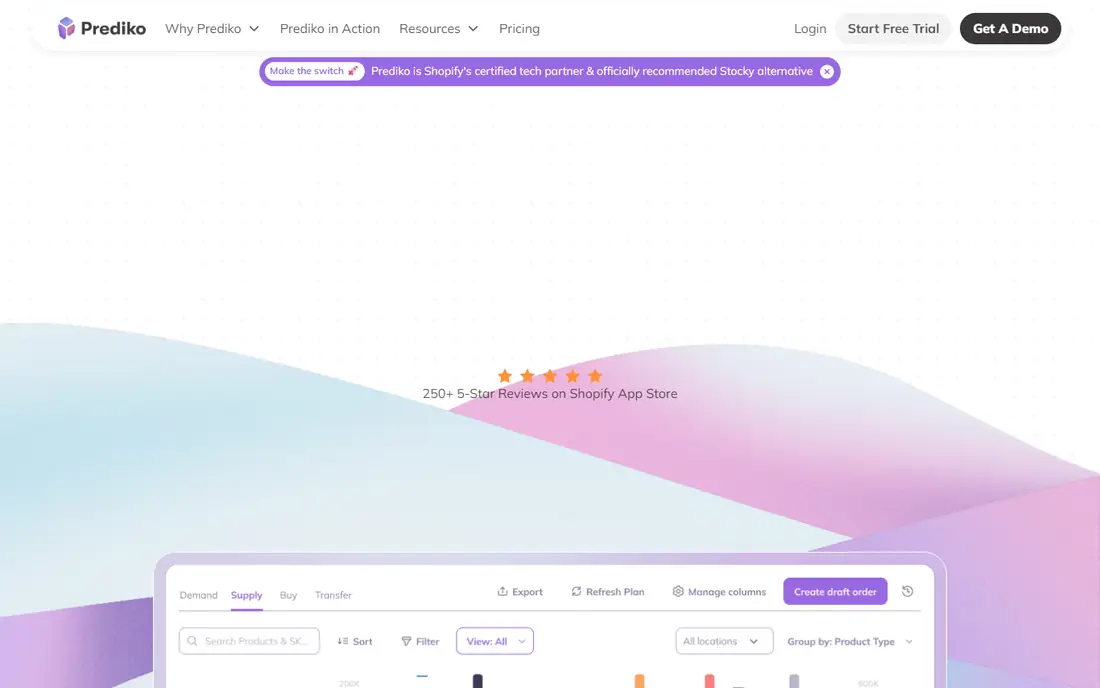
Prediko suits Shopify brands that are starting with forecasting and want a tool that reads the store directly. It forecasts demand, suggests purchase orders, and tracks inventory health without forcing a team to learn enterprise planning. The entry price near $49 per month and a free trial make it easy to test on real store data before committing.
The limits are scope and channel. Prediko is built for Shopify, so firms that sell mainly through an ERP or wholesale channels will find it narrow. Complex distribution networks with many warehouses and transfer rules need a tool such as Netstock or RELEX. For a Shopify brand moving from spreadsheets to its first forecast, Prediko is the value pick.
- Lowest entry price here
- Built for Shopify
- Easy purchase order flow
- Best for Shopify only
- Less depth for complex distribution networks
Slimstock Slim4 is a long-standing choice for distributors and retailers that need demand sensing across channels. It forecasts demand, sets stock policies, and plans replenishment for large assortments, with links to ERP and ecommerce systems. Firms with seasonal demand, promotions, and supplier lead time variation benefit from its planning depth, which goes beyond a simple reorder point.
Pricing is quote-only, and implementation needs planning, since assortment, lead times, and service targets must be set correctly. Small firms may find Slim4 more than they need. Mid-market and large distributors that want proven planning across channels should shortlist Slimstock alongside Netstock.
- Strong demand sensing
- Broad ERP and ecommerce links
- Proven in distribution
- Quote-only pricing
- Implementation needs planning
RELEX Solutions suits large retailers, wholesalers, and manufacturers whose problem is not just what to reorder, but how to optimise stock across an entire network. Its AI-native planning covers forecasting, replenishment, allocation, and promotion planning at scale, with experience in grocery and retail where freshness, space, and service levels interact. That network view is what separates RELEX from smaller forecasting apps.
Public pricing is unavailable, and the product is clearly aimed at larger, more complex organisations, so small firms should not start here. Implementation is a programme, not a setup wizard. For a large retailer with many stores, warehouses, and suppliers, RELEX is one of the strongest names in this category.
- AI-native network optimisation
- Strong retail and grocery experience
- End-to-end planning
- Quote-only enterprise pricing
- Aimed at large organisations
ToolsGroup helps firms plan inventory around service levels, so they hold the right stock to meet customer promises without overstocking slow movers. It suits distribution, manufacturing, and spare parts businesses where stockouts carry high costs and assortments run large. Automation features, including API-triggered planning runs, help planners keep forecasts current without manual reruns.
Pricing is quote-only, and the platform is built around planning workflows rather than user-built models, so firms that want fully custom model logic may prefer a tool such as Anaplan or Lokad. For a service-driven supply operation that wants proven planning depth, ToolsGroup deserves a demo.
- Service-level driven planning
- Strong for spare parts and distribution
- Automation features
- Quote-only pricing
- Core logic stays centred on planning workflows
Lokad suits data teams that want forecasting logic they can programme, rather than a fixed optimisation screen. Teams can encode custom rules, test scenarios, and tailor forecasts to unusual demand patterns, promotions, and supply constraints. That flexibility helps firms with complex assortments or unusual business rules that standard tools handle poorly.
The trade-off is skill. Lokad needs technical ability to write and maintain forecasting logic, and pricing is quote-based, so non-technical teams may find it heavy. For a firm with data talent and a planning problem that does not fit a standard tool, Lokad offers control that rivals cannot match.
- Programmable forecasting logic
- Suits data-savvy teams
- Handles complex rules
- Quote-based pricing
- Needs technical skill to get full value
Inventory Planner by Sage
Best for: Multi-channel sellers on major platforms
Inventory Planner by Sage suits multi-channel sellers that sell through Shopify, Amazon, and other major platforms and want forecasting plus replenishment in one tool. It reads sales across channels, forecasts demand, and suggests purchase orders, which helps sellers who otherwise juggle spreadsheets per channel. The Sage link adds value for firms already using Sage accounting or ERP tools.
Pricing is not published as a simple starting rate, so budgeting needs a quote or a trial conversation, and the tool fits best on its supported platforms. Sellers on a single small store may find Prediko cheaper. Multi-channel sellers that want one planning view across stores should test Inventory Planner with real channel data.
- Strong multi-channel links
- Forecasting plus replenishment
- Sage ecosystem fit
- No published starting price
- Best for firms on supported platforms
How we picked these
We compared vendor pages, pricing disclosures, and public reviews, and we checked that each homepage belongs to the product named. We favoured tools that optimise stock levels, not just record them, and that cover a clear buyer type from Shopify seller to enterprise retailer. We gave weight to published pricing where available, since quote-only tools make budgeting hard.
We did not claim hands-on testing that did not happen. Instead, we weighed ERP and channel integrations, forecasting approach, replenishment features, SKU and location handling, and implementation effort. That keeps the list useful for a small brand and a large distributor alike, even though their budgets differ sharply.
What to check before you buy
Count SKUs, locations, and channels before you talk to any vendor. A tool priced for 500 SKUs on one store will cost far more for 50,000 SKUs across ten warehouses, and a tool built for Shopify will not fit an ERP-driven distributor. Your counts decide the shortlist more than any feature list.
Test forecasts on your own history
Ask for a trial that uses your sales history, lead times, and promotions. Check forecast accuracy on your top SKUs and on seasonal items, not just on average. A tool that looks good on sample data can still miss your peak season, and a pilot finds that before you pay.
Check data quality first
Forecasts fail on dirty data. Clean up duplicate SKUs, missing lead times, and one-off demand spikes before implementation, and ask the vendor how it handles promotions and outliers. A tool that cannot edit or flag spikes will bake bad history into future orders.
Price the full first year
Add activation fees, annual commitments, implementation, and training to the monthly rate. Some tools charge by inventory value or SKU count, so model cost at higher volume. A $49 tool that needs a $900 upgrade at your SKU count is not a $49 tool for you.
FAQ
What is inventory optimization software?
Inventory optimization software forecasts demand, sets stock policies, and plans replenishment so firms hold enough stock to meet service targets without tying up excess cash. It goes beyond inventory tracking by suggesting what to order, when, and how much. Good tools handle seasonality, lead times, promotions, and multi-location stock.
How much does inventory optimization software cost?
Entry prices here range from $49 per month for Shopify tools and $199 per month for SMB planning tools to $900 per month for Netstock and quote-only enterprise contracts for RELEX, Slimstock, and ToolsGroup. SKU count, locations, and channels drive the final price, so get a quote on your real counts.
What is the difference between forecasting and optimization?
Forecasting predicts future demand for each SKU. Optimization turns that forecast into stock decisions, such as reorder points, safety stock, and order quantities, across locations and service targets. A forecasting app tells you what might sell, while an optimization tool tells you what to hold and order.
Do I need inventory optimization if I use an ERP?
An ERP tracks stock and orders, but it rarely forecasts demand or optimises policies as deeply as a dedicated tool. Mid-market firms on NetSuite, Sage, or Acumatica often add Netstock or Slimstock on top of the ERP. Small sellers on Shopify often use Prediko or Inventory Planner instead.
How long does implementation take?
Small seller tools can go live in days or weeks. Mid-market ERP tools take weeks to a few months, depending on data quality and integrations. Enterprise network tools take months, including planning design, data work, and training. Clean data shortens every timeline.
Can small businesses afford inventory optimization?
Yes. Prediko starts near $49 per month for Shopify brands, StockTrim starts near $199 per month for SMBs, and LabCollector-style tracking tools cost less if you only need records. Start with a tool that fits your SKU count, and upgrade only when stock complexity grows.