Best Influencer Management Platforms in 2026: 8 Tools Compared
Compare the best influencer management platforms for discovery, campaigns, payments, and reporting in 2026, with current pricing and trials before you buy.

- Editor's choice
 GRIN
Ecommerce creator programs
Starts atSee websiteVisit grin.coFull review - Great alternative
 CreatorIQ
Enterprise creator programs
Starts atSee websiteVisit creatoriq.comFull review - Also consider
 Aspire
Campaign workflows and UGC
Starts atSee websiteVisit aspire.ioFull review
TL;DR:
- GRIN is our pick for ecommerce brands that need creator management tied to Shopify and product seeding.
- CreatorIQ suits large enterprise programs with strict reporting and compliance needs.
- Modash is the clearest self-serve option for creator research and vetting, with published starting prices.
- Most enterprise platforms do not publish prices, so expect a demo, an annual contract, and a custom quote.
- Check creator experience as well as brand features, since a hard onboarding process will slow every campaign.
Quick comparison
| Tool | Best for | Starts at | Free plan? | |
|---|---|---|---|---|
| GRIN | Ecommerce creator programs | See website | Free trial | Visit |
| CreatorIQ | Enterprise creator programs | See website | No | Visit |
| Aspire | Campaign workflows and UGC | See website | No | Visit |
 Upfluence | Creator discovery and sales tracking | See website | Free trial | Visit |
 Modash | Creator research and vetting | $199 per month | Free trial | Visit |
 Traackr | Beauty and fashion programs | See website | No | Visit |
 Klear | Audience analysis and discovery | See website | No | Visit |
 Shopify Collabs | Shopify affiliate creators | Free | Yes | Visit |
The best influencer management platforms
These platforms help brands find creators, run campaigns, manage content, pay creators, and report results. We compared official feature pages, pricing pages, and public reviews.
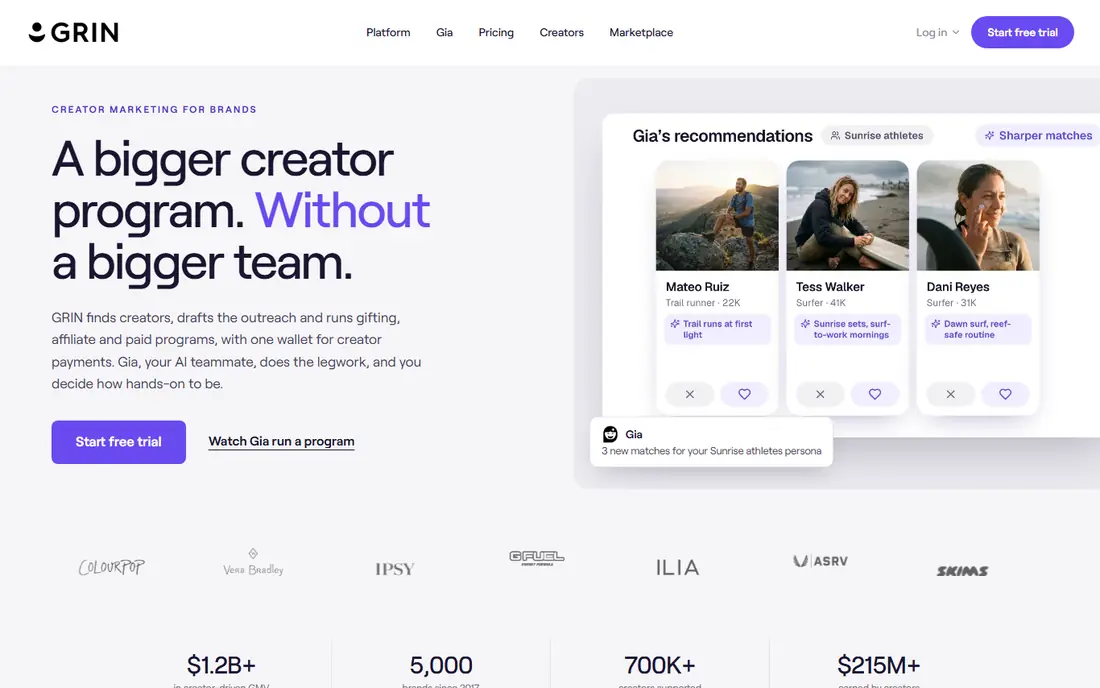
GRIN is our pick for direct-to-consumer brands because it treats creators like a customer relationship system, not just a list. You can discover creators, send products, track content, manage contracts, and pay creators in one place, with Shopify data tied to sales where available. That link between seeding and sales helps brands see which creators drive orders, not just likes.
The main drawback is pricing opacity. Recent third-party listings show a range of starting prices, but the vendor site requires a demo for a quote. That makes budgeting slower for small brands. If you run an ecommerce store with regular creator seeding, the workflow savings are still worth a demo.
- Strong Shopify integration
- Product seeding and gifting workflows
- Creator CRM with campaign and payment tools
- Pricing is not published on the main site
- Best suited to ecommerce brands, not all agencies
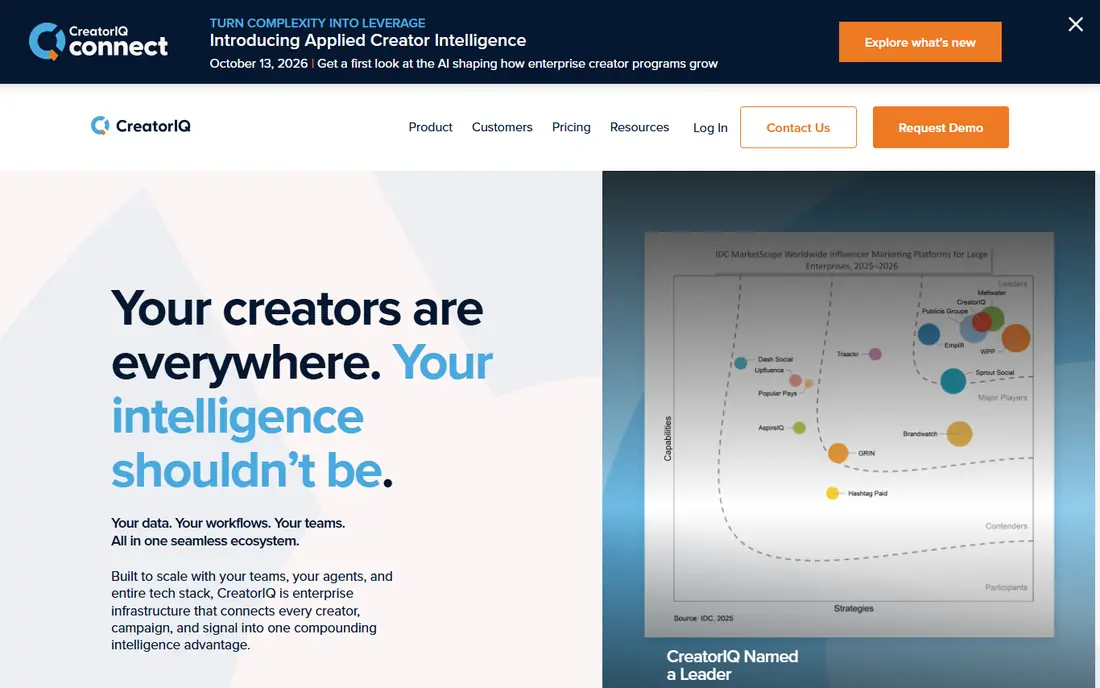
CreatorIQ suits large brands and agencies with many creators, many markets, and strict reporting needs. Its analytics cover reach, engagement, and sales signals, and its workflow tools handle approvals, contracts, and payments at scale. Compliance features, including content rights and disclosure checks, matter when a brand runs regulated campaigns.
Small teams should be realistic. CreatorIQ is priced as an enterprise platform, with annual contracts reported in the tens of thousands of dollars per year. If you run fewer than 50 active creator relationships, a lighter tool will likely serve you better.
- Deep analytics and reporting
- Compliance and content rights tools
- Large creator database
- Enterprise pricing and annual contracts
- Too heavy for small programs
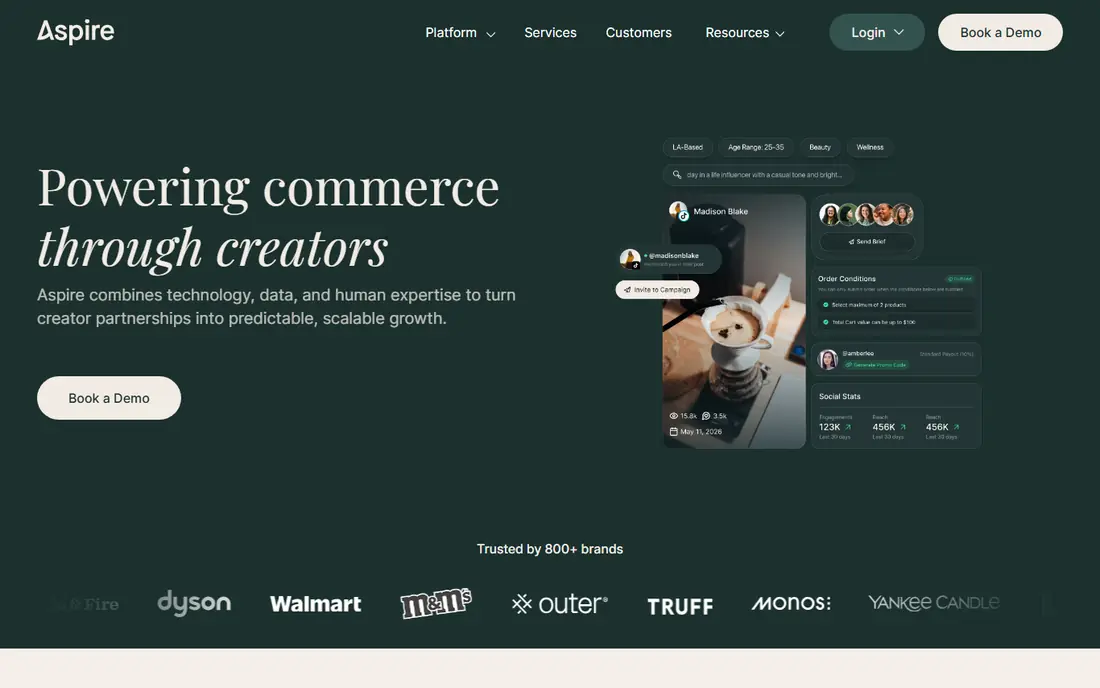
Aspire, formerly AspireIQ, is built around campaign workflows and user-generated content. Brands can find creators in its marketplace, brief them, collect content, and track performance, with tools for product seeding and payments. That workflow focus helps teams that run many campaigns a year and need repeatable steps.
Pricing is not published, and the platform is best judged in a demo with a real campaign brief. Ask about content rights, whitelisting for paid ads, and payment fees, since those details change the total cost. For UGC-heavy brands, Aspire is a strong shortlist name.
- Marketplace for creator discovery
- Automated campaign workflows
- ROI and content tracking
- Pricing requires a sales call
- Some features need higher tiers
Upfluence combines discovery, outreach, campaign management, and sales tracking. Its database helps brands find creators by audience, niche, and engagement, and its ecommerce integrations link creator posts to sales. That sales link is useful for brands that judge creators on revenue, not just reach.
The pricing path is less clear than Modash. The vendor site requires a demo for a quote, and many buyers report annual contracts. Small brands should confirm the total cost, including seats and modules, before signing. For mid-size ecommerce brands, the discovery depth is a real strength.
- Large creator database
- Shopify and WooCommerce integrations
- Affiliate and sales tracking
- Pricing is quote-based after a demo
- Contract terms reported as annual in many cases
Modash is the clearest self-serve option on this list. You can sign up, search a large creator database, check audience quality, and vet creators before outreach, with plans starting at $199 per month and a 14-day trial in recent listings. That transparency makes it easy for agencies and brands to test it without a sales process.
Modash is stronger on research than on full campaign management. If you need deep payment, gifting, and content approval workflows, pair it with another tool or pick GRIN or Aspire. For teams whose main bottleneck is finding the right creators and checking for fake followers, Modash is the best starting point.
- Published starting price
- Very large creator database
- Strong vetting and audience data
- Campaign workflow tools are lighter than GRIN or Aspire
- Best as a research tool first
Traackr is often chosen by beauty, fashion, and lifestyle brands that need global creator data and clear visual reports. Its tools cover discovery, campaign management, and performance reporting, with an emphasis on brand safety and audience quality. For a brand with creators in several countries, that global view matters.
Pricing is by quote, and the platform is less tied to Shopify sales data than GRIN or Upfluence. If your main goal is brand awareness and content quality, Traackr fits. If your main goal is direct sales tracking, compare it against GRIN first.
- Strong visual reporting
- Global creator data
- Good fit for beauty and fashion brands
- Quote-only pricing
- Less ecommerce depth than GRIN
Klear, now part of Meltwater, suits brands that start with research. Its database and audience analysis help you find niche creators, check demographics, and watch competitors. Social listening adds context on what audiences discuss, which can shape briefs and product choices.
Klear is not the deepest campaign CRM on this list. Teams that need heavy gifting, payment, and approval workflows may need another tool alongside it. For discovery and vetting, especially in a niche, it remains a solid option.
- Large creator database
- Audience and competitor analysis
- Social listening tools
- Pricing requires a quote
- Campaign workflow is lighter than full CRM platforms
Shopify Collabs is the best free starting point for a Shopify store. Merchants can invite creators, give them affiliate links and discount codes, and track sales tied to those links, all inside Shopify. There is no extra monthly fee for the basic tool, which makes it ideal for a store testing creator partnerships for the first time.
The limits are clear. Discovery is smaller than a paid database, and reporting is simpler than CreatorIQ or GRIN. Use Collabs to prove that creator sales work for your store, then move to a paid platform when campaign volume grows.
- Free for Shopify merchants
- Creator affiliate links and discount codes
- Simple setup inside Shopify
- Only for Shopify stores
- Discovery and reporting are lighter than paid platforms
How we picked these
We compared official feature pages, pricing pages, and public reviews for platforms that manage influencer relationships, not just schedule social posts. We kept only tools that cover discovery, campaign work, or creator payments in a meaningful way, and that are still offered in 2026. We mixed enterprise platforms, self-serve tools, and a free Shopify option so different budgets are covered.
What to check before you choose
Start with your bottleneck. If finding creators is the problem, pick a discovery-strong tool such as Modash or Klear. If managing seeding, content, and payments is the problem, pick a workflow-strong tool such as GRIN or Aspire. If reporting to leadership is the problem, pick an analytics-strong tool such as CreatorIQ or Traackr. Buying the biggest platform for a small problem wastes money and time.
Next, check the contract. Many enterprise platforms require annual deals with notice periods for cancellation, and per-seat or overage fees can add up. Run a real campaign during any trial, test creator onboarding, and check content rights and whitelisting. Also confirm how creators are paid, what fees apply, and how disclosures are handled. A platform that creators find hard to use will slow every campaign, no matter how good the brand dashboard looks.
FAQ
What are the best influencer management tools for small brands?
Modash and Shopify Collabs are the best low-cost starts. Modash offers discovery and vetting from $199 per month, while Shopify Collabs is free for Shopify merchants. Larger brands may need GRIN or Aspire for full workflows.
What is the best influencer management software for ecommerce?
GRIN is the strongest ecommerce pick because of its Shopify integration, seeding workflows, and creator CRM. Upfluence is another strong ecommerce option with sales tracking. Shopify Collabs works well as a free first step before a paid platform.
How much do influencer management platforms cost?
Prices range from free for Shopify Collabs to $199 per month for Modash, up to enterprise quotes that can reach tens of thousands of dollars per year for CreatorIQ. Most enterprise platforms do not publish prices, so get a written quote that covers seats, modules, and contract length.
Do I need a platform if I work with few creators?
No. If you run fewer than five campaigns a year with under ten creators, spreadsheets and direct messages can work. A platform pays off when creator counts, campaigns, or reporting needs grow beyond what manual tracking handles well.
What features matter most in an influencer platform?
Creator discovery with fraud checks, campaign workflows, content approvals, payment automation, and content rights management matter most. Prioritise the feature that solves your current bottleneck, and test it with a real campaign before signing an annual contract.