Best HRIS for Globally Distributed Companies in 2026: 8 Platforms Compared
We compared 8 platforms for best hris for globally distributed companies, covering payroll, employer of record services, compliance, and pricing worldwide.
- Editor's choice
 Deel
Hiring employees and contractors worldwide
Starts atSee websiteVisit deel.comFull review - Great alternative
 Remote
Compliance-first global employment
Starts atSee websiteVisit remote.comFull review - Also consider
 Rippling
Unified HR, IT, and payroll
Starts atSee websiteVisit rippling.comFull review
TL;DR:
- Deel and Remote lead for hiring employees abroad without setting up local entities, while Rippling suits teams that want HR, IT, and payroll in one place.
- Employer of record pricing is usually quoted per employee per month, and it sits on top of salary, local taxes, and benefits, so get a full loaded-cost quote.
- Papaya Global and G-P fit larger, finance-led teams with many countries, while Oyster and HiBob fit smaller distributed teams that want simpler core HR.
- Country coverage, contractor support, data protection, and payroll accuracy matter more than a long feature list when teams work across time zones.
- Always check which countries are served through owned entities and which rely on local partners, because that affects speed, control, and support.
Quick comparison
| Tool | Best for | Starts at | Free plan? | |
|---|---|---|---|---|
| Deel | Hiring employees and contractors worldwide | See website | No | Visit |
| Remote | Compliance-first global employment | See website | No | Visit |
| Rippling | Unified HR, IT, and payroll | See website | No | Visit |
 Papaya Global | Finance-led global payroll | See website | No | Visit |
 Oyster | Smaller distributed teams | See website | No | Visit |
 HiBob | Modern core HR for growing teams | See website | No | Visit |
 Workday | Large enterprise HR | See website | No | Visit |
 G-P | Enterprise employer of record | See website | No | Visit |
The best HRIS for globally distributed companies
We compared official product pages, pricing pages, and public coverage claims for platforms that handle hiring, payroll, and compliance across borders. The list below starts with the broadest global hiring platforms and moves toward core HR and enterprise options.
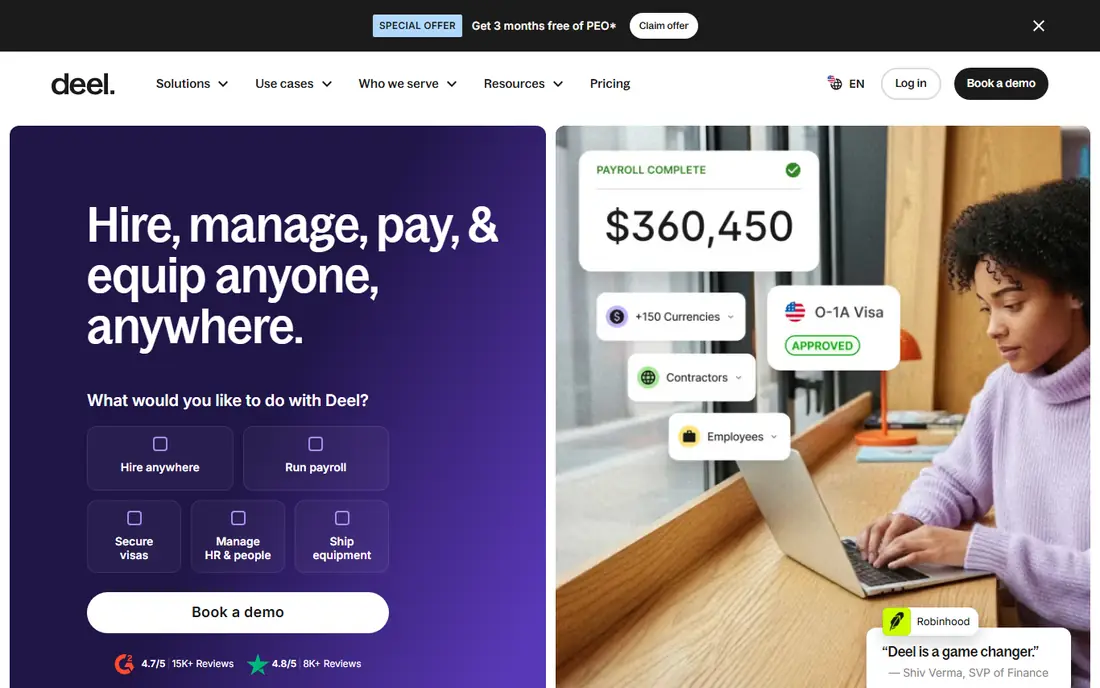
Deel is our pick for most companies that need to hire in several countries quickly. It offers employer of record services, contractor management, and global payroll, so a team can bring on a full-time employee in one country and a contractor in another without switching systems. That breadth matters when hiring plans change from month to month.
The trade-off is cost and complexity. Employer of record pricing is per employee per month, and local employer costs sit on top of it, so finance teams should model the full cost before approving a hire. Deel still makes sense when speed and coverage matter more than building a local entity for a handful of roles.
- Wide country coverage
- Employer of record and contractor tools in one platform
- Payroll and HR tools sit beside hiring
- Employer of record fees add up fast at scale
- Pricing varies by country and plan
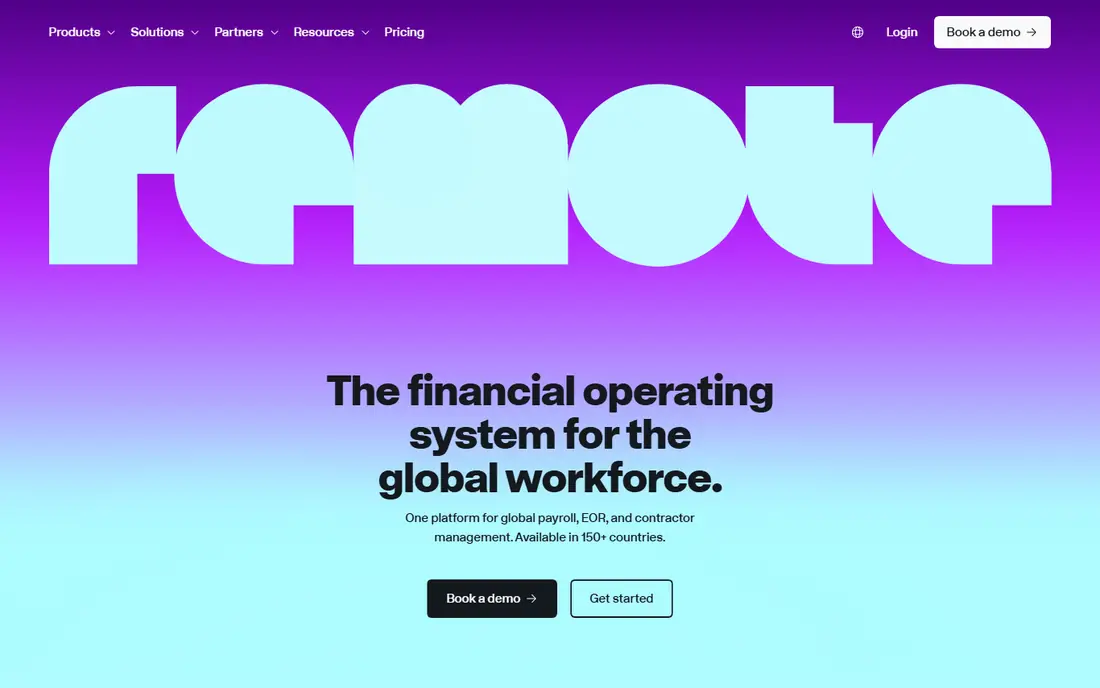
Remote appeals to teams that want a direct employment relationship rather than a chain of local partners. Its owned-entity approach can make compliance, data handling, and payroll timing easier to explain to legal and finance teams. Contractor management is also built in, which helps teams that mix employees and freelancers.
The main drawback is price. Like other employer of record providers, Remote charges per employee per month, and that fee grows with headcount. It is best for companies that value control and clean compliance over the lowest possible fee.
- Owned-entity model in many markets
- Clear public pricing for core plans
- Contractor and payroll tools included
- Employer of record fees are high for large teams
- Some services cost extra
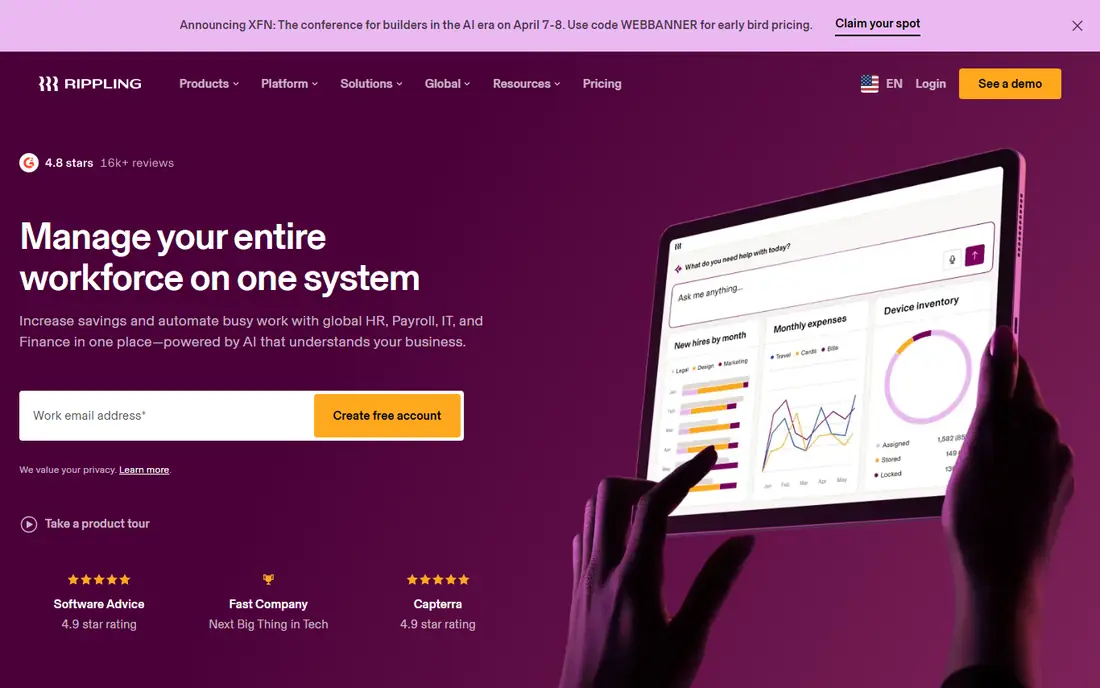
Rippling is different from a pure employer of record provider because it starts as a full HR and IT platform. When a new hire joins, the same system can handle payroll, device access, apps, and benefits, which cuts down on manual work for small people teams. That joined-up approach is a real advantage for US-based companies that are adding international staff gradually.
The catch is that global coverage is not uniform. Some countries are served through native payroll, while others need partners or an employer of record layer, so buyers should check each planned location in detail. Pricing also needs a demo or quote, which makes early budgeting harder than with providers that publish a flat rate.
- HR, IT, payroll, and benefits in one system
- Strong automation for onboarding and offboarding
- Global payroll add-ons
- Pricing is quote-based for many plans
- Global payroll depth varies by country
Papaya Global suits companies where finance, not just HR, owns the global payroll process. Its platform brings payroll, payments, and reporting together, which helps teams that need audit trails and consistent data across entities. That focus makes it a strong fit for mid-size and large companies with established payroll cycles.
Smaller teams may find it more formal than they need. Pricing is quote-based, and implementation can take more planning than a self-serve HR tool. If your main need is a simple directory and time-off tracker for a small remote team, a lighter core HR platform will be easier to run.
- Payroll across many countries
- Payment and reporting tools for finance teams
- Employer of record options
- Quote-based pricing
- Setup can be heavier than simpler tools
Oyster was built for distributed teams, and that shows in how it presents hiring, benefits, and compliance. It helps companies hire full-time staff abroad without opening an entity, and it supports contractors as well. For a startup or scale-up hiring its first roles in new countries, that clarity is helpful.
Larger companies with complex time, attendance, and workforce planning needs may outgrow it or pair it with another HR system. As with other employer of record options, buyers should confirm coverage and benefits for each specific country before making an offer.
- Employer of record hiring in many countries
- Contractor support
- Tools built for distributed work
- Less depth for large enterprise HR needs
- Pricing varies by country
HiBob is a good core HRIS for companies that already have entities or employer of record partners and need a strong system of record. It handles people profiles, org structure, time off, onboarding, and performance in a way that managers actually use. Integrations can connect it to payroll providers, which keeps data in sync without forcing every country onto one payroll engine.
It is not, on its own, a full global payroll provider in every market. Teams that need native payroll everywhere should pair it with a payroll partner or choose a payroll-first platform instead. That split can work well, but buyers should plan who owns payroll accuracy and local compliance.
- Clear people data, time off, and performance tools
- Modern interface
- Payroll integrations for several markets
- Global payroll is partner-based in many countries
- Pricing is quote-based
Workday is the enterprise option on this list. It combines human capital management, payroll, and finance in one suite, with reporting that suits large, multi-entity employers. Companies that already run Workday for finance often find it natural to extend it to global HR, since data stays in one system.
The cost and implementation time put it out of reach for most small distributed teams. It needs internal resources or a partner to configure, roll out, and maintain. For a company with hundreds or thousands of staff across many countries, though, that investment can pay off in consistency and control.
- Deep HR, payroll, and finance capabilities
- Strong reporting
- Suited to very large workforces
- Enterprise pricing and implementation effort
- Too heavy for small teams
G-P, formerly Globalization Partners, focuses on employer of record services for companies that need to hire abroad without local entities. Its coverage and compliance support suit enterprises and growing companies entering new markets at scale. Contractor management is also available, which helps teams with mixed workforces.
Small teams hiring one or two people abroad may find simpler providers faster to start with, and pricing will require a quote. For larger programs with many countries, legal review, and strict compliance needs, G-P is worth a shortlist place alongside Deel, Remote, and Papaya Global.
- Employer of record coverage in many countries
- Contractor support
- Enterprise-grade compliance tools
- Quote-based pricing
- Better suited to larger deals than single hires
How we picked these
We compared official feature pages, pricing pages, country coverage claims, and public product documentation for platforms that serve distributed teams. We favored platforms that exist and operate in October 2026, cover multiple countries, and handle at least two of hiring, payroll, compliance, and core HR. We left out US-only payroll tools, because they do not fit a globally distributed brief, and we did not claim hands-on testing.
What to check before you sign
Start with your hiring map, not a feature checklist. List the countries where you will hire in the next year, whether each role is an employee or a contractor, and whether you already have a local entity. Then ask each vendor which of those countries it serves directly, which it serves through partners, and what happens to payroll timing, benefits, and data if a partner changes.
Next, get a loaded-cost quote for a real role in a real country. Ask for the platform fee, employer taxes and contributions, statutory benefits, setup fees, foreign exchange charges, and off-cycle payroll costs in writing. Compare that total, not just the headline per-employee fee, because the gap between providers can be large once local costs are included.
Also check data protection, worker classification, and offboarding. Ask how employee data is stored and transferred, how the provider classifies contractors, and what notice, severance, and final-pay rules apply in each country. A platform that answers those questions clearly, with country-specific documents, is usually safer than one that only talks about speed.
FAQ
What is an HRIS for globally distributed companies?
It is a system that stores people data, manages hiring and payroll, and helps a company follow local employment rules across countries. Some platforms also act as the legal employer abroad, while others only provide software and connect to local payroll partners.
Do I need an employer of record, or just an HRIS?
You need an employer of record if you want to hire a full-time employee in a country where you have no legal entity. If you already have entities, or you only hire contractors, a core HRIS plus local payroll may be enough, and it is often cheaper.
How much does global HR software cost?
Costs vary widely by country, headcount, and service type. Core HR software is usually priced per employee per month, while employer of record services add a much larger per-employee monthly fee on top of salary and local employer costs. Always ask for a quote based on your actual countries and roles.
Can one platform handle contractors and employees?
Yes, several platforms on this list handle both, including Deel, Remote, Oyster, and G-P. Contractor tools usually cover contracts, payments, and tax forms, while employee tools cover payroll, benefits, and compliance. Check classification rules, because misclassifying a contractor can create legal risk.
How do I compare country coverage fairly?
Ask for a country-by-country list that shows owned entities, partner coverage, payroll options, and benefit packages. A headline count of countries can hide gaps, so confirm the exact countries you plan to hire in before you sign a contract.