Best HR Software for Medium Business: 8 Platforms Compared
Compare the best HR software for medium business teams, with HRIS and payroll features, pricing, support, and fit for companies with 50 to 500 staff today.
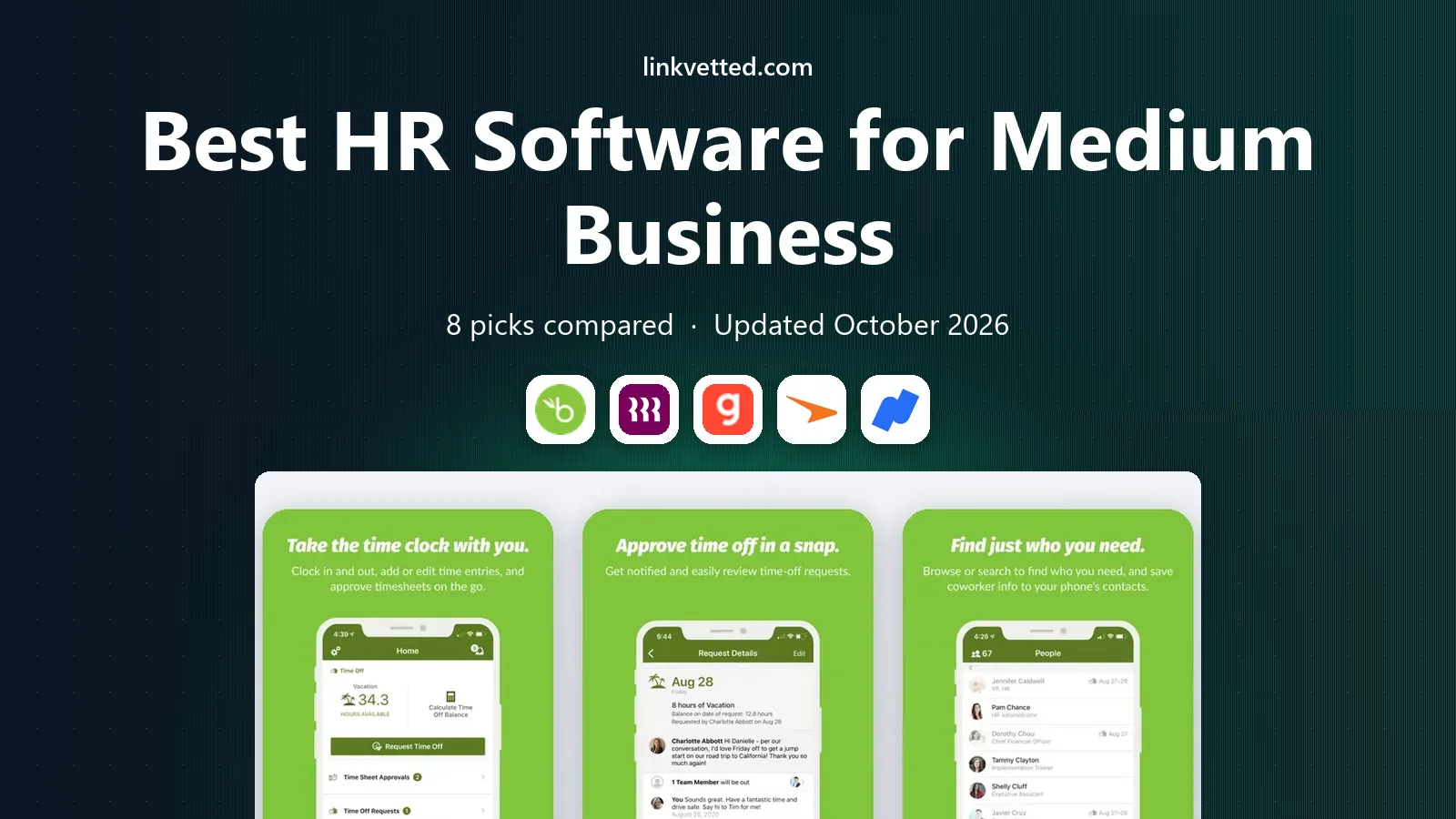
- Editor's choice
 BambooHR
Core HR for growing teams
Starts at$10 per employee per monthVisit bamboohr.comFull review - Great alternative
 Rippling
Unified HR, IT, and finance
Starts atFrom $8 per user per monthVisit rippling.comFull review - Also consider
 Gusto
Payroll first HR
Starts at$49 per month plus $6 per personVisit gusto.comFull review
TL;DR:
- BambooHR is the easiest starting point for medium businesses that want core HR, time off, and reporting without a long implementation.
- Rippling suits companies that want HR, IT, and finance in one system, but its modular pricing needs a careful quote review.
- Gusto is the strongest payroll first option, with clear published pricing, though multi state payroll and time tracking sit on higher plans.
- Medium businesses should price the full stack, including payroll, benefits administration, and time tracking, since those add ons change the total more than the base plan.
- Implementation time, support quality, and integration with payroll and accounting matter as much as the feature list for a team of 50 to 500.
Quick comparison
| Tool | Best for | Starts at | Free plan? | |
|---|---|---|---|---|
| BambooHR | Core HR for growing teams | $10 per employee per month | Free trial | Visit |
| Rippling | Unified HR, IT, and finance | From $8 per user per month | No | Visit |
| Gusto | Payroll first HR | $49 per month plus $6 per person | No | Visit |
 Paycor | Midsize payroll and HR | See website | No | Visit |
 Namely | Midsize HR and benefits | See website | No | Visit |
 Zenefits | Affordable HR and benefits admin | See website | No | Visit |
 HiBob | People management for global teams | See website | No | Visit |
 Deel | Global hiring and payroll | See website | No | Visit |
The best HR software for medium business
We compared platforms that serve companies in the roughly 50 to 500 employee range, with attention to core HR records, payroll, benefits, time tracking, performance, and integrations. We used vendor pricing pages and product documentation, and we note where pricing is quote based rather than publishing a number we could not verify.

BambooHR is the most straightforward HR platform on this list, and that simplicity is why many medium businesses choose it. Core covers employee records, time off, hiring, onboarding, and reporting, while Pro adds performance management and Elite adds compensation planning and benchmarking. Pricing is published, with Core from $10, Pro from $17, and Elite from $25 per employee per month for teams above 25 people, and a flat rate from $250 a month for smaller teams.
The catch is that payroll, benefits administration, time tracking, and global employment are add ons priced by quote, so the base price is not the total price. BambooHR also lacks the IT device management that Rippling offers, and its workflow tools suit standard processes better than highly custom ones. If you want a clean HR system of record and you are happy to buy payroll separately or as an add on, BambooHR is a strong, low friction pick.
- Clear published pricing
- Easy to learn
- Strong time off and reporting tools
- Payroll and benefits are paid add ons
- Native payroll is United States only
- Advanced features sit on higher plans
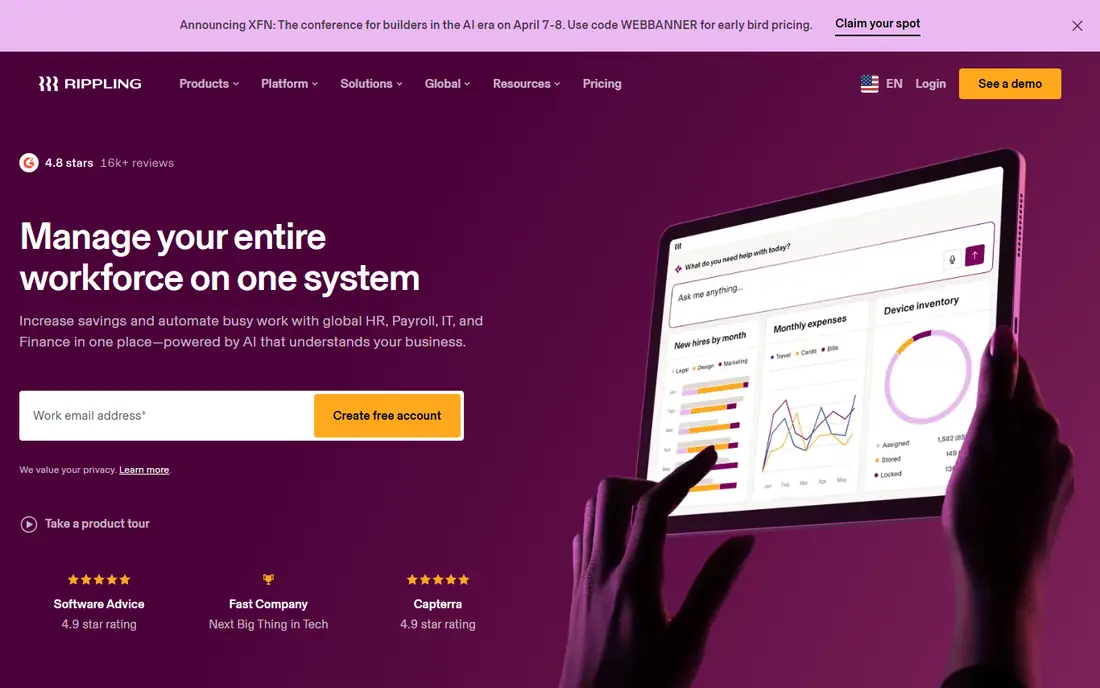
Rippling stands apart because it manages employees across HR, IT, and finance from one record. Onboarding can create accounts, assign devices, set payroll, and enroll benefits in one workflow, and changes flow through every system automatically. That depth suits medium businesses with remote or global teams, strong IT needs, and a wish to cut manual admin across departments.
Pricing is the hard part. Rippling publishes a platform starting point from $8 per user per month, but each HR, IT, and finance product is bought separately on top of that base, and the full quote depends on the modules you choose. Implementation also takes longer than a simpler HR tool, since there are more workflows to configure. If your company wants one platform for people, devices, and money, Rippling is worth the quote process. If you only need core HR, a simpler tool costs less and launches faster.
- One system for HR, IT, payroll, and spend
- Deep automation
- Global payroll and employer of record options
- Full pricing requires a quote
- Setup takes longer
- Breadth can overwhelm small HR teams

Gusto starts from payroll and builds HR around it, which suits medium businesses whose main pain is paying people correctly and on time. Simple costs $49 a month plus $6 per person, Plus costs $80 plus $12, and Premium costs $180 plus $22, with unlimited payroll runs and automatic tax filings on every plan. There is no long term contract, setup is free, and plans can change as the team grows.
The limits show up as you grow. Simple covers payroll in one state only, so a second state hire pushes you to Plus, and time tracking also sits on Plus rather than Simple. International hiring is limited to contractor payments, not full employee payroll abroad. Gusto also lacks the deep HRIS customization and IT tools of Rippling. For a United States based medium business that wants payroll done well with solid HR basics, Gusto is a reliable, transparent choice.
- Clear published tiers
- Unlimited payroll runs
- Automatic tax filings
- No long term contract
- Multi state payroll needs Plus
- Time tracking needs Plus
- International payroll is limited to contractors
Paycor is built for midsize employers, with payroll, tax filing, time and attendance, recruiting, onboarding, benefits, and performance tools in one platform. Its payroll compliance depth suits companies with hourly workers, multiple locations, or complex pay rules, and its reporting helps HR leaders answer headcount, turnover, and labor cost questions without exporting data to spreadsheets.
Pricing is quote based, so you cannot budget from the website alone, and the platform can feel less modern than BambooHR or Rippling in some screens. Implementation also rewards planning, since pay rules and time policies need to be set up correctly before the first payroll run. If payroll accuracy and compliance are your top concerns and you want a vendor with midsize experience, Paycor is a serious contender. Get a written quote that itemizes each module before you compare totals.
- Strong payroll and tax compliance
- Recruiting and onboarding tools
- Good reporting for midsize teams
- Pricing is quote based
- Interface can feel dated in places
- Implementation needs planning
Namely targets the midsize market directly, with HR records, payroll, benefits administration, time off, performance, and reporting in a single system. Its employee self service experience is a genuine strength, since staff can update details, view pay, enroll in benefits, and request time off without HR intervention. That self service quality matters at 200 employees, where every manual HR task multiplies.
Namely pricing is quote based, and its payroll and benefits depth is strongest for United States employers, so global teams need to check coverage carefully. Highly custom workflows may also need workarounds. For a United States medium business that wants a polished employee experience and combined HR and benefits administration, Namely is worth a demo. Ask for implementation timelines and support terms in the quote, since those vary by package.
- Clean employee experience
- Benefits administration and payroll in one place
- Strong for companies near 100 to 500 staff
- Pricing is quote based
- Payroll is United States focused
- Customization has limits
Zenefits made its name as an affordable HR platform for growing companies, combining employee records, time off, benefits administration, and compliance tools in a simple package. It suits medium businesses that want to move off spreadsheets without paying enterprise prices, and its benefits enrollment workflow is still a practical strength, especially for teams offering several plan options.
The trade offs are depth and pricing clarity. Current pricing is quote based, payroll is handled as an add on rather than a native strength, and advanced performance, compensation, and global features lag the larger platforms on this list. Zenefits fits a cost conscious medium business with standard HR needs. If you need deep payroll, global employment, or complex performance workflows, compare it against BambooHR or Rippling before deciding.
- Low cost entry for small and midsize teams
- Benefits administration and time off built in
- Simple setup
- Pricing is quote based on the current site
- Payroll is an add on
- Depth lags larger HRIS platforms
HiBob, often called bob, is a people management platform built for multinational and fast growing companies. It handles core HR, time off, performance, compensation, and people analytics across countries, with flexible fields and workflows that adapt to different local requirements. Its interface is modern and staff friendly, which helps adoption in companies where HR software has a poor reputation.
Payroll is the gap. HiBob integrates with payroll providers rather than running full payroll itself in most markets, so United States teams need to confirm how payroll, tax filing, and benefits connect before buying. Pricing is quote based. For a medium business with staff in several countries that wants strong people data and a good employee experience, HiBob is a strong pick. For a United States only team that wants payroll and HR in one native system, Gusto or Paycor may fit better.
- Strong for multinational teams
- Flexible people analytics
- Modern interface that staff enjoy using
- Pricing is quote based
- Payroll is handled through partners
- United States payroll depth varies
Deel solves a specific medium business problem, hiring people legally in countries where you have no local entity. Its employer of record service employs staff on your behalf, handles local contracts, payroll, taxes, and benefits, and its contractor platform manages payments and compliance for freelancers worldwide. Global payroll for your own entities is also available, which suits companies growing abroad fast.
Deel is less proven as a general HRIS for domestic United States teams than BambooHR or Namely, and its pricing is quote based, with costs that scale per global employee. If your medium business is hiring across borders, Deel can remove months of legal and payroll setup. If your team is mostly domestic, a domestic HRIS with payroll will usually cost less and cover daily HR needs more deeply.
- Hire employees and contractors in many countries
- Employer of record and global payroll
- Compliant contracts built in
- Pricing is quote based
- Core HRIS is newer than specialist HR platforms
- Costs scale with global headcount
How we picked these
We compared platforms that publish or quote pricing for teams in the 50 to 500 range, with working payroll or payroll integrations, benefits tools, and reporting. We used vendor pricing pages, product documentation, and feature guides, and we flagged quote based pricing rather than inventing numbers. We weighed ease of implementation, support, and integration with accounting and time systems alongside features, since a medium business feels implementation pain far more than a feature gap on a checklist.
Buying HR software for a medium business
Price the whole stack, not the headline plan
Ask every vendor for a quote that includes payroll, benefits administration, time tracking, and any per employee fees, plus implementation and support costs. A base plan that looks cheap can double once add ons are included, while a higher base plan that bundles payroll can be cheaper overall. Compare totals for your exact headcount, not list prices alone.
Test the workflows your team actually uses
Run a demo with real tasks, such as onboarding a hire, approving time off, running a payroll preview, and enrolling in benefits. Watch how many steps each task takes and who can do it without HR help. A platform that looks good in a sales demo can still frustrate managers if approvals and self service are clumsy in daily use.
Plan implementation before you sign
Ask for a written implementation plan with a timeline, a named contact, data migration scope, and training for managers and staff. Confirm how historical payroll and HR data move over, how integrations with accounting and time clocks are tested, and what support looks like after go live. A clear plan prevents the most common HR software regret, a rushed launch that leaves payroll and records in two systems.
FAQ
What is the best HR software for a medium sized business?
BambooHR is a strong general pick for core HR, Rippling suits companies that want HR, IT, and finance together, and Gusto suits payroll first teams. The best choice depends on headcount, locations, payroll complexity, and whether you need global hiring, so compare quotes for your exact stack before deciding.
What is HRIS and payroll software?
An HRIS, or human resource information system, stores employee records, time off, onboarding, and performance data in one place. Payroll software calculates pay, withholds taxes, files tax forms, and pays staff. Many platforms combine both, and the best HRIS and payroll software for a medium business keeps those records in sync so a change to pay or benefits flows through automatically.
How much does HR software cost for a medium business?
Costs vary by headcount and modules. Published starting points on this list range from $8 to $10 per user per month for base platforms, plus payroll and benefits add ons, while several vendors quote only. For a 100 person team, budget for the full stack including payroll and benefits, and get written quotes from at least two vendors.
Does HR software replace an HR team?
No, it removes repetitive admin so a smaller HR team can focus on hiring, performance, compliance, and employee relations. Someone still needs to set policies, handle sensitive cases, manage benefits decisions, and check payroll before it runs. Software makes HR work faster, it does not make HR judgment unnecessary.
Can medium businesses use HR software for remote and global teams?
Yes, but check coverage by country. Rippling and Deel offer global payroll and employer of record services, HiBob handles multinational people data well, and BambooHR and Gusto are strongest for United States teams. Confirm tax, benefits, and data rules for each country where you employ staff.
How long does it take to implement HR software?
Simple platforms can launch in a few weeks, while broader platforms with payroll, benefits, and integrations often take one to three months. Timeline depends on data quality, pay rule complexity, and how many systems need integration, so ask for a written plan with milestones before you sign.