Best HR Software for a 200-Person Company in 2026: 9 Platforms Compared
Best HR software for a 200 person company, compared across payroll, hiring, time off and price, so a growing team can choose with real confidence in 2026.
- Editor's choice
 BambooHR
Clear HR records and hiring
Starts at$10 per employee per monthVisit bamboohr.comFull review - Great alternative
 Rippling
HR, IT and payroll in one system
Starts at$8 per user per monthVisit rippling.comFull review - Also consider
 Gusto
Simple US payroll and HR
Starts at$49 per month plus $6 per personVisit gusto.comFull review
TL;DR:
- At 200 people, per-employee pricing matters more than the base fee, so always price the full quote at your exact headcount.
- BambooHR and Rippling are the most practical starting points for many 200-person teams, one for clarity and one for automation depth.
- Payroll, benefits and time tracking are often add-ons, so check what is included before you compare headline prices.
- A platform that handles multi-state payroll and compliance reporting will save more time than a cheaper tool that needs manual workarounds.
Quick comparison
| Tool | Best for | Starts at | Free plan? | |
|---|---|---|---|---|
| BambooHR | Clear HR records and hiring | $10 per employee per month | Free trial | Visit |
| Rippling | HR, IT and payroll in one system | $8 per user per month | Free trial | Visit |
| Gusto | Simple US payroll and HR | $49 per month plus $6 per person | No | Visit |
 HiBob | People experience and performance | See website | Free trial | Visit |
 Personio | European and global HR basics | See website | Free trial | Visit |
 Paycor | Payroll-led HR for mid-size teams | See website | Free trial | Visit |
 Deel | Global hiring and payroll | See website | Free trial | Visit |
 Factorial | Affordable all-in-one HR | See website | Free trial | Visit |
 ADP Workforce Now | Large-provider compliance depth | See website | No | Visit |
The best HR software for a 200-person company
A 200-person company sits in an awkward middle. It is too large for spreadsheets and basic payroll tools, yet it may not need a full enterprise suite. These nine platforms fit that middle well.
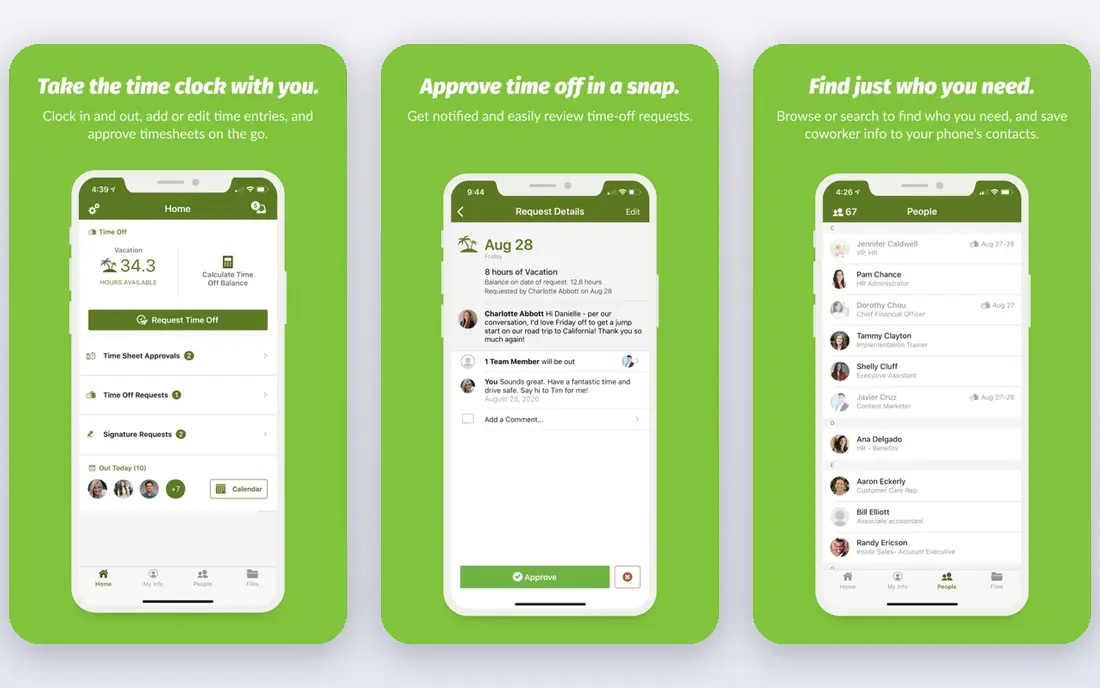
BambooHR works well when HR needs one reliable system of record. Employee records, time off, hiring and onboarding sit in one place, and managers can find answers without asking HR for a report each week. For a 200-person team, the Core plan at $10 per employee per month gives a useful baseline, while Pro at $17 adds performance tools that many growing companies want.
The catch is that the headline price is not the whole bill. Payroll and benefits administration are quoted separately, so a team that wants everything in BambooHR should ask for a combined quote early. Still, for companies that mainly need clean records, hiring and performance in one tidy system, BambooHR is a strong, low-friction choice.
- Published per-employee pricing
- Strong hiring and onboarding tools
- Easy reporting for managers
- Payroll and benefits are add-ons
- Advanced analytics sit on higher tiers
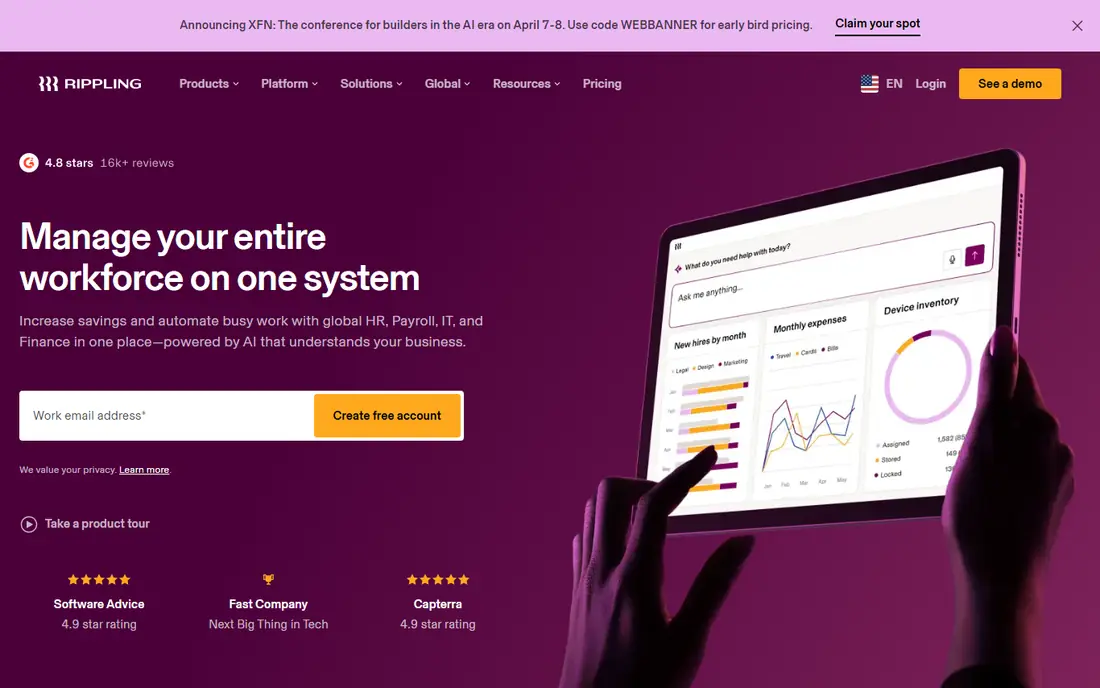
Rippling suits a 200-person company that wants onboarding to trigger everything at once. When a new hire starts, Rippling can set up payroll, benefits, app access and device management from the same record. That kind of automation matters at 200 people, when manual onboarding steps start to slip through the cracks.
The trade-off is price clarity. The platform starts at $8 per user per month plus a base fee, but payroll, benefits, time tracking and IT tools are priced on top. Teams should map every module they need before signing, and ask what a 200-person quote looks like with all of them included. If your company values automation over simplicity, Rippling is hard to beat.
- One employee record across HR, IT and finance
- Strong workflow automation
- Broad integration library
- Pricing is modular and can grow quickly
- Some modules need a custom quote
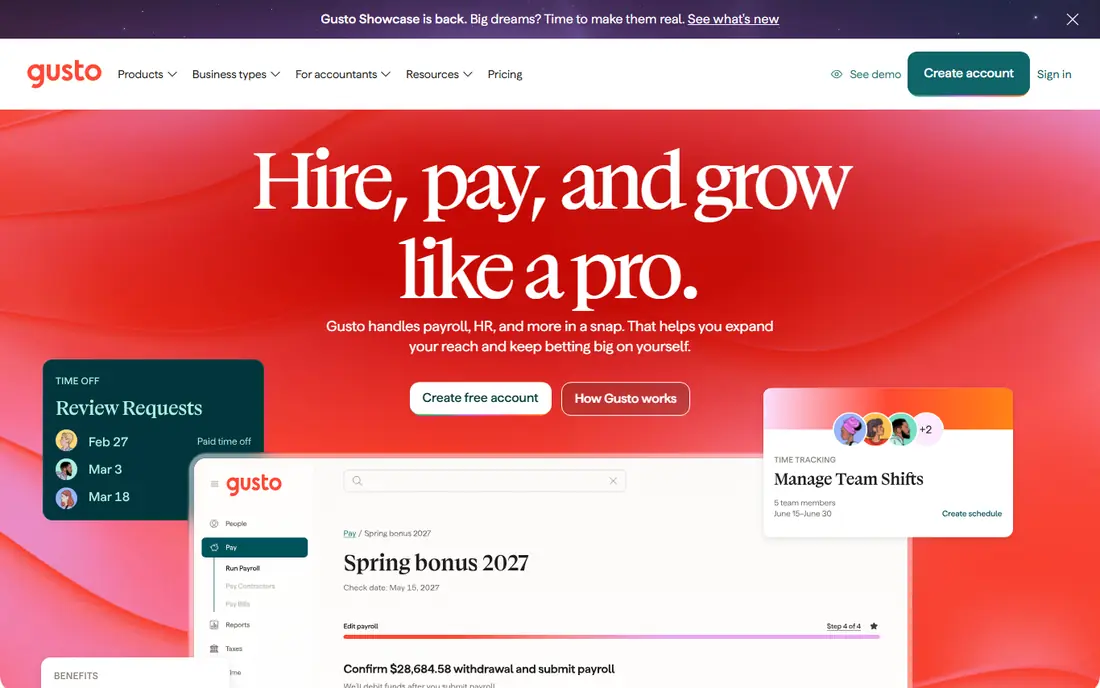
Gusto is the simplest option on this list, and that is its appeal. Simple starts at $49 per month plus $6 per person, with unlimited payroll runs and automatic tax filings. A 200-person US team can estimate its bill in minutes, which is rare in this market. The interface is friendly, and setup is faster than most rivals.
Gusto fits best when the workforce is US-based and HR needs are straightforward. Simple covers payroll in one state only, so a multi-state team will need Plus at $80 per month plus $12 per person. Companies with complex global hiring or deep performance management needs will outgrow Gusto sooner, but for payroll-led HR at 200 people, it remains a sensible pick.
- Transparent published pricing
- Easy payroll runs
- No long contract required
- US payroll only for employees
- Multi-state payroll needs a higher tier
HiBob, often called Bob, puts the employee experience first. Performance reviews, goals, compensation planning and surveys live in a system that feels modern rather than administrative. For a 200-person company trying to keep culture and feedback consistent as it grows, that design focus is a real advantage.
The main drawback is pricing transparency. HiBob does not publish a price list, and third-party estimates vary widely, so budget planning needs a direct quote. Native payroll is also limited to the US and UK, with other countries handled through partners. If your team is mostly in those markets and values performance tools, HiBob deserves a demo.
- Modern interface employees actually use
- Strong performance and compensation tools
- Flexible workflows
- Pricing is quote-only
- Native payroll is limited outside the US and UK
Personio is built for companies with 10 to 2,000 people, and it fits a 200-person team with European operations particularly well. It centralises people data, automates routine HR tasks, and covers recruiting, time off and document management in one system. Its integration library, with more than 200 tools, helps it sit alongside payroll and finance systems.
The honest catch is that Personio is not a native payroll provider in every market, so payroll may still need a separate tool or partner. Pricing is also quote-only, which makes early comparison slower. For a team with a European base that wants solid core HR without enterprise complexity, Personio is a practical shortlist option.
- Strong document and absence management
- Recruiting across many job boards
- Good for European compliance
- Pricing is quote-only
- Payroll is handled through partners in many markets
Paycor is a payroll-first platform that has grown into a broad HR suite, and that order matters. Companies that care most about accurate, on-time payroll and tax compliance will find its core strong. Time tracking, scheduling, hiring and performance tools sit around that payroll base, which suits a 200-person company with hourly staff as well as salaried roles.
The downside is the same as with many mid-market providers. Pricing requires a quote, and the breadth of the platform can feel heavy if HR is a team of one or two. Ask for a demo focused on your exact mix of hourly and salaried staff, and check which modules are included in the quote. For payroll reliability at this size, Paycor is a solid contender.
- Strong payroll and tax handling
- Workforce management tools
- Good reporting for managers
- Pricing is quote-only
- The full feature set can feel large for small HR teams
Deel is the pick when a 200-person company is spread across borders. It handles global payroll, employer of record services and contractor payments, so a team can hire in a new country without setting up a local entity first. Compliance documents, contracts and payments run through one dashboard, which reduces the admin load on a small HR team.
For a purely domestic US team, Deel may be more platform than needed, and its pricing is quote-based. But if even 20 or 30 of your 200 people sit outside your home country, Deel can replace several local vendors at once. Price it against the cost of those vendors, not just against a domestic HR tool, to judge it fairly.
- Hiring and payroll in many countries
- Employer of record services
- Strong contractor payments
- Quote-based pricing
- May be more than a US-only team needs
Factorial aims to give growing companies most of what they need in one affordable system. Time off, shift planning, documents, expenses and performance tools are included, and the interface is straightforward enough for managers to use without constant HR help. For a 200-person company watching costs, that breadth at a lower price point is attractive.
The trade-off is depth. Large-company reporting, advanced analytics and complex compliance workflows are not Factorial's strongest areas. A team with simple needs will rarely notice, but a company with complex multi-entity reporting should test those reports during a trial. As a value pick for a 200-person team, Factorial is worth a close look.
- Broad HR features at a competitive price
- Time off and document management
- Useful for growing teams
- Less depth in enterprise reporting
- Support quality can vary by plan
ADP Workforce Now is the established enterprise-leaning option here. It handles payroll, tax, benefits, time and compliance for mid-size and large employers, and it has the scale to keep growing with a company well past 200 people. For a team in a regulated industry, or one with complex benefits and multi-state compliance needs, that depth is reassuring.
The catch is speed and transparency. Pricing is quote-only, and implementation tends to take longer than with newer cloud tools. Smaller HR teams may also find the system more complex than they need day to day. If stability, compliance depth and room to grow matter more than a fast self-serve setup, ADP Workforce Now belongs on the shortlist.
- Deep payroll and tax expertise
- Broad compliance support
- Scales well beyond 200 people
- Quote-only pricing
- Setup can be slower than newer rivals
How we picked these
We compared official feature pages, published pricing where available, and public product documentation for platforms that serve companies around 200 people. We favoured tools with a clear HR system of record, payroll or payroll integration, time off, hiring and reporting, and we noted where pricing was quote-only rather than guessing a number. We did not claim hands-on testing. We looked for a mix of simple, automation-led and enterprise-leaning options so different kinds of 200-person teams can find a fit.
What to check before you sign
Start with headcount maths. Multiply any per-employee price by 200, add the base fee, then add payroll, benefits and time tracking if they are separate modules. A tool that looks cheap at $8 per person can cost far more once three add-ons are included, while a higher headline price that bundles payroll may be cheaper in total.
Next, test the workflows your team uses every week. Run a new hire from offer to first payroll, approve a week of time off, and pull a headcount report by department. If any of those steps needs a spreadsheet workaround, that friction will repeat hundreds of times a year. Also check multi-state and international coverage, data security, and how employee data can be exported if you leave.
Questions to ask on a demo
Ask how long implementation usually takes for a company your size, and what support is included after go-live. Ask who owns payroll tax filings and what happens if a filing is wrong. Ask about pricing at 250 and 300 people, so growth does not trigger a surprise tier jump. Finally, ask for two reference customers of a similar size and industry, and speak to them before you commit.
FAQ
What is the best HR software for a 200-person company?
There is no single winner, because the right choice depends on where your people are and whether payroll is in scope. BambooHR suits teams that want clear records and hiring, Rippling suits teams that want HR, IT and payroll automated together, and ADP Workforce Now suits teams that want deep compliance support. Shortlist two or three, price each at 200 people with all add-ons, and demo the weekly workflows before deciding.
How much does HR software cost for 200 people?
It varies widely. Published starting prices in this guide range from $10 per employee per month at BambooHR to quote-only enterprise pricing at several rivals. At 200 people, BambooHR Core at list price would be about $2,000 per month before add-ons, while Gusto Plus would be about $2,480 per month. Always get a written quote that lists every module, because add-ons change the total more than the headline rate.
Do I need payroll in the same system as HR?
Not always, but it helps at 200 people. One system means one employee record, fewer manual transfers, and fewer payroll errors when someone changes role, location or pay. If your payroll provider is strong and your HR tool integrates with it cleanly, separate systems can work. If the integration is manual or fragile, a combined system usually saves more time than it costs.
Can a 200-person company use Gusto?
Yes, if the workforce is mainly US-based and HR needs are straightforward. Gusto handles payroll, benefits, time tracking on higher tiers, and basic HR well, with transparent pricing. Companies with complex global hiring, deep performance management, or enterprise reporting needs may find Gusto limited, and should compare Rippling, HiBob or ADP Workforce Now as well.
How long does it take to set up HR software for 200 people?
Timelines vary by vendor and by how clean your current data is. Simpler cloud tools can be live in a few weeks, while broader platforms with payroll, benefits and integrations can take six to twelve weeks. Clean up employee records, decide who approves time off, and confirm payroll dates before implementation starts, because data cleanup is usually what causes delays.
Should we choose a quote-only platform?
Quote-only pricing is common at this size and is not a reason to reject a tool, but it does require more care. Ask for a written quote at your exact headcount, with each module priced separately, and ask what changes at 250 and 300 people. Compare that total, not the headline rate, against published-price rivals, and check contract length and renewal terms before signing.