Best Household Budgeting Apps in 2026: 8 Apps Compared
Compare the best household budgeting apps for 2026, with pricing, bank sync, and shared budgets, so your household can plan spending and save together.

- Editor's choice
 YNAB
Hands-on zero-based budgeting
Starts at$14.99 per monthVisit ynab.comFull review - Great alternative
 Monarch Money
Complete household dashboard
Starts at$14.99 per monthVisit monarchmoney.comFull review - Also consider
 Quicken Simplifi
Low cost all-rounder
Starts at$5.99 per monthVisit quicken.comFull review
TL;DR:
- YNAB suits households that want a strict method, while Monarch Money suits households that want a full money dashboard in one place.
- Quicken Simplifi is the cheapest capable all-rounder here, and Goodbudget and EveryDollar offer genuine free tiers.
- Shared budgets work best when both partners can see the same plan and categorise spending the same way.
- This is general information, not financial advice, and app prices change, so check the vendor site before subscribing.
Quick comparison
| Tool | Best for | Starts at | Free plan? | |
|---|---|---|---|---|
| YNAB | Hands-on zero-based budgeting | $14.99 per month | Free trial | Visit |
| Monarch Money | Complete household dashboard | $14.99 per month | Free trial | Visit |
| Quicken Simplifi | Low cost all-rounder | $5.99 per month | Free trial | Visit |
 Copilot Money | Apple users who value design | $13 per month | Free trial | Visit |
 EveryDollar | Simple zero-based plans | Free | Yes | Visit |
 Goodbudget | Envelope budgeting for couples | Free | Yes | Visit |
 PocketGuard | A simple safe-to-spend number | $12.99 per month | Free trial | Visit |
 Honeydue | Couples managing money together | Free | Yes | Visit |
The best household budgeting apps
A household budgeting app should answer three questions each week: what came in, what went out, and what is left for the rest of the month. The best household budgeting apps do that without turning money into a second job, and they let two people share the same plan. The apps below cover strict methods, simple tracking and full dashboards, so the right pick depends on how hands-on your household wants to be.

YNAB, short for You Need A Budget, is our pick for a household that wants to change how it handles money, not just track it. The method is simple to state and harder to practise: give every dollar a job, fund the month ahead, and move money between categories when plans change instead of overspending. That discipline is why many households stick with YNAB after trying simpler trackers that only show where money went.
The learning curve is real, and the first month can feel like homework, especially for a partner who did not choose the app. YNAB also costs more than Simplifi, and it focuses on budgeting rather than investments. If your household will follow the method together, YNAB is the strongest budgeting tool here. If you want a dashboard that mostly runs itself, Monarch Money will feel easier.
- Clear zero-based method that changes spending habits
- Bank sync plus manual entry
- Strong learning resources
- Steepest learning curve here
- No free plan, only a trial
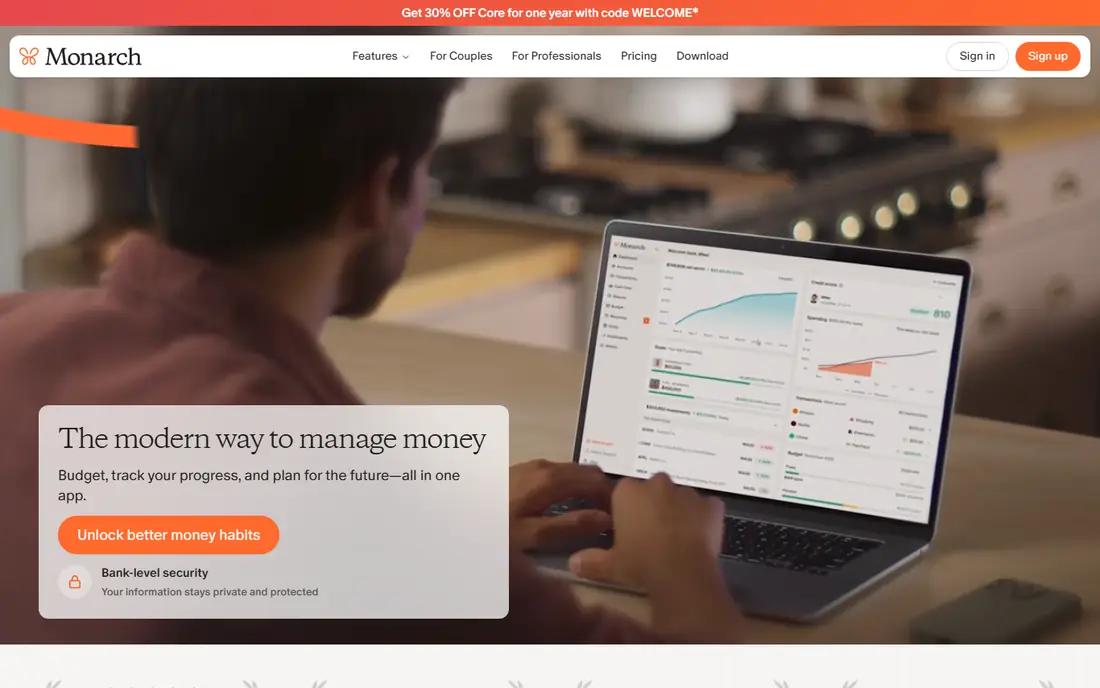
Monarch Money is the best all-round household money app for a couple or family that wants everything in one place. Bank accounts, credit cards, loans and investments sync into a single dashboard, with flexible budgets, goals and net worth tracking alongside. Partner sharing is built in, so both people see the same numbers and can categorise spending together, which removes the "whose spreadsheet is right" argument.
The price is at the premium end, and the seven-day trial is short for a tool that takes time to set up properly. Use the trial to connect your main accounts and test the budget view with your partner, not just to look at the dashboard alone. If your household wants a complete picture and will use the investment and net worth views, Monarch Money justifies its price. If you only need a budget, YNAB or Simplifi cost less for that job.
- Budgeting, net worth and investments in one dashboard
- Partner sharing
- Clean reports
- Premium price
- Trial is short at seven days

Quicken Simplifi is the value pick for a household that wants automatic tracking without a premium price. It builds a spending plan from your actual income and bills, forecasts cash flow so you can see a shortfall coming, and tracks investments alongside everyday spending. At $5.99 per month billed annually, it undercuts most rivals while covering the core jobs well.
The interface is less polished than Monarch Money, and it is less built around couples than Monarch or Honeydue, although a household can still share access. Simplifi also comes from Quicken, which gives it a long history in personal finance, but also a more traditional feel. For a household that wants good tracking at a low price, Simplifi is the best value in this list.
- Cheapest capable all-rounder here
- Spending plan plus cash-flow forecasting
- Investment tracking included
- Less polished than Monarch Money
- Household sharing is less central than on Monarch or Honeydue
Copilot Money is the pick for an Apple household that will actually open the app every day because it looks good. Transactions are categorised cleanly, budgets and goals are easy to read, and investment accounts sit alongside everyday spending. That design matters more than it sounds, because a budgeting app only works if both partners check it regularly.
The limit is platform. Copilot is built for iPhone, Mac and the web, and an Android household will not get the same experience. It also costs more than Simplifi for similar core tracking, so you are paying for design and daily ease. If your household is all Apple and design keeps you engaged, Copilot is worth it. If not, Monarch Money gives a similar dashboard across platforms.
- Beautiful design on iPhone and Mac
- Smart categorisation
- Investment tracking
- Apple-first, so Android households should look elsewhere
- No free plan, only a trial
EveryDollar is the simplest way to try zero-based budgeting for free. You list income, assign every dollar to a category, and track spending against that plan, with a clean interface that does not overwhelm a beginner. The free version uses manual entry, which suits a household that prefers to enter spending by hand and stay close to each purchase.
Bank sync is the main paid feature, and without it the manual version takes more time each week. The method is also fairly rigid, which suits a household with steady pay but can feel tight for freelance or variable income. Start with the free version to learn whether zero-based budgeting fits your household, then pay for Premium only if bank sync saves you real time each week.
- Free manual version
- Simple zero-based budgeting
- Easy for beginners
- Bank sync needs the paid Premium plan
- Method is rigid for households with variable income
Goodbudget is the closest digital version of envelope budgeting, and it is a great household app for couples who like that method. You divide money into envelopes for groceries, transport, eating out and bills, then spend from each envelope and see what is left. The free tier includes 20 envelopes, one account and two devices, which is enough for a couple to test the method properly.
The free tier does not include bank sync, so spending must be entered by hand unless you pay for Plus. That manual step is actually part of the appeal for some households, because it forces a daily money habit, but it can feel slow for a busy family. If envelope budgeting clicks for your household, Goodbudget Plus is good value. If you want automatic tracking, Simplifi or Monarch Money will suit you better.
- Free tier with 20 envelopes
- Digital envelopes are easy for couples to share
- Works without bank links if you prefer
- Bank sync needs the paid Plus plan
- Manual entry on the free tier takes time
PocketGuard answers the question most people actually ask each day: how much can I spend without breaking the plan? It takes income, subtracts bills and savings goals, and shows a single safe-to-spend number, which is far easier to act on than a long list of categories. Bill tracking helps you spot subscriptions and upcoming payments before they surprise you.
The simplicity is also the limit. PocketGuard has less planning depth than YNAB for a household that wants a strict method, and less dashboard depth than Monarch for a household that wants net worth and investments together. It is best for a household that wants a daily guardrail rather than a full financial plan. If that one number keeps spending in check, PocketGuard earns its price.
- Clear "in my pocket" safe-to-spend figure
- Bill tracking
- Simple daily view
- Less planning depth than YNAB or Monarch
- Best as a tracker, not a full household planner
Honeydue is built for couples, and it shows in the design. Each partner can see shared accounts and their own accounts together, set bill reminders, and discuss spending in the app instead of arguing about it later. The price is free, which makes it the easiest couple budgeting app to try without a subscription decision getting in the way.
The feature set is smaller than YNAB or Monarch, with less depth for goals, investments and detailed planning. Honeydue is best for a couple that mainly needs shared visibility and bill coordination, not a strict budgeting method. If your household needs a full method or a complete dashboard, pay for YNAB or Monarch. If you need to see the same money picture together for free, start with Honeydue.
- Free for couples
- Shared and individual accounts in one view
- Bill reminders and chat about spending
- Fewer budgeting tools than YNAB or Monarch
- Smaller feature set overall
How we picked these
We compared official pricing pages and feature lists for household budgeting apps available in the United States in 2026, and we kept apps that support shared household use, bank sync or a clear manual alternative, and a real budget view. We favoured apps with a free plan or trial so a household can test sharing before paying, and we noted where bank sync requires a paid plan. Prices change often, so confirm the current price on the vendor site, especially where annual billing changes the monthly figure.
How to budget as a household without arguments
The best household budget is the one both partners understand, even if it is not perfect. Start with a short monthly meeting, same day each month, where you review last month spending, set next month categories, and agree on one savings goal. Keep categories broad at first, such as housing, food, transport, bills and fun, and only split them when a broad category keeps overspending. Broad categories are easier to share than a 50-line budget nobody maintains.
Agree on a personal spending allowance for each partner, with no questions asked inside that amount. That one rule removes most budgeting arguments, because small personal purchases no longer need joint approval. Finally, automate what you can: bills on autopay, savings moved on payday, and a weekly app check instead of a monthly panic. A budget that runs on habits beats a budget that runs on willpower.
A short note on money and safety
This article is general information, not financial advice, and it does not replace advice from a qualified financial professional for debt, tax or investment decisions. Budgeting apps show your spending clearly, but they do not fix debt or income problems on their own. If debt is growing, talk to a nonprofit credit counsellor or a financial adviser before taking on new credit, and be careful with any app that asks for bank login details: use the official app, check its security pages, and turn on two-factor authentication where available.
FAQ
What is the best household budgeting app?
Monarch Money is the best all-round household app, YNAB is the best for a strict method, and Quicken Simplifi is the best value all-rounder. The best household budgeting apps all let both partners see the same plan, so choose based on whether your household wants a method, a dashboard, or the lowest price.
What is the best free monthly budget app?
EveryDollar, Goodbudget and Honeydue all offer genuine free tiers, with EveryDollar best for simple zero-based plans, Goodbudget best for envelope budgeting, and Honeydue best for couples sharing accounts. The best free monthly budget app depends on method, because a free app you will not use is worse than a paid app you will.
What is the best online budgeting software for couples?
Monarch Money and Honeydue are the strongest couple picks, with Monarch offering the fullest dashboard and Honeydue offering a free couple-first design. Goodbudget also works well for couples that like envelope budgeting. Test sharing with your partner during a trial, because the best couple app is the one both people open.
What is the best online budgeting tool for tracking bills?
PocketGuard and Quicken Simplifi both track bills well, with PocketGuard giving a clear safe-to-spend figure after bills, and Simplifi adding cash-flow forecasting. Monarch Money also tracks bills inside its wider dashboard. If missed bills are your main problem, bill reminders and forecasting matter more than investment tracking.
Should both partners use the same budgeting app?
Yes, in most cases, because two separate budgets hide the household picture and cause arguments about who spent what. Use one app with shared access, agree on categories together, and give each partner a personal allowance. If one partner dislikes the app, try a simpler one together rather than running two systems.
Is it safe to link a bank account to a budgeting app?
Reputable budgeting apps use bank-level security and read-only connections through established data providers, and they do not move money without your instruction. Still, use the official app, enable two-factor authentication, review connected accounts regularly, and remove access if you stop using the app. If you prefer not to link a bank, Goodbudget and EveryDollar both work with manual entry.