Best Healthcare Compliance Software in 2026: 8 Tools Compared
Compare the best healthcare compliance software for HIPAA training, policies, audits, incident tracking and risk management for care providers in 2026.

- Editor's choice
 Compliancy Group
Small practices and HIPAA
Starts atSee websiteVisit compliancy-group.comFull review - Great alternative
 MedTrainer
Training and credentialing
Starts atSee websiteVisit medtrainer.comFull review - Also consider
 Healthicity
Auditing and compliance
Starts atSee websiteVisit healthicity.comFull review
TL;DR:
- Compliancy Group and HIPAA One lead for smaller practices that need HIPAA compliance, training and risk assessments in one place.
- MedTrainer and Healthicity suit larger teams that need credentialing, training and audit workflows together.
- Symplr and PowerDMS help hospitals and larger organizations manage policies, credentials and compliance at scale.
- Accountable HQ and Vantage Point fit small practices and home-care teams that want simpler compliance tracking.
- The best tool depends on your regulations, because HIPAA, OSHA, credentialing and state rules need different workflows.
Quick comparison
| Tool | Best for | Starts at | Free plan? | |
|---|---|---|---|---|
| Compliancy Group | Small practices and HIPAA | See website | Free trial | Visit |
| MedTrainer | Training and credentialing | See website | No | Visit |
| Healthicity | Auditing and compliance | See website | No | Visit |
 Symplr | Hospitals and large providers | See website | No | Visit |
 PowerDMS | Policy and accreditation management | See website | No | Visit |
 HIPAA One | HIPAA risk assessments | See website | Free trial | Visit |
 Accountable HQ | Small practice HIPAA tracking | See website | Free trial | Visit |
 Vantage Point | Home care compliance | See website | No | Visit |
The best healthcare compliance software
Healthcare compliance software helps providers track HIPAA training, policies, risk assessments, incidents, audits, credentials and regulatory tasks in one place, instead of scattered spreadsheets and binders. Good tools send reminders before training expires, store proof of compliance and make audit preparation faster. We compared official feature pages, pricing pages and public reviews for tools available in the US in October 2026. Note: this article is general information, not legal, medical or compliance advice, and your obligations depend on your provider type, state and payer rules.
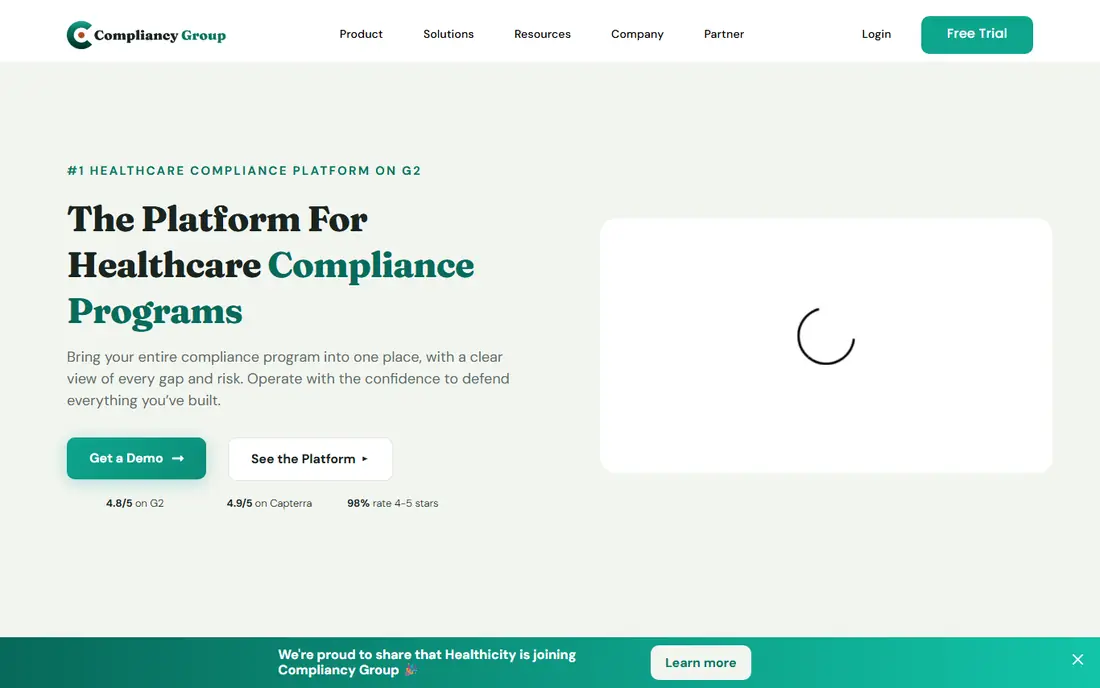
Compliancy Group offers a guided HIPAA compliance program with policies, employee training, risk assessments, incident tracking and documentation, supported by compliance coaches. Small practices like its step-by-step approach, since it turns a complex regulation into clear tasks with deadlines and proof of completion. That structure helps a practice show auditors what was done and when.
Pricing is quote-based and depends on practice size and services. Compliancy Group is strongest on HIPAA, so hospitals that also need credentialing, accreditation and OSHA workflows may need a broader platform alongside it. For a small clinic or therapy practice that needs HIPAA done properly, it is our pick for most people.
- Guided HIPAA compliance program
- Training, policies and risk assessments in one place
- Coach support included
- Quote-based pricing
- Focused mainly on HIPAA rather than full hospital compliance
MedTrainer combines compliance training, credentialing, policy management and incident reporting in one platform for healthcare organizations. It automates training assignments and expiry reminders, tracks provider credentials and licenses, and stores policies with staff acknowledgment. That breadth suits ambulatory surgery centers, clinics and multi-site providers that juggle several compliance areas.
Pricing is quote-based, and setup takes time to load courses, credentials and policies. Smaller solo practices may find MedTrainer more than they need. For a mid-sized provider that wants training and credentialing in one system, MedTrainer is a strong, practical choice.
- Compliance training, credentialing and policy management together
- Automated reminders
- Reporting for audits
- Quote-based pricing
- Setup needs time to load courses and credentials
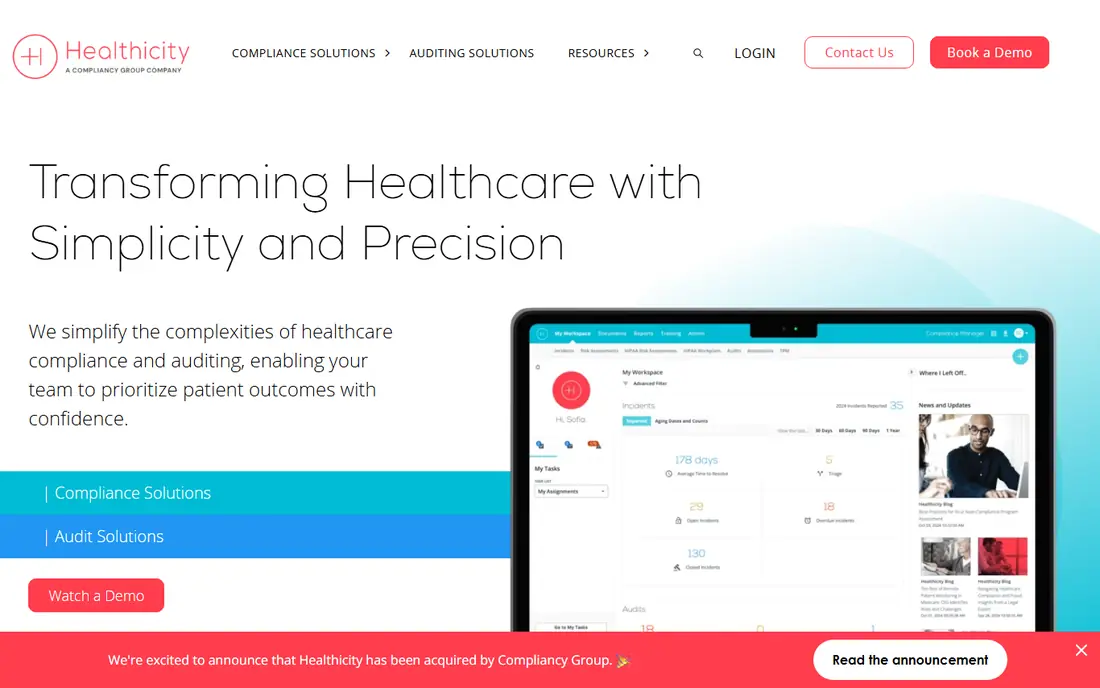
Healthicity offers auditing, compliance, coding and training tools for healthcare organizations, including audit management, risk scoring, policy resources and education. Its audit tools help compliance teams review charts, track findings and correct coding and documentation issues before payers or regulators do. Analytics highlight risk areas across departments or providers.
Healthicity pricing is quote-based, and its range of products can feel broad for a very small practice. Larger clinics, hospitals and compliance teams that need audit depth alongside training will get the most value. If audit readiness is your main worry, Healthicity deserves a demo.
- Audit, coding and compliance tools
- Training and policy resources
- Analytics for risk areas
- Quote-based pricing
- Product range can feel broad for a small practice
Symplr is a healthcare operations platform covering provider data management, credentialing, workforce management, compliance and quality tools for hospitals, health systems and large providers. It helps large organizations keep provider credentials current, manage compliance tasks and maintain accurate provider data across many sites. Its enterprise controls suit complex, multi-facility operations.
Symplr pricing is quote-based and setup is enterprise-scale, so small practices will find it too large and costly. For a hospital or health system that needs credentialing and compliance across many providers and locations, Symplr is one of the leading platforms.
- Provider data, credentialing and compliance at scale
- Broad healthcare operations platform
- Strong enterprise controls
- Quote-based pricing
- Enterprise setup and cost suit larger organizations
PowerDMS helps healthcare and public safety organizations create, approve, distribute and track policies, with staff acknowledgment, version control and accreditation workflows. Training can link to policies, so staff complete required learning when a policy changes. That makes audit preparation easier, since policy history and acknowledgments are stored in one place.
PowerDMS is less focused on HIPAA risk assessments than a dedicated HIPAA tool, so some practices pair it with a HIPAA-specific program. Pricing is quote-based. For an organization whose main compliance pain is policy control and accreditation, PowerDMS is a strong, proven choice.
- Policy creation, approval and acknowledgment
- Accreditation tracking
- Training linked to policies
- Quote-based pricing
- Less focused on HIPAA risk assessments than Compliancy Group
HIPAA One focuses on HIPAA risk analysis, remediation tracking and documentation, helping practices complete required risk assessments and fix gaps. Its reports give a clear view of risks, remediation steps and completion status, which auditors and business partners often request. That focus makes it easier to run than a broad suite for a practice whose main need is HIPAA risk work.
Its scope is narrower than MedTrainer or Symplr, so practices that also need credentialing or policy management may need another tool. Pricing varies by organization size, with a trial available. For a practice that needs a defensible HIPAA risk assessment, HIPAA One is a focused, useful pick.
- Focused HIPAA risk assessment and remediation
- Clear reports for audits
- Suitable for small and mid-sized practices
- Narrower scope than full compliance suites
- Pricing varies by organization size
Accountable HQ offers HIPAA compliance tools for small practices, including training, policies, risk assessments and tracking in a simpler package than enterprise platforms. It suits solo and small group practices that need to show training completion, policy acknowledgment and risk assessment work without a large implementation. Its trial lets a small practice test the workflow before paying.
Accountable HQ lacks the credentialing and enterprise reporting depth of larger tools, so bigger organizations may outgrow it. For a small practice moving off spreadsheets, it offers a clear, affordable step toward organized HIPAA compliance.
- Simple HIPAA training and tracking
- Policies and risk assessment tools
- Lower entry cost than enterprise tools
- Smaller vendor with fewer enterprise features
- Less credentialing depth
Vantage Point, formerly Vantage Point Compliance, provides compliance, training and quality tools for home care, home health and senior care organizations. It covers caregiver training, policy management, audits and compliance tracking shaped around home-care workflows, including state survey readiness. That specialty focus helps agencies that face home-care-specific rules and caregiver turnover.
Hospitals and general clinics will find its home-care focus less relevant, and pricing is quote-based. For a home-care agency that needs caregiver training and compliance tracking together, Vantage Point is a well-matched specialist choice.
- Compliance and training for home care and senior care
- Caregiver training and tracking
- Policy and audit tools
- Home-care focus limits fit for hospitals
- Pricing is quote-based
How we picked these
We compared official feature pages, pricing pages and public reviews for healthcare compliance tools available in the US in October 2026. We favored tools with training tracking, policy management, risk assessments, incident or audit workflows and a working official homepage, covering HIPAA and broader healthcare compliance. We left out generic learning systems without compliance tracking, discontinued tools and tools with no healthcare focus.
How to choose healthcare compliance software
Start with your regulations and provider type. A therapy practice mainly needs HIPAA training, policies and risk assessments, while a home-care agency needs caregiver training and survey readiness, and a hospital needs credentialing, policy control and audit tools. List your must-have workflows before a demo, and test them with real tasks, not just slides.
Next, check reminders, reporting and proof. Training and credential expiries should trigger alerts, and reports should show completion, acknowledgment and remediation status for auditors. Confirm who owns the data if you leave, how staff data is protected, and whether the vendor offers a business associate agreement where needed. Finally, compare total cost for your staff count and sites, including training content and support, since quote-based pricing varies widely.
FAQ
What is healthcare compliance software?
Healthcare compliance software tracks training, policies, risk assessments, incidents, audits and credentials that providers must manage under HIPAA, OSHA, state rules and payer requirements. It replaces spreadsheets and binders with reminders, reports and proof of completion. It helps prepare for audits, but it does not replace legal or compliance counsel.
Is HIPAA compliance software enough for HIPAA?
Software helps organize HIPAA work, but compliance also depends on your policies, staff training, access controls, device security and business associate agreements. Use software to track tasks and proof, and review your risk assessment and safeguards with qualified counsel or a compliance adviser. This article is general information, not legal advice.
How much does healthcare compliance software cost?
Most tools price by quote, based on staff count, sites and modules, while some small-practice tools offer trials and lower entry pricing. Get a written quote for your headcount and required modules, and check whether training content, risk assessments and support are included or billed separately.
Can compliance software track credentials?
Yes, tools such as MedTrainer and Symplr track provider licenses, certifications and credentials with expiry alerts. Smaller HIPAA tools focus more on training and policies than full credentialing. If credentialing is a core need, choose a platform that lists it as a main feature and test its expiry workflow.
What is a HIPAA risk assessment?
A HIPAA risk assessment reviews how protected health information is created, stored, shared and protected, identifies risks and documents remediation steps. Tools such as HIPAA One and Compliancy Group guide the assessment and track fixes. Regular assessments are a core HIPAA requirement, not a one-time task.
Do home-care agencies need different compliance software?
Often yes, because home-care agencies face caregiver training, state survey and visit documentation rules that general clinics do not. Tools such as Vantage Point shape training and audit workflows around home care. General HIPAA tools can still help with HIPAA training, but check home-care-specific needs before choosing.