Best Generative AI SEO Platforms in 2026: 8 Tools Compared
Compare the best generative AI SEO platforms in 2026, from Surfer and Clearscope to Semrush and Ahrefs, for AI search visibility and content growth now.
- Editor's choice
 Surfer
Content scoring and AI visibility
Starts atSee websiteVisit surferseo.comFull review - Great alternative
 Clearscope
Content briefs and optimization
Starts atSee websiteVisit clearscope.ioFull review - Also consider
 Frase
Fast AI-assisted briefs
Starts atSee websiteVisit frase.ioFull review
TL;DR:
- The best generative AI SEO platform for most teams is Surfer, because it combines content scoring, AI writing help, and tracking for both search and AI answers.
- Semrush and Ahrefs are the strongest all-round choices, since they add keyword research, site audits, and competitor data beyond AI-specific features.
- Clearscope and Frase suit content teams that want clear briefs and optimization scores, without the full cost of an enterprise SEO suite.
- AI search visibility is still hard to measure, so treat AI citation and mention tracking as directional, and keep classic rankings and traffic as core metrics.
Quick comparison
| Tool | Best for | Starts at | Free plan? | |
|---|---|---|---|---|
| Surfer | Content scoring and AI visibility | See website | No | Visit |
| Clearscope | Content briefs and optimization | See website | No | Visit |
| Frase | Fast AI-assisted briefs | See website | No | Visit |
 MarketMuse | Content strategy and gaps | See website | No | Visit |
 Semrush | All-round SEO plus AI tools | See website | No | Visit |
 Ahrefs | Keyword research and AI tracking | See website | No | Visit |
 Scalenut | Affordable AI content workflow | See website | No | Visit |
 ContentShake AI | Semrush-linked content drafts | See website | No | Visit |
The best generative AI SEO platforms
Generative AI SEO covers two jobs: creating content that ranks in classic search, and getting cited or mentioned in AI answers from chatbots and AI overviews. Tools on this list handle one or both jobs, with features for briefs, optimization scores, AI visibility tracking, and technical audits. Prices and AI features change quickly, so confirm current plans on vendor pages before buying.

Surfer started as a content optimization tool, and it has added AI-focused features such as tracking brand visibility in AI answers and optimizing pages for AI overviews. Its content editor scores drafts against top-ranking pages, suggesting terms, headings, and structure while writers work. That live feedback helps teams publish pages that are both readable and well structured for search engines and AI systems. Surfer also includes keyword research, site audits, and SERP analysis, so smaller teams can use it as a main SEO tool rather than a single-purpose add-on. The main limits are cost at team scale and uneven AI tracking for niche topics, where AI answers may be sparse.
- Content editor with live score
- AI tracker for brand mentions
- Keyword research and audits included
- Higher tiers needed for larger teams
- AI data coverage varies by topic and region
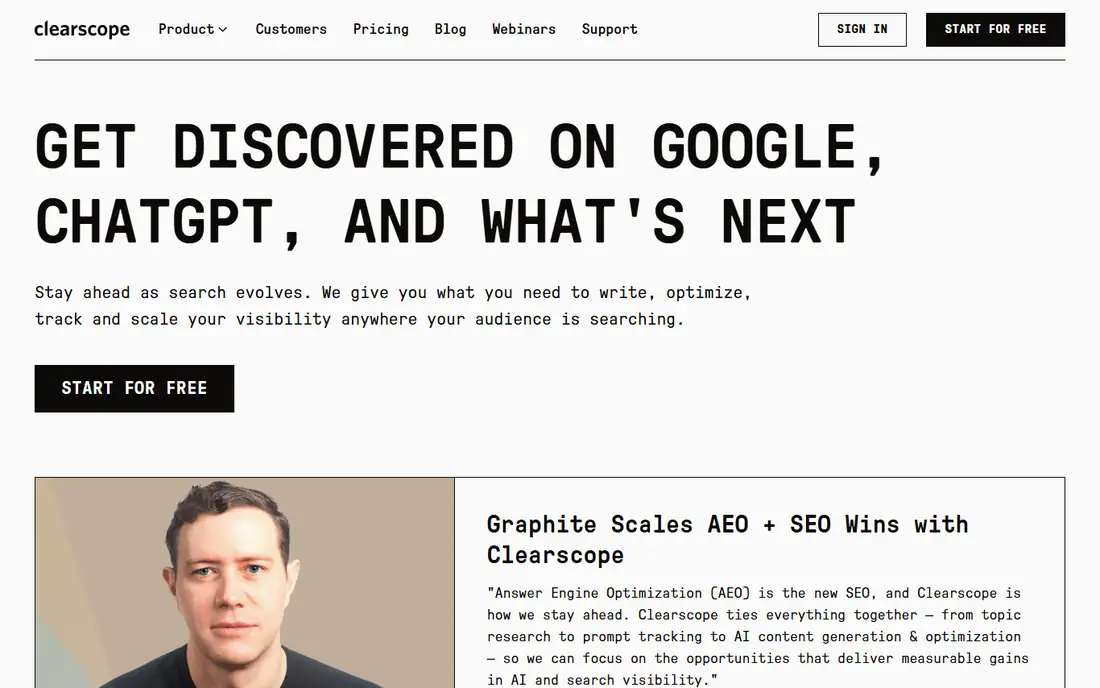
Clearscope focuses on one job and does it well: helping writers create content that covers a topic fully. It analyzes top-ranking pages, suggests relevant terms, and grades drafts with a letter score that writers can understand without SEO training. That simplicity makes Clearscope popular with editorial teams and agencies that hand briefs to freelance writers. It does not replace a full SEO suite, since it lacks deep technical audits, backlink analysis, and rank tracking at the level of Semrush or Ahrefs. Teams that already have an audit tool and mainly need better briefs will get the most value here, especially for high-volume content programs.
- Clear content grades
- Strong brief generation
- Simple interface for writers
- No full site audit suite
- Pricing is per report credit on many plans

Frase speeds up the research phase by building briefs from top search results, including common questions, headings, and terms to cover. Writers can then draft inside Frase with AI assistance, and the editor scores content as it grows. That workflow suits teams that publish often and need to move from keyword to draft quickly. Frase is more affordable than several rivals, which helps smaller teams and freelancers. The trade-off is depth, since its scoring and analysis are less detailed than enterprise tools for competitive topics, and AI-generated drafts always need editing for accuracy and voice. For speed plus structure, Frase is a practical pick.
- Fast brief creation
- AI writing assistance
- Question research from search results
- Output needs human editing
- Optimization depth is lighter than Surfer for some topics
MarketMuse takes a strategy view, scoring a whole site inventory and showing which topics are covered well, which are thin, and where new content would help most. Its topic models analyze how thoroughly a subject is covered, rather than just counting keywords, which helps teams plan clusters instead of isolated posts. That planning strength suits larger content programs and agencies managing multiple sites. The price is higher than brief tools, and the interface takes time to learn, since it presents more data than a simple editor score. Teams that already publish a lot and need to decide what to write next, not just how to write it, will benefit most from MarketMuse.
- Topic modeling and content gap analysis
- Inventory scoring
- Strategy-level insights
- Higher price point
- Learning curve for new users
Semrush is the broadest tool on this list, combining keyword research, rank tracking, site audits, backlink data, and competitor analysis with newer AI features. Its AI toolkit includes content creation, optimization, and brand visibility tracking in AI search, plus ContentShake AI for faster drafts. That breadth means one subscription can replace several smaller tools for marketing teams. The downside is complexity and cost, since the interface covers many modules and higher tiers or add-ons are needed for full team use. Semrush suits teams that want classic SEO depth plus AI features in one platform, rather than a narrow AI-only tool.
- Huge keyword and competitor database
- Site audits
- AI visibility and content tools
- Cost rises with team seats and add-ons
- Interface can feel crowded
Ahrefs is known for backlink and keyword data, and it has added AI-related tracking for brand mentions in AI answers and search overviews. Its site audit, content explorer, and rank tracker remain core strengths, giving teams reliable data for technical fixes and content planning. Ahrefs data is often praised for depth, especially for link research and competitor analysis. The main limits are price, since full access requires a paid plan, and AI tracking coverage that is still maturing compared with its classic SEO data. Teams that already trust Ahrefs for keyword and link work can add AI visibility tracking without switching platforms.
- Strong backlink and keyword data
- Site audit
- AI brand visibility features
- No free plan for full tools
- AI features are newer than core SEO features
Scalenut combines keyword planning, brief creation, AI writing, and content optimization in a single workflow at a lower starting price than enterprise suites. That all-in-one design appeals to small teams and solo creators who want to move from research to published draft without juggling multiple tools. It also includes traffic insights that help prioritize topics by potential value. Data depth is lighter than Semrush or Ahrefs, especially for backlinks and competitor analysis, so larger teams may still need a second tool. AI drafts also need human review for facts, since generated text can include errors or outdated claims. For budget-conscious content teams, Scalenut offers good coverage per dollar.
- Lower starting price than many rivals
- Briefs, AI writing, and optimization in one flow
- Traffic analysis
- Data depth is lighter than Semrush or Ahrefs
- AI drafts need careful fact checking
ContentShake AI is Semrush's AI content tool, designed to turn a topic idea into a structured draft with optimization suggestions based on Semrush search data. It helps writers start faster, with outlines, headings, and suggested terms, and it can publish or export drafts for further editing. The tool is most useful for teams already using Semrush, since its data and workflow tie into that ecosystem. As a standalone product, it does not replace keyword research, audits, or rank tracking, so buyers should view it as a content companion rather than a full SEO platform. For Semrush users who want faster drafts, ContentShake AI is a natural add-on.
- Built with Semrush data
- Fast idea and draft generation
- Optimization suggestions
- Works best with a Semrush subscription
- Less suited as a standalone SEO suite
How we picked these
We compared official feature pages, pricing pages, AI visibility features, and public reviews for tools that support both classic SEO and AI search optimization. We favored tools with real optimization scoring, brief generation, or AI mention tracking, rather than generic AI writers with no SEO data. We did not run ranking experiments on each tool, and AI search results change frequently, so readers should trial tools with their own topics before committing.
How to choose the right generative AI SEO tool
Start by deciding whether your main need is content creation, optimization, strategy, or AI visibility tracking, since no tool leads on all four. Check whether AI tracking covers your topics and regions, and test it with your own brand terms during a trial. Keep human editing in the workflow, since AI drafts can miss nuance, invent facts, or repeat competitor phrasing. Finally, track both classic rankings and AI citations over time, and judge a tool by traffic and conversions, not by scores alone.
FAQ
What is generative AI SEO?
Generative AI SEO is the practice of optimizing content so it ranks in classic search and gets cited or mentioned in AI-generated answers. It includes clear structure, factual accuracy, topic coverage, and brand visibility in AI tools. Classic SEO basics such as keyword research, technical health, and quality content still apply.
How do I track visibility in AI search?
Use tools such as Surfer, Semrush, or Ahrefs that track brand mentions and citations in AI answers for your chosen prompts and topics. Set up a consistent prompt set, check results regularly, and compare trends rather than single snapshots. AI answers vary by prompt wording and timing, so tracking is directional, not exact.
Can AI write SEO content for me?
AI can draft outlines and first versions quickly, but human editing is needed for accuracy, original insight, and brand voice. Pages that are purely generated without review risk errors, thin content, and poor user experience. Use AI for research and drafts, then edit, fact-check, and add expert detail before publishing.
Is Surfer or Clearscope better for content optimization?
Surfer suits teams that want a full editor plus keyword research, audits, and AI tracking in one tool. Clearscope suits teams that want simple, writer-friendly briefs and grades without a full suite. Choose Surfer for breadth, and Clearscope for simplicity and editorial workflow.
Do I still need classic SEO tools for AI search?
Yes, classic tools remain important, because AI systems draw on indexed web content, rankings, and authority signals. Keyword research, technical audits, and backlink data still shape which pages AI systems surface. Generative AI SEO adds a layer on top of classic SEO, rather than replacing it.