Best Fraud Protection Software in 2026: 9 Tools Compared
Compare the best fraud protection software for online stores, from chargeback guarantees to device checks, and find the right fit for your sales volume.
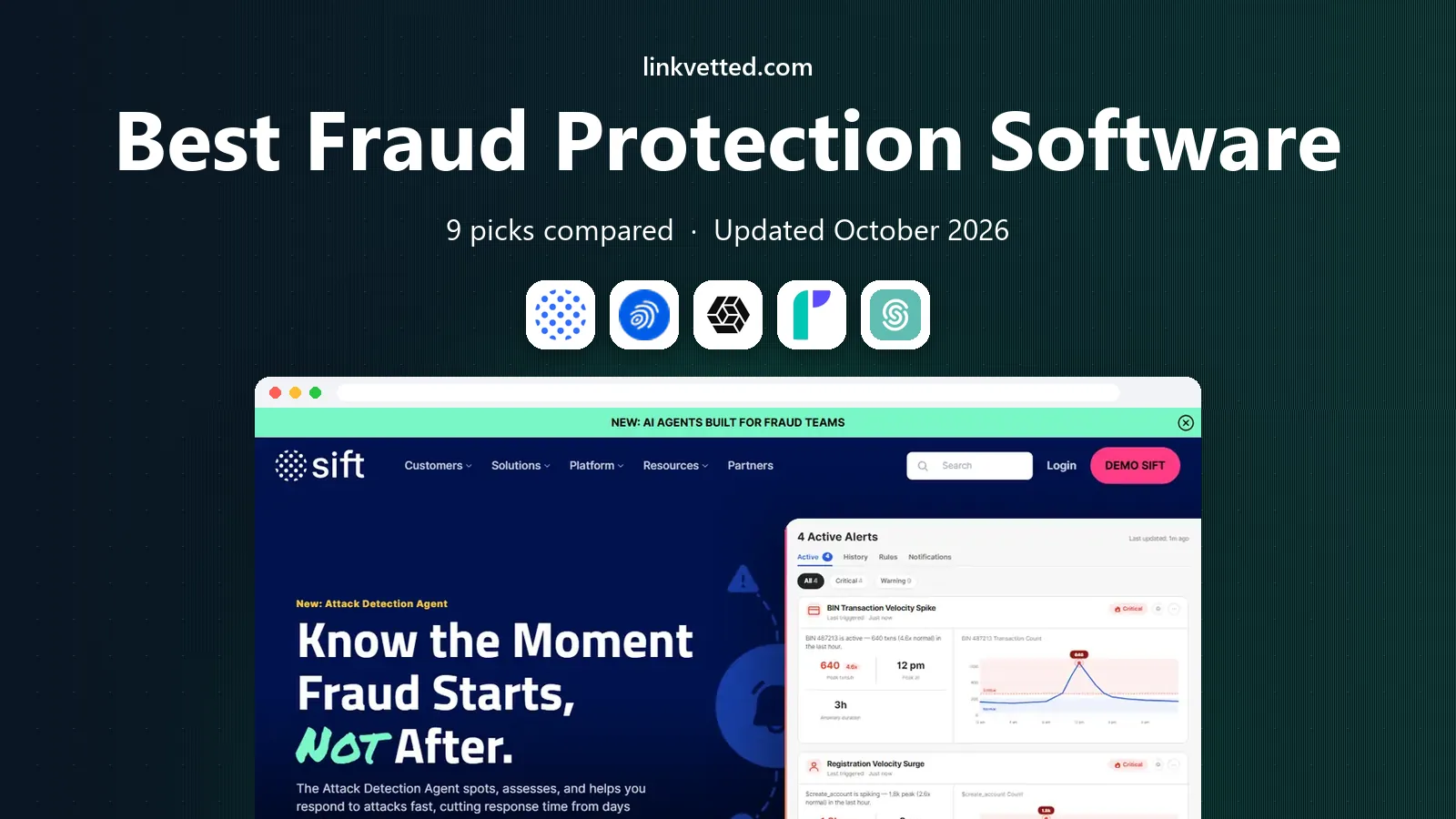
- Editor's choice
 Sift
Marketplaces and platforms with account fraud
Starts atSee websiteVisit sift.comFull review - Great alternative
 Forter
Large retailers focused on approvals
Starts atSee websiteVisit forter.comFull review - Also consider
 Signifyd
Stores wanting a chargeback guarantee
Starts atSee websiteVisit signifyd.comFull review
TL;DR:
- The best fraud protection software for most mid-size stores is either a chargeback guarantee service or a scoring tool, and the right choice depends on who should carry the loss when fraud slips through.
- SEON, Fingerprint, and FraudLabs Pro publish starting prices, while Sift, Forter, Signifyd, Riskified, and ClearSale mostly price by volume, so expect a sales conversation for those.
- Small stores do not need an enterprise platform at first, and a low-cost tool plus strong checkout controls can cover a large share of common fraud.
- Approval rate matters as much as blocked fraud, because rejected good orders cost revenue too, so any trial should track both numbers.
Quick comparison
| Tool | Best for | Starts at | Free plan? | |
|---|---|---|---|---|
| Sift | Marketplaces and platforms with account fraud | See website | No | Visit |
| Forter | Large retailers focused on approvals | See website | No | Visit |
| Signifyd | Stores wanting a chargeback guarantee | See website | No | Visit |
 Riskified | Enterprise sellers across many countries | See website | No | Visit |
 SEON | Teams wanting transparent pricing and control | $699 per month | Free trial | Visit |
 Stripe Radar | Stores already processing with Stripe | See website | Yes | Visit |
 Fingerprint | Developers adding device identification | $99 per month | Yes | Visit |
 ClearSale | High-risk and international sellers | $250 per month | No | Visit |
 FraudLabs Pro | Small stores on a tight budget | $29.95 per month | Yes | Visit |
The best fraud protection software
These tools cover different jobs, from approving orders to spotting fake accounts, so we grouped them by the problem each one solves best.
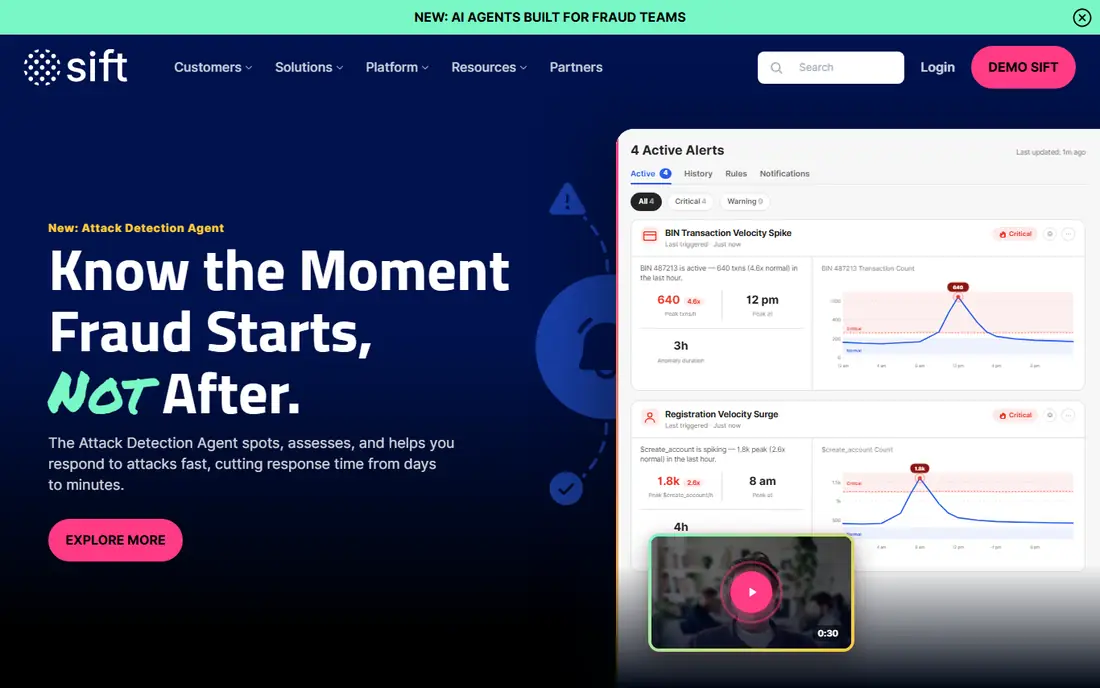
Sift fits teams that face more than checkout fraud. A marketplace, for example, must also deal with fake seller accounts, promo abuse, and account takeovers, and Sift is built to score events across that whole journey. Its network effect is the main selling point, because patterns seen at one customer can inform scores for others, without sharing private customer details in a way a store would see directly. That breadth helps when fraud moves from payments to another weak spot.
The trade-off is complexity. Pricing is not published, so a small store cannot tell quickly whether Sift fits its budget, and the platform rewards teams that can review scores, tune thresholds, and act on alerts. Stores with only a few hundred orders a month may find a simpler guarantee product easier to run. Larger platforms with a fraud analyst, or at least a dedicated owner, will get more from it.
- Covers payment, account, and content abuse in one platform
- Large shared network of signals
- Custom rules and machine learning scores
- Custom pricing makes budgeting hard
- Setup and tuning take real staff time
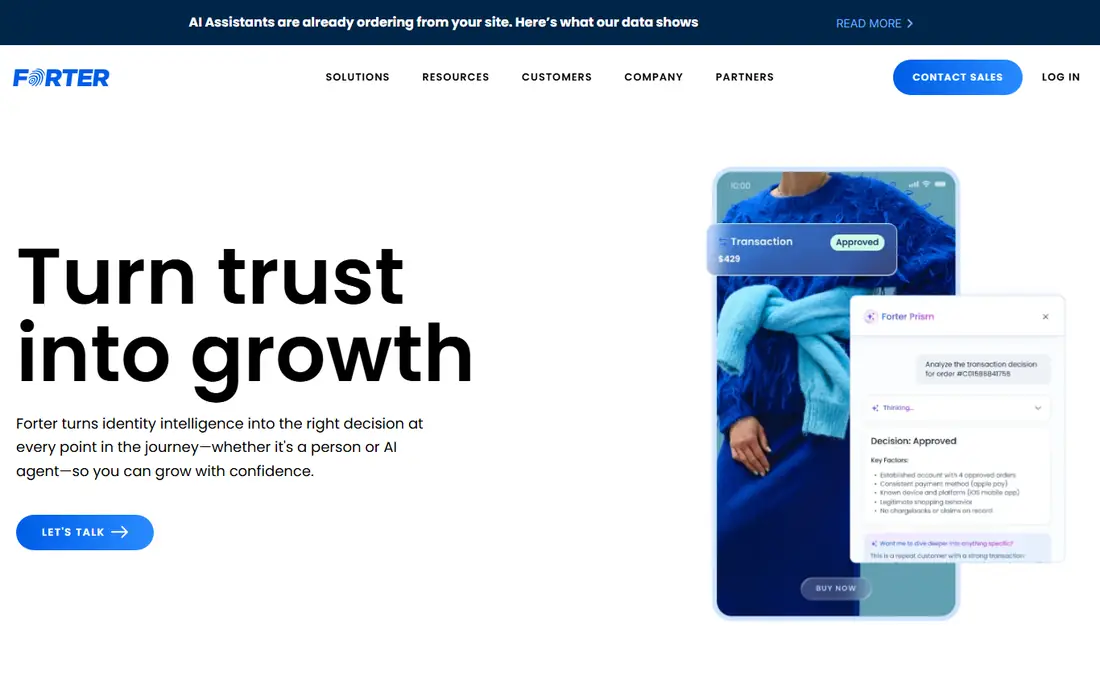
Forter takes an identity-first approach, linking signals about a shopper, device, and payment method to decide whether an order looks like a known good customer or a risky identity. For large retailers, that matters because the cost of declining a good customer can be larger than the cost of one fraud loss. Forter reports strong reductions in false declines for its customers, and its pitch is built around approving more good orders, not only blocking bad ones.
The catch is scale. Forter is aimed at high-volume merchants, and its custom pricing and integration work reflect that. A small shop will likely be steered elsewhere, or will pay more than it needs to for the volume it processes. For a large store with complex checkout, returns, and loyalty abuse, though, that depth is exactly the point.
- Identity-based decisions in real time
- Strong focus on approval rates and false declines
- Covers account and policy abuse
- Enterprise pricing and onboarding
- Less suited to very small stores
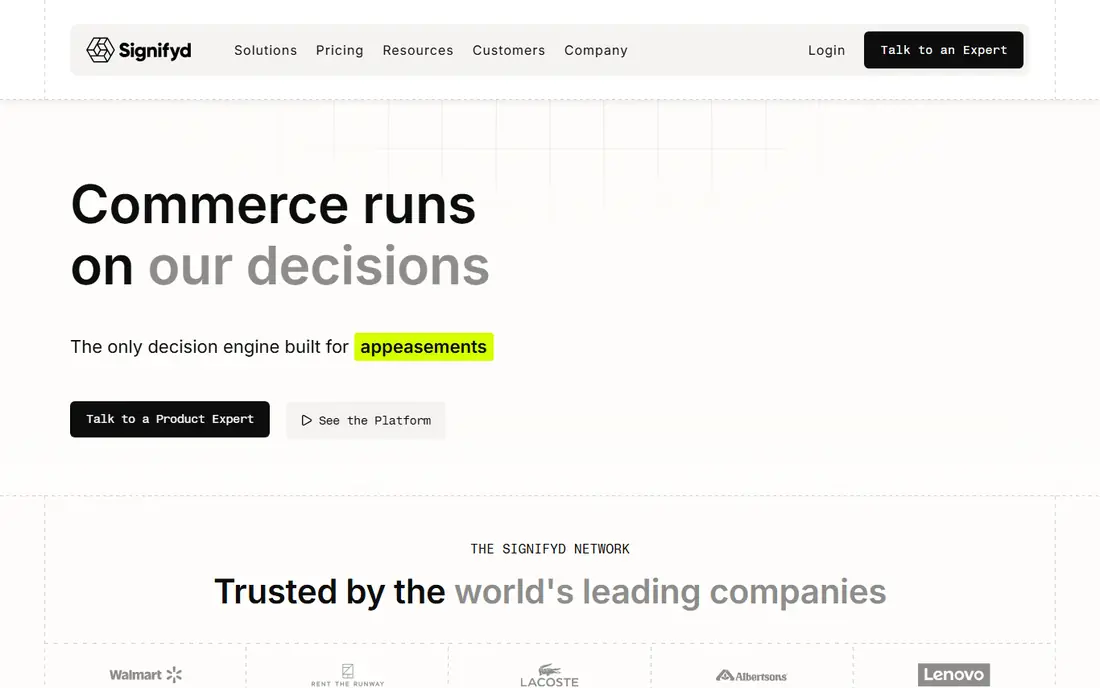
Signifyd is our pick for many mid-size stores because its model is easy to understand. When Signifyd approves an order, it backs that decision with a guarantee, and it covers qualifying fraud chargebacks on those orders. That shifts a large part of the fraud risk from the merchant to the vendor, which can make budgeting and planning simpler than running an in-house scoring team. It also integrates with common ecommerce platforms, so setup is often faster than a fully custom build.
The cost model needs attention. Because pricing is tied to order value, a store with high average order values will pay more per order than a store selling low-priced goods. Guarantee coverage also has rules, so digital goods, certain categories, and unusual fulfillment patterns may be treated differently. Read the guarantee terms before signing, and compare the fee against your current fraud loss and the time your team spends on manual review.
- Financial guarantee on approved orders
- Clear transfer of fraud risk
- Broad ecommerce platform integrations
- Pricing is based on order value, so costs rise with sales
- Guarantee terms and exclusions need careful reading
Riskified suits large merchants selling across borders, where payment methods, fraud patterns, and chargeback rules vary by country. Its platform combines fraud scoring with a chargeback guarantee, plus tools for policy abuse such as returns and promo misuse. That combination helps when the problem is not only stolen cards, but also customers and resellers gaming store policies at scale.
For smaller stores, Riskified is usually more than needed, and its pricing will reflect its enterprise positioning. Margin also matters. If a store sells low-margin products, a fee based on order value can eat into profit even when fraud falls. Larger merchants with thin fraud teams often value the guarantee and the managed decision-making enough to accept that cost.
- Chargeback guarantee and policy abuse tools
- Strong international coverage
- Checkout and account protection
- Enterprise focus and custom pricing
- Guarantee cost can be high for lower-margin goods
SEON stands out in this list because its pricing is public, which makes it easier to compare honestly. The Starter plan starts at $699 per month for a set number of checks, and the platform focuses on digital footprinting, device intelligence, and email and phone checks that help spot risky signups and orders. Teams that want to own their fraud rules, rather than hand every decision to a guarantee vendor, often prefer this model.
That control comes with work. SEON gives you signals and a rule engine, but your team still decides what to block, review, or allow. That is a strength for fintech, gaming, and marketplace teams with fraud expertise, and a weakness for stores that want a hands-off answer. If your monthly check volume grows, costs rise too, so forecast volume before choosing a tier.
- Published pricing from $699 per month
- Digital footprint and device checks
- Flexible rules teams can manage themselves
- Starter plan is a real commitment for small stores
- Teams still need to build and tune their own rules
Stripe Radar is the simplest starting point for any store already using Stripe for payments. Radar is included in a basic form with Stripe payments, and it uses network data from across Stripe to flag risky payments. Because it sits inside the payment flow, there is no separate vendor to integrate for basic screening, and teams can add custom rules and block lists as they learn their own fraud patterns.
The limitation is scope. Radar is a payment fraud tool first, not a full account protection or policy abuse platform, so stores with fake accounts or return abuse will need another tool alongside it. Advanced Radar features also carry extra fees, and pricing depends on the Stripe plan and volume. Still, for a Stripe store, it is hard to beat as a first layer, and it pairs well with a guarantee tool for high-risk orders.
- Built into Stripe checkout
- No separate integration for basic protection
- Machine learning trained on Stripe network data
- Best value inside the Stripe ecosystem
- Advanced features cost extra and may still need manual rules
Fingerprint does one job well, which is telling whether a visitor is using a known device, a new device, or a device linked to prior abuse. That signal is useful at signup, login, and checkout, and it helps catch account takeovers and multi-account abuse that a payment check alone would miss. Pricing starts at $99 per month for a set number of API calls, with a free tier for small volumes, so developers can test it without a large commitment.
Buyers should not mistake Fingerprint for a complete fraud platform. It returns an identifier and related signals, and your team, or another fraud tool, must turn those signals into allow, review, or block decisions. For product teams building their own risk logic, that flexibility is a plus. For a store that wants an out-of-the-box verdict, a scoring or guarantee product will be simpler.
- Accurate browser and device identification
- Free tier for small use
- Useful for signup, login, and checkout checks
- It identifies devices, it does not decide fraud on its own
- Teams must combine it with rules or another platform
ClearSale combines automated screening with human analysts, which helps on orders where a score alone is not enough. A high-value order from a new international customer, for example, might be declined by a purely automated system, while an analyst can check the details and approve it. ClearSale also offers chargeback guarantee options on some plans, starting at $250 per month for growth plans, which gives smaller high-risk sellers a path to a guarantee without enterprise pricing.
The trade-off is speed and cost on some orders. Human review is a strength for accuracy, but it can slow down edge cases, and guarantee terms still need review. Stores with very low order values may find the monthly minimum hard to justify, while stores selling higher-priced goods, or selling internationally, often find the analyst layer worth the cost.
- Human analyst review behind automated checks
- Chargeback guarantee options
- Experience with international orders
- Growth plans start at $250 per month
- Human review can add time on complex orders
FraudLabs Pro is the budget pick in this list, and it fills a real gap for micro and small stores. The free Micro plan covers a limited number of queries per month for stores with low sales, and the Mini plan starts at $29.95 per month. It screens orders using IP, email, device, and other signals, and it integrates with common ecommerce platforms, so a small store can add a fraud check without hiring a fraud team.
Expect limits. FraudLabs Pro does not offer the same network depth, guarantee, or analyst review as the larger vendors, and its free tier will not suit a growing store for long. For a new store learning its fraud patterns, though, it is a sensible first step. Upgrade when order volume, chargeback losses, or manual review time make a larger platform cheaper than the status quo.
- Free tier for very small stores
- Low starting price
- Simple risk scores and rules for common platforms
- Less depth than enterprise platforms
- Free tier limits queries and is suited to low sales volume
How we picked these
We compared official feature pages, pricing pages, app and platform listings, and public reviews for fraud tools that are actively sold in October 2026. We favored products with a clear job, published or obtainable pricing, and a track record with real merchants, and we mixed guarantee services, scoring platforms, and single-purpose tools so readers can match the tool to their actual problem. We did not claim hands-on testing that did not happen, and we treated vendor claims about approval rates and loss reductions as vendor claims, not verified results for every store.
What to check before you sign
A fraud tool is only as good as the trial behind it, so run any shortlist against your own orders before committing to a long contract.
Start with your fraud pattern, not the feature list
Look at your last six months of chargebacks, refunds, and manual reviews, and sort them by type. Stolen cards, friendly fraud, fake accounts, and promo abuse need different tools, and a vendor that is strong on one may be weak on another. If most losses come from one pattern, pick the tool built for that pattern first.
Test approval rate, not only blocked fraud
Ask for a trial or shadow mode where the tool scores orders without blocking them, then compare its decisions with your actual outcomes. Track how many good orders it would have declined, how many fraud orders it would have caught, and how much manual review it would have created. A tool that blocks fraud but also blocks good customers can cost more than it saves.
Read guarantee and pricing terms closely
For guarantee products, check which order types are covered, what evidence is needed for a claim, and how quickly claims are paid. For per-check or per-order pricing, forecast your volume at peak season, not only at an average month. Confirm contract length, renewal terms, and what happens to your data if you leave.
FAQ
What is the best fraud protection software for a small online store?
For a small store, start with the fraud tools built into your payment provider, such as Stripe Radar, and add FraudLabs Pro or a similar low-cost screener if chargebacks rise. A guarantee product makes sense once order volume and fraud losses are high enough that the fee is less than the loss plus the time spent on reviews.
Do fraud protection apps guarantee against chargebacks?
Some do, and some do not. Signifyd, Riskified, and ClearSale offer guarantee options on approved orders, subject to terms and exclusions, while scoring tools like Sift, SEON, and Fingerprint help you decide but leave the final loss with you. Always read the guarantee terms for covered order types and claim rules.
What are the best fraud protection apps for marketplaces?
Marketplaces need account and content abuse coverage as well as payment checks, so Sift and Forter are common fits, with Fingerprint as a device signal underneath. A payment-only tool will miss fake seller accounts and promo abuse, which are often the larger problem for a platform.
How much does fraud protection software cost?
Costs range from free tiers for very small stores to $29.95 per month for FraudLabs Pro, $99 per month for Fingerprint, $250 per month for ClearSale growth plans, and $699 per month for SEON Starter, with enterprise guarantee vendors priced by volume. Confirm the current price on the vendor site, since tiers and check limits change.
Can fraud software reduce false declines?
Yes, when it is tuned well. Identity and network data can help approve good customers who look risky on a single signal, such as a new device or a shipping address that differs from billing. Track approval rate during a trial, and do not judge a tool only by how much fraud it blocks.