Best Feedback Analytics Software in 2026: 8 Tools Compared
We compared the best feedback analytics software for surveys, tickets, and reviews, so you can turn customer comments into clear product decisions fast.
- Editor's choice
 Qualtrics
Enterprise experience management
Starts atSee websiteVisit qualtrics.comFull review - Great alternative
 Medallia
Real-time CX intelligence at scale
Starts atSee websiteVisit medallia.comFull review - Also consider
 Enterpret
AI-first theme analysis tied to revenue
Starts atSee websiteVisit enterpret.comFull review
TL;DR:
- Qualtrics and Medallia suit enterprises that need surveys, operations, and closed-loop action in one platform.
- Enterpret, Chattermill, and Thematic lead for AI theme detection across tickets, calls, reviews, and chats.
- Productboard and Canny suit product teams that want feedback flowing straight into roadmaps and voting boards.
- Dovetail suits research teams that need a searchable home for interviews and qualitative work.
- Pricing ranges from free tiers to six-figure enterprise contracts, so start with the channels you actually collect.
Quick comparison
| Tool | Best for | Starts at | Free plan? | |
|---|---|---|---|---|
| Qualtrics | Enterprise experience management | See website | Free trial | Visit |
| Medallia | Real-time CX intelligence at scale | See website | No | Visit |
| Enterpret | AI-first theme analysis tied to revenue | See website | No | Visit |
 Chattermill | Unified feedback intelligence | See website | No | Visit |
 Thematic | Hands-on control over AI themes | See website | No | Visit |
 Productboard | Feedback into roadmaps and prioritisation | $19 per maker per month | Free trial | Visit |
 Canny | Public feature request boards | $79 per month | Yes | Visit |
 Dovetail | Research repository and qualitative analysis | $30 per month | Free trial | Visit |
The best feedback analytics software
We compared vendor pages, pricing disclosures, and public reviews to find tools that analyse feedback, not just collect it. The list covers enterprise experience platforms, AI-first analytics tools, and product feedback tools, so start with the decision you need to make.
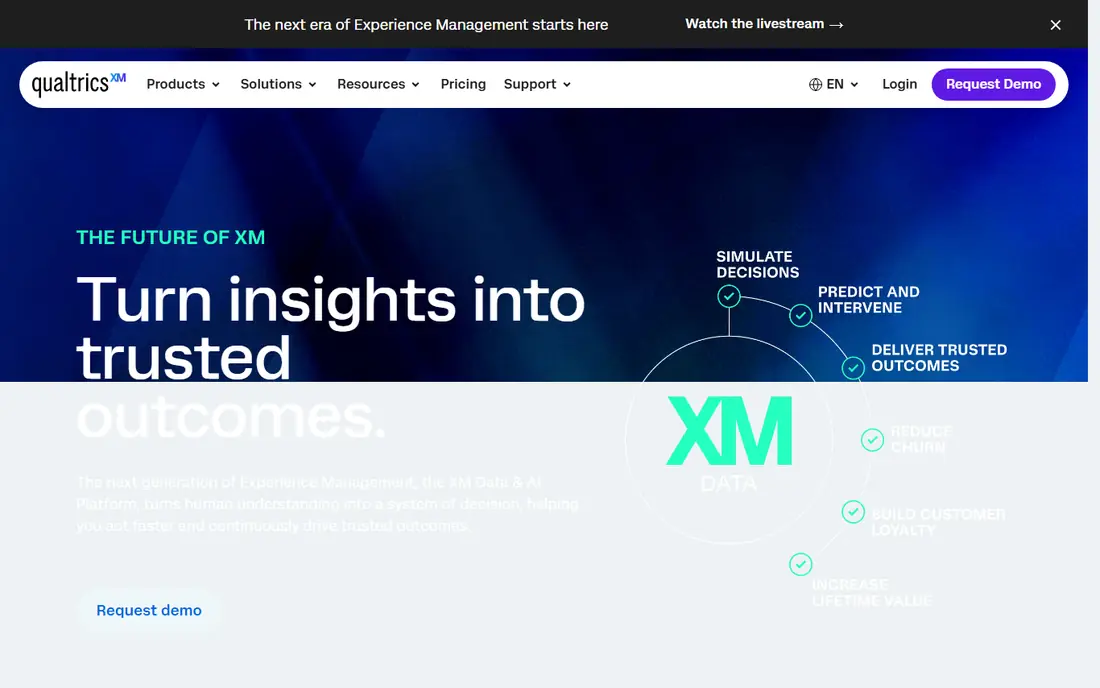
Qualtrics suits enterprises that run large experience programmes across customers, employees, and products. Surveys, digital feedback, contact centre data, and social signals can feed one platform, while text analytics tools such as Text iQ find themes in open comments. Predictive features help teams spot churn risk and prioritise fixes, which matters when feedback volume runs into the tens of thousands.
The trade-off is scale and cost. Pricing is quote-only and enterprise contracts can reach six figures, while setup often needs professional services to configure surveys, integrations, and dashboards. Small teams will find Qualtrics more than they need. Large organisations that need one system for surveys, operations, and closed-loop action will find it a strong, if costly, choice.
- Full experience management platform
- Strong survey and text analytics
- Predictive features
- Quote-only pricing
- Implementation often needs professional services

Medallia serves enterprises that need customer signals in near real time, from surveys and reviews to social posts, contact centre calls, and in-store feedback. The Athena AI engine applies text analytics and predictive scoring, so teams can see which themes drive satisfaction and act while the issue is still live. That speed suits retail, hospitality, telecom, and other firms where a service failure spreads fast.
Cost and complexity are the limits. Medallia is quote-only, enterprise-priced, and setup needs planning across channels and teams. Smaller firms should look at Chattermill or Thematic instead. For a large firm that treats customer experience as an operational system, Medallia offers depth that lighter tools cannot match.
- Real-time signal capture
- Athena AI engine
- Broad channel coverage
- Quote-only enterprise pricing
- Complex setup
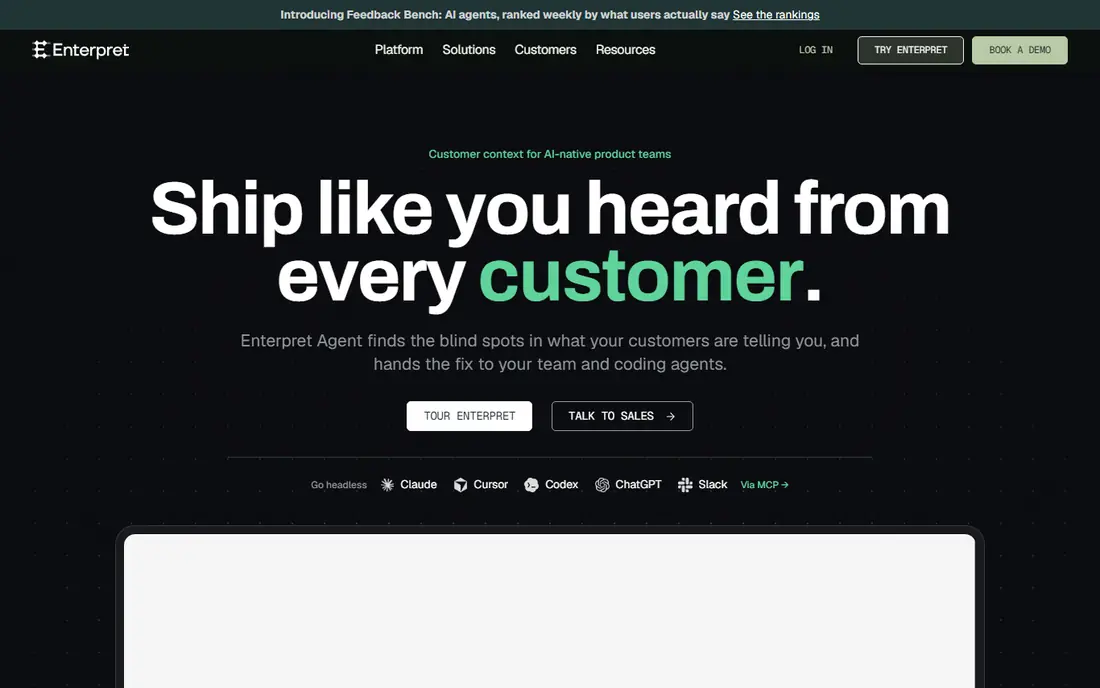
Enterpret is an AI-first pick for product and customer experience teams that need theme-level analysis tied to business context. It ingests feedback from support tickets, reviews, social posts, calls, and surveys, then classifies themes with an adaptive taxonomy and links them to revenue and customer segments. That link matters, because it helps a product team argue for a fix with numbers, not just a pile of quotes.
The tool suits teams with real volume. Pricing is quote-only, and a small team with a few hundred comments a month may not need this depth. For a mid-market or enterprise SaaS team drowning in unstructured feedback, Enterpret turns noise into a ranked list of themes with business weight behind each one.
- Adaptive taxonomy across many channels
- Revenue and segment context
- Strong product team fit
- Quote-only pricing
- Best for teams with large feedback volume
Chattermill unifies feedback from surveys, tickets, reviews, social media, chat, and calls into one analytics layer. Deep learning models detect themes and sentiment, score impact on metrics such as NPS and churn, and alert teams to anomalies. That breadth suits enterprise customer experience teams that run mature, multi-region programmes and need one view of what customers are saying everywhere.
Pricing is quote-only, and the platform is aimed at larger teams, so small firms should check the entry cost early. Implementation also needs care, since channel integrations and taxonomy setup decide how useful the themes become. For an enterprise team that wants quantified feedback intelligence, Chattermill is a leading option.
- Deep learning theme detection
- Links themes to NPS and churn
- Broad integrations
- Quote-only pricing
- Enterprise focus
Thematic appeals to insights teams that want hands-on control over AI-generated themes, rather than a black-box score. Teams can review, edit, and refine themes, then quantify how each theme affects NPS, CSAT, and churn. That control helps when a team must defend a finding to executives or when industry language confuses generic models.
The trade-off is ownership. Thematic works best with an insights owner who will tune themes and check results, and pricing is quote-based. Teams that want a fully automatic dashboard may prefer Chattermill. Teams that want to understand and trust every theme will value Thematic control.
- Transparent theme controls
- Quantifies theme impact
- Strong insights team fit
- Quote-based pricing
- Needs an insights owner to get full value
Productboard suits product teams that want feedback to flow directly into prioritisation and roadmaps, not sit in a separate report. Feedback from portals, email, Slack, Salesforce, and HubSpot can be tagged, scored, and linked to features, while roadmaps show customers and stakeholders what is planned. Published pricing starts at $19 per maker per month billed annually, which makes budgeting easier than quote-only rivals.
The limits are channel depth and tiering. Gong support is limited compared with Enterpret, and higher tiers at $59 per maker per month add features that larger teams may need. For a product team that lives by its roadmap, Productboard turns feedback into a planning system rather than a pile of notes.
- Feedback flows into roadmaps
- Prioritisation frameworks
- Published pricing
- Limited Gong support
- Higher tiers cost more per maker
Canny is the simplest tool on this list, and for many SaaS teams that simplicity is the point. Public feature request boards let customers post, vote, and comment, while product teams link votes to revenue and update a public changelog. The free tier covers a small number of tracked users, and paid plans start near $79 per month billed annually, which keeps costs predictable for a small team.
Canny does not collect NPS or CSAT surveys, so teams that need satisfaction scoring must pair it with another tool. Tracked-user limits also need care, since a plan can upgrade itself when the cap is passed, so set a spend limit on day one. For a SaaS team that wants public boards tied to its roadmap, Canny is a clear, affordable pick.
- Free tier
- Public voting boards
- Revenue-based vote context
- No survey or NPS features
- Tracked-user limits need care
Dovetail suits UX and product teams that need a searchable home for all customer research, from interview transcripts and usability tests to survey comments. AI-powered tagging helps researchers find patterns across studies, while highlight reels and shared projects make findings easy to present. Published pricing starts near $30 per month, with a free trial for testing.
Dovetail is a research repository first, not a survey analytics platform, so teams that need NPS dashboards or ticket analytics should pair it with another tool. Larger teams also need higher tiers for advanced features. For a team that runs regular interviews and wants every insight in one searchable place, Dovetail is a strong choice.
- Searchable research home
- AI tagging for interviews
- Published pricing
- Less focused on survey analytics
- Larger teams need higher tiers
How we picked these
We compared vendor pages, pricing disclosures, and public reviews, and we checked that each homepage belongs to the product named. We favoured tools that analyse unstructured feedback, not just collect surveys, and that link themes to business metrics or product decisions. We gave weight to published pricing where available, since quote-only tools make budgeting hard.
We did not claim hands-on testing that did not happen. Instead, we weighed channel coverage, AI theme quality claims, roadmap and closed-loop features, and the team type each tool serves. That keeps the list useful for an enterprise CX team and a small product team alike, even though their budgets differ.
What to check before you buy
Start with your channels, not with a demo. List where feedback actually arrives: surveys, support tickets, app store reviews, calls, chats, and social posts. A tool that cannot ingest your top two channels will leave your biggest signal outside the analysis, no matter how good its dashboard looks.
Validate themes on your own data
Run a trial with real feedback, not sample data. Check whether themes match your product language, whether sentiment looks right on tricky comments, and whether the tool handles non-English feedback if you need it. AI accuracy claims depend on tuning, so a real-data trial is the only honest test.
Decide who owns the insight
Feedback analytics fails when no one owns it. Name the person or team that will review themes weekly, decide actions, and close the loop with customers. Enterprise tools need an owner for taxonomy and integrations, while product tools need an owner for roadmap decisions.
Price by volume and seats
Ask how pricing scales with feedback volume, tracked users, and seats. Some tools charge by makers, some by tracked users, and some by volume, and each model punishes a different kind of growth. Model your cost at twice your current volume before signing.
FAQ
What is feedback analytics software?
Feedback analytics software collects comments from surveys, tickets, reviews, calls, and chats, then uses AI to find themes, sentiment, and impact. It helps teams see which issues matter most, rather than reading thousands of comments by hand. Product teams use it for roadmaps, while CX teams use it for service fixes.
How much does feedback analytics software cost?
Costs range from free tiers at Canny and trials at Dovetail and Productboard to six-figure enterprise contracts at Qualtrics and Medallia. Mid-market AI tools often cost $8,000 to $60,000 per year depending on volume and seats. Always model cost at higher volume before signing.
What is the difference between Qualtrics and Productboard?
Qualtrics is an enterprise experience platform that runs surveys, operations, and closed-loop action at scale. Productboard is a product management tool that turns feedback into prioritised features and roadmaps. Large firms often use both, with Qualtrics for experience measurement and Productboard for product planning.
Can feedback analytics tools replace surveys?
No. Analytics tools analyse the feedback you collect, but you still need surveys, tickets, and review channels to gather it. Some tools include survey features, but most work best when paired with existing collection channels such as email, in-app prompts, and support systems.
Do I need a separate research tool if I use feedback analytics?
If your analytics tool supports interview transcripts, qualitative coding, and highlight reels, many product teams do not need a separate research repository. Dedicated research teams running heavy generative research may still benefit from Dovetail or a similar tool for deeper study management.
How accurate is AI theme detection?
Leading platforms report high accuracy on theme detection and sentiment for English-language business feedback, especially after tuning to a team's taxonomy. Accuracy falls for niche jargon or non-English data. Always validate with a real-data trial and review themes by hand before acting on them.