Best Experience Management Software in 2026: 8 Platforms Compared
Find the best experience management software for customer and employee feedback. We compare 8 platforms on surveys, analytics, and action tools in 2026.

- Editor's choice
 Qualtrics XM
Enterprise-wide experience programs
Starts atSee websiteVisit qualtrics.comFull review - Great alternative
 Medallia
Operational CX at scale
Starts atSee websiteVisit medallia.comFull review - Also consider
 InMoment
Enterprise CX and journey insight
Starts atSee websiteVisit inmoment.comFull review
TL;DR:
- Qualtrics and Medallia lead enterprise experience management, with broad customer, employee, brand, and product coverage, at enterprise prices.
- InMoment and CustomerGauge suit large B2B and enterprise CX programs that need journey and account-level insight.
- SurveySensum, Retently, Zonka Feedback, and Delighted offer faster, cheaper routes for mid-market teams focused on NPS and feedback action.
- Most enterprise pricing is quoted, so compare response or signal limits, implementation costs, and which modules are included.
Quick comparison
| Tool | Best for | Starts at | Free plan? | |
|---|---|---|---|---|
| Qualtrics XM | Enterprise-wide experience programs | See website | No | Visit |
| Medallia | Operational CX at scale | See website | No | Visit |
| InMoment | Enterprise CX and journey insight | See website | No | Visit |
 CustomerGauge | B2B account experience programs | See website | No | Visit |
 SurveySensum | Mid-market CX and NPS programs | See website | No | Visit |
 Retently | Simple NPS and CSAT tracking | $39 per month | Free trial | Visit |
 Zonka Feedback | Multi-channel feedback collection | See website | Free trial | Visit |
 Delighted | Fast, simple customer surveys | See website | Free trial | Visit |
The best experience management software
Experience management software collects feedback across customers, employees, products, and brands, then turns it into actions: follow up with an unhappy customer, fix a broken journey step, or coach a team. The tools below range from enterprise platforms to simple survey tools, so match the platform to your program size and how fast you need to act.
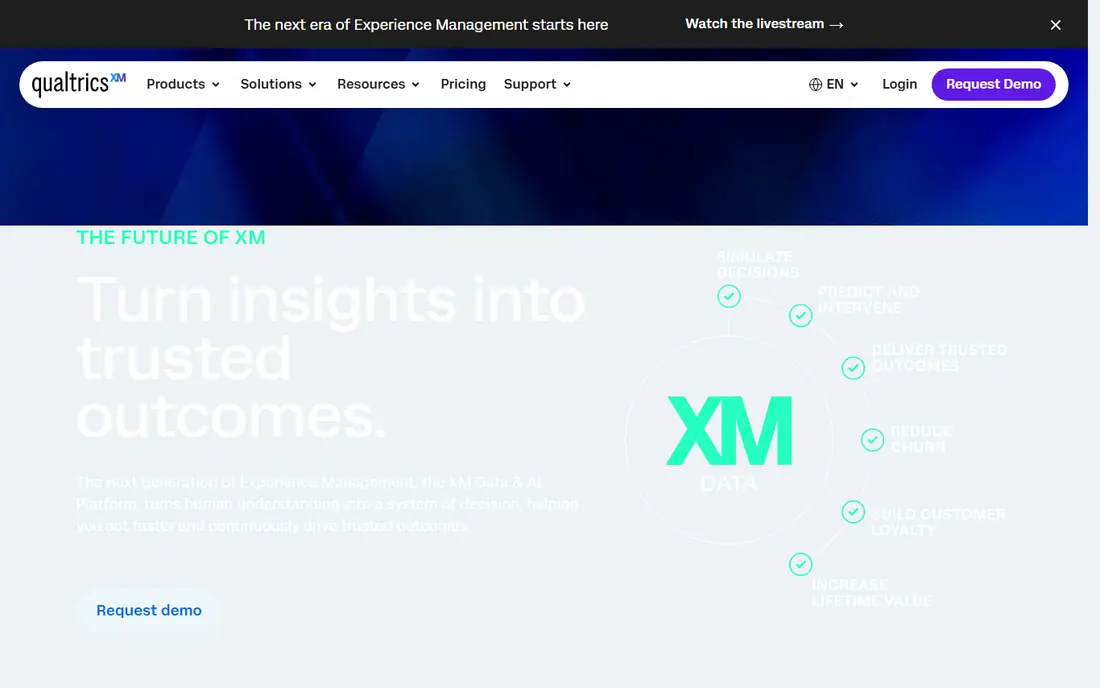
Qualtrics is our pick for a large organization that wants one experience platform across departments. Its XM products cover customer experience, employee experience, brand, product, and research, with advanced analytics, text analysis, and role-based dashboards. A global company can run multi-country programs with governance and permissions that smaller tools cannot match.
The cost is enterprise-level, and implementation often takes weeks to months with partner help. Small teams will find Qualtrics heavy, and pricing is quoted, so budgeting needs a sales conversation. If you run a large, governed experience program, Qualtrics is the most complete platform on this list.
- Broad coverage across customer, employee, brand, and product experience
- Strong research and analytics
- Large partner ecosystem
- Quote-based enterprise pricing
- Implementation can take months
- Needs a dedicated team to run well

Medallia suits large companies that need to act on customer signals in daily operations, not just report on them quarterly. It captures feedback from web, email, messaging, mobile, and contact centers, then routes alerts and tasks to the teams that can fix a problem. Journey tools help teams see where customers struggle across touchpoints.
Pricing is quoted and typically enterprise-level, and implementation takes time and internal ownership. Medallia is not a tool you set up in an afternoon for one survey. For a large CX program where frontline action matters, Medallia is one of the strongest operational choices available.
- Strong operational CX and journey orchestration
- Captures signals across many channels
- AI-assisted analysis
- Quote-based pricing
- Implementation is involved
- Best for large programs, not a quick survey tool

InMoment serves enterprise CX teams that need deep journey insight and text analytics across many locations or brands. Its platform combines surveys, operational data, and feedback signals into dashboards that managers can use to compare sites, teams, and journeys. That depth helps large service, retail, and hospitality companies find patterns a simple survey tool would miss.
InMoment is an enterprise purchase with quoted pricing and a real implementation effort. Mid-market teams that mainly need NPS tracking will get faster value from a simpler tool. For a large program with complex journeys, InMoment is a credible alternative to Qualtrics and Medallia.
- Enterprise CX depth
- Journey and text analytics
- Strong for multi-location and multi-brand programs
- Quote-based pricing
- Implementation can be complex
- Smaller teams may find it heavy
CustomerGauge is built for B2B companies where one account, not one transaction, is the unit that matters. It tracks NPS and experience at the account level, links feedback to revenue and retention signals, and gives account teams closed-loop tasks for at-risk customers. That account view is missing from most consumer survey tools.
Pricing is quoted, and the platform works best when your CRM and account data are clean, since dirty account records weaken the analysis. Consumer brands running simple transactional surveys will find it over-specialized. For a B2B company whose growth depends on keeping key accounts, CustomerGauge is a strong specialist pick.
- Built for B2B account-level NPS
- Links feedback to revenue and retention
- Good closed-loop tools for key accounts
- Quote-based pricing
- B2B focus means less fit for consumer survey programs
- Setup needs account data hygiene
SurveySensum targets mid-market and enterprise teams that want AI-assisted CX without enterprise complexity. It covers NPS, CSAT, and feedback programs across email, SMS, WhatsApp, web, and in-app channels, with text analytics and driver analysis that point to what actually moves scores. Launch times are typically days to weeks rather than months.
Pricing is quoted rather than published, so you will need a call for a firm number. Its research depth is also less than Qualtrics for complex market research. For a team that wants actionable CX insight quickly, SurveySensum offers a good balance of power and speed.
- Faster to launch than enterprise platforms
- AI-assisted text and driver analysis
- Closed-loop action tools
- Pricing is quoted
- Smaller partner ecosystem than Qualtrics
- Less research depth for academic-style studies
Retently is the simplest credible option on this list for a team that mainly needs NPS and satisfaction tracking. Starting at $39 per month, it lets you send surveys, track scores over time, and follow up with respondents, without a long implementation. Small SaaS and service teams can be live in days.
Retently is not a full experience management platform. It lacks the governance, journey orchestration, and research depth of Qualtrics or Medallia, and larger programs will outgrow it. If your goal is clean, regular NPS and CSAT measurement with follow-up, Retently is excellent value.
- Published starting price
- Simple NPS, CSAT, and CES surveys
- Easy setup for small teams
- Narrower than full XM platforms
- Advanced analytics sit on higher tiers
- Best for survey tracking, not enterprise governance
Zonka Feedback suits businesses that collect feedback in person as well as online: clinics, hotels, stores, and restaurants that use tablets, kiosks, or QR codes at the point of experience. Its surveys work across email, SMS, web, and on-site devices, and location reporting helps multi-site teams compare performance. A free trial lets you test the collection flow before paying.
Pricing is plan-based and varies with features and volume, so confirm response limits before you commit. Zonka also offers less enterprise governance than Qualtrics or Medallia. For a multi-location business that needs feedback where the experience happens, Zonka is a practical choice.
- Wide channel coverage including kiosks, tablets, and QR codes
- Good reporting for locations
- Free trial
- Pricing varies by plan and responses
- Less enterprise governance than the largest platforms
- Setup needs channel planning
Delighted is built for speed. Teams can launch a clean NPS or satisfaction survey in hours, collect responses by email or link, and see trends without training a dedicated admin. Integrations with common CRM, helpdesk, and messaging tools help you trigger surveys at the right moment and follow up with unhappy customers.
Delighted is not a replacement for an enterprise XM program. Analytics, journey tools, and governance are lighter than Qualtrics or Medallia, and pricing depends on volume. For a team that wants fast, simple feedback with minimal setup, Delighted is one of the easiest tools to adopt.
- Very fast to set up
- Clean NPS and CSAT surveys
- Good integrations with common business tools
- Narrower analytics than full XM platforms
- Pricing depends on survey volume
- Less suited to complex enterprise programs
How we picked these
We compared official product pages, vendor documentation, and 2026 comparisons of experience management platforms, focusing on feedback channels, analytics, closed-loop action, and pricing transparency. We favored tools that are live today and serve a distinct program size, from a simple NPS survey to a global enterprise XM program. We did not claim hands-on program testing, and we treated quoted pricing as quoted.
How to choose an experience platform
Start with the action you need, not the survey you want to send. If frontline teams must follow up with unhappy customers within a day, you need alerts and closed-loop tasks, not just a dashboard. If leaders need journey insight across locations, you need text analytics and location reporting. If you only need a monthly NPS score, a simple tool will serve you better than an enterprise platform.
Pilot with one journey first
Run a pilot on one customer journey or one employee group, not your whole organization. Test survey delivery, response rates, alert routing, and whether managers actually act on the data. A pilot shows whether the platform changes behavior, which is the real test of experience software.
Price responses, implementation, and ownership
Ask each vendor for the full cost: license, response or signal limits, implementation, training, and the internal time needed to run the program. Enterprise platforms often add large services costs to the license, while simpler tools cost less but need your team to own analysis. Choose the total cost you can sustain for at least a year.
FAQ
What is experience management software?
It is software that collects feedback about customer, employee, product, and brand experiences, analyzes it, and helps teams act on it. Typical features include surveys, text analytics, dashboards, alerts, and closed-loop tasks that route an unhappy customer or employee issue to the right person.
Is Qualtrics or Medallia better for a large company?
Both suit large companies, with different strengths. Qualtrics offers broader coverage across customer, employee, brand, and research programs, while Medallia leans toward operational CX and journey action at scale. Compare them on your main use case, implementation timeline, and total services cost, not just the license price.
Can a small business use experience management software?
Yes. Tools such as Retently, Delighted, and Zonka Feedback offer simple surveys, trials, and lower starting prices for small teams. Start with one survey type, such as NPS or post-service satisfaction, and expand only when you act consistently on the results.
How often should I survey customers?
It depends on the journey. Transactional surveys work best soon after an interaction, while relationship surveys such as NPS work best quarterly or twice a year. Surveying too often causes fatigue and lower response rates, so coordinate surveys across teams and respect customer contact limits.
What is closed-loop feedback?
Closed-loop feedback means following up with individual respondents, especially unhappy ones, to resolve their issue and learn from it. Open-loop feedback only reports aggregate scores. Closed-loop tools assign tasks, track resolution, and help teams spot patterns that need a wider fix.