Best Enterprise Workflow Orchestration Platform in 2026: 9 Platforms Compared
Compare the best enterprise workflow orchestration platform in 2026, from Camunda and Temporal to Airflow and Prefect, with pricing, retries and fit today.

- Editor's choice
 Camunda
Business processes and human tasks
Starts atSee websiteVisit camunda.comFull review - Great alternative
 Temporal
Durable code workflows
Starts atSee websiteVisit temporal.ioFull review - Also consider
 Astronomer
Managed Apache Airflow
Starts atSee websiteVisit astronomer.ioFull review
TL;DR:
- Workflow orchestration is about running complex, long-lived processes reliably, not just linking two apps, so judge tools on retries, state and observability.
- Camunda suits business processes with human tasks, while Temporal, Airflow, Prefect and Dagster suit data and code-driven workflows.
- ServiceNow and Workato suit firms that want orchestration inside a wider enterprise platform, rather than a standalone engine.
- Open-source engines can be free to run, but managed hosting, support and operations time still cost money.
- Test failure handling first, because a workflow that cannot retry, pause and resume safely will fail in production.
Quick comparison
| Tool | Best for | Starts at | Free plan? | |
|---|---|---|---|---|
| Camunda | Business processes and human tasks | See website | Free trial | Visit |
| Temporal | Durable code workflows | See website | Yes | Visit |
| Astronomer | Managed Apache Airflow | See website | Free trial | Visit |
 Prefect | Data workflows and orchestration | Free | Yes | Visit |
 Dagster | Data pipelines and assets | Free | Yes | Visit |
 Apache Airflow | Open-source data orchestration | Free | Yes | Visit |
 ServiceNow | Enterprise workflows in ServiceNow | See website | No | Visit |
 Workato | Business integration orchestration | See website | No | Visit |
 Nintex | Process workflows and documents | See website | Free trial | Visit |
The best enterprise workflow orchestration platform
Enterprise workflow orchestration coordinates many steps, systems and people into one reliable process. A loan approval, an order fulfilment flow or a nightly data pipeline may run for minutes, days or weeks, with retries, approvals and errors along the way. The platforms below handle that coordination, with different strengths for business processes and data work.
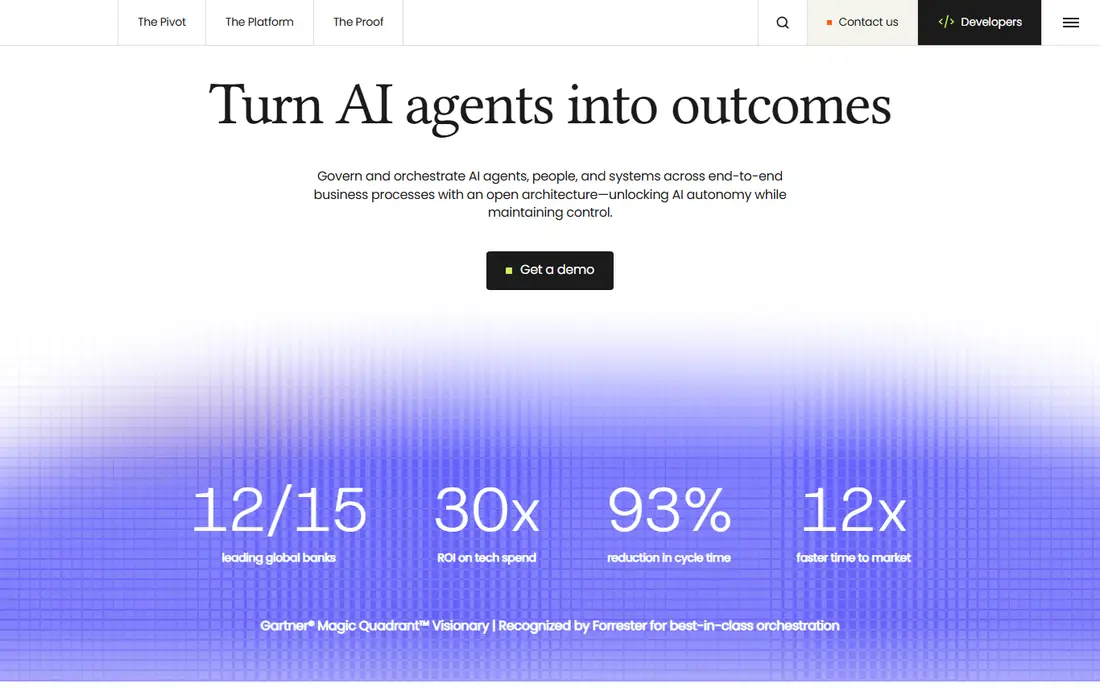
Camunda is a process orchestration platform built around BPMN, the standard notation for business processes. Teams model a process visually, add human tasks, timers, decisions and system steps, and Camunda runs it reliably, including processes that wait days for an approval. That visibility helps business and IT teams agree on how a process should work.
Camunda rewards firms that invest in process modelling. Without clear process ownership, a large set of models can become hard to maintain. For approval-heavy, regulated or long-lived business processes, Camunda is one of the strongest enterprise choices.
- BPMN process modelling
- Human task management
- Strong for long-running business processes
- Quoted pricing
- Modelling discipline needed for large process sets

Temporal lets developers write workflows as code, with durable execution that survives crashes, restarts and long waits. If a service fails mid-process, Temporal can resume from the last safe point rather than starting again. That reliability matters for order processing, payments, booking and other multi-service workflows.
Temporal is developer-focused, so business users will not model processes visually in the same way as with Camunda. Managed cloud pricing is usage-based, while self-hosting is possible for teams with operations skill. For code-driven, long-running workflows, Temporal is a leading choice.
- Durable execution for code workflows
- Automatic retries and state recovery
- Strong for microservices
- Developer-focused
- Managed cloud pricing varies by usage
Astronomer provides managed Apache Airflow, the widely used open-source tool for scheduling and orchestrating data pipelines. Teams get Airflow without running the infrastructure themselves, plus observability, deployment and support features. That suits data teams that already use Airflow or plan to standardise on it.
Airflow is a data engineering tool, not a business process modeller, so human approvals need extra design. Pricing is quoted for managed use. For data pipelines at enterprise scale, Astronomer is a practical way to run Airflow reliably.
- Managed Airflow with support
- Scheduling and observability
- Strong data pipeline ecosystem
- Quoted pricing
- Airflow itself needs data engineering skill
Prefect is a workflow orchestration tool for data teams, built around Python. Developers define flows, tasks, retries and schedules in code, then monitor runs, logs and failures from a dashboard. Cloud and self-hosted options give teams control over where workflows run.
Prefect has a free tier for getting started, with paid tiers for team and enterprise features. It is less suited to visual business process modelling with human tasks. For Python data workflows that need reliable scheduling and clear failure handling, Prefect is a strong choice.
- Python-native workflow building
- Good observability and retries
- Cloud and self-hosted options
- Paid tiers needed for team features at scale
- Data focus means less business process modelling
Dagster is a data orchestration platform built around data assets, such as tables, files and models, rather than only tasks. Teams define assets, dependencies and schedules, then Dagster tracks freshness, lineage and failures across the pipeline. That asset view helps data teams reason about what is ready and what broke.
Dagster has a learning curve, especially for teams new to asset-based thinking. The open-source core is free, with paid cloud and enterprise features. For data platforms where asset quality and lineage matter, Dagster is a strong alternative to Airflow and Prefect.
- Asset-focused data orchestration
- Good testing and observability
- Open-source core
- Learning curve for new data teams
- Enterprise features are paid
Apache Airflow is the open-source standard for scheduling and orchestrating batch data pipelines. Teams define directed acyclic graphs, or DAGs, that describe task order, retries and schedules, and Airflow runs them at scale. A large provider library connects Airflow to databases, cloud services and data tools.
Airflow is free software, but running it reliably needs operations skill, monitoring and upgrades. It suits batch pipelines better than event-driven or human-task processes. For teams that want a proven, free core and can operate it, or use Astronomer for managed hosting, Airflow remains a solid foundation.
- Free open-source core
- Huge community and provider library
- Proven at scale
- Self-hosting and operations effort
- Scheduling model suits batch pipelines best
ServiceNow Flow Designer and related workflow tools let firms automate processes inside ServiceNow, from IT service requests to HR cases and customer workflows. Approvals, tasks, notifications and integrations sit inside the same platform that already holds service data. That context is valuable for firms standardised on ServiceNow.
ServiceNow is quoted and is most valuable inside an existing ServiceNow estate. Firms without ServiceNow will usually get faster value from Camunda, Temporal or a data orchestrator. For ServiceNow customers, building workflows there avoids a separate platform.
- Workflow automation inside a major enterprise platform
- Approvals and case handling
- Strong governance
- Quoted pricing
- Best value inside an existing ServiceNow estate
Workato orchestrates workflows across business systems, with recipes that connect apps, transform data and handle approvals and errors. It suits IT-led teams that need governed orchestration across CRM, ERP, HR and finance systems, with monitoring and version control. That enterprise governance sets it apart from simple automation tools.
Workato is quoted and needs IT involvement for large rollouts. It is less suited to pure data pipelines than Airflow, Prefect or Dagster. For business system orchestration at enterprise scale, it is a strong platform choice.
- Integration and workflow orchestration
- Governance and monitoring
- Business process recipes
- Quote-based pricing
- More IT involvement than simple connectors
Nintex combines process mapping, forms, document generation and workflow automation, which suits business processes that involve documents and approvals. Teams can document a process, turn it into a workflow with forms and tasks, and track completion. Microsoft and SharePoint strengths help firms in that ecosystem.
Nintex pricing is quoted, and buyers should clarify which products they need. It is less of a data pipeline tool than Airflow or Dagster. For document and approval workflows in a business setting, Nintex is a practical enterprise option.
- Process mapping plus workflow automation
- Forms and document generation
- Microsoft strengths
- Quoted pricing
- Product range needs clarification at purchase
How we picked these
We compared official product pages, documentation and public reviews for orchestration platforms active in 2026. We favoured tools with durable execution, retries, scheduling, observability and a clear enterprise story, whether for business processes or data pipelines. We left out simple app connectors with no long-running state handling, and we used quoted pricing where vendors do not publish a list price.
What to check before you buy
Start with failure, not success. Ask how a workflow retries after a system outage, how it pauses for a human approval, how it handles a duplicate event and how you inspect a failed run. Those answers separate orchestration platforms from simple automation tools. Check state handling too, because a process that runs for weeks must survive restarts without losing its place.
Check integration, security and operations. Confirm connectors or APIs for your core systems, access controls for workflow editing, audit logs and data residency. Ask who operates the platform, how upgrades work and how you test a workflow change before it reaches production. For data tools, check scheduling, backfills and data quality checks. For business tools, check human task handling, deadlines and escalation.
Choosing between business and data orchestration
If your process involves people, approvals and documents, start with Camunda, ServiceNow, Workato or Nintex. If it involves code, services and data pipelines, start with Temporal, Airflow, Prefect or Dagster. Some firms need both, with a business layer for approvals and a data layer for pipelines, connected through APIs. Do not force one tool to do both jobs badly.
FAQ
What is enterprise workflow orchestration?
Enterprise workflow orchestration coordinates many steps, systems and people into one reliable process, with retries, state tracking and visibility when things fail. It differs from simple automation, which usually links two apps for a short task. Orchestration suits long-lived, multi-system processes such as approvals, order fulfilment and data pipelines.
What is the best enterprise workflow orchestration platform for business processes?
Camunda is our pick for business processes with human tasks and long waits, because BPMN modelling and task management are built in. ServiceNow suits firms already using ServiceNow, while Workato and Nintex suit integration and document workflows. Choose by process type and existing platform, not by feature count alone.
What is the best enterprise workflow orchestration platform for data pipelines?
Apache Airflow, managed through Astronomer, remains the most proven choice, while Prefect and Dagster offer modern Python and asset-based alternatives. Temporal suits code-driven service workflows rather than batch data pipelines. Test scheduling, retries, backfills and observability with a real pipeline before you choose.
Is open-source orchestration really free?
The software is free, but hosting, operations, monitoring, upgrades and support still cost time and money. Managed options such as Astronomer, Prefect Cloud and Temporal Cloud charge for that operations burden. Compare total cost, including engineering time, not just licence cost.
How do I handle failures in a workflow?
Use retries with backoff for transient failures, dead-letter handling for bad data, and human review for cases that need judgment. Keep an audit log of every run, and make failed runs easy to inspect and resume. Test failure cases in staging, including outages, duplicate events and approval timeouts, before production.
Do I need developers to run an orchestration platform?
For Temporal, Airflow, Prefect and Dagster, yes, because workflows are defined in code and need engineering skill. For Camunda, ServiceNow, Workato and Nintex, business analysts can model many processes, though complex integrations still need developers. Match the platform to the skills on your team and the process type.