Best Enterprise Performance Management Software in 2026: 9 Tools Compared
Compare the best enterprise performance management software for planning, budgeting, and close. We checked consolidation, models, and pricing for finance teams.
- Editor's choice
 Oracle Fusion Cloud EPM
Broad enterprise planning and close
Starts at$250 per user per monthVisit oracle.comFull review - Great alternative
 Anaplan
Connected enterprise planning
Starts atSee websiteVisit anaplan.comFull review - Also consider
 Workday Adaptive Planning
Workday customers
Starts atSee websiteVisit workday.comFull review
TL;DR:
- Oracle EPM leads for breadth, with planning, close, and consolidation in one cloud suite at a published $250 per user per month starting point.
- Anaplan leads for large-scale connected planning across finance, sales, and operations.
- OneStream suits firms that want close, consolidation, and planning in one platform without separate tools.
- Excel-native tools such as Vena and Datarails suit finance teams that want governance without leaving spreadsheets behind.
- Budget for implementation on top of licenses, since enterprise planning projects often take months to roll out fully.
Quick comparison
| Tool | Best for | Starts at | Free plan? | |
|---|---|---|---|---|
| Oracle Fusion Cloud EPM | Broad enterprise planning and close | $250 per user per month | No | Visit |
| Anaplan | Connected enterprise planning | See website | No | Visit |
| Workday Adaptive Planning | Workday customers | See website | No | Visit |
 OneStream | Unified close and planning | See website | No | Visit |
 Planful | Mid-market financial planning | See website | No | Visit |
 Prophix | Mid-market CPM | See website | No | Visit |
 Board | Planning and analytics in one platform | See website | No | Visit |
 Pigment | Modern AI-assisted planning | See website | No | Visit |
 Jedox | Excel-friendly planning | See website | No | Visit |
The best enterprise performance management software
Enterprise performance management software covers planning, budgeting, forecasting, consolidation, and reporting for large firms. The top enterprise performance management software choices below differ in how much they replace Excel, how they handle the close, and how they scale.

Oracle Fusion Cloud EPM covers financial planning, workforce planning, close and consolidation, and reporting in one suite. Firms already on Oracle ERP get native integration, which helps with actuals, hierarchies, and audit trails. A published starting price of $250 per user per month for the standard edition makes early budgeting easier than with fully quote-based rivals.
The breadth brings complexity. A full rollout needs finance process design, data work, and training, and the enterprise edition costs more. For a large firm that wants one EPM suite, Oracle is the broadest starting point.
- Wide planning, close, and consolidation coverage
- Strong Oracle ERP links
- Published starting price
- Complex to implement well
- Enterprise tier costs more per user
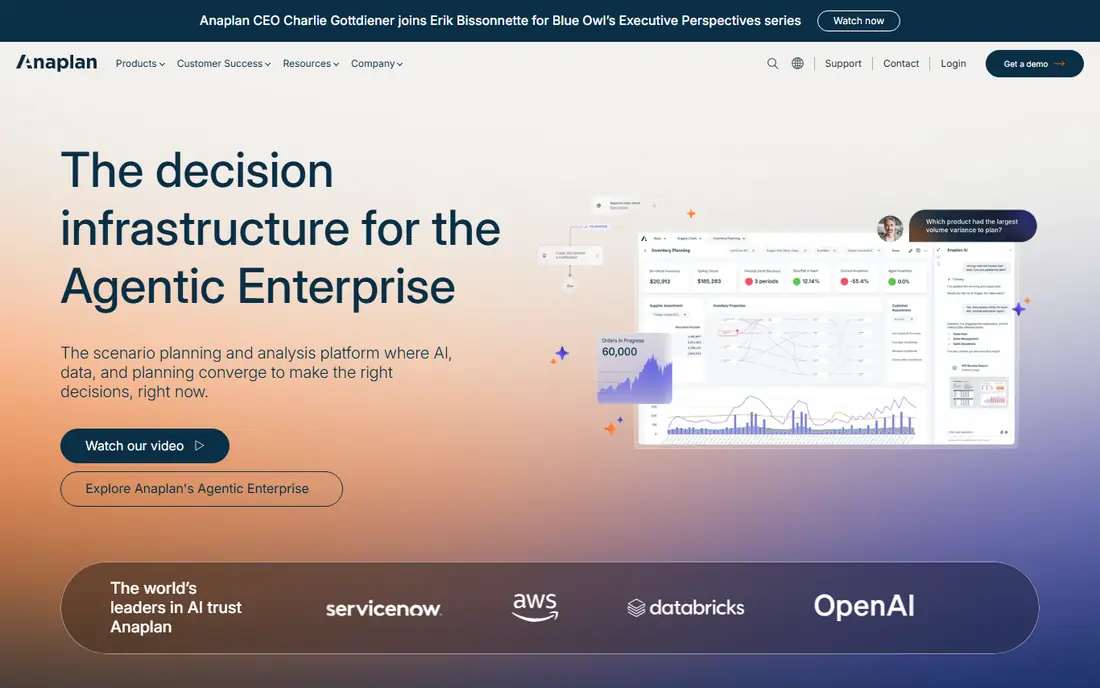
Anaplan is built for connected planning, where a sales forecast, a hiring plan, and a financial budget update together rather than living in separate spreadsheets. Its modeling engine handles large, multi-dimensional plans, and teams can build scenarios without rebuilding the whole model. That flexibility suits firms with complex drivers and frequent re-forecasts.
Pricing is not published and contracts are enterprise-scale. Model building also needs skill, so firms should budget for trained builders or partner help. For large-scale connected planning, Anaplan remains a leading choice.
- Connected planning across departments
- Flexible modeling
- Strong for large, complex plans
- Quote-based pricing
- Needs skilled model builders
Workday Adaptive Planning, formerly Adaptive Insights, gives Workday customers planning, budgeting, and forecasting linked to HR and finance data. Workforce plans can reflect hiring, attrition, and compensation, while financial plans roll up by department and entity. Reporting is clear enough for managers who are not finance specialists.
Firms outside Workday can use it, but the native link is the main advantage. Pricing is quoted, so ask for a total that includes users, models, and implementation. For a Workday firm, it is the natural planning pick.
- Native Workday links
- Clear planning and reporting
- Good for workforce and financial plans
- Quote-based pricing
- Best value inside a Workday stack
OneStream unifies financial close, consolidation, planning, and reporting, which appeals to firms tired of stitching separate tools together. Complex ownership structures, intercompany eliminations, and multi-currency consolidation are handled in the same platform as budgets and forecasts. That unity reduces reconciliation and gives finance one version of the truth.
Pricing is enterprise and quoted, and a full deployment takes months. For a large group with a complex close, the unified design can save more time than a cheaper, narrower tool.
- Close, consolidation, and planning in one platform
- Strong for complex groups
- Extensible
- Quote-based pricing
- Implementation takes planning for large groups
Planful suits mid-market and growing firms that need structured planning without enterprise complexity. Budgeting, forecasting, close management, and reporting live in one platform, with templates that speed up setup. Finance teams can move from spreadsheet chaos to a governed process without a year-long project.
Very large firms with complex connected planning may outgrow it. For a mid-size firm that wants a governed planning cycle in weeks rather than months, Planful is a practical choice.
- Clear budgeting and forecasting
- Close and reporting tools
- Faster deployment than enterprise suites
- Less depth for very large connected planning
- Pricing is not published
Prophix is a corporate performance management tool for mid-market finance teams, covering budgeting, forecasting, reporting, and workflow. Approvals and version control bring order to a process that often lives in emailed spreadsheets. Finance-led teams like the focus on planning and reporting over broad analytics.
The interface is workmanlike, and pricing requires a quote. For a finance team that wants control and clarity without enterprise scale, Prophix delivers the core job well.
- Strong budgeting and reporting
- Workflow and approval controls
- Good for finance-led teams
- Pricing is not published
- Interface is functional rather than modern
Board combines planning, budgeting, forecasting, and business intelligence in one platform, so a plan and its dashboard share the same data. That link helps managers see a forecast, drill into drivers, and test scenarios without switching tools. Board has a strong presence in Europe and in firms that want planning plus analytics together.
Complex models need skilled builders, and pricing is quoted. For a firm that wants planning and reporting in one governed platform, Board is a strong alternative to separate BI and planning tools.
- Planning, budgeting, and analytics together
- Flexible dashboards
- Strong in Europe
- Quote-based pricing
- Needs skilled builders for complex models
Pigment is a modern planning platform with a clean interface and AI-assisted features for modeling, forecasting, and scenario work. Finance and operations teams can build plans quickly, test changes, and share dashboards without heavy IT help. That speed suits firms that re-forecast often and want a tool business users can actually run.
As a newer vendor, it lacks the decades-long track record of Oracle or SAP. For a firm that values modern usability and fast planning cycles, Pigment is worth a trial on a real planning cycle.
- Modern interface
- AI-assisted modeling and forecasting
- Fast scenario building
- Newer vendor than Oracle or Anaplan
- Pricing is quote-based
Jedox offers Excel-friendly planning, reporting, and analytics, which helps finance teams move from spreadsheets to a governed platform without relearning everything. Models feel familiar to Excel users, while the platform adds version control, workflows, and centralized data. That balance suits firms where finance drives planning.
Pricing varies by use case and is quoted, so price your exact models and users. For an Excel-heavy finance team, Jedox eases the move to structured planning better than a tool that abandons spreadsheets entirely.
- Excel-like modeling
- Planning, reporting, and analytics
- Strong for finance users
- Pricing varies by use case
- Full setup needs planning
How we picked these
We compared official product pages, planning and close coverage, consolidation features, integrations, and published or reported pricing, plus public user feedback on implementation and support. We favored tools with proven enterprise deployments and clear audit trails, since planning data must stand up to review. We did not run a full planning cycle in each tool, so test your most complex model in a trial before signing.
What to check before you buy EPM software
Planning scope and close needs
Decide whether you need planning alone, or planning plus close and consolidation. A unified tool costs more but removes reconciliation between systems, while a planning-only tool may be faster to deploy. Map your close calendar and planning calendar before you demo.
Modeling skill and ownership
Connected planning tools need skilled model builders and clear ownership. Ask who will build and maintain models, how changes are governed, and what training is included. A powerful tool with no owner quickly becomes a set of stale spreadsheets in a new wrapper.
Total cost over three years
Add licenses, implementation, training, and support for three years, not just year one. Enterprise contracts often grow with users and models, so ask how pricing changes as you add entities, scenarios, and users.
Keep the first model simple
A common EPM mistake is building a very detailed model on day one. Start with the planning cycle that causes the most pain, such as the annual budget or the monthly forecast, and model only the drivers that actually change the result. Add detail later, once users trust the numbers and the process runs on time. A simple model that is used every month beats a complex model that only the builder understands, and it leaves room to grow as the finance team gains confidence.
FAQ
What is the best enterprise performance management software?
Oracle EPM leads for breadth, Anaplan leads for connected planning, OneStream leads for unified close and planning, and Workday Adaptive Planning leads for Workday customers. The top enterprise performance management software for your firm follows your ERP, planning complexity, and close needs.
How much does EPM software cost?
Oracle EPM starts at a published $250 per user per month for the standard edition, while most rivals are quote-based at mid-five-figure to six-figure annual contracts. Add implementation and training to get the true first-year cost.
Can EPM software replace Excel?
It depends on the tool. Anaplan, Pigment, OneStream, and Prophix offer native modeling designed to replace spreadsheet planning, while Excel-friendly tools such as Jedox keep a familiar interface with governance underneath. Most finance teams still use Excel for ad hoc work alongside an EPM platform.
How long does EPM implementation take?
Focused deployments can go live in weeks, while enterprise-wide rollouts take months. Timeline depends on process scope, data complexity, entity count, and model design more than on the software alone.
What is the difference between EPM and CPM?
The terms are largely interchangeable. Both describe software for planning, budgeting, forecasting, consolidation, and reporting. Vendors use whichever term their market prefers, so compare features rather than labels.