Best Enterprise Marketing Platforms in 2026: 9 Platforms Compared
We compared the best enterprise marketing platforms for B2B and B2C teams, covering automation, journeys, data and pricing notes for large teams choosing well.
- Editor's choice
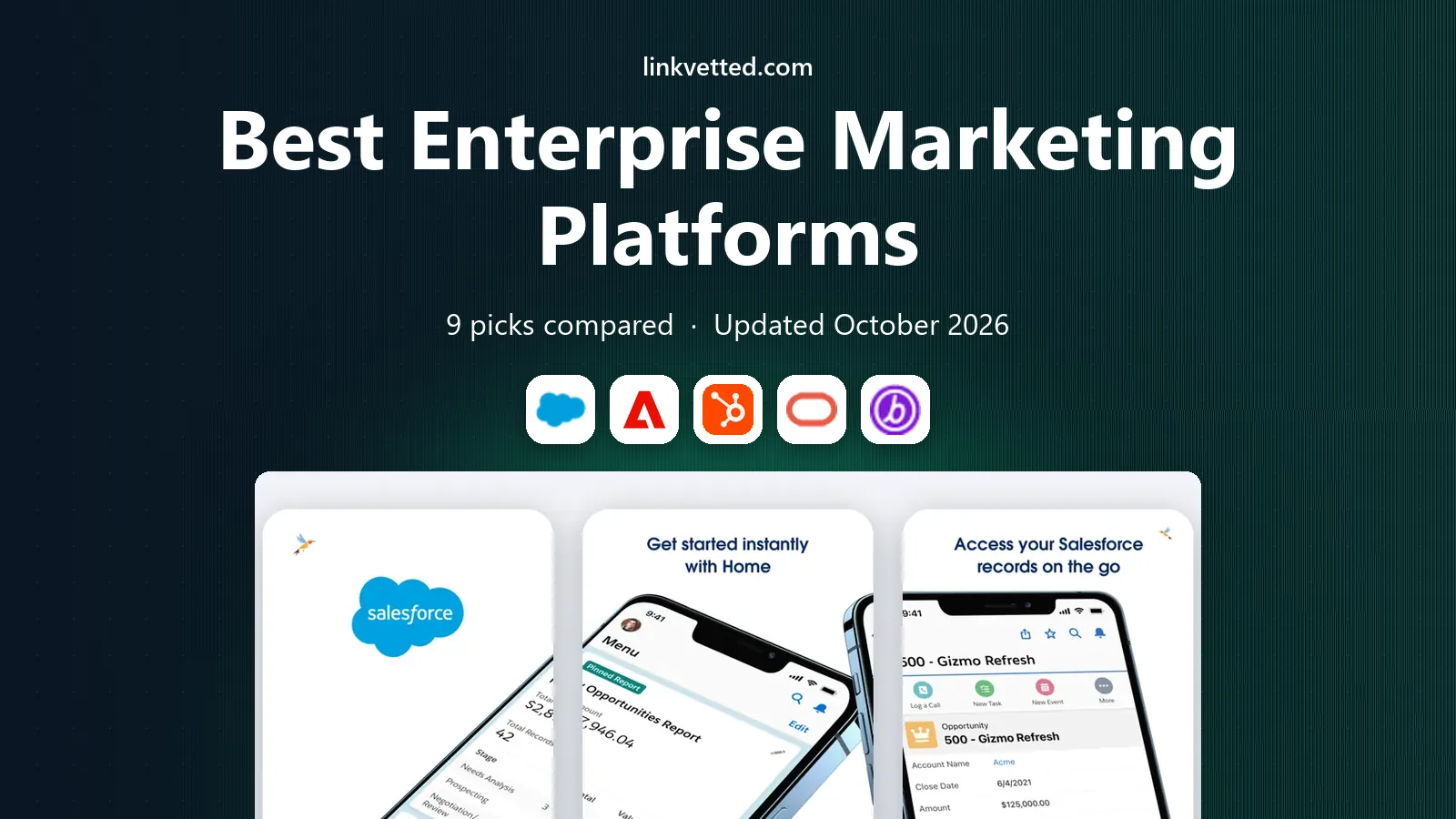
 Salesforce Marketing Cloud
Salesforce CRM teams and large B2C brands
Starts atSee websiteVisit salesforce.comFull review - Great alternative
 Adobe Marketo Engage
Mature B2B marketing operations teams
Starts atSee websiteVisit business.adobe.comFull review - Also consider
 HubSpot Marketing Hub Enterprise
Teams wanting CRM plus marketing in one place
Starts atSee websiteVisit hubspot.comFull review
TL;DR:
- Salesforce Marketing Cloud and Marketo suit teams already tied to those ecosystems.
- HubSpot Enterprise is the easier all-in-one pick for teams that want CRM and marketing together.
- Braze and Iterable lead for mobile and lifecycle messaging at scale.
- Enterprise pricing is almost always quoted, so budget for implementation and add-ons.
Quick comparison
| Tool | Best for | Starts at | Free plan? | |
|---|---|---|---|---|
| Salesforce Marketing Cloud | Salesforce CRM teams and large B2C brands | See website | No | Visit |
| Adobe Marketo Engage | Mature B2B marketing operations teams | See website | No | Visit |
| HubSpot Marketing Hub Enterprise | Teams wanting CRM plus marketing in one place | See website | Free trial | Visit |
 Oracle Eloqua | Large B2B firms on Oracle systems | See website | No | Visit |
 Braze | Mobile-first brands and lifecycle teams | See website | No | Visit |
 Iterable | Cross-channel lifecycle marketing | See website | No | Visit |
 Bloomreach | Retail and ecommerce personalization | See website | No | Visit |
 SAP Emarsys | Retail brands on SAP systems | See website | No | Visit |
 Acoustic | Enterprise email and multichannel campaigns | See website | No | Visit |
The best enterprise marketing platforms
These platforms handle large contact lists, many channels and complex approval workflows, so the right pick depends on your CRM, your data and your team size.

Salesforce Marketing Cloud is the natural pick for a company already running Salesforce as its CRM. Campaign data, customer records and sales activity stay in one ecosystem, which cuts sync work and manual exports.
Journey Builder, email, SMS, push and advertising tools let large teams run coordinated campaigns across channels. Agentforce and predictive features add drafting and scoring help, though results still depend on clean data.
The catch is complexity. Implementation takes planning, and many useful modules cost extra. Choose it when the Salesforce link is central to your stack, and budget for admin time as well as licences.
- Deep CRM link
- Journey Builder
- Many channels in one suite
- Complex setup
- Add-ons and support add cost

Marketo Engage, part of Adobe, is built for B2B lead nurturing at scale. Lead scoring, nurture programs, forms and CRM sync give revenue teams a clear path from first touch to sales handoff.
Its strength shows in long sales cycles with many stakeholders. Programs can be reused, tested and reported on, which helps a marketing operations team prove what worked.
Marketo needs a skilled admin and clean database habits, because price follows database size. It fits mature B2B teams, not a small team that wants a quick setup with little ongoing care.
- Strong lead scoring and nurture
- Deep CRM sync
- Mature automation
- No public pricing
- Admin skill needed
- Database hygiene matters
HubSpot Marketing Hub Enterprise
Best for: Teams wanting CRM plus marketing in one place

HubSpot Marketing Hub Enterprise bundles marketing automation with a CRM that sales and service teams already use. That shared record reduces the usual friction between marketing lists and sales pipelines.
Workflows, landing pages, email, social and reporting sit in one interface, which shortens training time. For a growing company, that ease of use is a real advantage over a platform that needs a dedicated admin team.
The trade-off is price at scale and some limits on very complex B2B automation. HubSpot fits teams that value speed and a single system over the deepest enterprise customization.
- Unified CRM
- Easier admin
- Strong reporting and AI helpers
- Contact-tier pricing can rise fast
- Some enterprise depth is lighter than rivals
Oracle Eloqua is a long-standing B2B marketing automation platform for large firms with complex buying journeys. Segmentation, lead scoring and campaign orchestration handle many audiences and regions.
Its fit is strongest inside an Oracle estate, where data and sales tools already sit together. Teams with strict governance and long approval chains will find its controls familiar.
Eloqua pricing is quoted, and setup can take time. It suits a large B2B firm that values depth and Oracle integration over a fast, light setup.
- Strong B2B automation
- Segmentation
- Oracle ecosystem link
- Quote-based pricing
- Older interface feel
- Implementation can be long
Braze is built for mobile-first brands that need real-time engagement. Push, in-app messages, email and SMS can run from one journey builder, with data processed fast enough for timely triggers.
Canvas journeys make it easier to map lifecycle flows for onboarding, retention and win-back. That matters for apps and subscription brands where timing drives revenue.
Braze is an enterprise product with enterprise pricing and a learning curve. It fits teams with a mobile product and a lifecycle strategy, not a firm that only sends a monthly newsletter.
- Real-time mobile messaging
- Canvas journeys
- Many integrations
- Enterprise pricing
- Learning curve for new teams
Iterable helps teams send email, push, SMS and in-app messages from one audience view. Segmentation and journey tools let marketers target by behavior, not only by list membership.
Its strength is lifecycle work for ecommerce, media and subscription firms, where the same customer moves across channels in one week. AI helpers can draft and optimize content, but human review still matters.
Iterable needs reliable event data to reach its full value, and pricing is quoted. Choose it when cross-channel journeys are the core job, and invest in tracking before you scale campaigns.
- Cross-channel journeys
- Strong segmentation
- AI-assisted content
- Quote-based pricing
- Needs clean event data to shine
Bloomreach Engagement combines customer data, personalization and omnichannel marketing for retail and ecommerce brands. Product, browsing and purchase data can shape email, SMS and on-site content.
For a retailer, that link between catalog and campaign is the main draw. A shopper who viewed a product can get a timely, relevant follow-up without manual list building.
Bloomreach is priced for enterprise retail, so a non-retail firm may pay for depth it does not use. It fits best when personalization and ecommerce revenue are central goals.
- Ecommerce personalization
- Real-time data
- Omnichannel journeys
- Enterprise cost
- Best value inside retail use cases
SAP Emarsys is a customer engagement platform built for retail, with automation, personalization and AI recommendations. It works well for brands with large catalogs and repeat purchase cycles.
Its SAP link is a plus for firms already running SAP commerce or ERP tools. Loyalty, lifecycle and campaign data can stay closer to the systems that hold orders and stock.
Emarsys is less natural for a firm outside the SAP world, and setup needs planning. Shortlist it when retail automation and SAP integration are both high priorities.
- Retail automation
- SAP link
- AI product recommendations
- Complex for non-SAP firms
- Implementation needs care
Acoustic, formerly part of IBM marketing software, offers enterprise email and multichannel campaign tools. It suits large teams that send high volumes and need control over journeys, data and reporting.
Its heritage in enterprise email gives it depth in segmentation, testing and deliverability work. Teams with large lists and strict sending rules will find its controls useful.
Acoustic has a smaller partner ecosystem than the largest suites, and pricing is quoted. It fits a large sender that values email depth and control over a broad app marketplace.
- Enterprise email scale
- Journey tools
- Strong deliverability focus
- Smaller ecosystem than Salesforce or Adobe
- Pricing is quoted
How we picked these
We compared official feature pages, pricing pages, app store listings, privacy and support pages, and public reviews for each product. We checked that each product exists and works today, that it fits the topic, and that its pricing or free tier could be stated honestly. Where a vendor does not publish a price, we wrote See website rather than guessing.
We also weighed who each product suits best, not only which one has the longest feature list. A tool that fits a small team can beat a larger platform for that buyer, even if the larger platform has more features. That is why our picks mix well-known leaders with strong smaller options.
We also checked free tiers and trial terms, because a tool that cannot be tested before purchase is a harder buy for a small team. Where a free plan was limited, we said so in the table and in the product write-up, so the starting price does not mislead a reader about what is actually included at that level.
How to choose an enterprise marketing platform
Start with your system of record. If sales lives in Salesforce, a native platform saves sync work. If your team needs one CRM plus marketing, HubSpot removes a layer. Map your channels, such as email, SMS, push and ads, before you compare feature lists.
Ask about data limits, contact pricing, deliverability support and migration help. A platform that looks cheap at 10,000 contacts can cost far more at 500,000. Run a pilot with real campaigns, real data and the people who will run it daily.
FAQ
What is an enterprise marketing platform?
It is marketing software built for large teams, with automation, multi-channel journeys, audience management, reporting and permission controls. It differs from small business tools in scale, security options and support.
Which enterprise marketing tool is best for B2B?
Marketo Engage and Salesforce Marketing Cloud Account Engagement are common B2B picks, because they handle lead scoring, nurture programs and CRM sync. HubSpot Enterprise also works well for B2B teams that want CRM included.
Which is best for B2C and mobile?
Braze and Iterable are strong for app push, in-app messages and lifecycle email at scale. Bloomreach and SAP Emarsys also suit retail and ecommerce teams with large catalogs.
Why is enterprise pricing often hidden?
Vendors price by contacts, messages, users and add-ons, so a single list price would mislead. Ask for a quote based on your contact count, send volume and required modules, plus renewal terms.
How long does implementation take?
Expect weeks to months for a large setup, including data migration, tracking, templates and training. A vendor with a named implementation team and a clear timeline is worth more than a lower licence price.