8 Best Email Drip Software Tools for Automated Sequences in 2026
Compare the best email drip software for welcome, nurture, and cart recovery sequences, including the best drip email tools for small teams in 2026 today.
- Editor's choice
 Drip
Ecommerce brands that live on automation
Starts at$39 per monthVisit drip.comFull review - Great alternative
 Klaviyo
Ecommerce brands that want data-driven flows
Starts atFreeVisit klaviyo.comFull review - Also consider
 ActiveCampaign
B2B teams running complex nurture
Starts at$15 per monthVisit activecampaign.comFull review
TL;DR:
- A drip sequence is an automated series triggered by signup, purchase, or behavior, so the builder should support waits, conditions, and branches.
- Pricing models differ: some tools charge by contacts, others by sends, so compare cost at your actual list size, not at the entry tier.
- Deliverability depends on list hygiene, domain setup, and sending limits, so verify contacts and set up authentication before scaling a sequence.
- Ecommerce drips need product and order data, while B2B nurture drips need CRM and lead scoring, so choose a tool built for your workflow.
- Start with one welcome sequence and one recovery sequence, measure opens, clicks, and conversions, then expand to longer nurture paths.
Quick comparison
| Tool | Best for | Starts at | Free plan? | |
|---|---|---|---|---|
| Drip | Ecommerce brands that live on automation | $39 per month | No | Visit |
| Klaviyo | Ecommerce brands that want data-driven flows | Free | Yes | Visit |
| ActiveCampaign | B2B teams running complex nurture | $15 per month | No | Visit |
 MailerLite | Simple sequences on a small budget | Free | Yes | Visit |
 Brevo | Send-based pricing for growing lists | Free | Yes | Visit |
 Omnisend | Ecommerce email plus SMS | Free | Yes | Visit |
 GetResponse | Drips paired with funnels and webinars | $19 per month | Yes | Visit |
 Kit | Creators and course sellers | Free | Yes | Visit |
The best email drip software
The best email drip software builds sequences around what subscribers actually do, not just around a fixed calendar, and it reports which step leads to a sale or a reply.
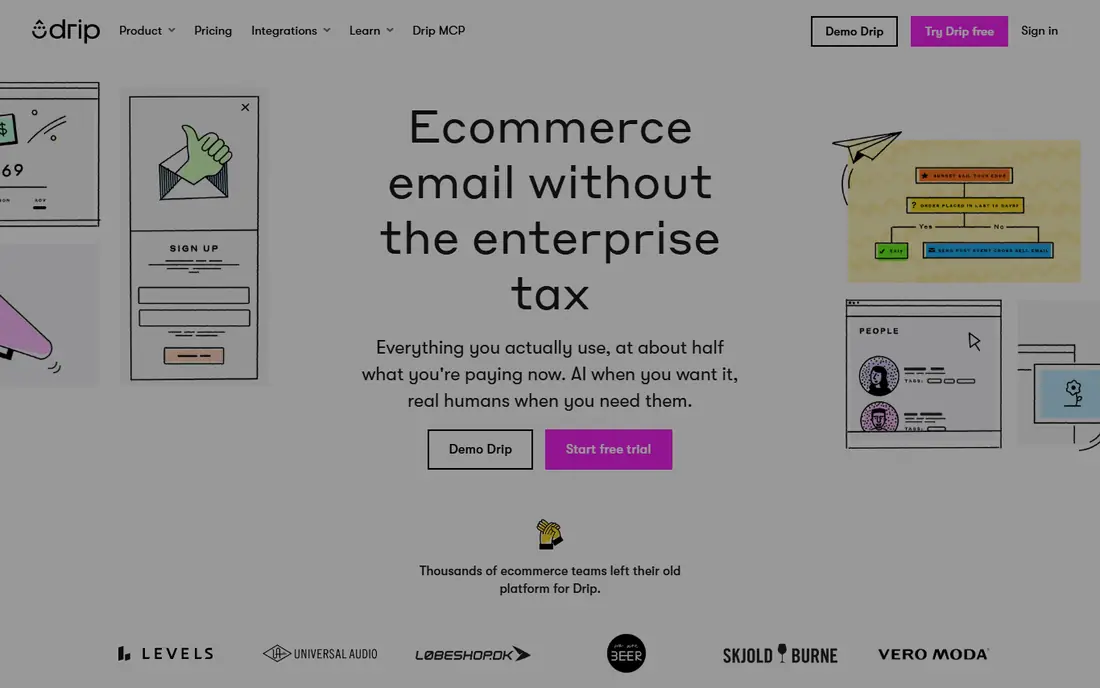
Drip is built for online stores, and its workflow builder reflects that focus. Sequences can branch based on browsing, cart abandonment, purchase, and repeat buying, rather than sending the same series to every subscriber. Every plan includes unlimited sends, automation, segmentation, and reporting, so the $39 entry price for up to 2,500 contacts buys the full product. The cost is the main caution. Pricing rises to $89 at 5,000 contacts and $154 at 10,000, and there is no free tier. Newsletter-first businesses or B2B teams may find Drip more tool than they need. For stores whose revenue comes from flows such as welcome, cart recovery, and post-purchase, the behavior-first design often earns its price.
- Every plan includes all features with unlimited sends
- Visual builder built around subscriber behavior
- Prebuilt workflows for welcome, cart recovery, and post-purchase
- No free plan, only a 14-day trial
- Pricing rises with list size
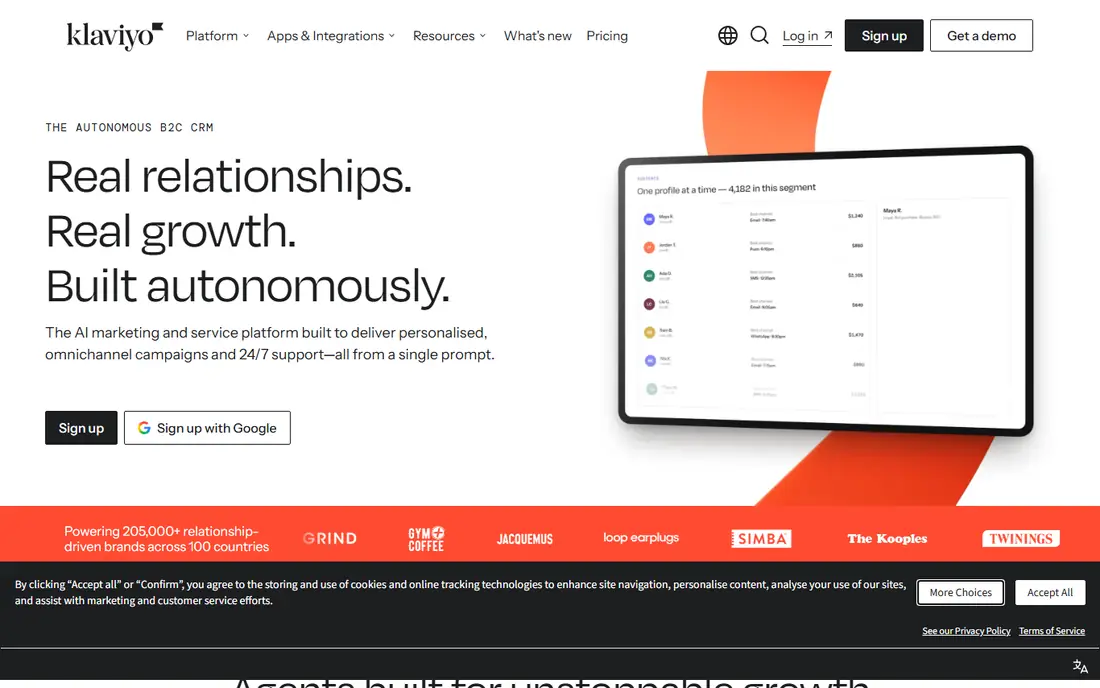
Klaviyo suits Shopify and other ecommerce stores that want flows driven by customer data. Its free plan covers up to 250 profiles, with paid email plans starting at $20 per month for 251 to 500 active profiles. Flow templates for welcome, abandoned cart, browse abandonment, and post-purchase help stores launch quickly, while segmentation uses purchase history and predicted behavior. The weakness is cost at scale. As profiles grow, the monthly price rises, and SMS adds further cost. Beginners may also find the data options overwhelming at first. For stores that already sell on Shopify and want revenue reporting per flow, Klaviyo is a strong choice.
- Free plan for up to 250 profiles
- Strong Shopify integration
- Predictive analytics and flow templates for stores
- Paid plans rise quickly as profiles grow
- Interface can feel dense for beginners

ActiveCampaign is the pick for B2B teams that need nurture sequences to hand off cleanly to sales. Its Starter plan starts at $15 per month for 1,000 contacts when billed annually, and its visual builder supports waits, conditions, goals, and lead scoring. That depth helps teams send different paths based on opens, clicks, site visits, and form answers. The learning curve is real. Teams that only need a simple welcome series may find ActiveCampaign more complex than MailerLite or Brevo. There is also no free plan, only a trial. For teams that run multi-step nurture, onboarding, and sales follow-up in one system, the depth is worth the setup time.
- Visual automation builder with conditions and scoring
- CRM features in the same account
- Strong segmentation for nurture sequences
- No free plan, only a 14-day trial
- Advanced features can take time to learn
MailerLite is the simplest route to a real drip sequence on a small budget. Its free plan covers a small list, and paid plans start at $12 per month for 500 subscribers. The automation builder is easy to learn, with triggers, delays, and conditions that cover welcome, onboarding, and simple nurture sequences without a steep learning curve. The trade-off is depth. MailerLite lacks the CRM and predictive features of larger tools, and its ecommerce reporting is lighter than Drip or Klaviyo. For a small business, creator, or nonprofit that needs clean sequences without complexity, that simplicity is a benefit. Larger teams with complex scoring or sales handoffs may outgrow it.
- Free plan for small lists
- Simple automation builder
- Paid plans start at $12 per month for 500 subscribers
- Fewer advanced CRM features than ActiveCampaign
- Ecommerce analytics are lighter than Klaviyo or Drip
Brevo, formerly Sendinblue, charges mainly by email volume rather than by contacts, which helps businesses with large lists that send infrequently. Its free plan allows a limited number of sends per day, and paid plans start at $9 per month for 5,000 emails. Automation, segmentation, and transactional email sit in the same account, which suits teams that send both marketing and system emails. The pricing structure can confuse new users, since contact limits and send limits interact. Design tools are also less polished than MailerLite for some users. For teams with a large list, modest sending frequency, and a tight budget, Brevo offers strong value.
- Free plan with daily sending limits
- Send-based pricing suits large lists with low frequency
- Automation included on free and paid plans
- Contact limits and feature tiers can confuse new users
- Template design is less polished than some rivals
Omnisend combines email and SMS flows for online stores, which helps when a cart recovery message needs both channels. Its free plan covers small stores, and paid plans start at $16 per month for 500 contacts. Prebuilt flows for welcome, cart abandonment, order confirmation, and win-back help stores launch without building every sequence from scratch. The focus is also the limit. Omnisend is built for ecommerce, so B2B nurture teams may find its CRM and lead scoring thinner than ActiveCampaign. SMS pricing also adds cost, so stores should budget for both channels. For Shopify and WooCommerce stores that want email plus SMS in one flow, Omnisend is a practical pick.
- Free plan for small stores
- Prebuilt ecommerce flows for email and SMS
- Paid plans start at $16 per month for 500 contacts
- Best fit is ecommerce, so B2B teams may find it narrow
- SMS costs add up on top of email
GetResponse suits businesses that want drip campaigns beside landing pages, funnels, and webinars in one account. Its paid plans start at $19 per month for 1,000 contacts, and its automation builder supports triggers, conditions, and scoring for nurture and onboarding sequences. That breadth helps course sellers, coaches, and small businesses that run webinars as part of their funnel. The breadth can also feel crowded. Users who only need email may find extra features distracting, and some advanced automation options sit on higher plans. For teams that already run webinars or funnels, the combined tool saves the cost and hassle of separate platforms.
- Free plan available
- Automation plus landing pages, funnels, and webinars
- Paid plans start at $19 per month for 1,000 contacts
- Interface can feel crowded with many features
- Advanced automation needs higher plans for some users
Kit, formerly ConvertKit, is built for creators, bloggers, and course sellers who need simple, reliable sequences. Its free plan lets creators collect subscribers and send broadcasts, while paid Creator plans add sequences and visual automations. Tagging and forms make it easy to segment by interest, course, or lead magnet without complex CRM setup. The limit is ecommerce depth. Kit does not match Drip or Klaviyo for product-based flows, revenue attribution, or SMS. For creators who sell courses, newsletters, or digital products through simple funnels, Kit is a clean fit. Stores that need deep product data should choose an ecommerce-first tool.
- Free plan for creators starting out
- Sequences and visual automations on paid plans
- Simple subscriber tagging and forms
- Ecommerce features are lighter than Drip or Klaviyo
- Paid Creator plans are needed for full sequences
How we picked these
We compared official feature pages, published pricing pages, app store listings, privacy policies, and public reviews for each product. We kept only tools that build automated drip sequences with triggers, waits, and conditions today, and we marked pricing as See website where a vendor quotes rather than publishes a price. We favored tools with clear free or trial options, deliverability controls, and reporting that shows which sequence step leads to a conversion.
What to check before you buy
A drip tool is only as good as the sequence you build in it, so test the builder with a real customer journey before committing.
Triggers, branches, and exits
Check whether sequences can trigger on signup, purchase, page visit, tag change, or inactivity, and whether subscribers can exit a path when they buy or reply. Branching based on opens and clicks helps, but behavior-based branches based on purchases and site actions are more useful for most businesses.
Pricing at your real list size
Compare pricing at 1,000, 5,000, and 10,000 contacts or profiles, since tools charge by contacts, profiles, or sends in different ways. Include SMS, transaction fees if any, and the cost of moving to a higher plan for advanced automation. A tool that looks cheap at 500 contacts can become expensive at 10,000.
Deliverability and list hygiene
Confirm domain authentication, bounce handling, unsubscribe management, and suppression lists. Clean your list before importing, remove hard bounces promptly, and avoid buying lists, since poor hygiene harms sender reputation across all future campaigns. Test a sequence to a small segment first, then expand.
FAQ
What is the best drip email software?
The best drip email software depends on your business type. Drip and Klaviyo suit ecommerce stores, ActiveCampaign suits B2B nurture, MailerLite and Brevo suit small budgets, and Kit suits creators. Start with the workflow you need most, such as cart recovery or lead nurture, and choose the tool that handles that workflow best.
What are the best drip email tools for beginners?
MailerLite, Brevo, and Kit are among the easiest drip email tools for beginners, because their builders are simple and their free plans let new users test sequences without paying. Drip and Klaviyo offer more ecommerce depth, but they take longer to learn. Beginners should start with one welcome sequence, measure results, and add complexity only when needed.
How much does drip email software cost?
Free plans cover small lists on Klaviyo, MailerLite, Brevo, Omnisend, GetResponse, and Kit, while paid plans in this list start from $9 to $39 per month at entry tiers. Costs rise with contacts, profiles, or sends, so compare pricing at your actual list size. SMS, advanced automation, and higher contact tiers can add further cost.
What is the difference between a drip campaign and a newsletter?
A newsletter is a broadcast sent to many subscribers at once, usually on a schedule. A drip campaign is an automated series sent to each subscriber based on a trigger, such as signup or purchase, with waits and branches along the way. Drips feel more personal because timing and content follow subscriber behavior, while newsletters work better for announcements and updates.
How many emails should a drip sequence have?
A welcome sequence often works well with three to five emails, while a longer nurture sequence may run five to eight emails over several weeks. The right number depends on purchase cycle, price, and how much trust a buyer needs before deciding. Measure drop-off by step, and remove or rewrite steps where subscribers stop opening or unsubscribe.
Can drip email software integrate with my store or CRM?
Yes, most tools in this list integrate with Shopify, WooCommerce, WordPress, and popular CRMs, either directly or through integration platforms. Ecommerce tools such as Drip, Klaviyo, and Omnisend sync order and product data, while ActiveCampaign syncs CRM and lead data. Confirm the specific integration you need before buying, since depth varies by tool.