Best Dynamic Application Security Testing Tools in 2026: 9 Tools Compared
Compare the best dynamic application security testing tools for web apps and APIs, from free scanners to enterprise DAST platforms with pricing notes.
- Editor's choice
 ZAP
Free CI scanning
Starts atFreeVisit zaproxy.orgFull review - Great alternative
 Burp Suite Professional
Manual practitioner testing
Starts at$499 per user per yearVisit portswigger.netFull review - Also consider
 StackHawk
Developer CI pipelines
Starts atSee websiteVisit stackhawk.comFull review
TL;DR:
- ZAP and Nuclei are free and open source, and they are the best starting point for teams with no security budget.
- Burp Suite Professional costs $499 per user per year and remains the standard for manual testing by a human.
- Invicti, Veracode, Checkmarx and Rapid7 are quote-based enterprise platforms for fleet-scale scanning and governance.
- Detectify publishes a price ladder, which makes budgeting easier than with most quote-only rivals.
- Our pick for most development teams is StackHawk for CI-friendly scanning, with ZAP as the free starting point.
Quick comparison
| Tool | Best for | Starts at | Free plan? | |
|---|---|---|---|---|
| ZAP | Free CI scanning | Free | Yes | Visit |
| Burp Suite Professional | Manual practitioner testing | $499 per user per year | No | Visit |
| StackHawk | Developer CI pipelines | See website | Yes | Visit |
 Invicti | Proof-based fleet scanning | See website | No | Visit |
 Detectify | Attack surface plus DAST | See website | No | Visit |
 Nuclei | Fast CVE and template checks | Free | Yes | Visit |
 Rapid7 InsightAppSec | Platform and SOC integration | See website | No | Visit |
 Veracode DAST | Governed enterprise scanning | See website | No | Visit |
 Checkmarx DAST | Unified AppSec pipelines | See website | No | Visit |
The best dynamic application security testing tools
We compared DAST tools on crawling, authenticated scanning, API support, false-positive handling, CI integration and price. These nine cover solo testers, development teams and large enterprises. DAST scans running applications from the outside, so only test systems you own or have permission to test.
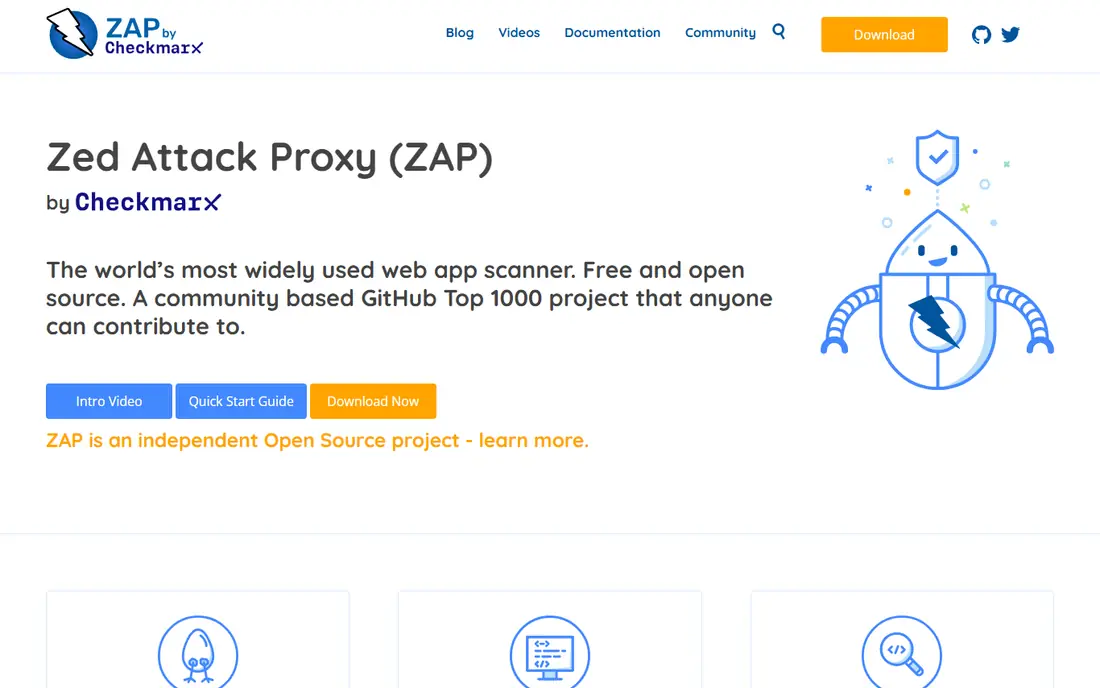
ZAP, the Zed Attack Proxy, is the best free DAST tool and the right first step for any team. It acts as a proxy that intercepts and probes web traffic, finds common flaws such as injection and cross-site scripting, and runs in CI through its automation framework. The community is large, and add-ons extend it for APIs, authentication and reporting.
The cost is your time. ZAP needs tuning to reduce noise, and authenticated scans need careful session setup. There is no vendor support line to call. For teams with no budget, ZAP plus a disciplined triage process beats buying a commercial tool nobody configures.
- Free and open source
- Automation framework for CI
- Large community and add-on range
- Setup and tuning take time
- No vendor support contract
- Authenticated scanning needs configuration
Burp Suite Professional from PortSwigger is the practitioner standard for manual web testing. Repeater lets a tester replay and modify requests by hand, Intruder automates parameter fuzzing, and the scanner supports that manual work rather than replacing it. The extension ecosystem adds checks for modern frameworks and APIs.
At $499 per user per year, it is priced per tester, so equipping a whole team costs real money. It is also not the best fleet scanner for dozens of apps. For one engineer doing real security testing, though, nothing free matches it, and it pairs well with ZAP or StackHawk for automation.
- Industry-standard manual testing tools
- Repeater and Intruder for hands-on work
- Large extension ecosystem
- Per-user price adds up for teams
- Automated fleet scanning is not its strength
- Learning curve for beginners
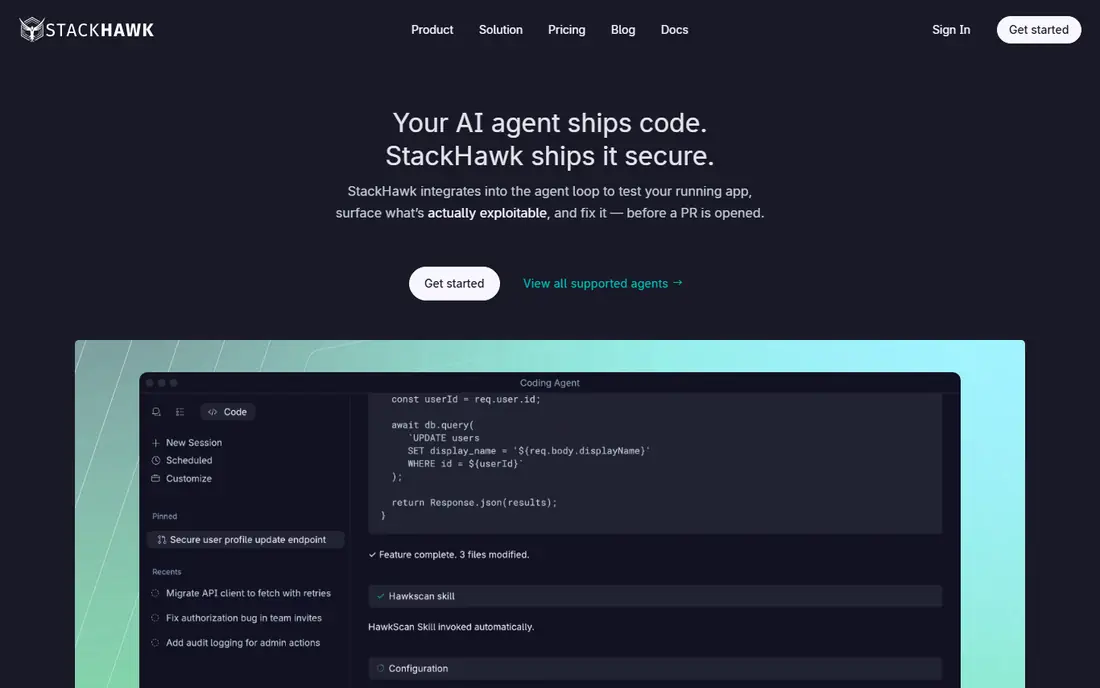
StackHawk brings DAST into the developer pipeline, with scans that run in CI and findings that land where developers already work. It offers a free scan tier for one application, which makes it easy to try on a real project before paying. Its focus on modern apps and APIs suits teams shipping frequently.
Pricing across its tiers has shifted over time, with different figures published in different years, so confirm the current plan before you budget. Scan depth also sits below enterprise fleet tools such as Invicti. For development teams that want DAST in every pull request, StackHawk is a practical, developer-friendly choice.
- Built for CI pipelines
- Free scan for one application
- Findings inside developer workflows
- Pricing has changed across tiers, so confirm current rates
- Depth below enterprise fleet tools
Invicti, built on the Acunetix heritage, leads fleet automation for web applications. Its proof-based scanning tries to confirm findings by safe exploitation, which cuts the false positives that waste developer time. Crawling handles modern JavaScript-heavy apps and single-page applications, and deployment works in the cloud or on premises.
Pricing is quoted, which is standard for this depth of DAST. Invicti also scans web apps, not networks, so pair it with a network scanner for full coverage. Development teams and security teams running many web apps will get the most from it.
- Proof-based scanning cuts false positives
- Deep crawling of JavaScript apps
- Cloud or on-premises deployment
- Quote-only pricing
- Web-app focus means no network scanning
- Can be slow on very large apps
Detectify combines attack surface monitoring with application scanning, using payloads contributed by a crowdsourced researcher community. That combination helps teams find exposed assets they forgot about, then test the apps behind them. It is also one of the few vendors here that publishes a full price ladder, which makes budgeting easier.
The ladder is priced in euros, and application scanning add-ons sit on top of the base plans, so the total can rise quickly. The jump to the professional tier is also steep. Teams that want surface monitoring plus DAST in one product, with transparent pricing, should shortlist Detectify.
- Published price ladder
- Crowdsourced payloads from security researchers
- Attack surface monitoring included
- Euro pricing
- Application scanning add-ons quoted separately
- Professional tier is a jump in price
Nuclei from ProjectDiscovery takes a different approach: instead of crawling an app deeply, it runs templates that check for known issues, misconfigurations and exposures across many hosts very fast. When a new CVE appears, the community often publishes a template within hours, so Nuclei answers the question "are we exposed to this?" in minutes.
It is not a full DAST crawler, so it will miss logic flaws and deep application issues that Burp or Invicti find. It also needs care with scan rates and scope to avoid hammering targets. As a complement to a real DAST tool, and as a first response to new CVEs, Nuclei is excellent and free.
- Free and open source
- Thousands of community templates
- Very fast for checking one issue across many hosts
- Template-based, not a full crawler
- Needs care to avoid noisy scans
- No vendor support
Rapid7 InsightAppSec suits teams already using Rapid7 for vulnerability management or security operations. Application findings flow into the same platform as infrastructure findings, which helps security teams prioritize across the whole estate. Scanning covers cloud and on-premises apps, with scheduling and reporting built in.
Pricing is quoted, and the wider platform can feel heavy if you only need app scanning. Tuning is still needed to keep findings actionable. Teams invested in Rapid7, or buyers who want one vulnerability platform, will find InsightAppSec a natural fit.
- Strong SOC and platform integration
- Cloud and on-premises scanning
- Broad vulnerability management ecosystem
- Quote-only pricing
- Platform breadth can feel heavy for app-only teams
- Scan tuning still needed
Veracode DAST fits enterprises that need governed, auditable application security across many teams. Findings sit alongside static analysis and other checks in one platform, with policy gates and attestation reporting for compliance teams. SaaS delivery removes the need to host scanning infrastructure.
The sales process is enterprise-grade, and pricing is quoted, so small teams will find it heavy. Manual testers will still want Burp for hands-on work. For large organizations that need consistent policy and proof of scanning across a portfolio, Veracode is a strong governance choice.
- Unified governance across DAST, SAST and other checks
- Attestation and compliance reporting
- SaaS delivery
- Quote-only pricing
- Enterprise sales process
- Less hands-on than Burp for manual testers
Checkmarx DAST brings dynamic scanning into the same platform and pipeline as its static analysis and other application security checks. Developers see findings in one queue, and security teams can apply consistent policy across languages and app types. That unity helps large teams that already use Checkmarx for code scanning.
Pricing is quoted, and platform setup takes effort to get right. Scan depth also varies by application type, so pilot it on your real apps before committing. Teams already on Checkmarx, or buyers who want one AppSec platform, should evaluate its DAST alongside Veracode and Invicti.
- One queue for DAST and other AppSec checks
- Developer workflow integration
- Enterprise scale
- Quote-only pricing
- Platform setup takes effort
- Depth varies by app type
How we picked these
We compared official feature pages, pricing pages and recent DAST comparisons, and we favored tools that are actively maintained and sold in October 2026. We looked for crawling depth, authenticated scanning, API and single-page app support, false-positive handling, CI integration and deployment options, and we included free, practitioner and enterprise options.
We did not claim hands-on testing. Our comparison rests on vendor documentation, pricing pages and public reviews. Only scan applications you own or have written permission to test, and run DAST against staging rather than production wherever possible, since active probing can change data or disrupt services.
What to check before you choose
Start by running ZAP against staging before you buy anything. The finding count tells you your real triage load: a team with twelve findings buys differently from a team with nine hundred. Then check authenticated scanning, since scans that only see the login page miss most business logic and most real flaws.
Next, match the pricing unit to your shape. Per-seat pricing punishes large teams with few apps, while per-application and platform fees punish small teams with many services. Finally, check API support for your stack, including REST, GraphQL and single-page apps, and confirm how findings flow into your issue tracker and CI gates.
FAQ
What is dynamic application security testing?
Dynamic application security testing, or DAST, tests a running web application from the outside, like an attacker would, by crawling it and probing for flaws such as SQL injection, cross-site scripting and misconfigurations. It needs no source code, which makes it useful for third-party and legacy apps as well as your own code.
What is the difference between DAST and SAST?
DAST tests a running application and finds flaws that only appear at runtime, such as authentication and session issues. SAST scans source code and finds flaws early, before the app runs. Most mature teams use both, since each finds issues the other misses.
What is the best free DAST tool?
ZAP is the best free DAST tool for most teams, with CI automation and a large community. Nuclei is the best free complement for fast checks of known issues across many hosts. Together they cover a lot of ground for teams with no security budget, at the cost of setup and tuning time.
Can DAST scan APIs?
Yes, modern DAST tools support REST and GraphQL APIs, usually from an OpenAPI definition or a recorded traffic file. Check that your chosen tool handles your authentication method and your API style, since older scanners that only crawl HTML pages will miss API-only flaws.
Should I run DAST against production?
Avoid it where possible. DAST actively probes an application and can change data, trigger emails or disrupt services. Run scans against staging or a dedicated test environment that mirrors production, and only scan production with written approval, tight scope and a maintenance window.
How do I reduce DAST false positives?
Use proof-based tools such as Invicti where false positives are costly, tune authentication and crawl scope, and triage findings with developers who know the app. A smaller, well-tuned scan that developers trust beats a large noisy scan that everyone ignores.