Best Donor Prospect Research Software in 2026: 9 Tools Compared
Compare the best donor prospect research software for nonprofits, with wealth screening, giving history, and CRM fit explained in plain terms for your team.
- Editor's choice
 DonorSearch
Broad nonprofit screening
Starts atSee websiteVisit donorsearch.netFull review - Great alternative
 iWave
Deep prospect profiles
Starts at$4,150 per yearVisit iwave.comFull review - Also consider
 WealthEngine
Enterprise wealth data
Starts atSee websiteVisit wealthengine.comFull review
TL;DR:
- DonorSearch and iWave are the most established starting points for wealth screening and prospect profiles.
- WealthEngine and Windfall suit larger teams that need deep wealth data and modeling across a big donor file.
- A screening score alone does not raise money; the value comes from how well results flow into your CRM and your gift officers' work.
- Use public-source data responsibly, and check each vendor's privacy and data practices before you upload a donor file.
Quick comparison
| Tool | Best for | Starts at | Free plan? | |
|---|---|---|---|---|
| DonorSearch | Broad nonprofit screening | See website | No | Visit |
| iWave | Deep prospect profiles | $4,150 per year | No | Visit |
| WealthEngine | Enterprise wealth data | See website | No | Visit |
 Windfall | Household wealth estimates | See website | No | Visit |
 GivingDNA | Continuous donor screening | See website | No | Visit |
 ResearchPoint | Blackbaud-centered teams | See website | No | Visit |
 DonorGraph | Small teams on a budget | $129 per month | Free trial | Visit |
 Dataro | Predictive fundraising priorities | See website | No | Visit |
 Prospect Visual | Relationship mapping | See website | No | Visit |
The best donor prospect research software
Prospect research helps a nonprofit answer a practical question: who among your donors and prospects has the capacity and the connection to make a larger gift, and what do you already know about them? These tools screen a donor file against wealth, philanthropic, and public-record data, then return scores and profiles your team can act on.
DonorSearch is one of the best-known names in nonprofit prospect research, and its strength is philanthropic history. It matches your records against giving data, wealth indicators, and affiliations, then returns capacity ratings that help gift officers sort a long list into a workable portfolio. The ProspectView tools support both batch screening and individual research.
The main drawback is price transparency. DonorSearch does not publish standard pricing, so you will need a quote based on your file size and needs. That is normal in this category, but it makes budgeting harder. Ask what a re-screen costs, how often data refreshes, and exactly which fields write back to your CRM before you sign.
- Large philanthropic giving database
- AI scoring options
- Works with major CRMs
- Pricing is quoted, not published
- Smaller nonprofits may find it costly
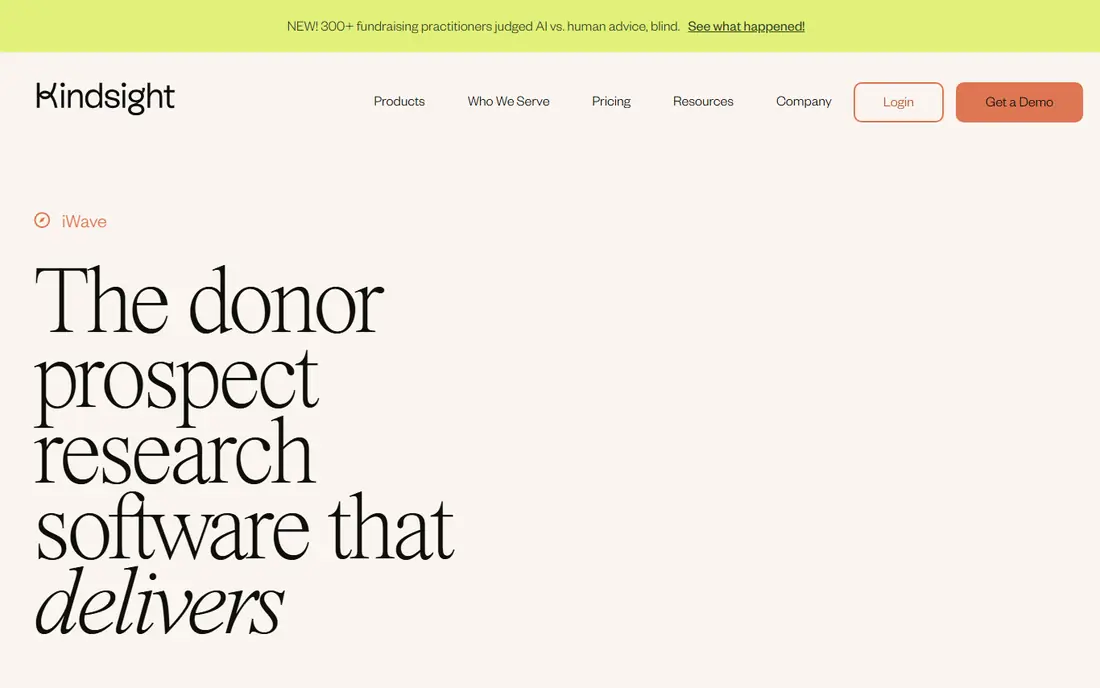
iWave, now part of Kindsight, builds rich prospect profiles that pull together wealth, philanthropic giving, real estate, and business affiliations. Gift officers get context for a meeting, not just a number: past gifts, board roles, and connections that help shape an approach. That depth is why many mid-size nonprofits start here.
Pricing is clearer than most rivals, with a published starting point around $4,150 per year for a starter tier. Higher tiers add more screens, users, and CRM integration, and those are quoted. If your team screens regularly rather than once a year, confirm how many screens your plan includes and what happens when you exceed it.
- Detailed 360-degree profiles
- Multiple data sources
- Published starting price
- Higher tiers are quoted
- CRM integration sits on higher plans
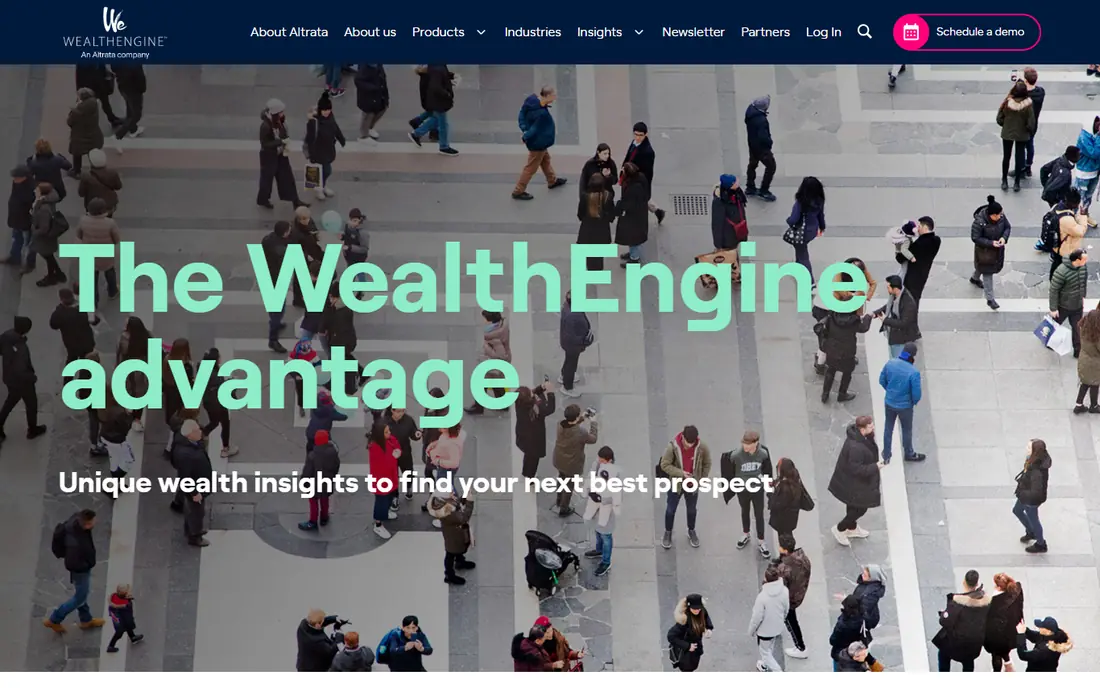
WealthEngine, now part of Altrata, is built for organizations with large files and serious major-gift programs. It offers modeled wealth attributes, gift capacity ranges, and propensity scores across a very large set of profiles, plus tools for finding look-alike prospects. For a university or hospital system, that scale matters.
The trade-off is cost and complexity. Pricing is quoted, and smaller organizations often find it out of reach. It also rewards teams that have the staff to work the results; a huge scored file does not help if no one follows up. If your program is still building, a smaller tool may give you more usable value per dollar.
- Very large pre-scored profile set
- Modeling and segmentation
- Salesforce integration
- Quote-only pricing
- Can be costly for small nonprofits
Windfall focuses on precise household wealth data, with net worth estimates and a set of wealth attributes that help teams rank prospects. Weekly refreshes keep the data fresher than a one-time screen, which matters because wealth changes and old scores mislead. Integrations with common nonprofit CRMs help results reach the people who use them.
As with most enterprise tools here, pricing is quoted, so you will need to talk to sales to budget accurately. Windfall tends to make most sense when your file is large enough that better ranking changes who your officers call first. Smaller shops should compare it against iWave and DonorGraph on total cost for the same file size.
- Household-level net worth estimates
- Weekly data refreshes
- Strong CRM integrations
- Quote-only pricing
- Best value at larger file sizes
GivingDNA takes a different angle: it blends your own donor history with outside wealth and affinity data, then builds donor personas and segments. That combination helps teams see not just capacity, but likely behavior, such as who responds to certain appeals. Continuous screening means new signals surface over time rather than in one annual batch.
The catch is data quality on your side. A messy donor file with duplicates and missing fields will produce weaker segments, whatever the tool. Clean your file first, and ask how GivingDNA handles duplicates and householding. Pricing is quoted, so get a figure tied to your record count.
- Combines internal giving data with outside data
- Persona and segmentation tools
- Regular refreshes
- Quote-only pricing
- Setup needs a clean donor file to work well
ResearchPoint is the natural choice if your advancement team already runs on Blackbaud Raiser's Edge NXT. Screening results, wealth ratings, and predictive models flow directly into the records your officers already use, which removes a lot of export and import work. That tight fit is its main selling point.
Outside that ecosystem, the case is weaker. ResearchPoint is priced by quote, and teams on other CRMs will get more flexibility from a standalone tool. If you are committed to Blackbaud, though, the time saved on integration and the shared data model can justify staying in the family.
- Deep integration with Raiser's Edge NXT
- WealthPoint screening
- Predictive models
- Best value only inside the Blackbaud world
- Pricing is quoted
DonorGraph stands out in this category for a simple reason: it publishes its price. A solo plan starts at $129 per month with a set number of complete screenings, and annual billing lowers the monthly figure. For a small nonprofit that could never justify a quote-only enterprise tool, that transparency is refreshing.
Its profiles aim to show the evidence behind each field, such as a property record or a foundation grant, rather than only a modeled score. That helps a gift officer judge whether a number is solid or a guess. DonorGraph is newer and smaller than DonorSearch or WealthEngine, so enterprise buyers should check integration depth, but small teams get a lot here for the price.
- Published monthly pricing
- Cited evidence for profile fields
- Trial screenings on your own donors
- Newer and smaller than the leaders
- Fewer enterprise integrations
Dataro sits one layer above screening. Instead of only telling you who could give, it ranks donors by who is most likely to act, using your CRM data plus screening results. That ranked list helps a small team focus its limited hours on the donors most worth calling this week, which is often the real bottleneck.
The trade-off is price and data needs. Published comparisons put Dataro's starting point well above the small-team tools, and predictive models need enough giving history to learn from. Organizations with a thin history may get more from a straightforward screening tool first, then add a predictive layer later.
- Ranks donors by likely action, not just capacity
- Works on top of your CRM
- Campaign modeling
- Higher starting cost
- Needs enough history to model well
Prospect Visual answers a question that scores cannot: who knows whom? It maps relationships between donors, board members, and organizations, so a gift officer can see a warm path to a prospect instead of a cold call. For major-gift work, that introduction path often matters as much as capacity.
It is not a replacement for wealth screening, and pricing is quoted. Think of it as a companion tool: screen for capacity with one of the tools above, then use Prospect Visual to plan how to reach the people at the top of the list. Teams that already have strong board networks will get the most from it.
- Visual relationship networks
- Board and donor connections
- Useful for major-gift strategy
- Quote-only pricing
- Narrower than full screening suites
How we picked these
We compared vendor feature pages, published pricing where available, and independent comparisons of prospect research tools. We kept tools that screen individuals for philanthropic capacity or that directly support prospect research workflows, and we left out general CRMs that only store donor records. Where pricing is quoted, we wrote See website rather than guessing. We did not claim hands-on testing; our view rests on vendor documentation and public comparisons.
How to buy prospect research without wasting money
Start with a small, clean test file before you screen your whole database. Pick donors your team already knows well, run them through a trial or a small paid screen, and check whether the results match reality. If a vendor's capacity scores look wrong on people you know, they will not be more reliable on people you do not know.
Questions to ask every vendor
Ask which lists and sources feed the scores, how often data refreshes, and whether results include the evidence behind a figure or only a modeled range. Ask what writes back to your CRM, whether re-screens are included, and how duplicates and households are handled. Get the total cost for your record count, including any per-record fees, before you compare headline prices.
Ethics and privacy
Screening uses public-source and modeled data, and donors did not ask to be scored. Use results to guide outreach, not to make assumptions about a person in conversation, and follow your organization's gift acceptance and privacy policies. Check each vendor's data sources and retention practices, and do not upload sensitive information that the tool does not need.
FAQ
What does donor prospect research software actually do?
It matches your donor records against wealth, philanthropic giving, real estate, and public-record data, then returns capacity estimates, giving history, and profiles. Gift officers use those results to rank prospects and prepare for meetings. It does not replace relationship building; it helps a team decide where to spend limited time.
How accurate are wealth screening scores?
Scores are estimates, often modeled from public data, and they can be wrong for individuals. They are most useful for ranking a large file and spotting likely major-gift prospects, not for stating a person's exact net worth. Always check a score against what you already know, and treat modeled figures as a starting point for research, not a fact.
Do I need prospect research software if I already have a CRM?
A CRM stores what you know about donors, while research software adds what you do not know, such as outside giving and wealth signals. Many teams use both: the research tool enriches records, and the CRM holds the outreach history. If your file is small and your officers know every donor personally, research software may add less value.
How much does donor prospect research software cost?
Prices range widely. Small-team tools start around $129 per month, mid-market tools start near $4,150 per year, and enterprise tools are quoted based on file size and features. Always ask for the total cost at your record count, including re-screens and per-record fees, since headline prices rarely tell the full story.
Is prospect research ethical for nonprofits?
Most nonprofits consider it ethical when it uses lawful public-source data, follows privacy law, and supports respectful outreach. Problems arise when teams treat modeled scores as personal facts, share them carelessly, or pressure donors. Set a clear policy on who sees scores, how they are used, and how long they are kept.