Choosing Digital PR Agencies for Insurance Brands in 2026: 6 Options Compared
A guide to the best digital PR agencies for insurance brands in 2026, picked from vendor documentation and public sources, with limits and checks.
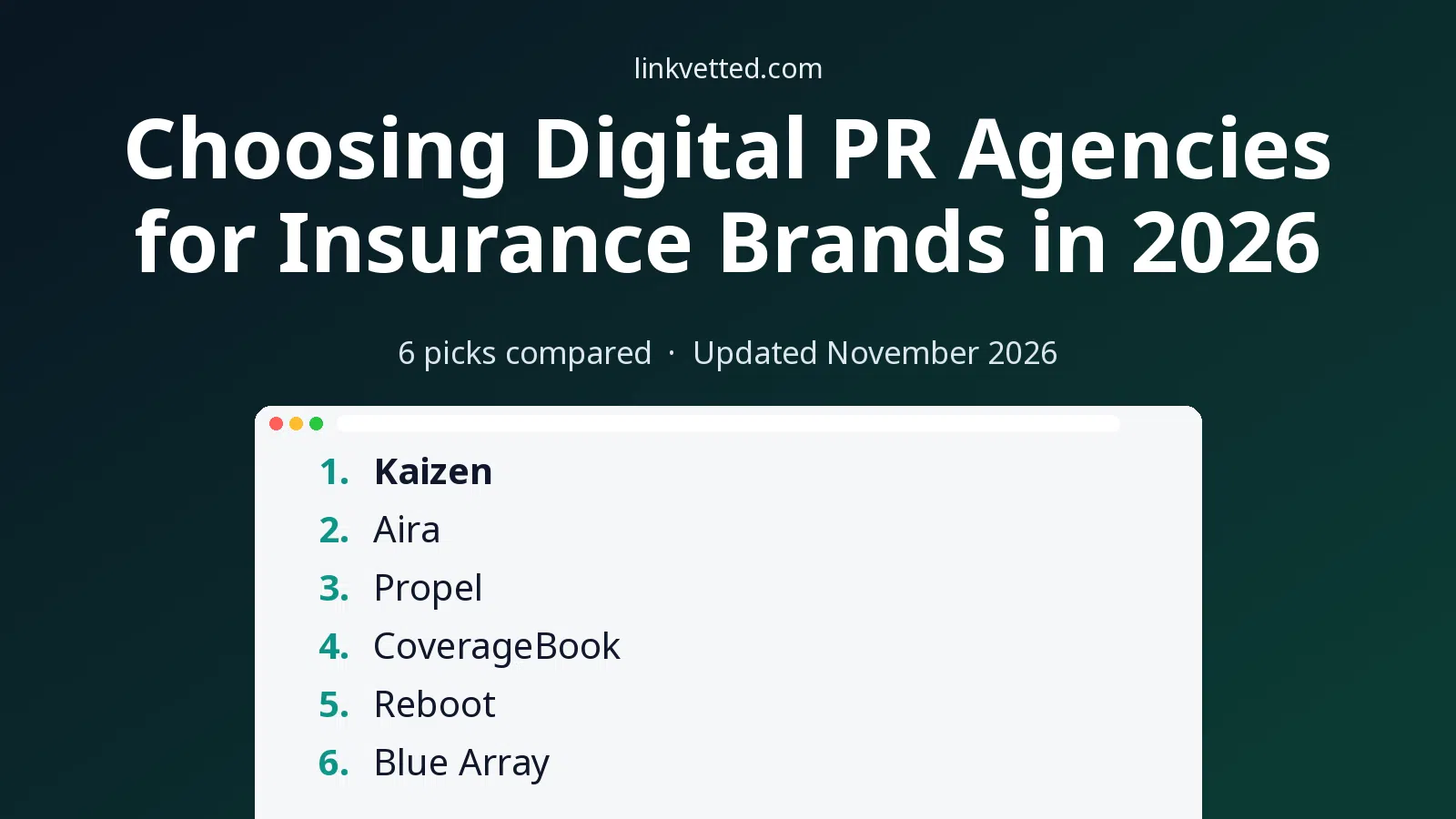
- Editor's choiceKaizen
Regulated-sector digital PR and SEO
Starts atSee websiteVisit kaizen.co.ukFull review - Great alternativeAira
Link-led digital PR campaigns
Starts atSee websiteVisit aira.netFull review - Also consider
 Propel
Integrated PR and SEO
Starts atSee websiteVisit propel.co.ukFull review
Direct answer
My top pick is Kaizen. Kaizen is a well-known digital PR and SEO agency that publicly works across regulated sectors and publishes its outreach process. For link-focused campaigns, Aira is a solid second choice, and for broader integrated PR, Propel is worth a look. I compared these from vendor documentation and public sources, not hands-on tests.
TL;DR:
- Insurance is a regulated vertical, so the agency you pick needs to understand compliance review before it pitches anything.
- Digital PR for insurance usually means data-led stories, survey campaigns and expert commentary, not generic press releases.
- Ask each agency how it handles claims, statistics and FCA-style approval wording before content goes out.
- Link acquisition should be a by-product of coverage, not a promise of rankings.
- Check whether the agency reports placements by domain, relevance and editorial context, not just a count.
Last checked November 2026. Plan prices are not quoted in this guide because they change often; see each vendor's own pricing page for current figures before you buy.
Quick comparison
| Tool | Best for | Starts at | Free plan? | |
|---|---|---|---|---|
| Kaizen | Regulated-sector digital PR and SEO | See website | Not stated | Visit |
| Aira | Link-led digital PR campaigns | See website | Not stated | Visit |
| Propel | Integrated PR and SEO | See website | Not stated | Visit |
 CoverageBook | Coverage reporting and proof of value | See website | Free trial | Visit |
| Reboot | Online reputation and SEO-led PR | See website | Not stated | Visit |
 Blue Array | SEO programmes with digital PR support | See website | Not stated | Visit |
The best digital PR agencies for insurance brands compared
I put this list together from vendor documentation, public case pages and agency service descriptions. I did not run hands-on tests with any of these providers, and I have not commissioned work from them on behalf of insurance clients. Treat it as a starting shortlist to research yourself.
Kaizen
Best for: Regulated-sector digital PR and SEO
Kaizen is a UK digital PR and SEO agency that describes its work across finance, tech and other regulated sectors. For an insurance brand, that matters because content often needs a compliance read before it goes to press. The agency publishes its approach to outreach and content, which gives you something concrete to question in a pitch.
In practice, an insurance campaign might involve survey data, claims trends or expert commentary that journalists can use. Kaizen's documented workflow covers ideation, asset creation and outreach, so you can ask how each stage handles sign-off. That structure is useful when your compliance team needs a clear paper trail.
The limit is that Kaizen is not an insurance specialist, and its broader service mix may not fit a small in-house team with a tight budget. Skip it if you want a pure press office rather than a digital PR and SEO partner.
- Public process documentation
- works across regulated sectors
- combines SEO and digital PR
- Service mix is broad
- not a dedicated insurance-only shop
Aira
Best for: Link-led digital PR campaigns
Aira is a digital PR agency that positions itself around earning links through creative campaigns and data stories. That model suits insurance brands that want editorial coverage in personal finance and consumer pages, where comparison and money sections often cite original data.
The workflow usually starts with a campaign concept, then an asset such as a survey or analysis, then outreach to journalists. Aira documents this process publicly, so you can ask how it would adapt a concept for an insurer's compliance rules. Reporting tends to focus on placements and links earned.
One limit is that a link-led agency may prioritise coverage volume over brand messaging. If your priority is reputation and thought leadership, a broader PR firm may fit better.
- Clear digital PR focus
- publishes campaign examples
- reports on link outcomes
- Link-first framing may not suit brand-led PR
- limited public detail on insurance work
Propel is a UK agency that blends digital PR with SEO and content. For insurance brands, that combination helps when you want coverage and search visibility to move together rather than running separate PR and SEO programmes.
The agency publishes case studies and describes a process built around research, creative assets and outreach. You can ask it to show how it would handle a claims-related data story, including the approval steps before pitching. Reporting covers both coverage and search-side outcomes.
The main limit is cost and scope: an integrated programme is more than a standalone outreach retainer. Smaller insurers may find it heavier than they need.
- Combines PR and SEO
- public case studies
- structured reporting
- Integrated scope can raise cost
- insurance experience not always explicit
CoverageBook is a reporting tool, not an agency, and I am including it because insurance marketing teams often need a clean way to show what a PR agency delivered. It turns coverage into shareable reports with screenshots, reach context and domain details.
If you hire one of the agencies above, CoverageBook can sit alongside them to standardise reporting across campaigns. That helps when compliance or leadership wants evidence of where the brand appeared and in what context.
Skip it if you are looking for someone to run outreach. It only reports on work that already happened, and it will not create campaigns or pitch journalists.
- Purpose-built coverage reports
- easy to share with stakeholders
- works with agency output
- Not an agency
- no outreach or content service
Reboot
Best for: Online reputation and SEO-led PR
Reboot is an online marketing agency with a well-known digital PR and SEO practice. It suits insurance brands that care about how they appear in search results and online coverage, especially around branded queries and comparison pages.
Its public material covers digital PR campaigns, content and outreach, so you can see the style of work before enquiring. For an insurer, a useful conversation is how it would handle sensitive topics such as claims disputes or pricing stories without creating risk.
The limit is that Reboot's online-first angle may not match a traditional insurer's press office needs. If you want broad national media relations, a general PR firm may be a better fit.
- Strong online-first focus
- public resources on digital PR
- combines SEO and content
- Reputation focus may skew away from pure PR
- insurance work is not its headline niche
Blue Array is a UK SEO agency that includes digital PR within its service mix. For insurance brands, that is useful when the goal is to support category pages and comparison visibility with editorial coverage rather than running PR in isolation.
The agency publishes material on its approach to SEO and content, so you can ask how digital PR would feed into a wider search plan. That could mean data-led stories for money pages or expert commentary that earns relevant mentions.
The limit is that PR is a supporting service here, not the core. If your main need is media relations and brand reputation, look at a dedicated PR agency first.
- SEO-led planning
- digital PR as part of the mix
- public content on method
- PR is one component, not the whole service
- not insurance-specific
How I chose
I built this list from vendor documentation, public service pages, published case studies and general knowledge of how these agencies describe their work. I did not run hands-on tests, and I have not commissioned any of these providers for insurance clients. The aim is to give you a shortlist you can verify yourself.
My criteria were fit for a regulated vertical, clarity of process, whether digital PR is core or a side service, and how each provider reports on coverage. I also weighed limits, because an agency that suits a large insurer may be wrong for a small broker. Where I was unsure about insurance-specific experience, I say so rather than guess.
What to check before you buy
- Ask how the agency handles compliance sign-off on data, claims and statistics before outreach starts.
- Request examples of coverage in personal finance, money or business sections, not just any link.
- Confirm how they report placements: domain, context, whether links are followed, and whether mentions are branded.
- Check who writes the content and whether an insurance specialist reviews it.
- Ask what happens if a campaign gets no coverage, and whether there is a re-pitch or credit policy.
- Clarify whether links or brand mentions are the primary goal, and make sure nobody promises rankings.
FAQ
Do insurance brands need a specialist digital PR agency?
Not always, but it helps. Insurance content often touches regulated claims, pricing and consumer advice, so an agency that understands approval steps reduces friction. A general digital PR agency can work if you brief it well and keep compliance in the loop. Ask for examples in finance or other regulated sectors before you commit.
What does digital PR for insurance usually include?
Typical work includes data-led stories from claims or market trends, survey campaigns, expert commentary and outreach to personal finance journalists. Some agencies also support thought leadership and report on coverage. The output should be editorial coverage and relevant mentions, with links as a by-product rather than a promise.
How is digital PR different from traditional PR?
Traditional PR often targets broad brand awareness across press and broadcast. Digital PR tends to focus on online publications, search visibility and link-earning content. For insurers, the two overlap: a story may run in national press and also earn online coverage. The difference is mainly in planning, measurement and how content is built for online readers.
Can a digital PR agency guarantee links or rankings?
No credible agency should guarantee links or rankings. Editorial coverage depends on journalists and news cycles. What you can ask for is a clear process, realistic targets, reporting on what was pitched and placed, and a plan for campaigns that do not land. Treat any ranking promise as a warning sign.
How should I brief an agency for an insurance campaign?
Give them your compliance boundaries, approved data sources, target publications and the topics you cannot touch. Share examples of coverage you like and explain who signs off content. Ask them to show a sample campaign plan with approval steps built in. A clear brief up front saves rework later.
Sources
- https://www.kaizen.co.uk
- https://www.aira.net
- https://www.propel.co.uk
- https://www.coveragebook.com
- https://www.rebootonline.com
- https://www.bluearray.co.uk