Digital PR Agencies for Energy Companies in 2026: The 6 Best Options Side by Side
A practical guide to digital PR agencies for energy companies in 2026, compared from vendor documentation and public sources, with limits and fit notes.
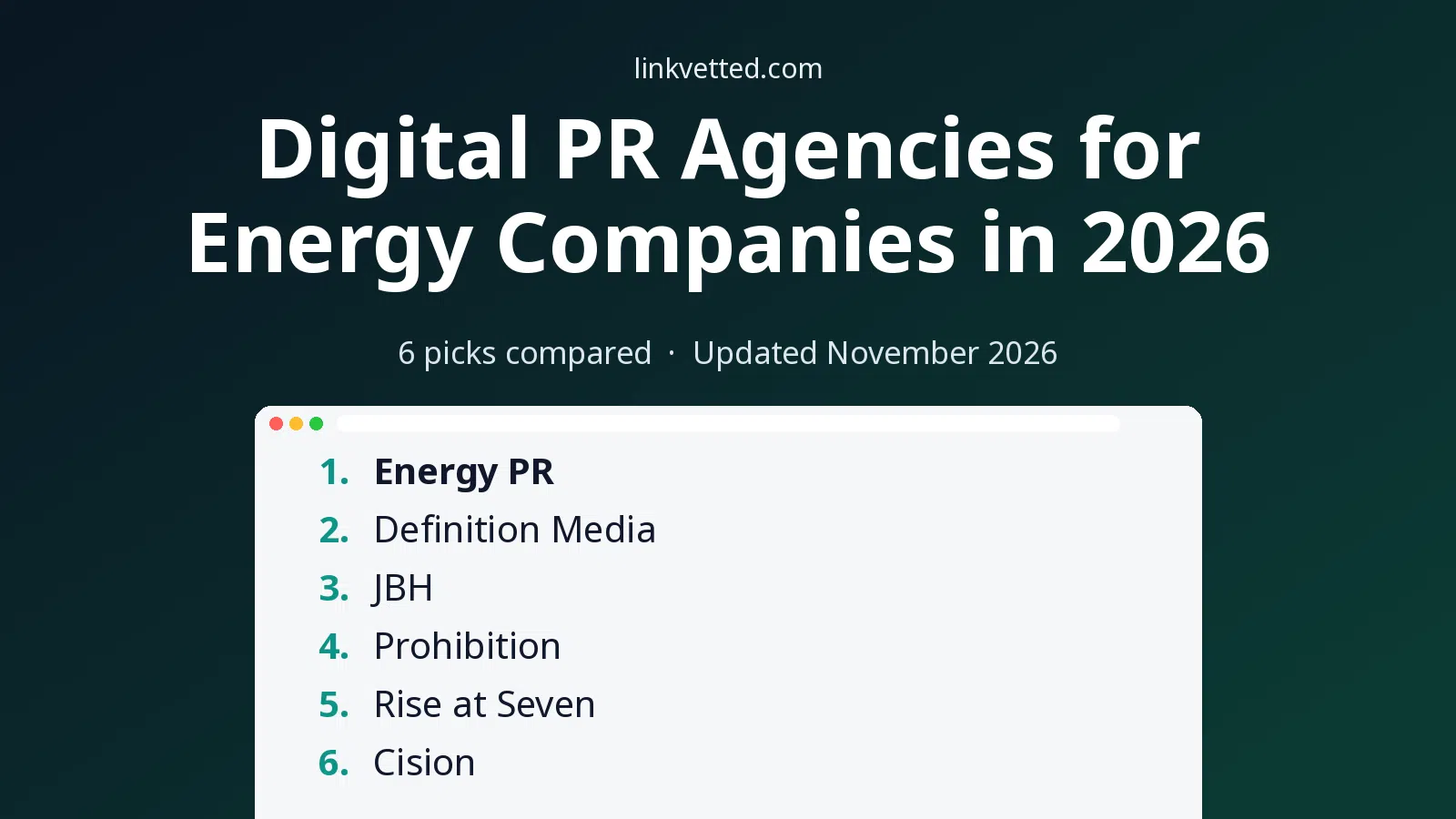
- Editor's choiceEnergy PR
Energy and engineering sector PR
Starts atSee websiteVisit energy-pr.comFull review - Great alternativeDefinition Media
Corporate and B2B reputation work
Starts atSee websiteVisit definitionmedia.co.ukFull review - Also considerJBH
Data-led link earning campaigns
Starts atSee websiteVisit jbh.co.ukFull review
Direct answer
My first pick is Energy PR, a UK agency that publicly focuses on energy and engineering clients. For broader corporate and B2B reach, I would look at Definition Media, and for campaigns built around data and links I would consider JBH. Each fits a different need: sector depth, corporate reputation, or link-focused digital PR.
TL;DR:
- Energy companies face regulation, safety scrutiny and long sales cycles, so sector knowledge matters more than general PR volume.
- A good agency will explain how it handles technical accuracy, approvals and compliance review before publishing anything.
- Digital PR for energy is usually about authority and trust, not quick link counts, so ask how success is measured.
- Check whether the agency can produce data-led stories, since those tend to earn coverage and links together.
- Ask for named people, a clear process and examples of work in regulated or technical sectors.
Last checked November 2026. Plan prices are not quoted in this guide because they change often; see each vendor's own pricing page for current figures before you buy.
Quick comparison
| Tool | Best for | Starts at | Free plan? | |
|---|---|---|---|---|
| Energy PR | Energy and engineering sector PR | See website | Not stated | Visit |
| Definition Media | Corporate and B2B reputation work | See website | Not stated | Visit |
| JBH | Data-led link earning campaigns | See website | Not stated | Visit |
| Prohibition | Creative campaigns with press appeal | See website | Not stated | Visit |
| Rise at Seven | Bold, search-led brand campaigns | See website | Not stated | Visit |
 Cision | Media databases and monitoring | See website | Not stated | Visit |
The best digital PR agencies for energy companies compared
I put this list together from vendor documentation and public sources, including each agency's own service pages and published client sectors. I did not run hands-on tests or commission campaigns, so treat this as a starting point for your own shortlist and conversations.
Energy PR
Best for: Energy and engineering sector PR
Energy PR is a UK agency that states it works with energy, engineering and industrial clients. That matters because energy stories often involve regulation, infrastructure and safety, and a team that already knows the vocabulary spends less time getting up to speed. It suits utilities, renewables firms, equipment makers and consultancies that want press coverage and reputation work rather than only backlinks.
For digital PR purposes, the value is in story placement and authority. The agency's work tends to sit around trade press, business media and sector commentary. If you want coverage that supports search visibility, ask how they turn client expertise into stories journalists will actually use, and how they report on links and mentions afterwards.
The limit is geography and scope. If you operate outside the UK, or you want a tightly link-focused campaign with no broader PR retainer, this may not be the best fit. Ask about international reach before you commit.
- Publicly focused on energy and engineering
- UK media relationships
- handles technical subject matter
- UK-centric
- not a pure link-building shop
Definition Media
Best for: Corporate and B2B reputation work
Definition Media is a UK communications agency that works on corporate and B2B accounts, including industrial and technical sectors. It fits energy companies that need consistent messaging across press, content and stakeholder communications, especially where the audience is investors, regulators, buyers or trade media rather than consumers.
On the digital PR side, the useful part is message discipline. Energy firms often have several audiences at once, and an agency that can keep the story consistent across channels helps avoid contradictions that journalists notice. Ask how they approach data stories and whether they handle outreach to sector publications directly.
Skip it if you want a fast, campaign-led consumer push or a pure link vendor. The approach leans towards steady reputation building, which takes time and suits companies with something to explain rather than a single stunt to promote.
- B2B and corporate focus
- messaging and content support
- works with technical sectors
- Less consumer-style creativity
- retainer model may not suit small firms
JBH
Best for: Data-led link earning campaigns
JBH is a UK digital PR and SEO agency that builds campaigns around data, surveys and creative assets, then pitches them to journalists. For energy companies, that model works when you hold useful data: consumption trends, grid figures, installation numbers or regional comparisons. The agency turns that into stories that earn coverage and links together.
The workflow usually starts with a workshop to find angles, then asset production, then outreach. That means your team needs to supply accurate data and approve claims, which is where energy firms often slow down. Plan for sign-off time and make sure someone technical is available to check numbers before anything goes out.
The drawback is sector depth. JBH is not an energy specialist, so you carry more of the subject-matter burden. It suits firms with clean data and a willingness to be involved, not those wanting a fully hands-off retainer.
- Digital PR and SEO focus
- data-driven story formats
- outreach built into the process
- Not energy-specific
- needs strong input data from you
Prohibition
Best for: Creative campaigns with press appeal
Prohibition is a UK PR agency known for creative campaigns and press-led work across consumer and business sectors. Energy companies with a public-facing angle, such as smart home products, EV charging or community schemes, can use that creativity to get coverage that a straight corporate release would not earn.
The practical benefit is story packaging. A campaign concept, a visual and a clear hook give journalists something easy to publish. For search purposes, that coverage often brings brand mentions and links from mainstream outlets. Ask how they handle regulated claims, because energy marketing has rules about what you can say on savings and environmental benefit.
The limit is fit. If your work is purely industrial or B2B, a consumer-style creative shop may not understand your buyers. It also helps to have internal sign-off ready, since creative ideas tend to need more approvals in regulated sectors.
- Creative campaign approach
- press and social integration
- broad media contacts
- Consumer style may not suit technical firms
- creative concepts need approval
Rise at Seven
Best for: Bold, search-led brand campaigns
Rise at Seven is a UK agency that combines search, content and digital PR with a strong creative style. Energy brands trying to stand out, particularly in consumer-facing areas like renewables, home energy or EV, may find the campaign approach useful for earning attention and links at the same time.
The way it helps is by treating PR and search as one job. Campaign ideas are built with search demand and link value in mind, not bolted on afterwards. That can produce coverage that supports rankings rather than just brand awareness. Ask for examples in regulated or technical categories, since the portfolio leans towards retail and consumer.
Skip it if you need steady trade press coverage, careful technical explanation or a low-cost retainer. The style is bold and campaign-based, and that usually means a bigger commitment per project.
- Search and PR combined
- strong creative output
- campaign-led link earning
- Creative-first pricing can be high
- not a sector specialist
Cision is a media intelligence and PR software provider, not an agency. I include it because many energy companies end up running digital PR in-house and need the basics: journalist contact data, monitoring and coverage reports. It is a practical tool for a comms team that wants to manage outreach directly.
It helps by giving your team the infrastructure to find journalists, track coverage and report to stakeholders. That can reduce reliance on an agency for routine tasks. For link-focused work, you still need someone to build the story and pitch it, so the software is only part of the job.
The drawback is exactly that: it is a tool. Without a capable operator, a database does not produce coverage. Skip it if you want an agency to own the work end to end, or if your team has no spare capacity to run outreach.
- Large media database
- monitoring and reporting tools
- widely used by PR teams
- Software, not a done-for-you agency
- needs an operator
How I chose
I compared these agencies using their own service pages, published sector information and other public sources. I looked at whether each one publicly states experience in energy, industrial or technical sectors, how they describe their digital PR process, and whether their model fits a company that needs approvals and accurate claims. I did not run campaigns with any of them, so I cannot vouch for results.
I also weighed limits. Some are sector specialists with narrow geography, others are general agencies with strong creative or link-earning skills. A few are software rather than services, which matters if you want a done-for-you team. The aim is to give you a shortlist to question, not a ranking to trust blindly.
What to check before you buy
- Ask for named examples of energy, industrial or regulated-sector work, and check whether the agency can discuss the brief openly.
- Confirm who handles technical accuracy and how claims about savings, emissions or performance are checked before pitching.
- Ask how they measure success: coverage, links, referring domains, brand mentions or traffic, and which of those they report on.
- Check the approval process and typical turnaround, since energy comms often needs legal or regulatory sign-off.
- Ask whether the team doing the pitching is in-house or freelance, and who your day-to-day contact will be.
- Request a clear scope with deliverables, reporting cadence and what happens if a campaign underperforms.
FAQ
Do energy companies need a specialist digital PR agency?
Not always, but sector knowledge helps. Energy stories involve regulation, safety and technical detail, and an agency that understands the vocabulary will need less hand-holding. A general agency with strong digital PR skills can work if your team is available to supply context and check claims.
What does digital PR do for an energy company's search visibility?
It earns coverage and links from publications that search engines treat as authoritative. That can support rankings for competitive terms and build brand recognition at the same time. It is not a guarantee of rankings, and results depend on the story, the outreach and the site's overall quality.
How long does a digital PR campaign take?
Most campaigns run in phases: research and concept, asset production, outreach and reporting. Approval steps in regulated sectors can add time. Ask each agency for a realistic timeline based on your sign-off process rather than accepting a generic estimate.
Can I run digital PR in-house instead of hiring an agency?
Yes, especially if you have a comms team and a tool like Cision for contacts and monitoring. The trade-off is time and skills: pitching journalists and building link-worthy assets takes practice. Many firms start in-house and bring in an agency for larger campaigns.
What should I ask about links in a digital PR proposal?
Ask which publications they expect to target, whether links are a stated goal or a by-product, and how they report on them. Be wary of anyone promising a set number of links or specific rankings. Good agencies talk about story quality and audience fit first.
Sources
- https://www.energy-pr.com
- https://www.definitionmedia.co.uk
- https://www.jbh.co.uk
- https://www.prohibitionpr.co.uk
- https://www.riseatseven.com
- https://www.cision.com