Best Dental Practice Software in 2026: 8 Tools Compared
Compare the best dental practice software for 2026, from Dentrix and Eaglesoft to Open Dental and Curve, and pick scheduling, charting, and billing that fits.

- Editor's choice
 Dentrix
Established Henry Schein practices
Starts atSee websiteVisit dentrix.comFull review - Great alternative
 Eaglesoft
Patterson supplied practices
Starts atSee websiteVisit eaglesoft.netFull review - Also consider
 Open Dental
Cost conscious practices owning data
Starts at$199 per location per monthVisit opendental.comFull review
TL;DR:
- Dentrix and Eaglesoft remain the mature, full-featured choices for established practices with on-site servers and supplier relationships.
- Open Dental is the value pick for practices that want published pricing and control over their data, at $199 per location per month for the first year, then $149.
- Curve Dental and Dentrix Ascend suit practices that want cloud delivery without a server, with multi-location access built in.
- Denticon and CareStack suit DSOs and multi-location groups that need centralized management and reporting.
- tab32 suits solo dentists and small groups that want cloud software with published starting pricing and a short setup path.
Quick comparison
| Tool | Best for | Starts at | Free plan? | |
|---|---|---|---|---|
| Dentrix | Established Henry Schein practices | See website | No | Visit |
| Eaglesoft | Patterson supplied practices | See website | No | Visit |
| Open Dental | Cost conscious practices owning data | $199 per location per month | No | Visit |
 Curve Dental | Mature cloud practices | See website | No | Visit |
 Dentrix Ascend | Cloud Dentrix workflows | See website | No | Visit |
 Denticon | DSOs and multi-location groups | See website | No | Visit |
 CareStack | Growing practices and groups | See website | No | Visit |
 tab32 | Solo and small cloud practices | $125 per location per month | Free trial | Visit |
The best dental practice software
Dental practice software handles scheduling, patient records, charting, treatment planning, billing, insurance claims, and reporting in one system. The tools below cover desktop, cloud, and multi-location options, so a practice should pick based on size, deployment, and imaging needs.

Dentrix, from Henry Schein One, is the most widely installed dental practice management system in North America, and its feature depth is hard to match for a multi-operatory practice. Scheduling, charting, treatment planning, billing, insurance claims, and reporting live in one desktop application, with a large ecosystem of add-ons for imaging, patient engagement, and analytics. Practices already in the Henry Schein supply world get a natural fit.
The downside is age and cost shape. Dentrix is a Windows desktop system, not a cloud native tool, and pricing is quoted with add-ons that raise total cost. A practice that wants browser access from anywhere should look at Dentrix Ascend instead. For an established practice that values depth and a large trained workforce, Dentrix remains a credible default.
- Deep scheduling, charting, billing, and claims features
- Large ecosystem of add-ons and trained staff
- Henry Schein supply links
- Windows desktop focus
- Pricing is quoted and add-ons add cost
- Interface feels older than cloud rivals
Eaglesoft, from Patterson Dental, is a mature desktop practice management system known for intuitive scheduling, easy navigation, and strong reporting. It handles patient records, charting, treatment planning, billing, and claims, with Patterson supply and support links that suit practices already buying through Patterson. Reviewers often cite ease of setup and support quality as strengths compared with older desktop rivals.
The limit is deployment. Eaglesoft is a desktop system, so a practice that wants true cloud access, multi-location browser login, and no server should compare Curve Dental, Dentrix Ascend, or tab32. For a Patterson supplied practice with an on-site server and a stable team, Eaglesoft is a solid, proven choice.
- Intuitive scheduling and navigation
- Strong reporting
- Patterson Dental ecosystem for supplies and support
- Desktop focus
- Pricing is quoted
- Cloud access requires a different approach than cloud native tools
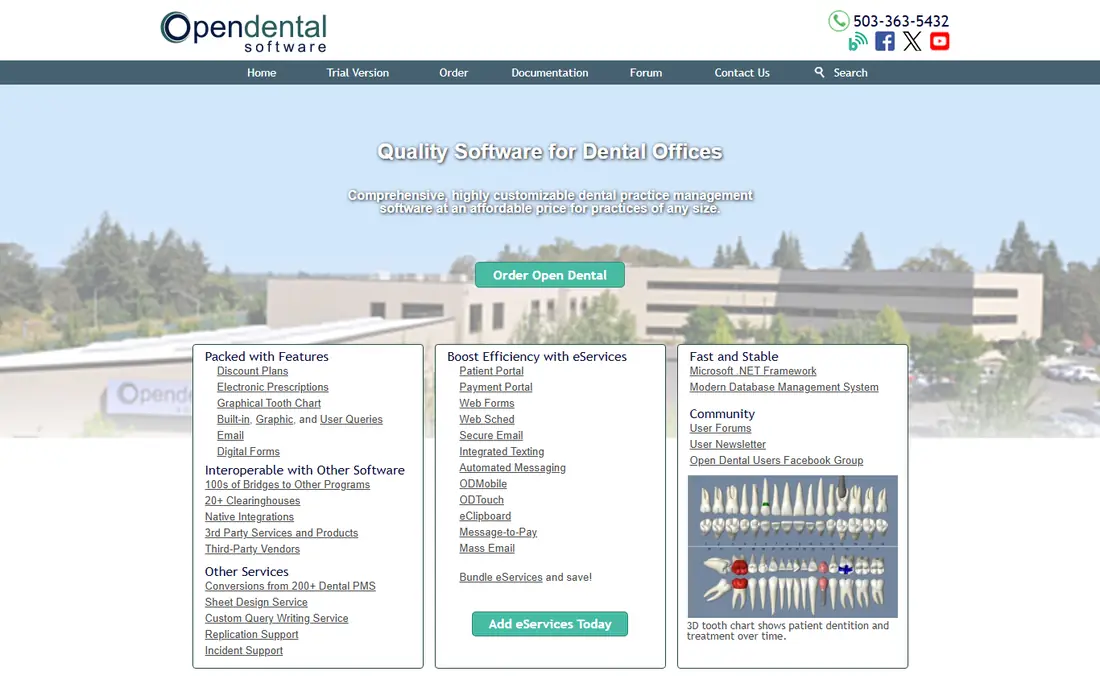
Open Dental is the transparency outlier in dental software. It publishes pricing at $199 per location per month for the first 12 months, then $149 per month, with add-ons such as eServices priced separately. The software is open source at its core, with strong customization and reporting, and practices value the control over their data and the lower long term cost compared with quoted enterprise systems.
The weakness is polish and bundling. The interface is plainer than Curve or CareStack, and imaging, patient messaging, and online scheduling often need partner tools or paid modules. A practice comfortable with a more technical setup, or with IT help, will get the best value. For a cost conscious practice that wants published pricing and data control, Open Dental is the value pick.
- Published pricing
- Flexible customization and reporting
- Open source core with strong data control
- Plainer interface than cloud rivals
- Imaging and patient engagement often need partner tools or paid modules
Curve Dental is an established cloud practice management system, often cited as Curve Hero in some listings, that lets a practice run scheduling, charting, billing, and patient communication from a browser, without an on-site server. Multi-office access suits growing groups, and cloud updates remove the server maintenance burden that desktop systems carry. For a practice that wants to work from multiple locations or from home, Curve is a natural shortlist option.
The catch is quoted pricing and tier variation. Imaging support, patient engagement features, and advanced reporting vary by tier, so a practice should test its own X-ray sensors and its insurance workflow during a trial. For a cloud-first single or multi-location practice, Curve Dental is a mature and well supported choice.
- Cloud native access from anywhere
- Mature practice management with imaging in some tiers
- Multi-office access
- Pricing is quoted
- Imaging depth varies by tier, so check sensor and imaging support early
Dentrix Ascend is Henry Schein One cloud successor to desktop Dentrix, offering scheduling, charting, billing, claims, and reporting from a browser, with multi-location and DSO support built in. For a practice that likes Dentrix workflows but wants cloud delivery, Ascend is the logical upgrade path, without keeping a server in the office. Central reporting helps groups see performance across locations in one view.
The downside is migration. Moving charts, images, ledgers, and perio data from desktop Dentrix, or from another system, needs a planned migration and a check of what transfers cleanly. Pricing is also quoted. A practice planning that move should budget weeks for migration and training, and should test imaging and claims with its own hardware before signing.
- Cloud delivery with Dentrix style workflows
- Multi-location and DSO support
- No on-site server needed
- Pricing is quoted
- Migration from desktop Dentrix needs planning for charts, images, and ledgers
Denticon, from Planet DDS, is a cloud practice management system built for DSOs and multi-location groups that need centralized scheduling, billing, reporting, and standardization across offices. A central team can set workflows, view performance by location, and manage patient records across a group, which is hard to do with separate desktop installs in each office. That central control is why Denticon appears on many DSO shortlists.
The limit is size. Denticon pricing is quoted and enterprise oriented, and a solo practice will get better value from tab32 or Open Dental. For a group that is growing by acquisition or opening new locations, Denticon offers the central management that smaller tools lack.
- Centralized multi-location management
- Cloud delivery
- Strong for DSO reporting and standardization
- Pricing is quoted and enterprise oriented
- Oversized for a single solo practice
CareStack is a cloud dental platform that combines practice management, clinical charting, billing, and patient engagement in one connected system, with analytics for growing practices and groups. That single system view helps a practice avoid juggling separate scheduling, billing, and messaging tools, and it gives managers clearer reporting as the practice adds providers or locations.
The weakness is enterprise pricing and implementation weight. CareStack pricing is quoted, and a group rollout needs training and data migration planning. A solo practice may find it oversized, while a growing group that wants one system for clinical and business work will find CareStack a strong contender alongside Denticon and Dentrix Ascend.
- One connected system for scheduling, charting, billing, and patient engagement
- Analytics for growing groups
- Cloud delivery
- Pricing is quoted
- Implementation for a group needs planning and training time
tab32 is a cloud dental practice system for solo dentists and small groups, with published starting pricing at $125 per month per location in its Alpine year one plan, rising in year two on that plan, and a 14 day trial. It covers scheduling, charting, billing, and patient engagement, with cloud access that removes server work. For a new practice or a small group that wants a modern cloud start without a quoted enterprise negotiation, tab32 is appealing.
The catch is scale and price change. Very large practices may need deeper features from Dentrix, Denticon, or CareStack, and the year two price rise should be factored into a multi-year budget. For a solo or small practice that wants cloud software with a trial and published pricing, tab32 is a practical and clear choice.
- Published starting pricing
- Cloud access with patient engagement included in many plans
- 14 day trial to test fit
- Smaller feature depth than Dentrix for very large practices
- Pricing rises after the first year on some plans
How we picked these
We compared official feature pages, pricing pages, and public documentation, plus public reviews and comparison guides, for dental practice management tools available now. We favored tools with clear scheduling, charting, billing, and claims coverage, and we mixed desktop, cloud, and DSO options. We did not claim hands-on testing, and we used See website where pricing is quoted.
How to choose dental software without a painful migration
Start with deployment and imaging. Decide whether you want a server in the office, a cloud system, or a hybrid, then test your own X-ray sensors, intraoral cameras, and imaging software with each shortlisted tool. Imaging incompatibility is a common migration regret, and a demo with generic images will not catch it.
Next, test insurance and billing with your real payers. Run eligibility checks, submit test claims, and check how denials and patient statements are handled. Also check patient communication: online booking, recall, two-way texting, and text-to-pay are often add-ons, so confirm what is included and what costs extra. Finally, ask exactly what migrates: charts, images, ledgers, perio, and treatment plans, and budget time for staff training on the new workflow.
A note on review software for dental practices
The best dental software programs for scheduling and billing do not always include full review management. Many practices pair a practice system above with a patient communication tool such as Weave or NexHealth, or a dedicated review tool, to request Google reviews after appointments and respond to feedback. If reviews are a priority, ask each vendor whether review requests, monitoring, and replies are included, or whether you will need a separate tool.
FAQ
What is the best dental practice software?
The best dental practice software depends on practice size. Dentrix and Eaglesoft suit established desktop practices, Open Dental suits cost conscious practices, Curve Dental and Dentrix Ascend suit cloud practices, and Denticon and CareStack suit DSOs and groups.
What are the best dental software programs for a small practice?
For a small practice, Open Dental and tab32 are strong starting points, because they publish starting pricing and cover core scheduling, charting, and billing. Curve Dental is another cloud option if a practice wants a more mature cloud platform and can accept quoted pricing.
What is the top review software for dental practices?
Top review software for dental practices is often a patient communication add-on, such as Weave or NexHealth, or a dedicated review tool that requests reviews after appointments. Check whether your practice system includes review requests, or whether a separate tool is needed for Google review collection and replies.
How much does dental practice software cost?
Published starting prices include Open Dental at $199 per location per month for the first year, then $149, and tab32 at $125 per location per month in year one on its Alpine plan. Dentrix, Eaglesoft, Curve, Dentrix Ascend, Denticon, and CareStack are quoted, so total cost depends on locations, providers, and add-ons.
Should a new practice choose cloud or desktop dental software?
A new practice often benefits from cloud software, because it avoids server purchase and maintenance, and it supports access from multiple locations. A practice with strict on-site requirements, legacy imaging, or an existing supplier relationship may still prefer a desktop system such as Dentrix or Eaglesoft.