Best Dating App for Over 50 in 2026: 8 Apps Compared
Compare the best dating app for over 50 options in 2026, with matching styles, safety tools, free tiers and pricing to help mature daters choose well.
- Editor's choice
 SilverSingles
Daters over 50 who want curated matches
Starts atSee websiteVisit silversingles.comFull review - Great alternative
 OurTime
Daters who want to browse and search freely
Starts atSee websiteVisit ourtime.comFull review - Also consider
 eharmony
People seeking a long-term partner
Starts atSee websiteVisit eharmony.comFull review
TL;DR:
- SilverSingles is our pick for daters over 50 who want a 50-plus only pool and personality-based matches rather than endless browsing.
- OurTime suits daters who prefer to browse freely and search by location, interests and lifestyle at their own pace.
- eharmony suits people seeking a long-term partner who are willing to complete a long questionnaire and pay for curated matches.
- Match is the strongest mainstream fallback when the local 50-plus pool on a niche site feels thin, thanks to its large user base and search tools.
Quick comparison
| Tool | Best for | Starts at | Free plan? | |
|---|---|---|---|---|
| SilverSingles | Daters over 50 who want curated matches | See website | Yes | Visit |
| OurTime | Daters who want to browse and search freely | See website | Yes | Visit |
| eharmony | People seeking a long-term partner | See website | Yes | Visit |
 Match | Daters who want a large pool and flexible search | See website | Yes | Visit |
 EliteSingles | Professional singles seeking a serious partner | See website | Yes | Visit |
 SeniorMatch | Older daters who want a community feel | See website | Yes | Visit |
 Zoosk | Budget daters who want a large browsing pool | See website | Yes | Visit |
 Christian Mingle | Christians seeking a faith-based partner | See website | Yes | Visit |
The best dating apps for over 50
We compared official sign-up flows, matching methods, free tier limits, safety and verification tools, and pricing structures. The best app for you depends on whether you want curated matches, free browsing, a niche community or a large mainstream pool. All of these services are for adults aged 18 and over, and most members on the age-focused services are in their 50s, 60s and 70s. Stay alert to romance scams, never send money to someone you have not met, and report suspicious profiles.
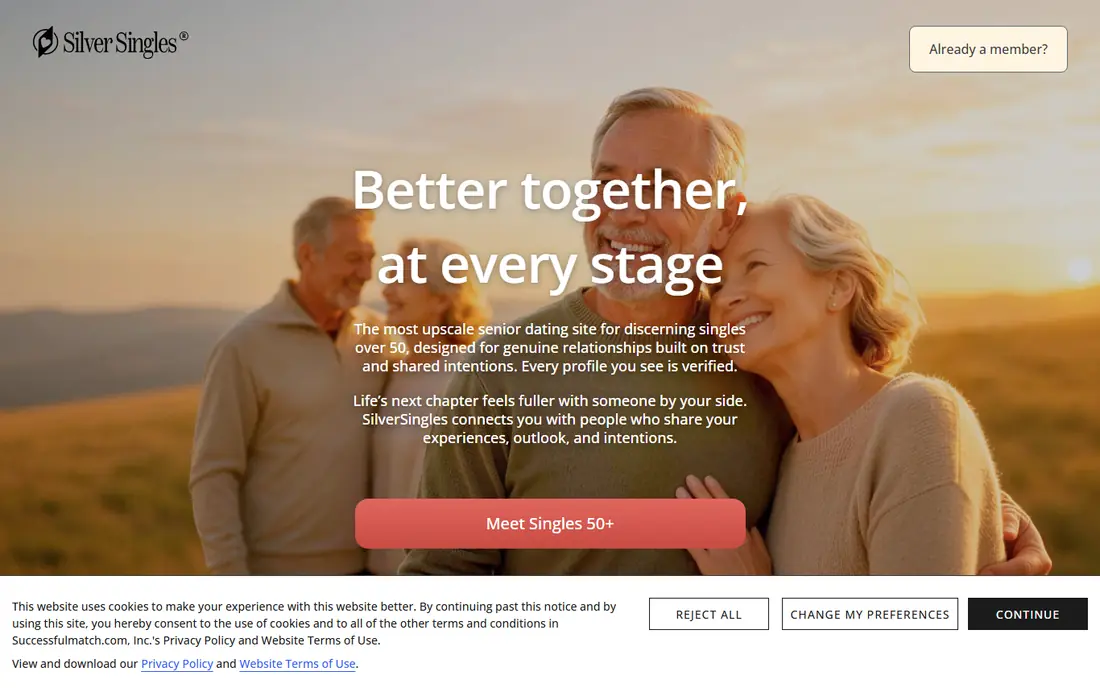
SilverSingles is built around a simple idea: fewer, better matches for people over 50. Sign-up starts with a detailed personality questionnaire covering values, lifestyle and relationship goals, and the system then suggests a small number of compatible profiles each day. That slower pace suits daters who feel overwhelmed by endless swiping and who would rather read a few thoughtful profiles than sort through hundreds. The 50-plus only pool also removes the filtering work that comes with mainstream apps.
The trade-off is control and cost. You cannot freely browse the whole pool in the same way as on OurTime, and full messaging requires a paid plan, so the free tier is mainly for setting up a profile and viewing matches. Pricing is confirmed at checkout and often involves multi-month bundles, so check the total charge and renewal terms before paying. If you value curation over volume, SilverSingles is a strong first choice.
- 50-plus only community
- Personality questionnaire drives matches
- Small, focused daily match list
- Free tier does not allow full messaging
- Fewer matches per day than browsing apps
- Pricing requires checkout to confirm
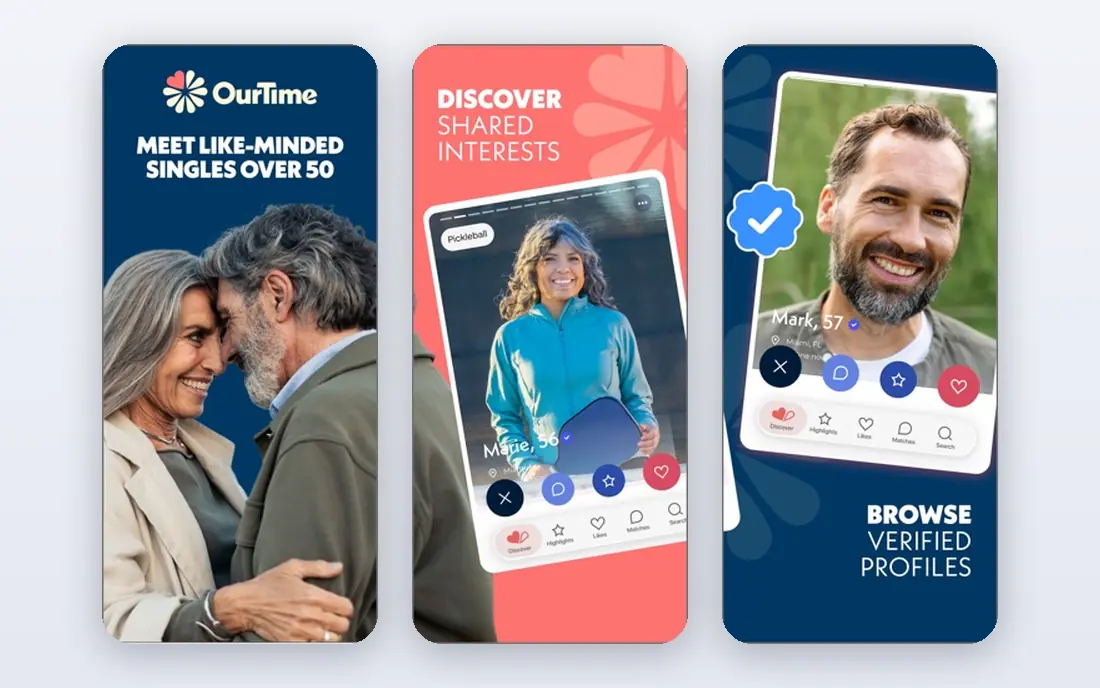
OurTime appeals to daters who like to take charge of the search. Instead of waiting for daily matches, you can browse profiles, search by location, interests and lifestyle, and contact people who catch your eye. The community is large for the 50-plus age group, which helps outside major cities where niche pools can feel thin. The free tier lets you browse and receive messages, so you can get a sense of local activity before paying. For many returning daters, that control feels more natural than an algorithm-only approach.
The interface is not the most modern here, and the experience can feel busy with prompts for extras such as boosts. Standard messaging and the most useful features still require a paid plan, and package totals are charged in full for multi-month plans. Check the plan length and renewal date at checkout. If you prefer browsing to curated matches, OurTime remains a practical, budget-friendly starting point.
- Large 50-plus community
- Browse and search by location and interests
- Free tier lets you browse and receive messages
- Interface feels dated compared with newer apps
- Full messaging and extras require a paid plan
- Boosts cost extra
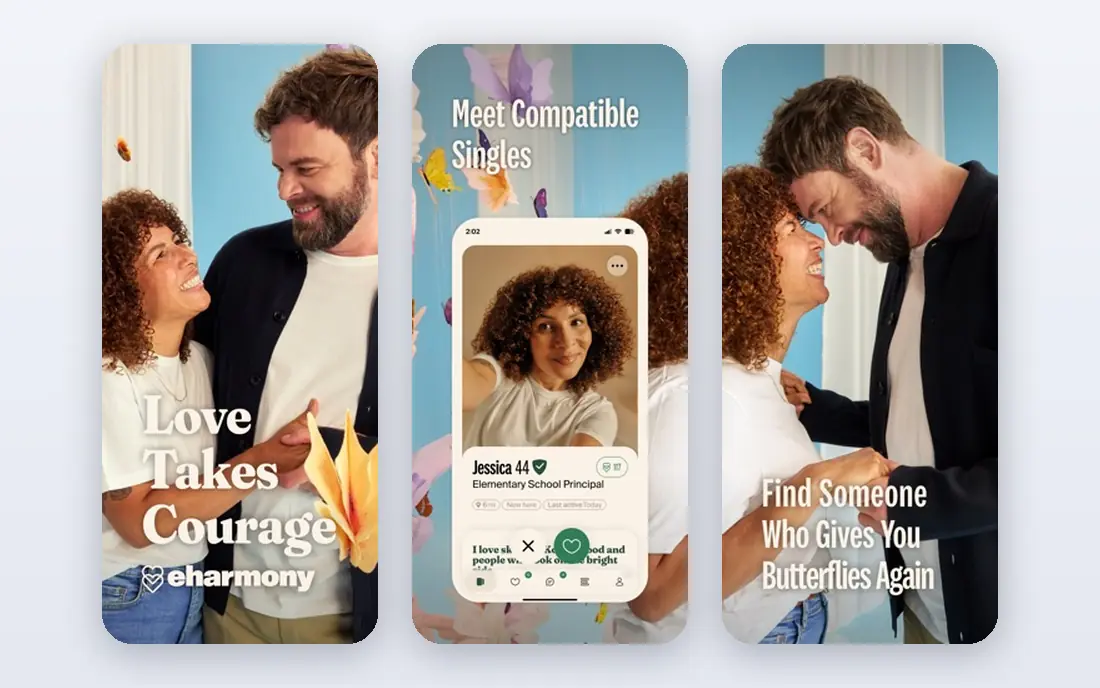
eharmony is the most structured option here, and that structure is the point. A long compatibility quiz explores communication style, values and relationship goals, and the system uses those answers to suggest a small number of matches each day. Guided communication prompts and video dates help people who feel nervous about returning to dating, since they offer a low-pressure way to talk before meeting in person. For daters who want a serious, long-term partner, that deliberate pace can be reassuring.
The cost is time and money. The questionnaire is long, free messaging is limited, and paid plans are priced by length, with totals that vary between web and app checkout. If you want quick browsing or casual dating, eharmony will feel slow. If you want a system that does much of the filtering for you and you are willing to invest several months, it is a strong contender.
- Long compatibility questionnaire
- Curated daily matches
- Video dates and guided communication tools
- Questionnaire takes time
- Free tier does not allow full messaging
- Pricing varies by plan length and checkout channel
Match is not built only for over-50 daters, but its size makes it useful for them, especially outside large cities. Search tools let you set an age range, location and interests, and the pool includes many people in their 40s, 50s and 60s. That breadth helps when a niche site has few local profiles. Match also offers events, detailed profiles and messaging tools that suit daters who want to read a full profile before reaching out. Longevity since 1995 also means most people have heard of it, which can make joining feel less daunting.
The drawback is that you must do the filtering yourself. Because Match serves all ages, you will see younger profiles unless you set search filters carefully, and the most useful features require a subscription. Prices vary by plan length, so confirm the total at checkout. Use Match as a complement to a niche site, or as your main app if local niche pools are thin.
- Very large user base since 1995
- Flexible search by age, location and interests
- Events and profile tools
- Not age-exclusive, so filtering is needed
- Full features require a paid plan
- Interface can feel busy
EliteSingles targets professional singles who want a serious relationship, with a personality test and curated matches similar in spirit to SilverSingles and eharmony. Its members tend to be career-focused and well educated, which appeals to daters who value shared ambition and lifestyle. Daily matches keep the pace manageable, and profiles tend to be detailed, which helps you judge compatibility before messaging. For a professional dater in a city, that focus can produce more relevant conversations than a general browsing app.
The pool is not exclusively over 50, so older daters should set age preferences clearly and expect some younger matches in the mix. Full messaging requires a paid subscription, and local matches can be sparse outside metropolitan areas. If you live in a smaller town, check local activity during the free phase before committing to a multi-month plan.
- Personality-based matching
- Focus on educated, professional singles
- Curated daily matches
- Pool skews to 40-plus rather than 50-plus only
- Full messaging requires a paid plan
- Fewer local matches in smaller towns
SeniorMatch offers a smaller, more community-oriented alternative to the large 50-plus sites. Its user base skews toward older daters, and interest and community features help people connect over shared hobbies as well as romance. That community feel suits daters who want conversation and companionship first, rather than a fast, photo-led process. A free basic membership lets you explore profiles and get a sense of the site before paying.
The main limit is size. Outside metropolitan areas, the pool can be thin, and the most useful messaging and search features require a subscription. That makes SeniorMatch a better second app than a sole choice for many daters, unless your area has strong local activity. Check profile counts near you during the free phase, and compare that local depth with OurTime or Match before you pay.
- Focus on senior daters
- Community and interest features
- Free basic membership
- Smaller pool than OurTime or Match
- Most useful features require a paid plan
- Local matches can be thin
Zoosk is a low-cost, browsing-led option with a large pool and a behavioural matching system that learns from profiles you like and message. That approach can surface people you might not have found through a questionnaire alone, and the app is easy to use for daters who are new to online dating. Entry costs are generally lower than at curated services, which makes Zoosk a useful low-risk way to test online dating before committing to a pricier plan.
The catch is focus and safety. Zoosk is not built only for over-50 daters, so you must filter by age and location, and the open browsing model means you should vet profiles carefully. Full messaging requires a paid plan, and some features cost extra. Use Zoosk with the same safety habits as any dating app: keep early conversations in the app, do not share financial details, and meet in public places.
- Large pool and easy browsing
- Behavioural matching learns from your activity
- Low entry cost compared with some rivals
- Not age-focused, so filtering matters
- Safety requires extra vigilance
- Paid features needed for full messaging
Christian Mingle suits daters for whom shared faith is central to a partnership. Profiles include questions about church activity, denomination and faith priorities, which helps filter for values that matter deeply to many mature daters. The community is focused, so conversations often start from a shared outlook rather than just photos or hobbies. For Christians over 50 who want a partner who shares their faith life, that focus is more valuable than a larger but less filtered pool.
The limit is local depth. The pool is smaller than Match or OurTime, and matches can be sparse in some regions, especially for specific denominations. Full messaging requires a paid plan, so check local activity during the free phase. If your area has a strong Christian Mingle presence, it can be an excellent primary app. If not, pair it with a larger site and keep faith filters clear in your profile.
- Faith-based community and profile questions
- Search by denomination and church activity
- Long history in Christian dating
- Smaller pool than mainstream apps
- Full messaging requires a paid plan
- Local matches vary by region
How we picked these
We compared official sign-up and pricing pages, matching methods, free tier limits and safety tools, and we read public reviews about local pool depth, messaging limits and billing. We kept only services that are live in October 2026, that serve US daters, and that either focus on over-50 daters or have a large older user base with age filtering. We used See website for prices where checkout totals vary by plan length and channel, rather than repeating a single monthly figure that could mislead.
What to check before you pay
Start with local activity, not national claims. Create a free profile, set your age range and location, and see how many active profiles appear near you. A site that looks strong nationally can still be quiet in your town, and a smaller site with good local depth can beat a large site with few nearby members. Also check what the free tier actually allows, since browsing without messaging tells you little about conversation quality.
Safety, photos and first meetings
Use recent, honest photos and a profile that states what you want clearly, including whether you seek companionship, a long-term partner or marriage. Keep early chats inside the app, do not send money or gift cards for any reason, and be wary of profiles that avoid video calls, claim to be abroad, or ask for financial help. Meet first in a public place, tell a friend where you are going, and arrange your own transport. Report and block suspicious profiles rather than engaging further.
Cost and cancellation
Dating apps often sell multi-month bundles charged in full, with auto-renewal, so check the total, the plan length and the renewal date before paying. Note how to cancel in the app or on the website, and whether cancellation stops renewal or also ends current access. A cheaper monthly equivalent on a long plan is only a saving if you plan to stay that long. Start with the shortest plan that gives you full messaging, then extend if the local pool proves worthwhile.
FAQ
What is the best dating app for over 50?
SilverSingles is our top pick for a 50-plus only pool with curated matches, while OurTime suits free browsing and eharmony suits long-term seekers. Match is the best mainstream fallback when local niche pools are thin. The right choice depends on whether you prefer curation, browsing or a faith or professional focus.
Are dating apps for over 50 free?
Most offer a free profile and limited browsing, but full messaging usually requires a paid plan. Free tiers help you check local activity and profile quality before paying. Always confirm the total bundle price and renewal terms at checkout, since monthly equivalents can hide a larger upfront charge.
How do I stay safe on dating apps over 50?
Keep conversations in the app, never send money to someone you have not met, and be wary of urgent financial requests or excuses to avoid video calls. Meet in public, tell a friend your plans, and report suspicious profiles. Legitimate matches will respect a slow pace and public first meetings.
Do I need a niche app, or will Match work?
A niche app helps when you want a 50-plus only pool or a shared faith or professional focus. Match works well when you want the largest pool and flexible search, especially in smaller towns. Many daters use one niche app plus Match, then keep the one with better local conversations.
How long should I try a dating app before judging it?
Give a paid plan at least four to six weeks, since curated services need time to learn your preferences and browsing apps need time for replies. Use that period to send thoughtful messages, update photos and check local activity weekly. If conversations stay thin after that time, try a different app rather than extending the same plan.