Data Quality Software in 2026: A Guide to 7 Tools
Need the best data quality software? We compare 7 tools on cost, free access and who each suits. Each pick comes with its main catch. Read the profiles.

- Editor's choice
 Ataccama
Enterprises combining quality with governance and compliance
Starts atSee website (custom quote)Visit ataccama.comFull review - Great alternative
 Monte Carlo
Enterprises wanting ML-based pipeline monitoring
Starts atSee website (custom quote)Visit montecarlodata.comFull review - Also consider
 Melissa
SMBs verifying addresses, emails and phones
Starts atSee website (credit-based pricing)Visit melissa.comFull review
TL;DR:
- This list starts with Ataccama, which is built for enterprises combining quality with governance and compliance.
- No starting price is published for Ataccama, Monte Carlo, Melissa and others; expect a quote.
- Great Expectations fits Python-native teams wanting free open-source validation.
- Before buying Ataccama, weigh this: custom pricing and real implementation effort.
- A free plan is available from 2 of the 7 tools: Soda, Great Expectations.
Direct answer
Ataccama comes first here, mainly for enterprises combining quality with governance and compliance. Monte Carlo is the stronger choice for enterprises wanting ML-based pipeline monitoring, while Melissa suits SMBs verifying addresses, emails and phones. Details, prices and limits for the rest of the 7 tools are below.
Quick comparison
| Tool | Best for | Starts at | Free plan? | |
|---|---|---|---|---|
| Ataccama | Enterprises combining quality with governance and compliance | See website (custom quote) | No | Visit |
| Monte Carlo | Enterprises wanting ML-based pipeline monitoring | See website (custom quote) | No | Visit |
| Melissa | SMBs verifying addresses, emails and phones | See website (credit-based pricing) | Free trial (90 days) | Visit |
 Precisely | Enterprises needing quality plus data enrichment | See website (custom quote) | No | Visit |
 Soda | Data engineering teams wanting code-based checks | $0/month (Free plan); $750/month (Team) | Yes | Visit |
 Informatica | Large enterprises standardizing on one data system | See website (custom quote) | No | Visit |
 Great Expectations | Python-native teams wanting free open-source validation | Free (GX Core open source); See website (GX Cloud) | Yes | Visit |
Our 7 picks for data quality software
Choosing data quality software usually comes down to price, fit and limits. This LinkVetted guide sets 7 tools side by side on those three points, with the facts kept short and checkable.
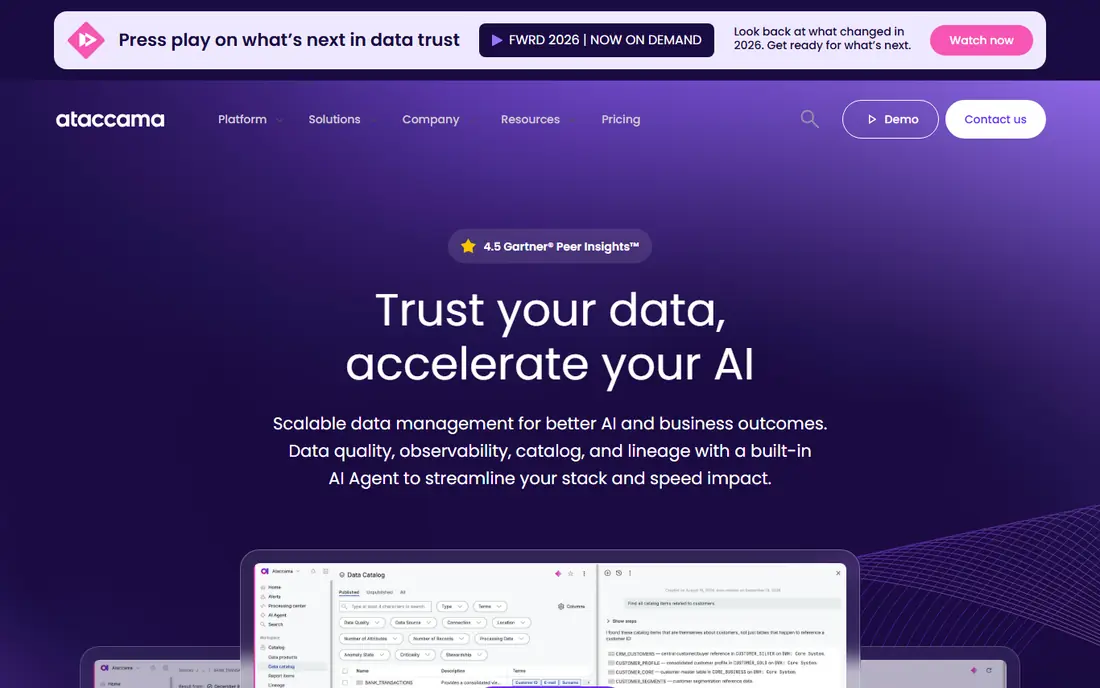
Ataccama is a good fit for enterprises combining quality with governance and compliance. Customer logos on the site skew toward banks, insurers and telecoms, which tells you who buys it.
Worth adding: Ataccama's strength is environments where auditability matters as much as the cleansing itself. No starting price is listed for Ataccama here; confirm pricing on the vendor site. No free plan comes with Ataccama.
Watch-outs: Custom pricing and real implementation effort.
- Lineage and master data with a built-in AI agent
- Capable auditability for regulated industries
- Enterprise-shaped, so smaller teams pay for scope they will not use
Think of Monte Carlo for enterprises wanting ML-based pipeline monitoring. Machine-learning watches watch pipelines and tables for anomalies in freshness, volume, schema and distribution, then alert the right owner. It catches the silent breakages that rule-based checks miss: the upstream table that stopped updating, the column whose values quietly shifted.
Pricing is custom and enterprise-oriented, and Monte Carlo assumes a modern cloud data stack for example Snowflake, Databricks or BigQuery. It observes; it does not cleanse or standardize. Also, pair it with a cleansing tool, or accept that detection is the job you are buying. Check the vendor site for Monte Carlo pricing; none is listed in this comparison. No free plan comes with Monte Carlo.
Trade-offs to know: Observes but does not cleanse or standardize.
- Schema and distribution anomalies
- Wide coverage of modern cloud data stacks
- Assumes a modern cloud warehouse or lakehouse
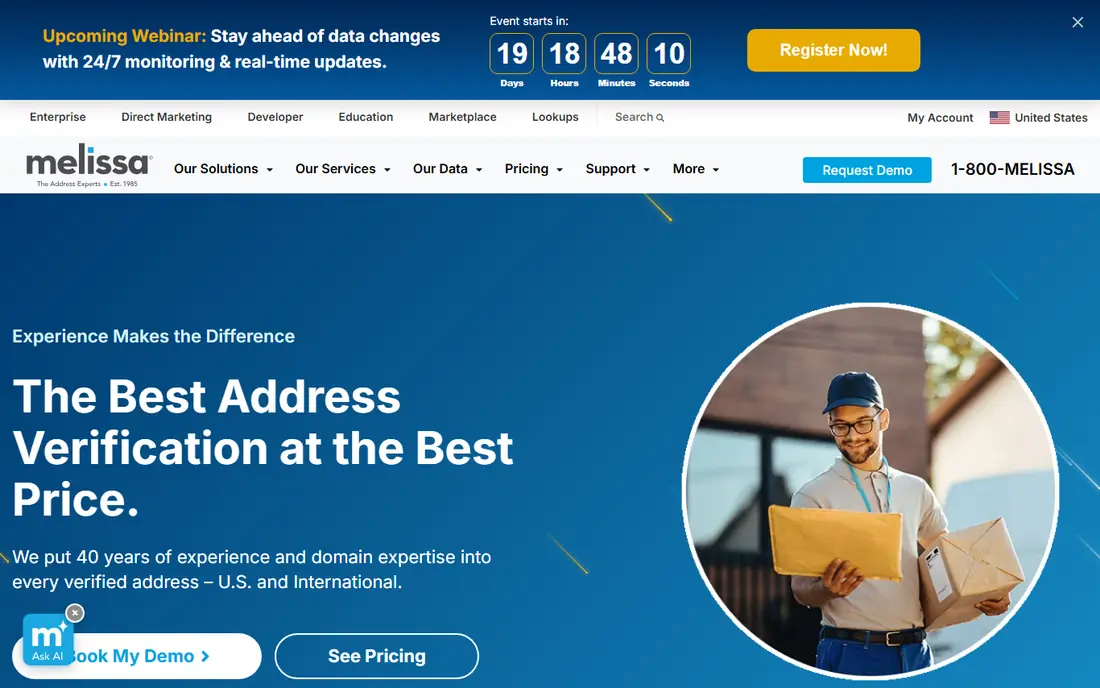
Melissa is designed for SMBs verifying addresses, emails and phones. The pricing page lists pay-as-you-go, subscription and unlimited levels, with a 90-day free trial on subscriptions. Also, for SMBs running ecommerce, direct mail or CRM cleanup, that focus is a feature.
Drawbacks to consider: No flat starting price published, so budgeting needs a quote; not pipeline monitoring or governance.
Melissa is the value pick for contact data quality: address verification, email and phone checks, dedupe and geocoding, sold on usage-based credits rather than enterprise contracts. Enterprise data teams will outgrow it. Melissa shows no starting price here, so confirm the cost on the vendor site. Free access: Free trial (90 days).
Main advantages: Usage-based credits rather than enterprise contracts.
- Dedupe and geocoding
- 90-day free trial on subscription plans
- Contact-data scope only
Think of Precisely for enterprises needing quality plus data enrichment. The enrichment angle is the differentiator, with pre-linked datasets for addresses, locations and business data ready to append.
Where it falls short: Consolidation projects take time.
Worth adding: everything is custom-quoted and enterprise-shaped. Smaller teams will find the scope overwhelming and the sales cycle long. Pricing for Precisely is not stated here, so ask the vendor for current figures. Precisely does not include a free plan.
- Long enterprise track record
- Hundreds of pre-linked enrichment datasets for addresses
- Custom pricing and an enterprise sales cycle
In short, Soda is for Data engineering teams wanting code-based checks. The free plan is genuinely usable: pipeline testing, metrics observability and alerting integrations at $0 a month with no credit card required.
In a category where everyone else hides behind "contact sales," published prices are a statement. On top of that, Soda writes data quality checks as code, in a YAML-style language data engineers already understand, and pairs it with a no-code interface so business users share one workflow. What you pay to start with Soda: $0/month. Soda offers a free plan.
Trade-offs to know: Concentrated on checks and contracts; not legacy-source profiling or cleansing.
- Rare in this category
- Checks written as code with a no-code interface for business users
- Newer vendor than the incumbents
Informatica serves large enterprises standardizing on one data platform. Informatica is the incumbent most enterprises compare everything else against. That matters since quality stops being a side project when it shares the same platform as the pipelines moving the data.
For large enterprises standardizing on one data product, it is the safe default. In practice, the main limit is the buying process. This comparison lists no price for Informatica; ask the vendor. Informatica has no free plan.
What to check first: Custom pricing and a sales-led buying process. What users get: MDM and observability.
- Data quality sits inside a full product with integration, governance
- The safe enterprise default with long track record
- Implementation usually needs services and in-house data engineers
Great Expectations
Best for: Python-native teams wanting free open-source validation
Great Expectations targets Python-native teams wanting free open-source validation. Python-native data teams with engineering capacity get enormous value here.
Trade-offs to know: You build the surrounding infrastructure (scheduling, alerting, dashboards) yourself.
Worth adding: GX Core is Apache 2.0 licensed, and the vendor states it will always remain free. Starting cost for Great Expectations: Free. You can start on Great Expectations without paying.
- The open-source standard for data validation
- Apache 2.0 licensed
- Real ramp-up time for non-engineers
How we built this list
Each tool was reviewed on what its vendor publishes: price, plan limits, core features and stated drawbacks. We did not run hands-on tests. Plan names, prices and limits change often. Treat the figures here as a starting point and verify them with the vendor. The sequence is a judgement call: typical use case first, then pricing transparency, then free access. Use the profiles to check fit.
Things to verify first
- Get a written quote from Ataccama, Monte Carlo, Melissa and others; the list shows no starting price for them.
- Read the fine print on the free plans from Soda and Great Expectations; seat, project and feature caps differ.
- Take the trial from Melissa and push a live task through it before you pay.
- Before choosing Ataccama, weigh its main limit: custom pricing and real implementation effort.
- Confirm that Soda connects to the apps your team already uses, on the plan you would actually buy.
- The entry price of Precisely is only the starting point; model the full cost with seats and extras.
FAQ
Which options for data quality software have a free plan?
On this list, Soda and Great Expectations include a free plan. Caps on seats, usage or features are common, so test the free plan against your real workload. One other tool offers a trial instead.
What is data quality software?
It spans profiling (finding problems), cleansing and standardization (fixing them), validation (blocking bad data) and monitoring (watching for new issues). Some tools specialize in one job; products like Informatica and Ataccama include multiple.
Do I need data quality software if my data is already in a warehouse?
Probably yes. A warehouse keeps data; it does not check it. Bad values, duplicates and stale tables accumulate silently in any warehouse, and dashboards built on them mislead with confidence.
Do these tools publish their prices?
Not all of them. Ataccama, Monte Carlo, Melissa and others publish no starting price, so expect a quote request for those. The rest, Soda included, show a starting price, though seats and billing terms still change the final cost.
Is Ataccama the right pick for everyone comparing data quality software?
No single tool suits every team. Ataccama comes first because it fits enterprises combining quality with governance and compliance, while Monte Carlo suits enterprises wanting ML-based pipeline monitoring and Melissa suits SMBs verifying addresses, emails and phones. Match the tool to your own size, budget and workflow before deciding.
Can I try these options before paying?
Often, yes. Soda and Great Expectations have a free plan and Melissa offers a free trial. Use your own data and a real task during the test, and check what the free tier or trial limits before you rely on it.