Best Data Labeling Tools in 2026: 8 Tools Compared
We compared the best data labeling tools on data types, quality control, automation, and price, so AI teams can build training data they can trust at scale.
- Editor's choice
 Labelbox
Enterprise multimodal data operations
Starts atSee websiteVisit labelbox.comFull review - Great alternative
 Scale AI
Large managed labeling programs
Starts atSee websiteVisit scale.comFull review - Also consider
 SuperAnnotate
Complex computer vision and text projects
Starts atSee websiteVisit superannotate.comFull review
TL;DR:
- Labelbox and Encord lead for enterprise data operations with strong workflow and quality controls.
- Scale AI suits teams that want a managed workforce plus a platform for large programs.
- Label Studio and Roboflow suit smaller teams and computer vision projects on a budget.
- Always test on your own data type first, since annotation quality varies by task.
Quick comparison
| Tool | Best for | Starts at | Free plan? | |
|---|---|---|---|---|
| Labelbox | Enterprise multimodal data operations | See website | Yes | Visit |
| Scale AI | Large managed labeling programs | See website | Free trial | Visit |
| SuperAnnotate | Complex computer vision and text projects | See website | Free trial | Visit |
 Encord | Quality focused multimodal annotation | See website | Free trial | Visit |
 V7 Darwin | Medical and complex image annotation | See website | Free trial | Visit |
 Label Studio | Open source labeling on a budget | Free | Yes | Visit |
 Roboflow | Computer vision from label to deploy | See website | Yes | Visit |
 Snorkel AI | Programmatic labeling for large text data | See website | Free trial | Visit |
The best data labeling tools
Good training data needs clear labels, consistent review, and a workflow that scales without losing quality. The tools below cover image, video, text, and 3D data, from open source options for small teams to managed services for large programs.
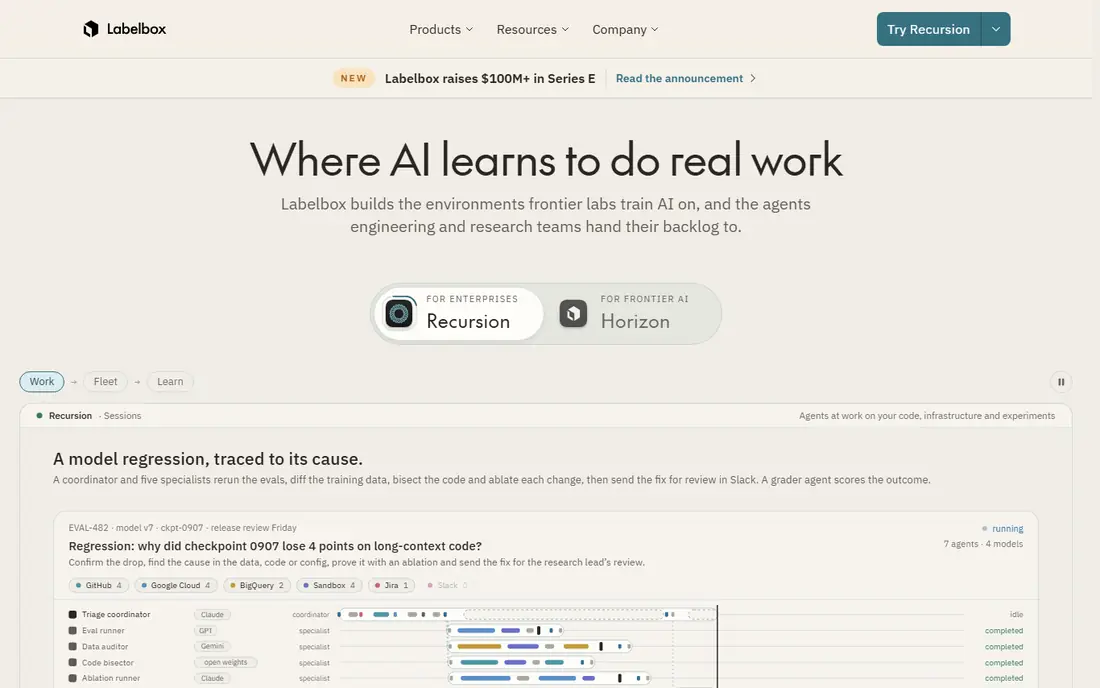
Labelbox is a solid choice for Enterprise multimodal data operations, and it stands out because it covers image, video, text, and documents in one platform. Our pick for most people in this group is to test it against one concrete outcome, such as faster turnaround, fewer errors, or clearer reporting, and to judge it on that outcome alone. The product earns its place here because it covers the core job well, it is still actively sold and supported, and its pricing page or vendor page gives a clear starting point for a budget discussion.
The practical test is simple: can a new person pick it up in a week, and can a manager see what is happening without asking for a status report. On that test, this option holds up well for its target buyer, though it still needs a short setup period and a named owner inside your team.
Be clear eyed about the limit: small teams may find the enterprise process heavy. Plan around it from the start, either by pairing this product with a second tool or by choosing a plan that closes the gap.
- Multimodal support
- Workflow automation
- Model assisted labeling
- Enterprise pricing can be high
- Setup takes time

For Large managed labeling programs, Scale AI deserves a close look, mainly because it pairs a platform with a managed workforce for large programs. Our pick for most people in this group is to test it against one concrete outcome, such as faster turnaround, fewer errors, or clearer reporting, and to judge it on that outcome alone. The product earns its place here because it covers the core job well, it is still actively sold and supported, and its pricing page or vendor page gives a clear starting point for a budget discussion.
What we liked in our comparison was the balance between depth and ease of use, plus a support path that does not leave a small team stranded. You should still confirm contract terms, renewal pricing, and data export options before you sign, and ask for a written answer on security and privacy if you handle sensitive records.
The weak spot is that budget teams should start with an open or self serve tool. Ask the vendor to show that exact case in a demo, using your own example, before you buy.
- Managed workforce
- Data engine
- Robotics and language data
- Enterprise quote pricing
- Less suited to tiny projects
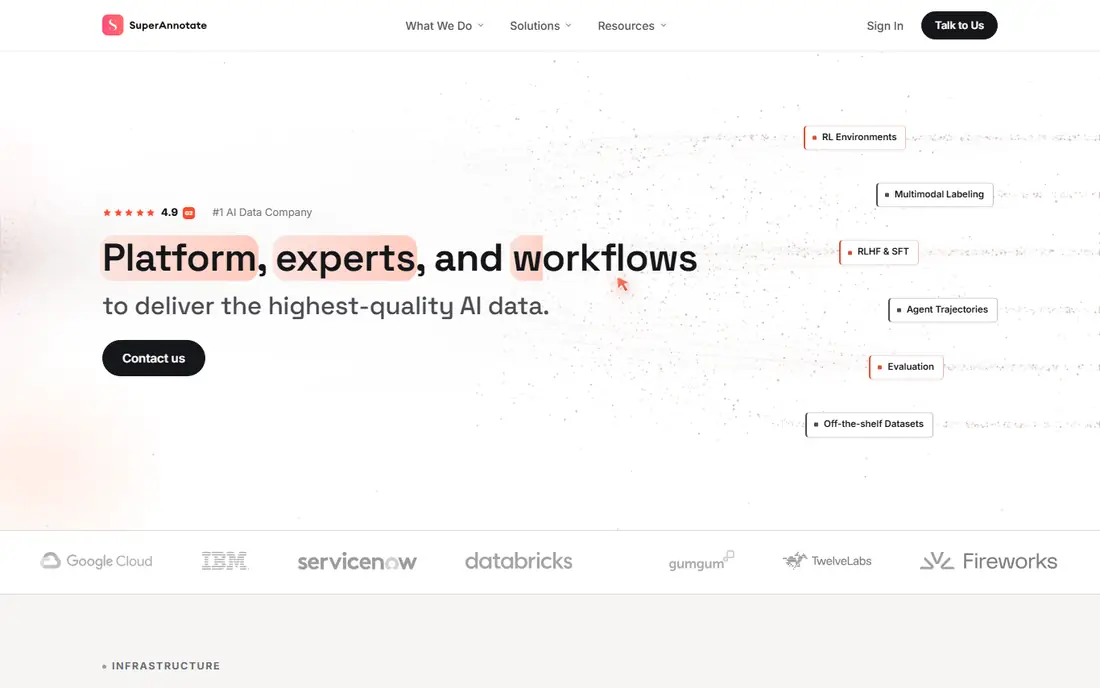
If your priority is Complex computer vision and text projects, start with SuperAnnotate, since it gives fine control over annotation steps and review. Our pick for most people in this group is to test it against one concrete outcome, such as faster turnaround, fewer errors, or clearer reporting, and to judge it on that outcome alone. The product earns its place here because it covers the core job well, it is still actively sold and supported, and its pricing page or vendor page gives a clear starting point for a budget discussion.
Buyers often judge this kind of product on the first month, but the real cost shows up in training, upkeep, and the time spent fixing edge cases. This option keeps those costs in check for its intended audience, as long as you keep the setup simple and resist adding every add on at once.
The honest catch is that small teams may find it more than they need. If that limit touches your main use case, shortlist a different option from this list and compare them side by side on the same task.
- Flexible workflows
- Quality tools
- Managed marketplace
- Quote pricing
- Setup can be complex
Encord suits teams and buyers focused on Quality focused multimodal annotation, with a clear strength in that it emphasizes quality checks and audit trails for serious programs. Our pick for most people in this group is to test it against one concrete outcome, such as faster turnaround, fewer errors, or clearer reporting, and to judge it on that outcome alone. The product earns its place here because it covers the core job well, it is still actively sold and supported, and its pricing page or vendor page gives a clear starting point for a budget discussion.
In day to day use, the value shows up in planning, follow through, and review, rather than in a single flashy feature. The product works best when you set a clear goal at the start, assign one owner to each next step, and check progress on a fixed schedule.
One drawback to weigh is that simple image tasks may not need its full depth. That trade off is common in this category, and it matters most for buyers who need the missing piece on day one.
- Multi stage review
- Video tracking
- Medical imaging support
- Quote pricing
- Learning curve for advanced workflows
V7 Darwin is a solid choice for Medical and complex image annotation, and it stands out because it handles DICOM and complex image formats well. Our pick for most people in this group is to test it against one concrete outcome, such as faster turnaround, fewer errors, or clearer reporting, and to judge it on that outcome alone. The product earns its place here because it covers the core job well, it is still actively sold and supported, and its pricing page or vendor page gives a clear starting point for a budget discussion.
The practical test is simple: can a new person pick it up in a week, and can a manager see what is happening without asking for a status report. On that test, this option holds up well for its target buyer, though it still needs a short setup period and a named owner inside your team.
Be clear eyed about the limit: general teams should compare simpler vision tools first. Plan around it from the start, either by pairing this product with a second tool or by choosing a plan that closes the gap.
- Medical imaging support
- Auto labeling
- Video tools
- Quote pricing
- Medical features add complexity for general use
For Open source labeling on a budget, Label Studio deserves a close look, mainly because it gives a free, flexible starting point for many label types. Our pick for most people in this group is to test it against one concrete outcome, such as faster turnaround, fewer errors, or clearer reporting, and to judge it on that outcome alone. The product earns its place here because it covers the core job well, it is still actively sold and supported, and its pricing page or vendor page gives a clear starting point for a budget discussion.
What we liked in our comparison was the balance between depth and ease of use, plus a support path that does not leave a small team stranded. You should still confirm contract terms, renewal pricing, and data export options before you sign, and ask for a written answer on security and privacy if you handle sensitive records.
The weak spot is that large enterprise programs may need vendor support. Ask the vendor to show that exact case in a demo, using your own example, before you buy.
- Free open source core
- Many data types
- Self hosted option
- Cloud features cost extra
- Needs setup and upkeep
If your priority is Computer vision from label to deploy, start with Roboflow, since it covers the full vision path from annotation to model use. Our pick for most people in this group is to test it against one concrete outcome, such as faster turnaround, fewer errors, or clearer reporting, and to judge it on that outcome alone. The product earns its place here because it covers the core job well, it is still actively sold and supported, and its pricing page or vendor page gives a clear starting point for a budget discussion.
Buyers often judge this kind of product on the first month, but the real cost shows up in training, upkeep, and the time spent fixing edge cases. This option keeps those costs in check for its intended audience, as long as you keep the setup simple and resist adding every add on at once.
The honest catch is that text or audio projects need a different tool. If that limit touches your main use case, shortlist a different option from this list and compare them side by side on the same task.
- Vision focused tools
- Dataset management
- Model training links
- Vision only focus
- Paid plans for private projects
Snorkel AI suits teams and buyers focused on Programmatic labeling for large text data, with a clear strength in that it helps teams label large text sets with rules and models. Our pick for most people in this group is to test it against one concrete outcome, such as faster turnaround, fewer errors, or clearer reporting, and to judge it on that outcome alone. The product earns its place here because it covers the core job well, it is still actively sold and supported, and its pricing page or vendor page gives a clear starting point for a budget discussion.
In day to day use, the value shows up in planning, follow through, and review, rather than in a single flashy feature. The product works best when you set a clear goal at the start, assign one owner to each next step, and check progress on a fixed schedule.
One drawback to weigh is that small manual labeling tasks may be simpler elsewhere. That trade off is common in this category, and it matters most for buyers who need the missing piece on day one.
- Labeling functions
- Weak supervision
- Enterprise data tools
- Needs data science skill
- Quote pricing
How we picked these
We compared official product pages, pricing pages, and public documentation, and we checked that each product is still sold and still fits the topic in October 2026. We favored products with a clear use case, a published starting price or a clear quote process, and a realistic path for a small or mid sized team to adopt them. We did not claim hands on testing we did not do, and we left out products that were closed, renamed without a clear successor, or a poor fit for the stated topic. Where a price could not be confirmed on the vendor site, we wrote See website rather than guessing.
How to choose a data labeling tool
Start with your data and your label types. Image boxes, video tracking, text spans, and 3D point clouds need different editors, and a tool that looks strong for images may be weak for text. Run a pilot on 200 to 500 real examples, measure agreement between labelers, and check export formats before you sign.
Start with the job, not the feature list
Quality control matters more than speed alone. Look for review stages, consensus checks, audit trails, and clear rules for edge cases. Ask how model assisted labeling works, how pre labels are checked, and whether you can track who labeled each item and when it changed.
Check price, support, and exit options
Price by output, not just by seat. Some tools charge per user, some per label unit, and some by managed service volume, so model your full project cost. Check data security, access controls, and whether your data stays in your cloud or moves to the vendor, especially for health or sensitive data.
FAQ
What is the best data labeling tool?
Labelbox and Encord suit enterprise programs, Scale AI suits managed large scale work, and Label Studio suits budget teams. The best data labeling software depends on data type, volume, and quality needs.
Which data labeling platforms are the best for computer vision?
Roboflow, SuperAnnotate, Encord, and V7 Darwin all cover image and video well, with tracking and segmentation tools. Test video tracking on your own clips, since performance varies by scene.
Is there a free data labeling platform?
Label Studio has a free open source version, and several vendors offer free tiers or trials. Free tiers often limit users, projects, or exports, so check those limits before you build a workflow on them.
What is the best data labeling platform for text?
Labelbox, SuperAnnotate, and Label Studio all support text annotation, including spans and classification. For large language model work, check support for preference data and human feedback workflows.
Should I use a managed labeling service?
A managed service helps when volume is large, deadlines are tight, or you lack labelers. It costs more per label, but it can improve consistency if the vendor provides trained reviewers and quality checks.