Best Cyber Security Companies in 2026: 9 Companies Compared
Compare the best cyber security companies in 2026, from endpoint protection to managed detection, with pricing notes and honest trade-offs for buyers.
- Editor's choice
 CrowdStrike
large teams needing cloud endpoint protection
Starts atSee websiteVisit crowdstrike.comFull review - Great alternative
 Palo Alto Networks
enterprises consolidating network and endpoint security
Starts atSee websiteVisit paloaltonetworks.comFull review - Also consider
 SentinelOne
teams wanting automated endpoint response
Starts atSee websiteVisit sentinelone.comFull review
TL;DR:
- Most leading vendors now sell a platform, not a single tool, so check what is included before you compare prices.
- Endpoint protection is the starting point for most small and mid-size teams, while larger teams add network, cloud, and identity controls.
- Quote-based pricing is common in this category, so budget time for a sales conversation and ask what renewal pricing will look like.
- Managed detection can suit a lean team better than buying tools it has no staff to watch around the clock.
Quick comparison
| Tool | Best for | Starts at | Free plan? | |
|---|---|---|---|---|
| CrowdStrike | large teams needing cloud endpoint protection | See website | Free trial | Visit |
| Palo Alto Networks | enterprises consolidating network and endpoint security | See website | Free trial | Visit |
| SentinelOne | teams wanting automated endpoint response | See website | Free trial | Visit |
 Microsoft Defender | Microsoft 365 shops | See website | Free trial | Visit |
 Fortinet | mid-size teams needing network security value | See website | Free trial | Visit |
 Sophos | small and mid-size businesses | See website | Free trial | Visit |
 Bitdefender GravityZone | cost-conscious multi-layer protection | See website | Free trial | Visit |
 Trend Micro Vision One | broad multi-layer protection | See website | Free trial | Visit |
 Arctic Wolf | lean teams wanting managed detection | See website | No | Visit |
The best cyber security companies
The best cyber security companies sell different things under a similar label, so the right choice depends on what you already run and who will watch the alerts. This list covers endpoint leaders, network specialists, and one managed option for teams without a security staff.
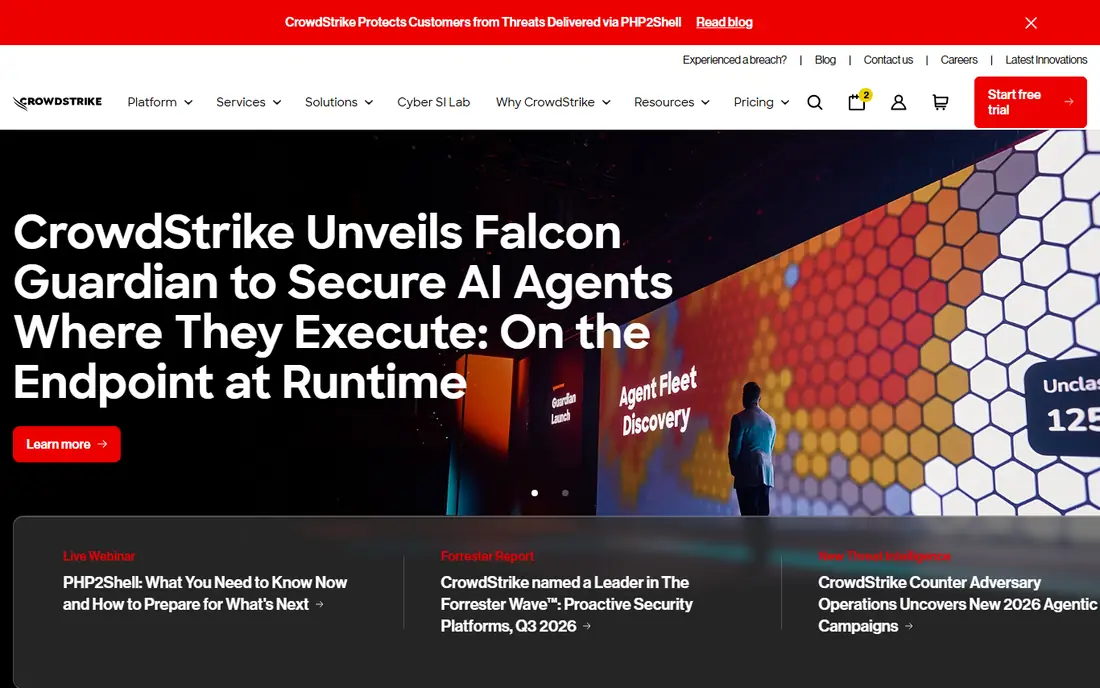
CrowdStrike Falcon is built around endpoint detection and response, with cloud delivery that keeps the on-device agent fairly light. It collects telemetry across endpoints, flags suspicious behaviour, and helps analysts trace an incident back to its first steps. For a team that already thinks in terms of endpoints first, that focus is a strength, since the product does not try to be a firewall, an email filter, and a cloud scanner all at once.
The trade-off is cost and complexity at scale. Pricing is generally quoted, and the full platform grows through add-on modules, so a buyer should map which modules are included in a quote before signing. Smaller firms may also find the console and the alert volume demanding without a managed option. Still, for mid-size and larger firms that want a widely used endpoint platform, CrowdStrike remains a sensible first shortlist entry.
- Cloud-native agent with a light footprint
- Strong threat intelligence
- Managed detection options for lean teams
- Pricing is quote-based for most buyers
- Depth can be more than a very small team needs
Palo Alto Networks
Best for: enterprises consolidating network and endpoint security
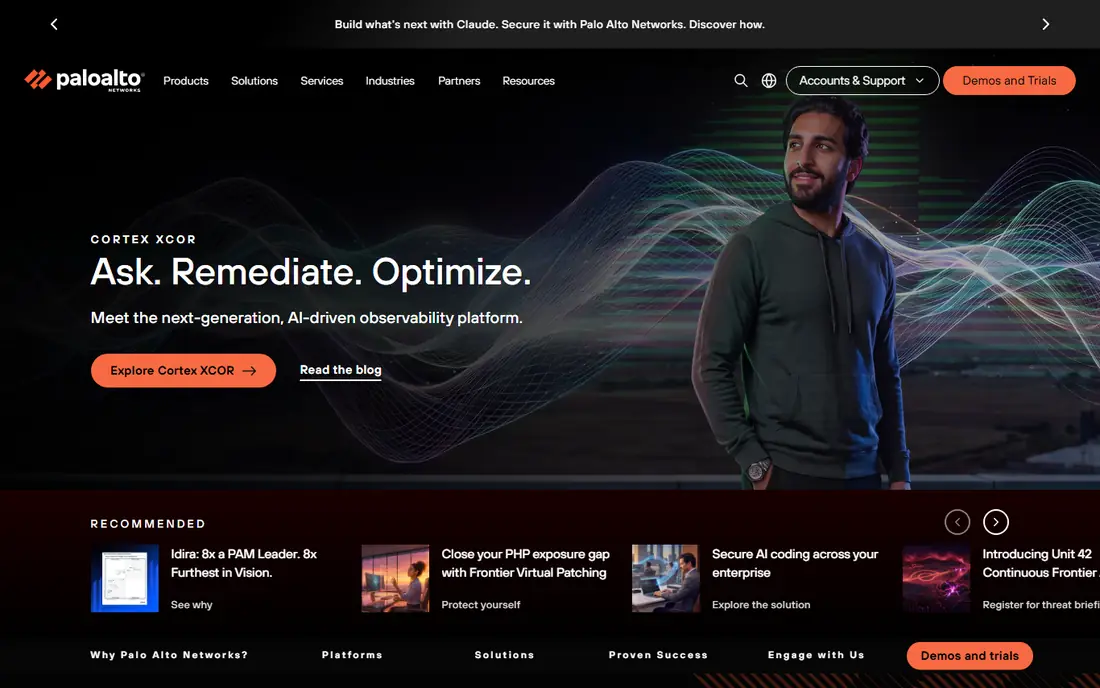
Palo Alto Networks is best understood as a platform vendor rather than a single product company. Its firewalls are widely deployed, and Cortex XDR extends that network view to endpoints and cloud workloads. For a large firm that already uses Palo Alto firewalls, keeping detection and response in the same family can simplify policy work and incident review, since events can be traced across network and endpoint data in one place.
That breadth comes with a price tag and a learning curve. Smaller buyers may find the range of products confusing, and costs can climb as modules and data retention are added. A firm with a small IT team should ask for a clear scope, a phased rollout, and named support contacts before committing. For enterprises with the staff to run it, though, the platform depth is hard to match.
- Broad platform across network, endpoint, and cloud
- Strong firewall heritage
- Extensive partner and support network
- Pricing is quote-based and can rise fast
- Setup can be complex for small teams
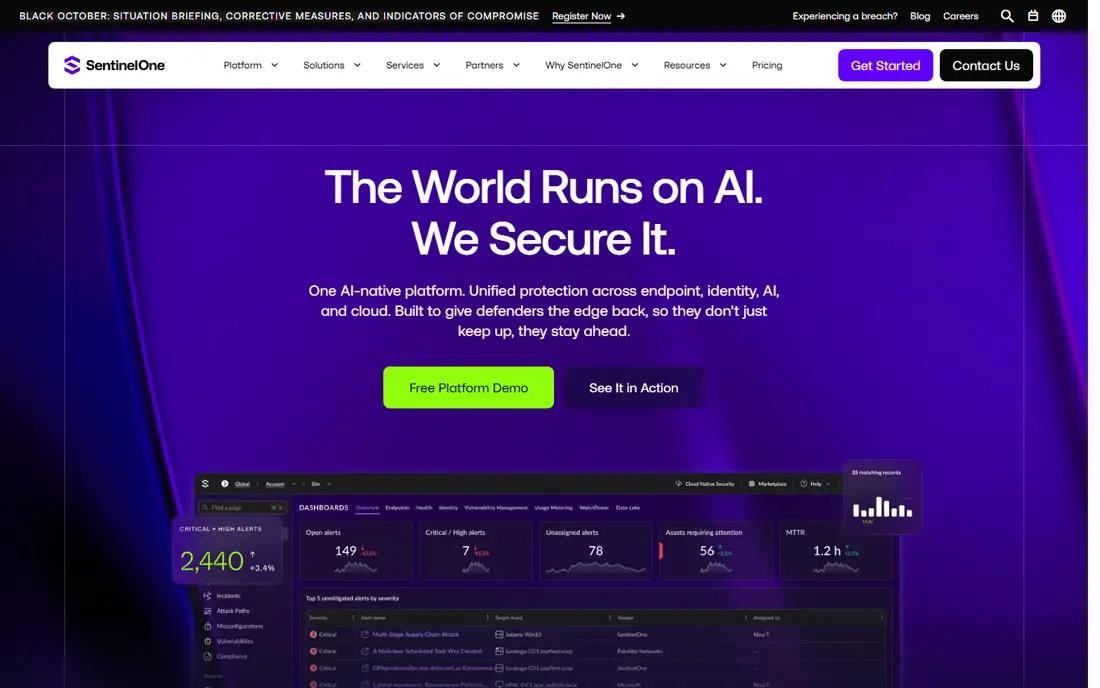
SentinelOne Singularity puts automated response at the centre of its pitch. When it spots a threat, it can isolate a device and roll back changes linked to a ransomware event, which matters when an incident is found outside office hours. That automation suits teams that cannot staff a round-the-clock desk, since the product takes a first action rather than only sending an alert for a person to read later.
The product also covers cloud workloads and identity signals, so it fits firms that have moved past a single office network. As with most endpoint platforms, pricing is quoted, and tuning is still needed to keep false alarms low in a large estate. Buyers should trial it on a mix of typical and unusual devices, not only on clean office laptops, to see how it handles their real fleet.
- Automated response and rollback for ransomware events
- Works across endpoint, cloud, and identity
- Clear console for analysts
- Pricing is quote-based
- Large rollouts may need tuning to cut noise
Microsoft Defender makes the most sense when a firm already lives in Microsoft 365. Defender for Endpoint, Defender for Office 365, and related tools share identity, device, and email signals, and admins manage much of it from tools they already know. That integration can cut the number of separate consoles a small IT team must check each day, and some Microsoft plans already include parts of the suite.
The catch is licensing. The exact Defender features available depend on the Microsoft plan in place, so two firms can both say they have Defender and mean quite different coverage. Firms with many Mac, Linux, or mobile devices should also check coverage for those platforms before assuming one suite covers all. For a Windows-centred firm, however, it is often the lowest-friction starting point.
- Deep fit with Microsoft 365 and Windows
- Included in some Microsoft plans
- Familiar admin tools for Windows teams
- Best value depends on existing Microsoft licensing
- Non-Windows coverage is less central
Fortinet is best known for FortiGate firewalls, and that network strength is the reason many mid-size firms start here. A firm with several offices, remote workers, and a need for secure remote access can build a consistent network policy across sites with Fortinet hardware and software. The range covers small branch devices up to large data centre gear, which helps a growing firm stay on one vendor as sites are added.
Licensing is the main frustration buyers report, since features, support, and hardware bundles are sold in combinations that need careful reading. Fortinet also offers endpoint protection, but buyers who put endpoint detection first may compare it closely with CrowdStrike or SentinelOne before deciding. For network-led security, with endpoints as a second priority, Fortinet offers a strong balance of price and capability.
- Strong firewall and network range
- Good value for mid-market buyers
- Broad product family for branch offices
- Licensing can be hard to follow
- Endpoint tools are less famous than its firewalls
Sophos has long pitched itself to smaller firms, and that focus shows in its packaging. Intercept X covers endpoints, and Sophos Firewall covers the network, with shared threat data between the two. A small IT team gets a single vendor to call, a console that is easier to learn than some enterprise platforms, and managed detection options when it cannot watch alerts itself.
Very large firms may find less depth than Palo Alto or CrowdStrike offer at the top end, and some advanced controls require higher tiers. That is a fair trade for the target buyer, though, since most small firms need solid coverage and clear support more than they need the deepest enterprise feature set. Sophos is a practical pick for a firm buying its first serious security platform.
- Endpoint and firewall products designed to work together
- Approachable pricing for smaller firms
- Managed detection options
- Less depth for very large enterprises
- Some advanced features sit in higher tiers
Bitdefender GravityZone is a cloud-managed endpoint platform that layers antivirus, behaviour checks, and device controls in one console. It suits firms that want solid endpoint coverage without paying for a full enterprise platform, and it covers Windows, Mac, and Linux devices, which helps mixed fleets. Admins can set policies, check device status, and push updates from the cloud console without managing on-site servers.
Pricing depends on the tier and on add-ons such as risk analytics or extended detection, so buyers should compare like-for-like tiers rather than headline figures. Bitdefender is less often the named vendor in very large enterprise shortlists, but that matters less for a mid-size buyer focused on endpoint results. For a firm that wants dependable protection at a measured price, it deserves a trial.
- Multi-layer endpoint protection at a competitive price
- Good fit for mixed Windows, Mac, and Linux fleets
- Cloud console
- Pricing varies by tier and add-on
- Brand is less visible in large enterprise deals
Trend Micro Vision One pulls signals from endpoints, email, networks, and cloud workloads into one view, with risk scores that help analysts decide which alerts to handle first. That breadth suits firms that have already had trouble in more than one place, such as a phishing mail that led to an endpoint infection, since the chain can be followed across layers. Trend Micro also has a long history in antivirus and email security, which gives smaller buyers some comfort.
The platform can feel large for a firm that only needs endpoint protection, and pricing is quoted rather than published for most buyers. A trial should focus on whether the risk scoring actually reduces alert noise for that firm, rather than on the size of the feature list. For firms that want one vendor across several layers, Vision One is a credible option.
- Covers endpoint, email, network, and cloud in one platform
- Long track record
- Risk scoring to prioritise alerts
- Pricing is quote-based
- The breadth can feel heavy for a very small team
Arctic Wolf is different from most names on this list because it sells a managed service, not only software. Its team watches data from endpoints, networks, and cloud accounts, triages alerts, and guides a firm through response. For a small or mid-size firm with no dedicated security analyst, that human layer is the main point, since buying a powerful tool that nobody watches does little good.
The trade-off is trust and cost structure. A buyer hands security telemetry to an outside provider, so it should read data handling terms and ask how incidents are escalated. Pricing is quoted and recurring, which suits a firm that treats security as an ongoing service rather than a one-time purchase. If your team has no one to own detection, Arctic Wolf may deliver more real protection than a stronger tool left unwatched.
- Managed detection with a human security team
- Covers endpoint, network, and cloud data
- Suits firms without a security staff
- Requires trusting an outside team with security data
- Pricing is quote-based and ongoing
How we picked these
We compared official product pages, pricing pages where published, documentation, and public reviews, and we favoured vendors with a clear, current product that fits a defined buyer. We looked for coverage across endpoint, network, and cloud, for managed options where a buyer has no security staff, and for pricing transparency where it exists. Where pricing is quoted, we say so rather than guessing a figure, and we note when a product fits a specific stack, such as Microsoft 365, rather than claiming it fits every firm.
We also weighed the honest limits of each vendor. A platform that covers everything can be hard to run, a focused endpoint tool may leave network gaps, and a managed service asks a buyer to trust an outside team. Those limits shape the picks above more than any single feature claim.
What to check before you buy
Start with your current stack and your staffing, not with a feature list. A firm already on Microsoft 365 should price Defender fully before adding a second endpoint vendor, while a firm with several branch offices should weigh network controls as heavily as endpoint tools. Count the devices and cloud accounts that need coverage, including personal devices that touch company data, since an incomplete count leads to a short quote and a surprise renewal.
Ask each vendor the same practical questions. What is included in the quoted tier, and what costs extra? How are alerts triaged, and who responds outside office hours? What data leaves your network, where is it stored, and how long is it kept? How long does rollout take, and what training or support is included? A short trial on real devices, with real email and real web traffic, will reveal more than a polished demo.
Also plan for renewal. Security contracts often run one to three years, and module pricing can change at renewal, so ask for renewal terms in writing and for a clear exit path for your data and logs. If no one on your team will own the console, budget for a managed option from the start rather than buying a tool and hoping alerts get read.
FAQ
What are the best cyber security companies for a small business?
Sophos, Bitdefender GravityZone, and Microsoft Defender are common starting points for a small business, since they pair endpoint coverage with consoles a small team can run. If no one can watch alerts, a managed option such as Arctic Wolf may be safer than a stronger tool left unwatched.
Which company is best for cyber security overall?
There is no single best company for every firm, since the right pick depends on your stack, your size, and your staffing. CrowdStrike and SentinelOne lead on endpoint detection, Palo Alto Networks leads on platform breadth, and Microsoft Defender leads for Microsoft 365 shops.
How much do the best cyber security companies cost?
Most enterprise vendors price by quote, based on device count, modules, and contract length, so published figures are rare. Small business endpoint plans can cost far less than enterprise platform deals, but you should get written quotes for the exact tier, data retention, and support level you need.
What is the best cyber security company for endpoint protection?
CrowdStrike Falcon and SentinelOne Singularity are widely cited for endpoint detection and response, with automated response as a key difference from basic antivirus. Bitdefender GravityZone and Sophos Intercept X are also strong endpoint options for firms that want a lower price point.
Do I need a managed security service?
You need one if no one on your team can triage alerts promptly, including outside office hours, since an unwatched tool still leaves incidents unhandled. A managed service costs more over time, but it adds human review and guided response that software alone does not provide.
Is Microsoft Defender enough on its own?
For a Windows-centred firm on Microsoft 365, Defender can cover a large share of endpoint and email risk, especially when paired with good identity controls and patching. Firms with large Mac, Linux, or cloud estates, or with strict compliance needs, often add a second layer or a managed service.