Best Customer Journey Orchestration Tools in 2026: 8 Platforms Compared
We compared the best customer journey orchestration tools for cross-channel campaigns in 2026, so you can build journeys that follow real customer behavior.
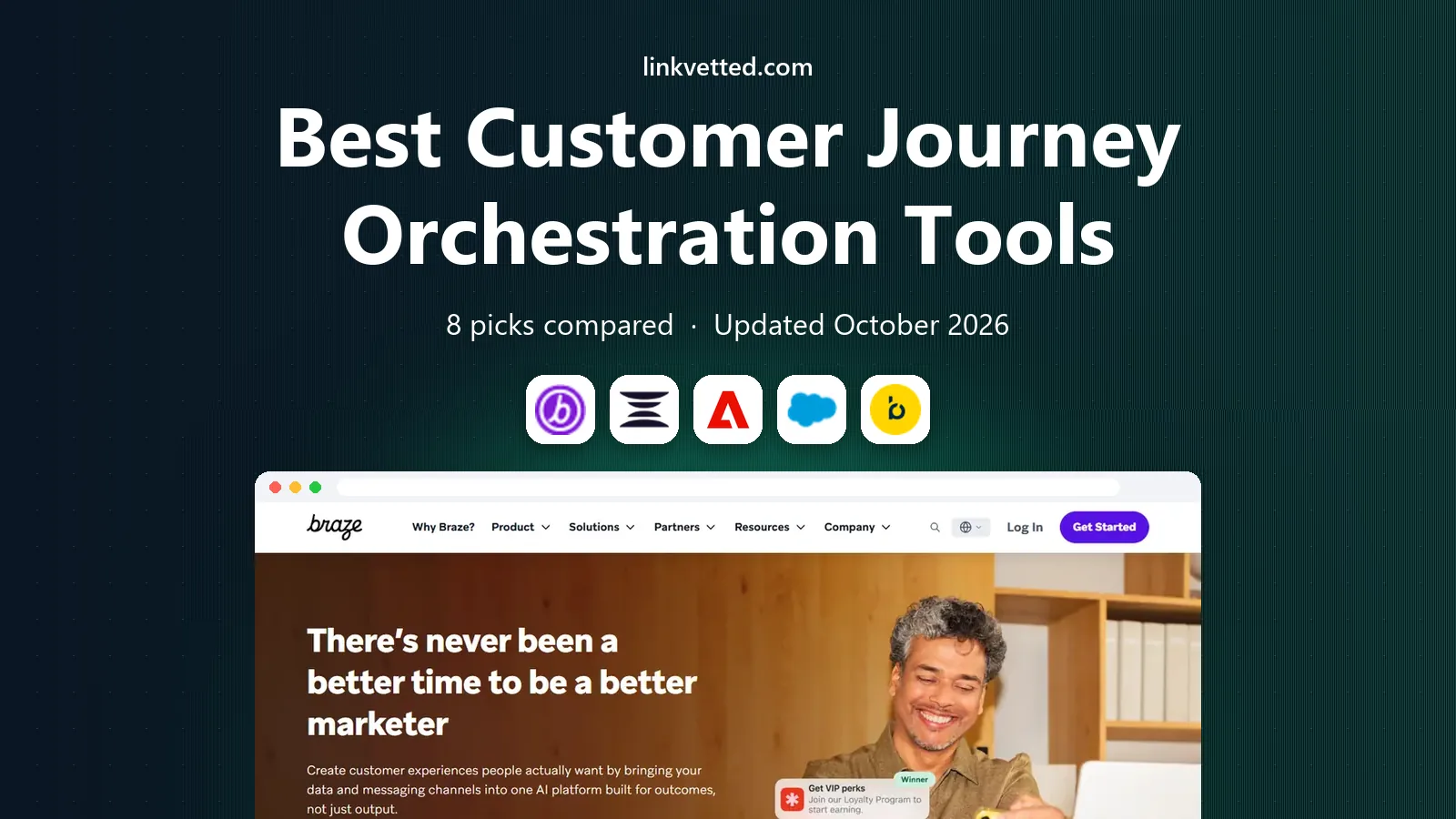
- Editor's choice
 Braze
Large brands running complex cross-channel journeys
Starts atSee websiteVisit braze.comFull review - Great alternative
 Iterable
Marketers wanting an approachable enterprise journey builder
Starts atSee websiteVisit iterable.comFull review - Also consider
 Adobe Journey Optimizer
Adobe Experience Platform customers
Starts atSee websiteVisit adobe.comFull review
TL;DR:
- Braze and Iterable lead for large cross-channel programs, but both are quote-based, so budget planning needs a sales conversation and a clear message volume estimate.
- Customer.io and MoEngage give smaller and mid-size teams a more accessible entry point, with visual journey builders and pricing that scales with audience size.
- Adobe Journey Optimizer and Salesforce Marketing Cloud suit enterprises already invested in those ecosystems, where data and content already live in the same stack.
- The best customer journey orchestration software is the one your team will actually maintain, so builder ease, data connections, and reporting matter as much as channel count.
Quick comparison
| Tool | Best for | Starts at | Free plan? | |
|---|---|---|---|---|
| Braze | Large brands running complex cross-channel journeys | See website | No | Visit |
| Iterable | Marketers wanting an approachable enterprise journey builder | See website | No | Visit |
| Adobe Journey Optimizer | Adobe Experience Platform customers | See website | No | Visit |
 Salesforce Marketing Cloud | Salesforce CRM and Service Cloud teams | See website | No | Visit |
 Bloomreach | Ecommerce brands needing journeys plus search and personalization | See website | No | Visit |
 Insider | Retail and ecommerce omnichannel journeys | See website | No | Visit |
 MoEngage | Mobile-first brands and apps | See website | Free trial | Visit |
 Customer.io | Product and growth teams wanting flexible journeys | See website | Free trial | Visit |
The best customer journey orchestration tools
Journey orchestration is the work of deciding what message a customer gets next, on which channel, and when, based on what they just did. A good tool pulls behavior, profile, and purchase data into one builder, then lets marketers design branching paths without waiting for engineers for every change.

Braze is built for teams that run email, push, in-app messages, SMS, and WhatsApp from one journey canvas, with triggers that react to live behavior rather than nightly batches. Its Canvas builder supports branching, delays, experiments, and personalization from profile and event data, which helps large brands keep a coherent story across channels. Real-time segmentation means a customer who abandons a cart or finishes onboarding can enter the right path within minutes, not the next day.
The cost and setup are the honest limits. Braze does not publish a self-serve price, and annual costs for mid-size audiences are commonly in the tens of thousands of dollars, with onboarding fees on top in some deals. Teams without dedicated lifecycle staff may use only a fraction of the platform at first. For a brand with high volume, many channels, and a team to run it, Braze remains one of the strongest orchestration choices available.
- Broad channel coverage
- Visual Canvas builder
- Real-time segmentation and testing
- Quote-only pricing
- Implementation can take weeks
- Overkill for a single-channel team
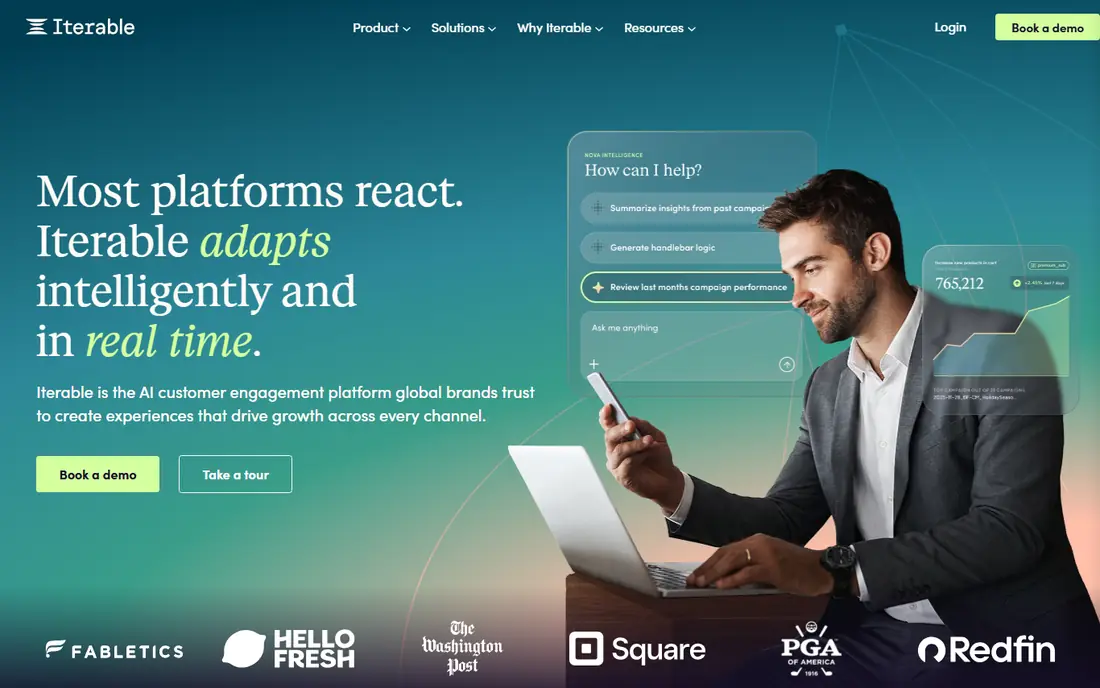
Iterable competes directly with Braze on cross-channel journeys, but many marketers find its Workflow Studio easier for day-to-day campaign work. Journeys can branch on events, profile changes, and engagement, and AI features help with send-time and content choices. The platform also handles data management without code for common sources, which shortens the time between an idea and a live journey.
Pricing is again quote-based and enterprise-level, so small teams will likely find it out of reach, and teams that need deep ecommerce merchandising may prefer Bloomreach or Insider. Support and onboarding are often cited as strengths, which matters when a journey touches many systems. For a mid-market or enterprise team that wants Braze-level orchestration with a gentler learning curve, Iterable is a credible first call.
- Visual Workflow Studio
- AI-assisted optimization
- Strong email, mobile, and SMS coverage
- Quote-only pricing
- Ecommerce features are thinner than specialist retail tools
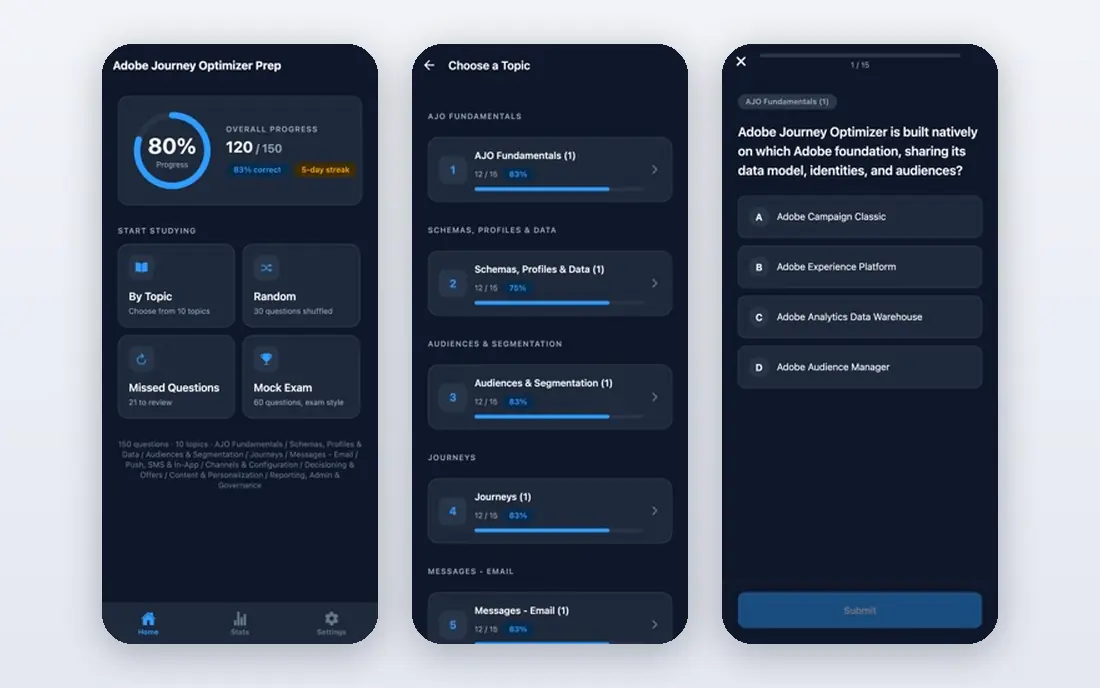
Adobe Journey Optimizer sits on Adobe Experience Platform, so it can build journeys from unified customer profiles that already combine web, app, CRM, and offline data. That data foundation is its main advantage: messages can react to a profile change, a purchase, or a support event, and content can be personalized with Adobe tools the team may already use. Governance, approvals, and large-scale delivery are built for enterprise use.
The drawback is scope. A team that does not already use Adobe products will face a large implementation and a steep learning curve, and pricing is custom. Smaller brands should not buy it for journey building alone. For an Adobe-centered enterprise, however, it avoids the data sync work that comes from bolting a separate journey tool onto Adobe, and that integration value is often the deciding factor.
- Real-time profiles from Adobe data
- Strong personalization and content tools
- Enterprise governance
- Requires Adobe ecosystem investment
- Pricing and setup are enterprise-scale
Salesforce Marketing Cloud, through Journey Builder and related studios, lets teams design multi-step journeys that draw directly on Salesforce CRM data, service cases, and sales activity. That closeness helps when a journey must respect a sales stage, a support case, or a contract renewal, rather than only marketing behavior. Email, mobile, advertising, and social channels are covered, and the platform scales to very large audiences.
Complexity is the price. Licensing is modular, pricing is quote-based, and teams often need a Salesforce specialist or partner to build and maintain journeys well. A company without Salesforce as its system of record will get less value than a dedicated journey tool. For a Salesforce-centered business, though, the shared data model and the ability to hand a customer from marketing to sales to service in one record are hard to match.
- Journey Builder with CRM data
- Broad channel and automation options
- Large partner ecosystem
- Complex licensing
- Setup and maintenance need skilled staff
Bloomreach
Best for: Ecommerce brands needing journeys plus search and personalization
Bloomreach combines a customer data platform, engagement journeys, and product discovery, which suits ecommerce teams that want personalization and messaging from the same customer view. Journeys can react to browsing, cart, and purchase behavior, while product recommendations and search personalization use the same data. That shared view reduces the usual mismatch between what a store shows and what its emails say.
Pricing is modular and custom, so a team should ask for a full quote for the modules it actually needs, not only the engagement piece. Teams outside ecommerce may find parts of the suite less relevant. For a retailer that already wants better search, recommendations, and email in one platform, Bloomreach offers a coherent path that pure journey tools do not.
- Customer data plus ecommerce personalization
- Strong segmentation
- Merchandising tools
- Modular pricing can grow
- Best value comes with the wider Bloomreach suite
Insider positions itself as a growth platform for retailers, with journey orchestration, personalization, and predictive analytics in one place. Its templates cover common retail paths such as cart recovery, price-drop alerts, browse abandonment, and post-purchase care, which shortens setup for teams without a large lifecycle staff. Predictive segments can surface customers likely to buy, churn, or discount-seek, so journeys can be targeted more tightly.
The limits are price and fit. Insider is an enterprise tool with custom pricing, and non-retail teams may find its retail focus less useful than a general tool such as Customer.io. Reporting and channel depth also depend on the plan, so buyers should test the exact channels they need during evaluation. For a retailer that wants journeys, on-site personalization, and messaging together, Insider is a strong contender.
- Predictive segments
- Web, app, email, SMS, and WhatsApp journeys
- Strong retail templates
- Enterprise pricing
- Reporting depth varies by plan
MoEngage grew from mobile engagement, and that history shows in its journey builder, which handles push, in-app, email, SMS, and WhatsApp with analytics close at hand. Teams can build flows from app events, test variants, and see retention and conversion effects without exporting data to a separate analytics tool for every check. That closeness helps app teams that live or die by activation and retention.
Email-first brands may prefer Iterable or Customer.io, since MoEngage is strongest where mobile behavior drives the journey. Pricing is also quote-based for larger plans, so a small app team should confirm entry costs early. For a mobile-first business that needs journeys tied to product behavior, MoEngage offers a practical and well-supported option.
- Mobile and web journey builder
- Analytics tied to journeys
- Flexible integrations
- Enterprise pricing is still quote-based
- Email depth trails email-first tools
Customer.io is the most approachable tool in this list for product-led teams. Journeys trigger from events and profile data sent by API or common integrations, and the builder makes branching, delays, and A/B tests easy to read and maintain. Email, push, SMS, and in-app messages are covered, and the platform suits teams that think in events, such as signup, trial start, or feature use, rather than only list membership.
It does not match Braze or Salesforce on every enterprise channel or governance control, and very large brands may need extra tooling for some channels. Pricing is also usage-based and should be modeled on message and profile volume. For startups and mid-size teams that want real journey orchestration without an enterprise sales cycle, Customer.io is often the best balance of power and usability.
- Flexible data-triggered journeys
- Clear builder
- Good API and integration options
- Channel breadth is narrower than Braze
- Large enterprise governance is thinner
How we picked these
We compared official product pages, pricing and plan information, channel lists, and public documentation for tools that build multi-step, behavior-triggered journeys across at least two channels. We favored platforms with a visual journey builder, real segmentation, and live delivery in 2026, and we left out single-channel email tools and tools whose journey features are only a minor add-on.
What to check before you buy
Start with your data, not your channel list. A journey tool is only as good as the events and profile fields it receives, so confirm how your app, store, or CRM will send signup, purchase, and behavior events, and how often that data refreshes. A tool that updates nightly will miss the moment a customer needs a cart reminder or an onboarding nudge, while a real-time feed keeps journeys timely.
Cost, volume, and maintenance
Model cost on profiles, monthly active users, and message volume together, since vendors charge on different units and a quote can hide overage fees. Ask what happens when you exceed a message cap, and whether unused volume carries over. Also plan for upkeep: journeys need owners, naming rules, and regular reviews, or they grow into a tangle of overlapping paths that send conflicting messages.
Testing and measurement
Check that you can A/B test a journey branch, hold out a control group, and read results by channel and by step, not only by campaign total. A journey that looks good overall can still fail at one step, such as a delayed SMS that arrives after a customer already bought. Good reporting at step level is what turns orchestration from a diagram into a tool that improves revenue and retention.
FAQ
What is the best customer journey orchestration software?
For large enterprises, Braze and Iterable lead on channel breadth and real-time journeys. For Adobe or Salesforce shops, the matching platform in that ecosystem often wins on data integration. For smaller teams, Customer.io and MoEngage offer strong journeys at a more accessible entry point.
What are the best customer journey orchestration platforms for ecommerce?
Bloomreach and Insider are strong for retailers, because they combine journeys with product personalization, recommendations, and retail templates. Braze and Iterable also work well for ecommerce, especially when the brand sells across app, web, and messaging channels.
How much does journey orchestration software cost?
Most enterprise tools in this list are quote-based and priced on audience size and message volume, with annual costs often reaching tens of thousands of dollars. Smaller teams should request a quote based on their actual profile count and monthly sends, and ask about overage rates before signing.
Do I need a customer data platform first?
Not always, but it helps. A journey tool can work with events sent directly from your app or store, yet a customer data platform makes it easier to keep profiles consistent across tools. If your data already lives cleanly in a CRM or warehouse, you may not need a separate platform at the start.
Can small teams use journey orchestration tools?
Yes, if they pick a tool built for their size. Customer.io and MoEngage offer trials and more accessible onboarding than enterprise-only platforms. Start with two or three core journeys, such as welcome, cart recovery, and onboarding, before building complex branching paths.