Best CRM for Staffing Companies in 2026: 8 Platforms Compared
We compared best CRM for staffing companies in 2026 on pipelines, automation, back office tools and price, so you can choose a platform that fits today.
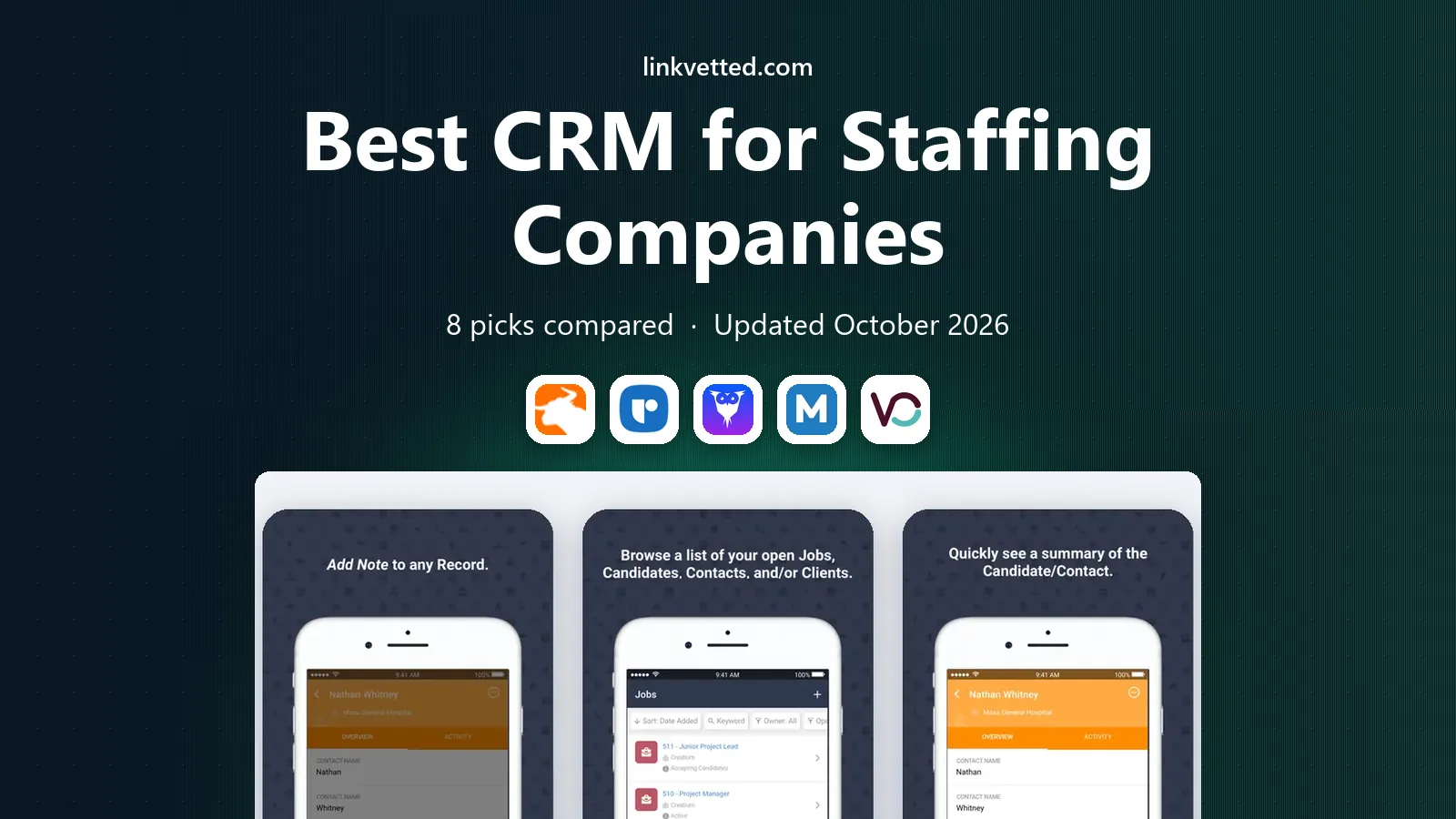
- Editor's choice
 Bullhorn
Large staffing firms and enterprise teams
Starts atSee websiteVisit bullhorn.comFull review - Great alternative
 Recruit CRM
Staffing agencies wanting CRM plus ATS value
Starts atSee websiteVisit recruitcrm.ioFull review - Also consider
 Loxo
Agencies wanting sourcing plus CRM in one tool
Starts atSee websiteVisit loxo.coFull review
TL;DR:
- Staffing CRM and ATS functions now overlap heavily, so judge platforms on workflow fit, automation and back office depth, not on labels alone.
- Large firms need scale, reporting and back office tools, while small firms need ease of use, price and fast setup.
- Sourcing heavy agencies benefit from Loxo style database access, while temp heavy firms need timesheet and billing strength.
- Trial with a real job, a real candidate and a real client workflow, not only a demo, before you sign a staffing CRM contract.
Quick comparison
| Tool | Best for | Starts at | Free plan? | |
|---|---|---|---|---|
| Bullhorn | Large staffing firms and enterprise teams | See website | No | Visit |
| Recruit CRM | Staffing agencies wanting CRM plus ATS value | See website | Free trial | Visit |
| Loxo | Agencies wanting sourcing plus CRM in one tool | See website | Free trial | Visit |
 Manatal | Small and mid-size teams on a budget | See website | Free trial | Visit |
 Vincere | Global staffing firms needing back office depth | See website | No | Visit |
 Crelate | Executive search and mid-size staffing firms | See website | No | Visit |
 JobAdder | Agencies in APAC, UK and expanding US markets | See website | No | Visit |
 Recruiterflow | Small and mid-size agencies wanting automation | See website | Free trial | Visit |
The best crm for staffing companies
Staffing companies need a CRM that manages candidates, clients, job orders and placements together, with automation to keep both pipelines moving. The platforms below cover large enterprise firms, mid-size agencies and budget conscious teams.
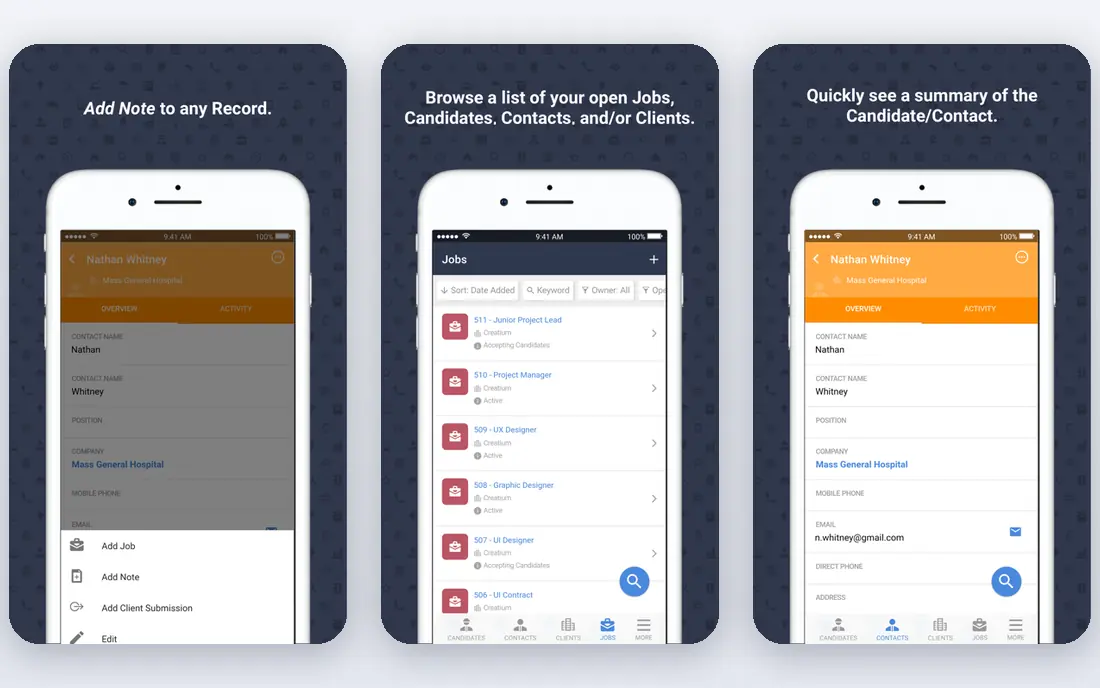
Bullhorn is the long standing standard for large staffing firms, combining CRM, applicant tracking, candidate and client management, reporting and workflow automation in one platform. It suits firms with high volume temp and contract placements, multiple offices and complex back office needs, where scale and integration depth matter more than a simple interface. The platform also supports timesheets, billing and reporting through its wider product range.
Bullhorn pricing is quoted rather than published as a flat rate, and implementation can take time and training. Some users find the interface dated compared with newer tools, and smaller firms may pay for capacity they do not use. Bullhorn earns its place for scale, but smaller agencies should trial it against lighter options before committing.
- Mature staffing CRM and ATS
- Candidate, client and job workflows in one system
- Large integration range
- Pricing is quoted
- Interface feels dated to some users
- Setup and training take time
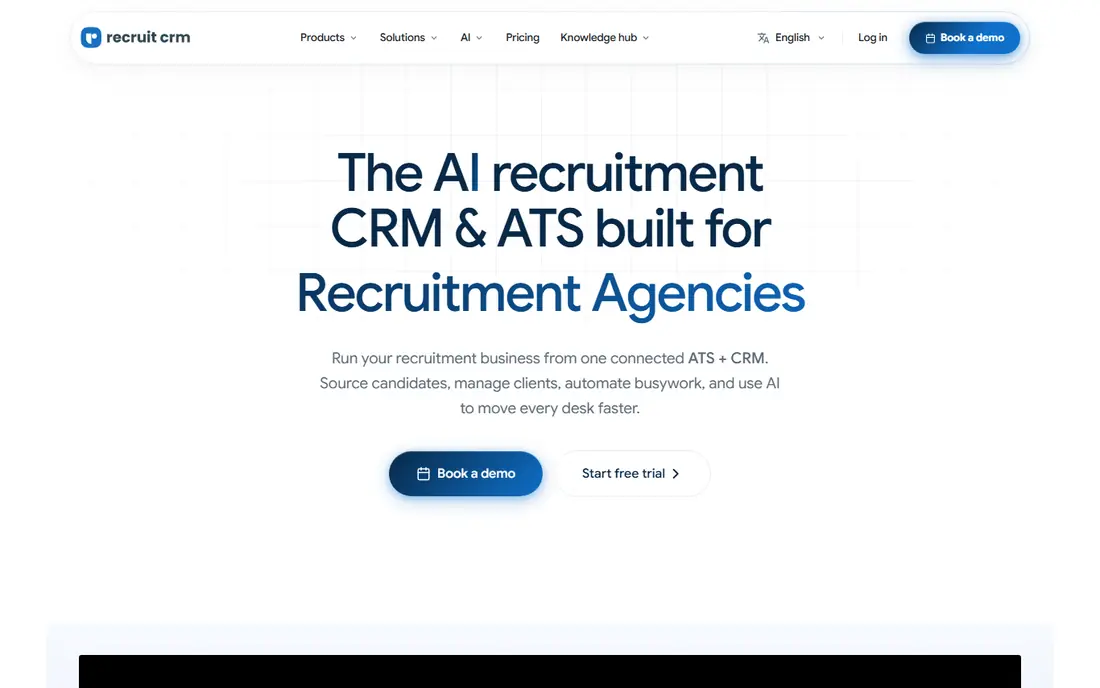
Recruit CRM is built for staffing and recruitment agencies, with candidate and client pipelines, job order tracking, email automation and placement management in one system. It suits small and mid-size agencies that want a clean agency workflow without enterprise complexity or enterprise pricing. Kanban pipelines and automation help recruiters move candidates and clients through stages with less manual work.
Reporting and analytics are adequate for most agencies but less deep than Bullhorn or Vincere, and retained executive search workflows are less of a focus. The integration ecosystem is also smaller, so firms with unusual back office tools should check integrations during a trial. For contract and temp focused agencies, those limits are often acceptable.
- Combined CRM and ATS for agencies
- Kanban pipelines
- Email automation and sequencing
- Placement and invoicing tools
- Reporting depth is lighter than enterprise tools
- Less suited to retained executive search
- Integration range is smaller than Bullhorn
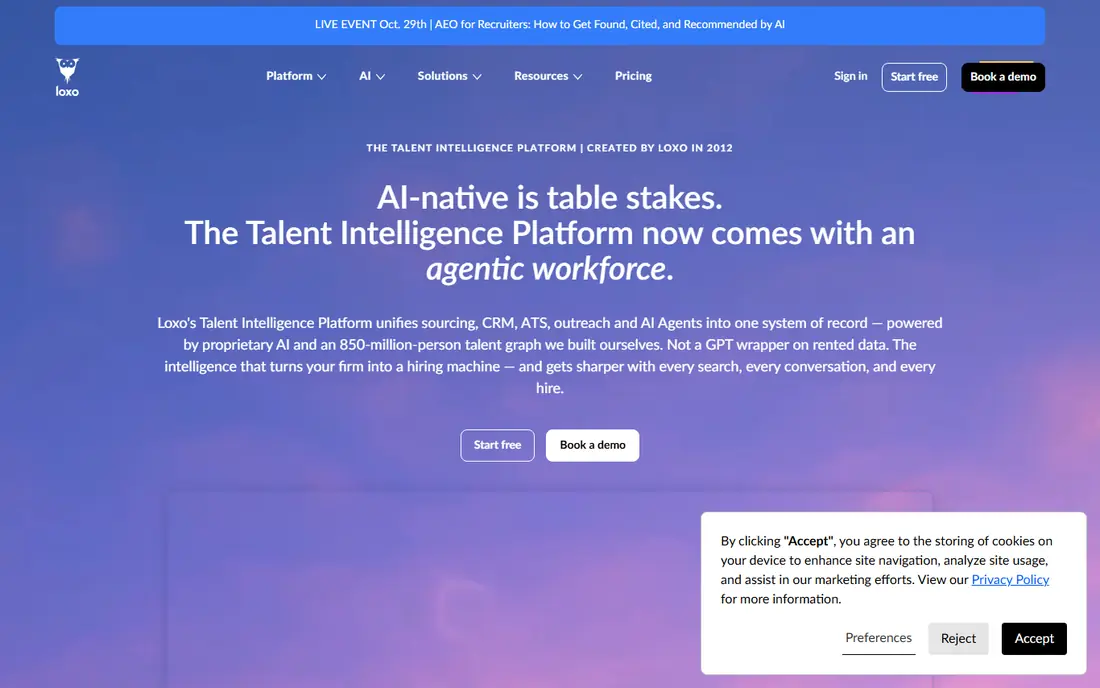
Loxo combines sourcing, CRM and applicant tracking, with access to a large candidate database and outreach automation. It suits agencies that source actively, rather than only managing inbound applicants, since sourcing, engagement and pipeline work happen in one system. That combination can reduce the need for separate sourcing tools and spreadsheets.
Loxo pricing depends on plan and database access, so costs rise as sourcing needs grow. The full suite can feel heavy for firms that only need basic pipeline tracking, and advanced sourcing features take time to learn. Agencies that source daily will see the value sooner than firms that rely mainly on referrals and job boards.
- All in one sourcing, CRM and ATS
- Large candidate database access
- Automation and outreach tools
- Pricing rises with database access
- Smaller firms may find the full suite heavy
- Learning curve for advanced sourcing
Manatal offers an affordable ATS and CRM combination for small and mid-size recruiting teams, with drag and drop pipelines, job posting, social sourcing and collaboration tools. It suits firms that want a simple, fast to learn system without a large licence bill, and that need to share candidates and clients across a small team. The price point makes it a low risk starting point for new agencies.
Analytics and reporting are lighter than enterprise platforms, and advanced back office, billing and compliance features are more limited. Larger firms with complex temp payroll or multi office reporting may outgrow Manatal sooner. For small teams, those limits are often outweighed by ease of use and price.
- Affordable ATS plus CRM
- Drag and drop pipelines
- Social sourcing and job posting
- Collaboration tools
- Analytics are lighter than enterprise tools
- Advanced back office features are limited
- Customisation has limits at lower tiers
Vincere combines CRM, ATS and back office tools, including timesheets, invoicing and reporting, for staffing firms operating across offices and countries. It suits global or multi office firms that need a single system from candidate sourcing to placement billing, rather than separate CRM and back office tools. That breadth helps firms that handle temp and contract payroll alongside permanent placements.
Vincere pricing is quoted, and setup and training take time, especially for firms moving from spreadsheets or a simpler CRM. The depth that helps large firms can feel heavy for small agencies. Firms should trial Vincere with a real temp workflow, not only a permanent placement workflow, before deciding.
- Staffing CRM plus ATS and back office
- Timesheets, invoicing and reporting
- Global multi office support
- Pricing is quoted
- Setup takes time
- Interface and workflow depth need training
Crelate is often rated highly for staffing firms that need connected candidate, client, job order and placement workflows in one system. It suits executive search firms and mid-size agencies that want customisable pipelines, strong reporting and automation without moving to a very large enterprise platform. The balance of depth and usability makes it a strong middle ground.
Crelate pricing is per user and depends on plan, so costs grow with team size. Smaller firms that only need basic tracking may find the feature depth more than they need, and integration needs should be checked during a trial. Firms that value connected workflows and reporting will find Crelate a good fit.
- Connected candidate, client, job and placement workflows
- Customisable pipelines
- Reporting and automation
- Pricing is per user and rises with features
- Smaller firms may find enterprise features heavy
- Integration range varies
JobAdder combines ATS and CRM with a focus on usability and job board distribution, with particular strength in Australia, New Zealand and the UK. It suits agencies in those markets that want clean candidate and client management, fast job posting and a mobile app for recruiters on the move. Collaboration features also help small and mid-size teams share pipelines.
US market support and job board integrations are less mature than in APAC and the UK, so US based agencies should test local job board coverage carefully. Advanced client pipeline forecasting is lighter than Bullhorn or Vincere, and custom reporting sits on higher tiers. For APAC and UK agencies, those limits matter less than distribution and ease of use.
- ATS plus CRM with strong job board distribution
- Clean candidate and client management
- Mobile app
- US job board integrations are less mature than APAC and UK
- Advanced CRM forecasting is lighter
- Custom reporting needs higher tiers
Recruiterflow focuses on automation for small and mid-size agencies, with email sequences, workflows and pipeline management that reduce manual follow up. It suits agencies that send high volumes of candidate and client outreach and want automation built in, rather than added through separate tools. Support quality is often cited as a strength in public reviews.
Recruiterflow pricing is per user, so costs grow with team size, and reporting depth varies by plan. The integration range is smaller than Bullhorn or Vincere, so firms with complex back office stacks should check integrations. For automation focused agencies, the workflow benefits often outweigh those limits.
- Automation focused CRM and ATS
- Email sequences and workflows
- Candidate and client pipelines
- Pricing is per user
- Reporting depth varies by plan
- Integration range is smaller than large enterprise tools
How we picked these
We compared official vendor pages, pricing pages, feature documentation and public reviews for staffing CRM and ATS platforms operating in 2026. We favoured platforms built for agency workflows, with current candidate, client and placement features, and we noted where pricing is quoted. We did not claim hands-on testing, and we used See website where pricing is quoted or tier dependent.
How to choose a CRM for a staffing company
A staffing CRM must handle two pipelines at once: candidates moving toward jobs, and clients moving toward signed fees and placements. Many platforms were built for one pipeline first and added the other later, so the balance matters. Test both pipelines during a trial, with your own data and your own team roles.
Match the platform to your staffing model
Temp and contract firms need timesheets, billing and high volume candidate handling. Permanent firms need client pipeline, fee tracking and candidate nurturing. Executive search firms need retained workflows and deep client records. Choose the model first, then the platform.
Check automation and integrations
Email sequences, job board posting, calendar, payroll and back office integrations save hours each week. List the tools you already use, and confirm each integration works in the trial, not only on a sales page.
Plan total cost over three years
Per user pricing grows with headcount, and higher tiers give access to reporting, automation and back office features. Model cost at current headcount and at planned headcount, and check contract length, training costs and data export terms.
FAQ
What is the difference between a staffing CRM and an ATS?
An ATS tracks applicants through a specific job pipeline, while a CRM nurtures candidate and client relationships before and after a job exists. Most modern staffing platforms combine both, so the practical difference is how well each pipeline is handled, not whether both labels appear.
Which CRM is best for a small staffing agency?
Manatal, Recruit CRM and Recruiterflow often fit small agencies best, due to price, ease of use and agency focused workflows. Trial all three with a real job and candidate, and compare automation, reporting and support, not only headline price.
Which CRM is best for large staffing firms?
Bullhorn and Vincere often fit large firms best, due to scale, back office depth, reporting and multi office support. Both need implementation time and training, so budget for onboarding as well as licences.
How much does staffing CRM software cost?
Costs range from around 15 dollars per user per month for budget tools, to quoted enterprise pricing for large platforms. Per user pricing, plan tiers and add ons shape the total, so model cost at your planned team size.
Can I migrate data from another staffing CRM?
Most platforms offer import tools and support for candidate, client and job data, but migration quality varies. Ask about import formats, duplicate handling, history preservation and export terms before signing, and test migration with a sample data set.