Best Credit Score Apps in 2026: 9 Apps Compared
Compare the best credit score apps for 2026, from free Credit Karma and Experian to myFICO, with score types, bureaus, paid plans, and safety tips for users.

- Editor's choice
 Credit Karma
Free two-bureau tracking
Starts atFreeVisit creditkarma.comFull review - Great alternative
 Experian
Free FICO score and Boost
Starts atFreeVisit experian.comFull review - Also consider
 myFICO
Real FICO scores from all bureaus
Starts at$29.95 per monthVisit myfico.comFull review
TL;DR:
- Most free apps show VantageScore, while most lenders use FICO scores, so a free score and a lender score can differ by a meaningful amount.
- Credit Karma is our pick for free tracking from two bureaus, while Experian is our pick for a free FICO score from one bureau.
- myFICO is our pick for mortgage and loan preparation, since it shows FICO scores from all three bureaus, starting at $29.95 per month for its paid plans in recent checks.
- Checking your own score through an app is a soft inquiry and does not lower your score, and you should dispute errors on your full credit reports, not just in an app.
Quick comparison
| Tool | Best for | Starts at | Free plan? | |
|---|---|---|---|---|
| Credit Karma | Free two-bureau tracking | Free | Yes | Visit |
| Experian | Free FICO score and Boost | Free | Yes | Visit |
| myFICO | Real FICO scores from all bureaus | $29.95 per month | No | Visit |
 Credit Sesame | Actionable credit advice | Free | Yes | Visit |
 WalletHub | Daily TransUnion updates | Free | Yes | Visit |
 CreditWise | Free score simulator | Free | Yes | Visit |
 Chase Credit Journey | Free score for anyone | Free | Yes | Visit |
 Discover Credit Scorecard | Free score without a card | Free | Yes | Visit |
 Equifax | Direct bureau monitoring | See website | Yes | Visit |
The best credit score apps
The best credit score app depends on which score you need, how many bureaus you want to watch, and if you plan to pay for full reports. The apps below cover free tracking and paid FICO monitoring.

Credit Karma is the most widely used free credit app, and its coverage explains why. It shows VantageScore scores and report details from TransUnion and Equifax, with alerts for changes and tools that explain what drives your score. It is free to use, with no card required for the core score features, and it also offers banking and tax tools for members who want them.
The main limit is score type. Most lenders use FICO scores, so your Credit Karma score can differ from the score a lender sees. The app also shows financial product offers, since offers fund the free service. For free, regular tracking from two bureaus, Credit Karma is our pick for most people.
- Free scores and reports from TransUnion and Equifax
- Regular updates and alerts
- Tax and banking tools in the same app
- Shows VantageScore, not the FICO scores most lenders use
- App is funded by product offers
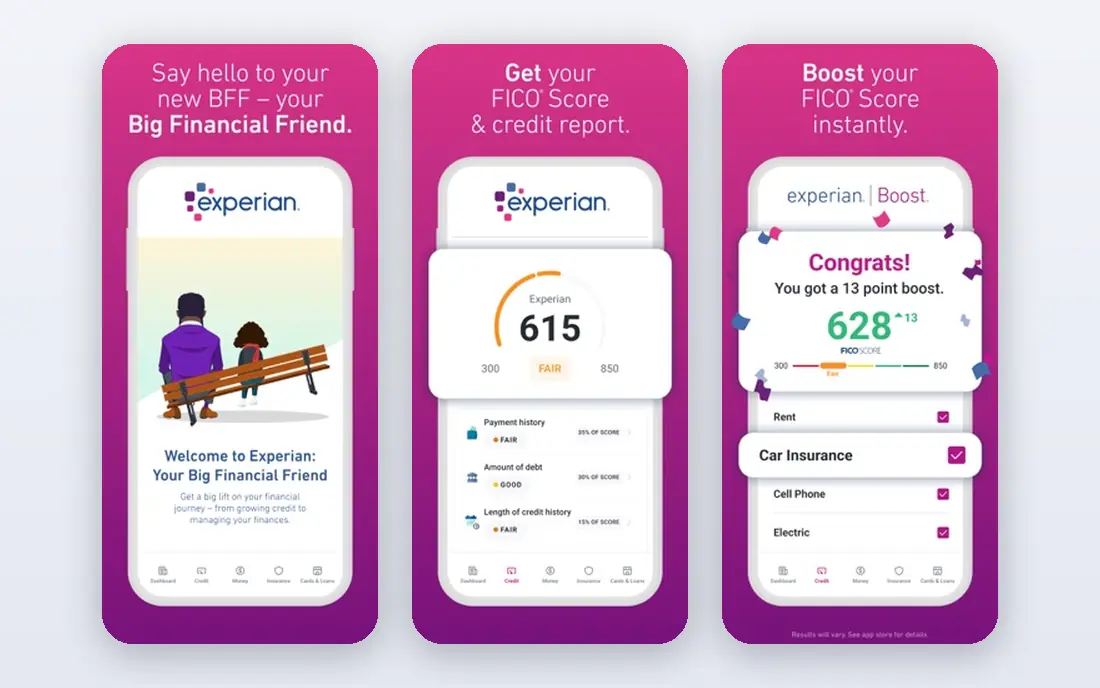
Experian is the bureau itself, so its app gives a direct view of your Experian file. The free tier shows your FICO Score 8 from Experian, with report details and alerts, and Experian Boost lets you add utility, phone, and streaming payments to your Experian file, which can help some thin files. A paid plan at $24.99 per month in recent checks adds broader monitoring and identity features.
Free coverage is limited to Experian, so you will not see TransUnion or Equifax scores without paying. If you want a free FICO score rather than a VantageScore, Experian is our pick, and pairing it with Credit Karma covers all three bureaus for free across two apps.
- Free FICO Score 8 from Experian
- Experian Boost can add bill payments to your file
- Paid plan adds monitoring
- Free tier covers Experian only
- Full three-bureau monitoring costs $24.99 per month in recent checks

myFICO is the choice when the score itself matters, such as before a mortgage or auto loan. It shows FICO scores from Equifax, Experian, and TransUnion, including versions lenders use for mortgages and car loans, with full reports and monitoring. Recent checks list paid plans from $29.95 per month, with a higher tier at $39.95 per month for broader monitoring.
That price is hard to justify for casual tracking, since free apps cover basic monitoring. For loan preparation, though, seeing the actual FICO versions a lender may pull removes guesswork. Subscribe for a few months around a major application, fix any errors you find, then cancel if you no longer need full monitoring.
- FICO scores from all three bureaus
- Many FICO versions used for mortgages and auto loans
- Detailed reports
- Paid plans start at $29.95 per month in recent checks
- No ongoing free tier beyond a trial in some offers
Credit Sesame pairs a free credit score with practical next steps. The free tier shows a TransUnion VantageScore with alerts and recommendations, such as lowering utilization or fixing a late payment, which helps new credit builders act rather than just watch a number. Paid tiers from $12.99 per month in recent checks add three-bureau scores and reports plus identity features.
Free users see only TransUnion, so pair Credit Sesame with Experian free or Credit Karma for fuller coverage. Its advice is general education, not personal financial advice, and product offers fund the free tier. For guidance-led tracking, Credit Sesame is a friendly choice.
- Free TransUnion VantageScore
- Clear action steps and alerts
- Paid tiers add three-bureau data
- Free tier covers TransUnion only
- Paid plans start at $12.99 per month in recent checks
WalletHub stands out for update frequency, with daily TransUnion VantageScore updates and monitoring alerts for free. Its report breakdown explains factors such as utilization, payment history, and account age in detail, which suits data-minded users who check often. It also covers banking and card comparisons for users who want broader money tools.
WalletHub covers TransUnion only, and its score is VantageScore rather than FICO. Like other free apps, it earns money from offers shown inside the service. For daily tracking of one bureau with detailed explanations, WalletHub is a strong free pick.
- Free TransUnion VantageScore with daily updates
- Detailed report analysis
- Financial tools and reviews
- Covers TransUnion only
- Shows VantageScore, not FICO
- Offers and ads fund the free service
CreditWise, from Capital One, is free for anyone, not just Capital One cardholders. It shows a TransUnion-based score with weekly updates, alerts, and a simulator that estimates how actions such as paying down a card might affect your score. That simulator helps users test plans before acting.
Coverage is TransUnion only, and simulator results are estimates based on a model, not a promise from a lender. Still, for a free, no-card-required score with a useful simulator, CreditWise is an easy add beside Credit Karma or Experian.
- Free to use without a Capital One card
- TransUnion-based score with simulator
- Weekly updates and alerts
- Covers TransUnion only
- Simulator results are estimates, not lender decisions
Chase Credit Journey is free for everyone, with no Chase account required. It shows a VantageScore based on Experian data, with factors that explain your score and alerts for changes. That Experian view pairs well with Credit Karma, which covers TransUnion and Equifax, giving free coverage of all three bureaus across two apps.
The score is VantageScore, so it may differ from a lender FICO score, and the service includes Chase offers. For a simple, free Experian-based score without opening a bank account, Chase Credit Journey is a solid choice.
- Free for non-Chase customers too
- VantageScore based on Experian data
- Alerts and score factors explained
- Covers one bureau view
- Shows VantageScore, not FICO
- Chase product offers appear in the service
Discover Credit Scorecard gives a free credit score without requiring a Discover card, which makes it useful for users who want one more free check. It explains score factors in plain terms and updates regularly, helping users spot changes between fuller report checks.
Its coverage is narrower than paid three-bureau monitoring, and it does not replace full credit reports from AnnualCreditReport.com. Use it as a free extra view, not as your only monitoring tool, and check your full reports at least yearly for errors.
- Free score for non-cardholders
- Clear score factors
- No card required for the basic score
- Score type and bureau coverage are limited next to paid monitoring
- Full reports need other sources
Equifax, as a bureau, lets you see and manage your Equifax file directly. Its free tools and app offer score views, alerts, and a way to lock your Equifax file, while paid monitoring adds broader protection and reports. Disputing an Equifax error is also simplest through Equifax itself, since the bureau holds the file.
Free coverage is Equifax only, and paid plan pricing varies by product, so check the current Equifax site before subscribing. For users who want direct control over one bureau file, especially when disputing errors, Equifax is the direct route.
- Direct view of your Equifax file
- Monitoring and alerts
- Lock and dispute tools in the same place
- Paid monitoring pricing varies
- Free tools cover Equifax only
How we picked these
We compared official app listings, bureau coverage, score types, and pricing for apps that are still open to new US users and offer real score or report access. We favored apps with clear free tiers, honest score-type labels, and alerts for changes, and we mixed free trackers with paid FICO monitoring. We did not claim hands-on testing, and we checked that each homepage below loads and belongs to the named product.
How to use credit score apps without confusion
Start by learning which score each app shows. VantageScore and FICO scores use the same report data but different models, so scores differ even on the same day. Lenders also use different FICO versions by loan type, so no single app shows the exact score every lender will see.
Check reports, not just scores
A score can look fine while a report still holds an error, a duplicate account, or a wrong late payment. Get your full reports from AnnualCreditReport.com, which is the official free source, and dispute errors with the bureau that holds the file. Apps help you spot changes, but disputes run through bureaus.
Protect your data while you monitor
Free apps fund themselves through offers, so read privacy settings and limit data sharing where the app allows it. Use strong passwords and two-factor authentication, freeze your credit files when you are not applying for credit, and be wary of paid monitoring that duplicates free alerts you already get.
FAQ
What is the best credit score app overall?
Credit Karma is our pick for free tracking, since it covers TransUnion and Equifax for free. Pair it with Experian free for an Experian FICO view, and add myFICO only when preparing for a mortgage or major loan.
What is the best app for credit score checks for free?
Credit Karma, Experian, WalletHub, CreditWise, and Chase Credit Journey all offer free scores without a card for the core score. Use two apps together to cover all three bureaus for free.
What is the best app to check credit score for FICO?
myFICO is our pick for FICO scores from all three bureaus, while Experian free gives a single-bureau FICO Score 8. Free VantageScore apps are useful for tracking, but they do not show lender FICO scores.
Does checking my credit score lower it?
No. Checking your own score through an app is a soft inquiry and does not affect your score. Lender checks for a loan or card application can be hard inquiries, which may lower your score slightly for a time.
Why do my scores differ across apps?
Different apps use different models, VantageScore or FICO, and different bureaus, and bureaus may hold slightly different data. Small differences are normal, and large gaps often point to an error on one report.
Is a credit score app financial advice?
No. These apps offer education and monitoring, not personal financial advice. For debt, mortgage, or major loan decisions, talk to a qualified financial professional about your full situation.