Best Creator Platforms in 2026: 8 Platforms Compared
We compared the best creator platforms for memberships, courses, newsletters and shops, covering fees, features and the best platform for creators at any stage.
- Editor's choice
 Patreon
Memberships around mixed content formats
Starts atFreeVisit patreon.comFull review - Great alternative
 Substack
Paid newsletters and written content
Starts atFreeVisit substack.comFull review - Also consider
 Kajabi
Courses, coaching and marketing in one system
Starts atSee websiteVisit kajabi.comFull review
TL;DR:
- Patreon and Substack are free to start but take about 10 percent of revenue, which gets expensive as income grows.
- Kajabi, Teachable and Podia charge flat monthly fees, which usually cost less once monthly revenue passes a few thousand dollars.
- Gumroad and Ko-fi are best for selling single products, tips and small shops without a monthly commitment.
- Mighty Networks and Circle suit creators whose main product is a paid community rather than a course or newsletter.
- The cheapest platform at launch is not always the cheapest at scale, so model fees at your expected revenue in 12 months.
Quick comparison
| Tool | Best for | Starts at | Free plan? | |
|---|---|---|---|---|
| Patreon | Memberships around mixed content formats | Free | Yes | Visit |
| Substack | Paid newsletters and written content | Free | Yes | Visit |
| Kajabi | Courses, coaching and marketing in one system | See website | Free trial | Visit |
 Teachable | Structured online courses | See website | Free trial | Visit |
 Gumroad | Selling digital products with no monthly fee | Free | Yes | Visit |
 Ko-fi | Tips, small shops and low-cost memberships | Free | Yes | Visit |
 Mighty Networks | Mobile-first paid communities | See website | Free trial | Visit |
 Circle | Branded communities linked to courses | See website | Free trial | Visit |
The best creator platforms
Creator platforms turn an audience into income, but they solve different problems. Some give you distribution, some give you course tools, and some give you a community home. The picks below cover those jobs, so you can choose by what you sell rather than by hype.

Patreon remains the default membership platform for creators who publish several formats. You set tiers, post exclusive content, run polls and livestreams, and let fans pay monthly or annually. Because many fans already have Patreon accounts, the checkout step feels familiar, which can help conversion for established creators.
The fee is the catch. New creators pay around 10 percent of Patreon income plus payment processing, so a creator earning $5,000 a month gives up roughly $500 before processing costs. That is fine at launch, when a flat fee would cost more, but it adds up at scale. Use Patreon if membership is your product and you want distribution, and revisit the math each year.
- Free to start with a familiar membership model
- Supports tiers, video, audio, livestreams and community posts
- Large existing audience of patrons
- Platform fee of about 10 percent for new creators plus processing fees
- Fee grows with revenue

Substack is the lowest-friction starting point for writers. You publish posts, send them by email, offer free and paid tiers, and benefit from recommendations inside the Substack app. There is no monthly fee to start, which makes it easy to test whether readers will pay for your writing before you invest in a full website.
Like Patreon, Substack takes 10 percent of paid revenue plus Stripe processing fees, so successful newsletters pay a growing share over time. It also lacks the course lessons, quizzes and structured community tools that Kajabi or Circle offer. If writing is your core product and discovery matters, Substack is an excellent start. If you plan to sell courses, pair it with or move to a course platform later.
- Free publishing with built-in discovery
- Simple newsletter and subscription setup
- App-based reading experience
- Takes 10 percent of paid subscriptions plus Stripe fees
- Limited course and community tools
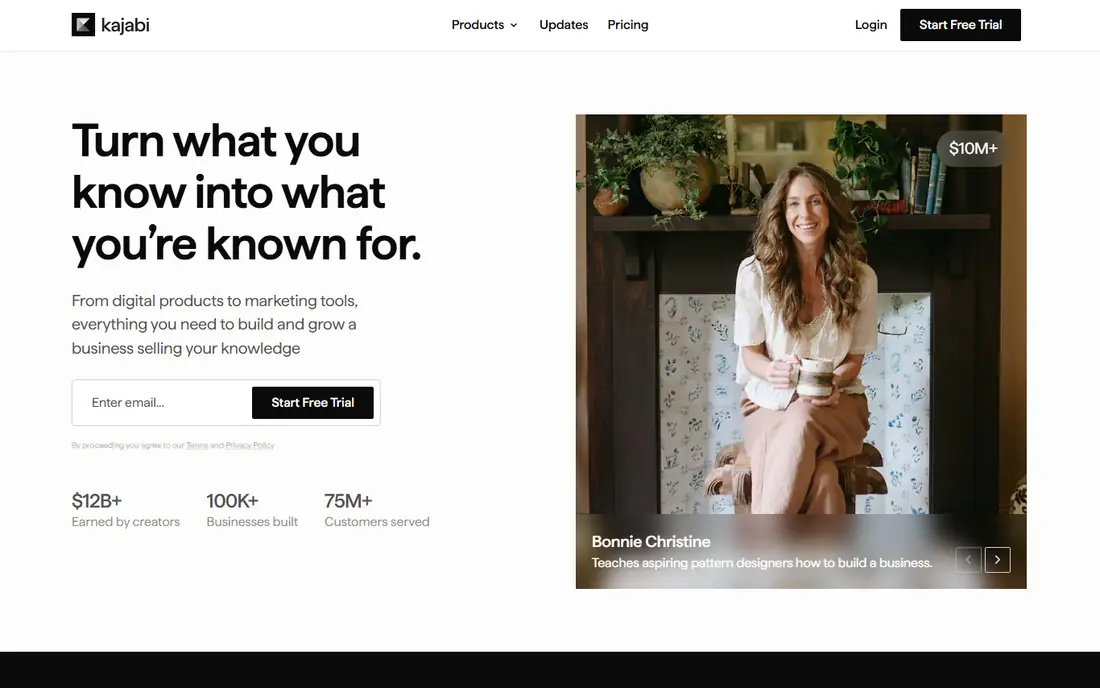
Kajabi is the all-in-one option for creators who sell courses and coaching. Lessons, quizzes, email campaigns, landing pages, checkout and a website all live in one system, which removes the need to stitch together several tools. Because Kajabi charges a flat monthly fee rather than a revenue share, larger creators keep more of each sale, even after payment processing.
The price is the barrier. Monthly plans sit well above cheaper course tools, so a creator with no audience yet may pay for power they do not use. Kajabi also gives you no discovery, so you must bring your own traffic through email, social or search. If you already sell and want one system to run the business, Kajabi is hard to beat.
- Courses, email, funnels, checkout and website in one tool
- No platform cut on sales with Kajabi Payments
- Strong marketing automation
- Monthly price is high for beginners
- No built-in audience or discovery
Teachable focuses on courses, and that focus shows in a clean builder. You can organize lessons into sections, add quizzes, drip content over time, track student progress and sell one-time or subscription access. The checkout and student dashboard feel professional without much setup, which suits teachers and experts who want to launch a course rather than build a website.
Community and marketing tools are thinner than Kajabi, so creators who need a lively member forum or advanced funnels may add another tool. Entry plans also carry transaction fees, so check the plan that gives you zero percent fees before you price your course. For course-first creators, Teachable remains a reliable pick.
- Clear course builder with lessons, quizzes and certificates
- Student progress tracking
- One-time and subscription sales
- Limited community and marketing depth next to Kajabi
- Lower tiers add transaction fees
Gumroad is built for selling files, templates, ebooks, music, presets and other digital products without a monthly subscription. You upload a product, set a price, share a link and get paid, with a storefront that needs almost no setup. That simplicity suits creators who sell individual items rather than a full membership or course program.
Fees are the trade-off. Gumroad charges a flat percentage plus a small per-sale fee on direct sales, and a higher share on marketplace discovery sales, so high-volume sellers may save money on a flat-fee platform. Course features are also basic compared with Teachable. If you sell products one at a time, Gumroad is a fast and flexible start.
- Free to start for digital sales
- Simple storefront and checkout
- Supports memberships and one-time products
- Flat fee of 10 percent plus a per-sale charge on direct sales
- Limited course structure
Ko-fi started as a tip jar and has grown into a small creator shop. Fans can leave tips with no platform fee, and creators can sell shop items, offer memberships and post exclusive content. The paid Gold plan is inexpensive and removes the percentage fee on shop sales and memberships, leaving only payment processing costs.
It is not a full course platform, and it will not bring you an audience the way Substack recommendations or Patreon search might. For artists, writers and streamers who want a friendly place to accept support and sell a few items, Ko-fi is one of the best-value creator platforms available. Start free, upgrade to Gold when memberships grow.
- Zero percent platform fee on tips
- Free shop and membership options
- Low-cost Gold plan removes shop and membership fees
- Less depth for full courses
- Discovery is limited compared with Patreon or Substack
Mighty Networks suits creators whose main product is belonging, not just content. You can run discussion spaces, courses, live events and member directories inside a branded community with its own mobile app. That structure works well for coaching groups, hobby communities and professional networks where members talk to each other, not just to the creator.
Pricing includes monthly plans plus transaction fees on some tiers, so model the total cost at your expected member count. Building a lively community also takes ongoing hosting effort, since an empty forum will not retain members. If community is the product, Mighty Networks gives you more structure than a social group or a newsletter comments section.
- Community, courses and events in one app
- Branded mobile experience
- Member profiles and activity feeds
- Transaction fees on some plans
- Setup takes effort for a polished community
Circle is a popular choice for creators who already sell courses and want a dedicated community beside them. Spaces can host discussions, events, courses and member directories, with moderation tools that keep conversations organized. Many course creators pair Circle with Teachable, Kajabi or a website, using Circle as the member home.
The cost adds up when you pay for both a course tool and Circle, and Circle brings no audience of its own. Transaction fees on some plans also raise the effective price. If you want a polished, branded community and you already have traffic, Circle is a strong pick. If you need discovery, start with Substack or Patreon instead.
- Clean community spaces with courses and events
- Integrates with course and email tools
- Good moderation controls
- Monthly price plus transaction fees on some plans
- No built-in audience
How we picked these
We compared official pricing and fee pages, feature lists and public documentation for each platform, and we kept only platforms that are actively maintained and widely used by US creators. We favored a mix of fee models, from free-to-start membership tools to flat-fee course platforms, so readers can see the trade-off between low startup cost and long-term fees. Where pricing changes by billing period, we wrote See website rather than quoting a figure that may be outdated.
How to choose a creator platform
Start with what fans pay for. If they pay for writing, Substack wins on simplicity. If they pay for belonging, Mighty Networks or Circle fits better. If they pay for a structured course, Teachable or Kajabi fits better. If they pay for single products or tips, Gumroad or Ko-fi fits better.
Model the fees at scale
Do a simple calculation before you commit. Multiply your expected monthly revenue by the platform percentage, add processing fees, and compare that total with a flat monthly plan. A 10 percent fee costs $100 at $1,000 a month and $500 at $5,000 a month, while a flat plan stays the same. Also check who owns your email list and whether you can export members, since that list is your safety net if you move platforms later.
FAQ
What is the best platform for creators starting out?
Substack is best for writers, Patreon is best for mixed-format memberships, and Ko-fi is best for tips and small shops. All three are free to start, so you can test demand before paying a monthly fee. Move to a flat-fee tool when fees start to exceed what a monthly plan would cost.
What are the best app creator tools for building a creator business?
Kajabi, Teachable, Mighty Networks and Circle are the main app creator tools in this list, covering courses, websites, communities and mobile access. Kajabi covers the most in one system, while Teachable plus Circle gives you a course plus community pairing. Choose by whether courses, community or marketing matters most to you.
Is Patreon or Substack better?
Patreon suits creators who publish video, audio, art and community posts behind membership tiers. Substack suits writers who publish newsletters and want discovery inside an app. Both charge about 10 percent plus processing, so the choice should follow your content format rather than a small fee difference.
Can I sell courses and memberships on the same platform?
Yes, Kajabi and Mighty Networks handle both in one system, while Teachable plus Circle is a common pairing for courses plus community. Gumroad and Ko-fi handle memberships and products at a smaller scale. Check whether the platform supports the exact mix you sell, including subscriptions, one-time sales and free tiers.
How do I move platforms without losing my audience?
Export your email list and member data before you move, tell fans early, and run both platforms briefly during the transition. Offer the same tiers and prices on the new platform, and send clear migration emails with new links. Owning your email list matters more than any single platform feature, since it lets you reach fans wherever you go next.