Best Construction Management Software in 2026: 9 Tools Compared
Looking for the best construction management software in 2026? We compared 9 tools for general contractors, home builders, and field teams on cost and fit.
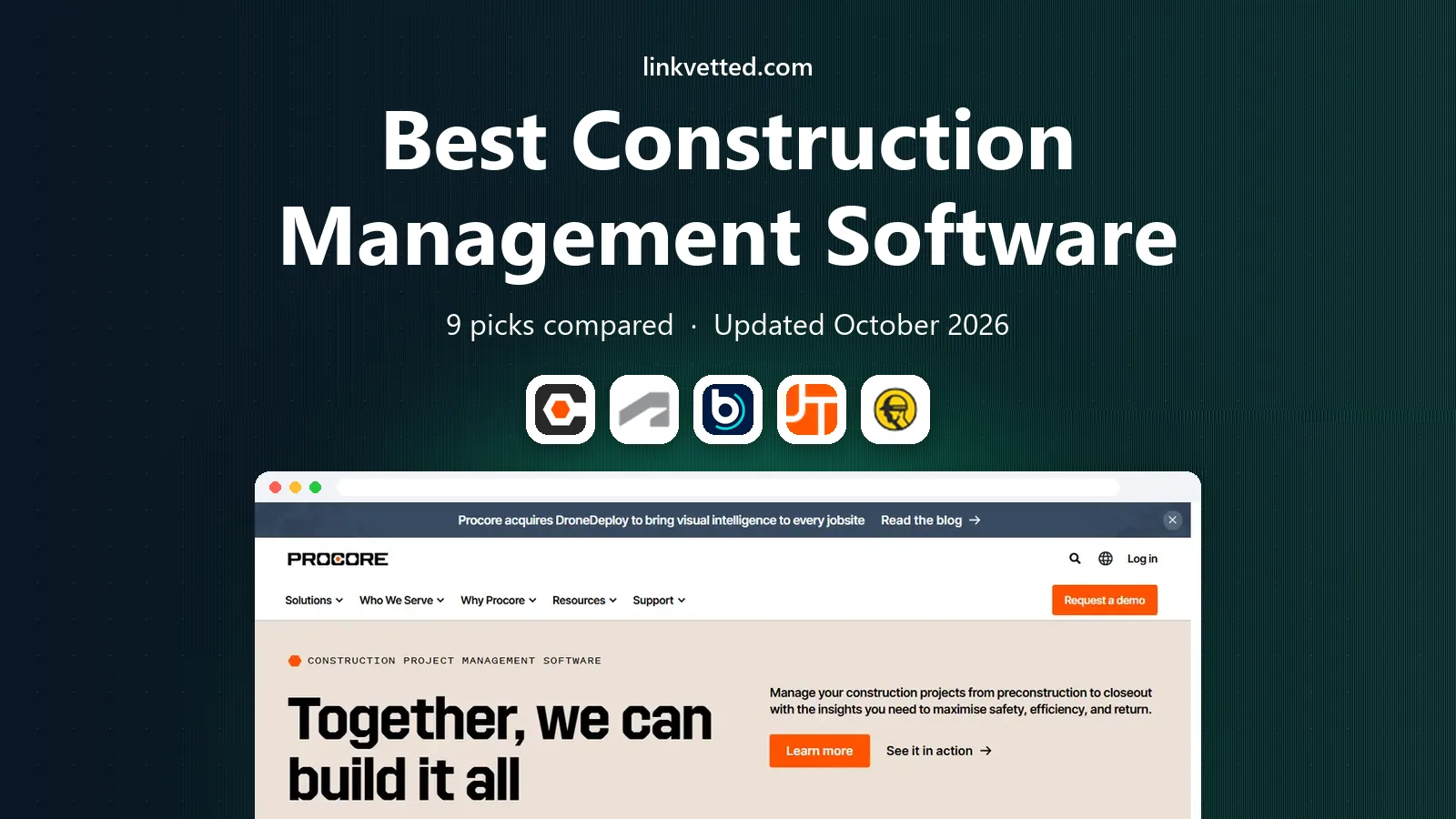
- Editor's choice
 Procore
Large commercial projects
Starts atSee websiteVisit procore.comFull review - Great alternative
 Autodesk Construction Cloud
BIM and document control
Starts atSee websiteVisit construction.autodesk.comFull review - Also consider
 Buildertrend
Home builders and remodelers
Starts atSee websiteVisit buildertrend.comFull review
TL;DR:
- Procore is our pick for large commercial general contractors who need a full platform for projects, finances, and field work.
- Autodesk Construction Cloud suits firms that already use Autodesk design tools and need strong BIM and document control.
- Buildertrend and JobTread are the better fits for home builders and remodelers who need client communication and job costing.
- Fieldwire is the best low-cost start for field teams that mainly need plans, tasks, and punch lists on site.
- Many top tools now quote prices on request, so ask for total cost, including users, modules, and onboarding, before you sign.
Quick comparison
| Tool | Best for | Starts at | Free plan? | |
|---|---|---|---|---|
| Procore | Large commercial projects | See website | No | Visit |
| Autodesk Construction Cloud | BIM and document control | See website | Free trial | Visit |
| Buildertrend | Home builders and remodelers | See website | No | Visit |
 JobTread | Residential job costing | $159 per month | Free trial | Visit |
 Fieldwire | Field plans and tasks | Free | Yes | Visit |
 Contractor Foreman | Low-cost all-round contractor software | $49 per month | Free trial | Visit |
 Oracle Aconex | Large infrastructure document control | See website | No | Visit |
 Buildxact | Small builders and estimating | See website | Free trial | Visit |
 Houzz Pro | Remodelers and design-build firms | $99 per month | Yes | Visit |
The best construction management software
We compared official feature pages and pricing pages for tools that serve different sizes of firm. A tool that suits a large commercial contractor can be too costly and complex for a small remodeler, so we grouped this list by fit rather than by feature count alone.

Procore is our pick for large commercial general contractors because it covers the full project life in one system. It handles drawings, RFIs, submittals, change orders, budgets, and field reports, with permissions that let you control what each subcontractor and client sees. For a project with many parties, that control reduces version confusion and lost emails.
The financial tools are a key reason firms choose Procore. Budget tracking, commitments, and change order workflows sit alongside project documents, so a project manager can see cost impact without switching systems. Integrations with accounting and scheduling tools help larger firms keep data in sync.
The catch is cost and complexity. Procore does not publish a standard price, and quotes are based on annual construction volume and modules. Small firms may find it too costly, and implementation takes planning. If you run large, multi-party projects, that investment can pay off. If you run a small residential firm, start with a residential tool below.
- Broad platform for project, financial, and field management
- Strong permissions and audit trails
- Large partner and integration network
- Pricing is quoted on request and can be high for small firms
- Setup and training take time
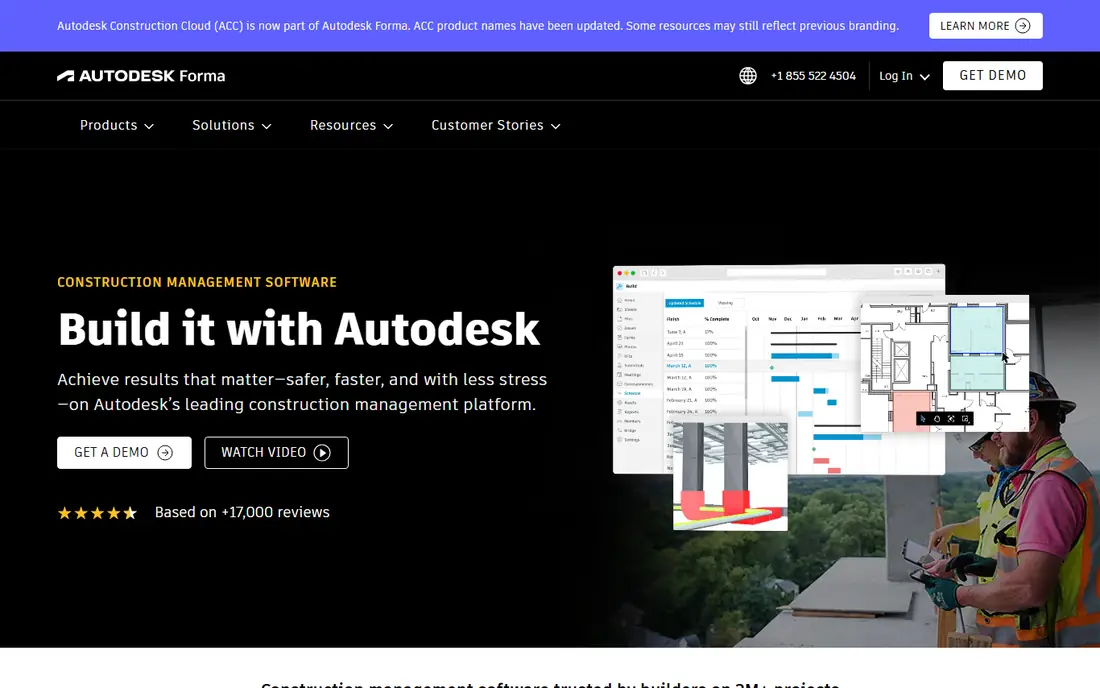
Autodesk Construction Cloud suits firms that already design in Autodesk tools and want that design data to flow into construction without rework. It brings together document management, field management, cost tracking, and BIM coordination in one cloud platform. Teams can view models, mark up drawings, and track issues from the same source.
Document control is a strength. Version history, permissions, and review workflows help large teams avoid building from an old drawing. Field tools let site staff raise issues, attach photos, and link them to drawings, which keeps office and site work aligned.
The drawback is complexity. Autodesk sells several products under this cloud umbrella, and pricing depends on which products and seats you need. A firm with no Autodesk history may find setup heavier than a simpler tool. For design-led firms, though, the integration is hard to match.
- Strong BIM coordination and model viewing
- Central document control with version history
- Integrates with AutoCAD and Revit workflows
- Pricing is complex and varies by product
- Learning curve for teams new to Autodesk

Buildertrend is built for home builders and remodelers, and that focus shows in its client tools. Homeowners can see schedules, make selections, approve change orders, and message the builder in one portal. That transparency reduces phone calls and disputes, and it helps a small firm look professional.
The core business tools cover scheduling, estimating, budgets, documents, and payments. For a residential firm, having those in one place beats stitching together spreadsheets, email, and a separate scheduling app. Buildertrend also offers integrations with accounting tools, which helps with job costing.
The main change to note is pricing. Buildertrend no longer publishes standard prices, and quotes are based on your firm. Ask for a full quote, including onboarding and any add-ons, and compare it with JobTread before you sign. For residential work, it remains a leading choice.
- Strong client communication and selections
- Scheduling, budgets, and change orders in one place
- Unlimited users on current plans, according to its site
- Pricing is now quoted on request
- Less suited to large commercial projects and BIM work
JobTread is our pick for residential builders who want clear job costs without a large enterprise system. It covers estimating, budgets, change orders, scheduling, and client communication, with a focus on knowing whether each job is making money. That clarity matters for remodelers, where small changes can quickly eat margin.
The interface is straightforward, and the published starting price makes it easier to compare with other tools. You can see what a basic plan costs before you book a sales call, which is a welcome change in a market where many vendors hide prices. A free trial lets you test it on a real job.
The limit is scale. JobTread is built for residential and light commercial work, not for large infrastructure projects with complex BIM needs. If your firm grows into large commercial work, you may need to move later. For home building and remodeling today, it is a strong, practical choice.
- Clear job costing and budgets
- Good estimating and change order tools
- Published starting price helps comparison
- Less suited to large commercial work
- Some advanced features need higher tiers
Fieldwire is the best starting point for a field team that needs drawings and tasks on site, without a full business system. The free Basic plan covers small teams and a few projects, with plan viewing, tasks, files, photos, and checklists. That makes it easy to try on one job before you pay.
On site, Fieldwire is fast and simple. Crews can open the current drawing, see markups, complete tasks, and raise punch items from a phone or tablet. Office staff can track progress without chasing paper forms. That simplicity is why many specialty contractors choose it over a heavier platform.
The trade-off is scope. Fieldwire does not handle estimating, invoicing, or customer management, so you will still need other tools for the office side. Paid plans add RFIs, submittals, and budget tracking, but per-user pricing can rise with a large crew. For field coordination alone, it is excellent value.
- Free Basic plan for small teams
- Fast mobile plan viewing and task tracking
- Simple setup for field crews
- No estimating, invoicing, or CRM features
- Per-user pricing adds up as crews grow
Contractor Foreman suits small contractors who want many tools in one low-cost package. It covers customer management, estimates, scheduling, project tracking, invoices, and documents, with a starting price that undercuts most rivals. For a firm moving off spreadsheets, that breadth is attractive.
The value is clear: one subscription can replace several separate apps, and the trial lets you test the workflow on a real job. Small general contractors, remodelers, and specialty firms often find that the core modules cover their daily work without extra purchases.
The catch is focus. With so many modules, the interface can feel crowded, and some features are simpler than specialist tools. A large firm with complex financial needs may still need Procore or Autodesk. For a small firm on a tight budget, Contractor Foreman is a strong first system.
- Broad feature set for a low starting price
- Covers CRM, scheduling, estimates, and invoicing
- Free trial to test it
- Interface can feel busy with so many modules
- Support and onboarding quality matter for larger teams
Oracle Aconex is built for large, complex projects where document control and audit trails are not optional. It manages drawings, correspondence, approvals, and workflows across owners, designers, contractors, and subcontractors, with a clear record of who approved what and when. That record matters on infrastructure and public projects.
The platform is designed for scale and compliance. It handles large document volumes, strict permissions, and multi-organisation workflows better than a general project tool. If your work involves formal submissions and long approval chains, Aconex gives you control that simpler tools cannot match.
The downside is fit and cost. It is quoted on request, and it is too heavy for a small residential firm. Implementation and training also take time. For large infrastructure and complex commercial work, though, it remains a serious, proven choice.
- Strong document and workflow control for large projects
- Audit trails for approvals and changes
- Used on major infrastructure work
- Pricing is quoted on request
- Too complex and costly for small firms
Buildxact suits small builders, remodelers, and trades who need accurate estimates without a complex system. It lets you build estimates from supplier price lists, turn an estimate into a job, and track scheduling and costs in one place. For a firm that still estimates in spreadsheets, that step alone can save hours each week.
The interface is simpler than Procore or Autodesk, which helps small teams adopt it quickly. You can share quotes with clients, track variations, and keep job documents together. That simplicity is the point: it covers the core residential workflow without enterprise overhead.
The limit is scale. Buildxact is not built for large commercial projects with BIM coordination and complex financial modules. Pricing also varies by region, so check the plan for your country. For small residential firms, it is a practical and affordable option.
- Simple estimating with supplier price lists
- Scheduling and job tracking for small firms
- Easy to learn for new users
- Less depth for large commercial projects
- Pricing varies by region, so check your local plan
Houzz Pro suits remodelers and design-build firms that already find clients through Houzz. It offers estimates, invoicing, scheduling, client communication, and a 3D floor planner, with a free plan for basic use. That combination helps a small design-led firm present professionally and win work.
The client tools are a strength. Homeowners can approve estimates, view schedules, and communicate in one place, which reduces back-and-forth by email. The link to the Houzz marketplace can also bring leads, although lead quality varies by area and service.
The catch is fit. If you do not use Houzz for marketing, some of the value is lost, and larger builders may prefer Buildertrend or JobTread for deeper job costing. For a remodeler who wants a client-friendly system with a low starting cost, Houzz Pro is worth a trial.
- Client-facing tools and a free plan option
- Estimates, invoicing, and scheduling in one place
- Exposure on the Houzz marketplace
- Best value if you already use Houzz for leads
- Some features feel lighter than Buildertrend for complex builds
How we picked these
We compared official feature pages and pricing pages, and we checked that each homepage loads and belongs to the product named. We favoured tools that are still active in 2026, that serve a clear firm size or trade, and that cover core needs such as drawings, scheduling, budgets, and client communication. We also noted where pricing is published and where it is quoted on request.
We did not claim hands-on use on live construction sites, and we did not rely on a single review site. Where pricing was not published, we wrote See website rather than repeating an estimate as fact. Ask each vendor for total cost, including seats, modules, onboarding, and contract length, before you sign.
How to choose construction software
Start with your firm size and project type. A large commercial contractor needs permissions, financial modules, and audit trails. A home builder needs client communication, selections, and job costing. A field crew needs fast mobile plans and tasks. Choosing by firm type will narrow the list faster than comparing feature counts.
Trial it on a real job
Use a trial or a free plan on one live job, not just a demo project. Test drawing uploads, task assignment, change orders, and client messages with the people who will use it daily. Check mobile use on site, where signal is weak and screens are dusty. A tool that works in the office but fails on site will not last.
Check total cost and exit terms
Ask about per-user fees, module fees, onboarding, and price rises at renewal. Check how you export your data if you leave, and how long your documents stay accessible after a contract ends. A low starting price can rise quickly if every useful module is an add-on.
FAQ
What is the best construction management software for small builders?
JobTread, Buildertrend, and Contractor Foreman are the strongest small-firm options. JobTread suits job costing, Buildertrend suits client communication for home builders, and Contractor Foreman suits a low-cost, all-round system. Try each on a real job before you choose.
What is the best construction management software for large contractors?
Procore and Autodesk Construction Cloud lead for large firms. Procore covers project, financial, and field work in one platform, while Autodesk suits firms that need BIM coordination and document control. Oracle Aconex suits large infrastructure work where audit trails matter most.
Is there free construction management software?
Fieldwire offers a free Basic plan for small teams, and Houzz Pro offers a free plan for basic use. Most other tools offer trials rather than free plans. Free plans suit small teams and simple field work, but larger firms usually need a paid plan for full features.
How much does construction management software cost?
Costs vary widely. Contractor Foreman starts at $49 per month, JobTread at $159 per month, and Houzz Pro at $99 per month, based on vendor pages we checked. Procore, Buildertrend, and Oracle Aconex quote on request, so ask for a full quote that includes users, modules, and onboarding.
Can construction software replace accounting software?
No, in most cases. Construction tools track job costs, budgets, and change orders, but most firms still use accounting software for payroll, tax, and full financial reporting. Look for an integration between your construction tool and your accounting system, and check what data syncs each way.
Do I need BIM software as well?
Only if your projects use building information models. Autodesk Construction Cloud and Oracle Aconex handle BIM workflows well. Home builders and small remodelers usually do not need full BIM tools, and a simpler project tool will serve them better.