Best Construction Machine Tracking Software in 2026: 8 Tools Compared
Our guide to the best construction machine tracking software in 2026 compares 8 GPS and telematics tools for heavy equipment, with prices and hardware notes.

- Editor's choice
 Hapn
Construction fleets of all sizes
Starts at$13 per monthVisit gethapn.comFull review - Great alternative
 Geotab
Large mixed fleets
Starts at$10 per monthVisit geotab.comFull review - Also consider
 Azuga
Safety-focused fleets
Starts at$25 per monthVisit azuga.comFull review
TL;DR:
- Hapn and One Step GPS offer the lowest published per-asset prices, while Geotab suits fleets that want deep reporting across many vehicle types.
- Powered and unpowered assets need different hardware, so check battery, wiring and cellular coverage for trailers, generators and attachments.
- Geofencing, engine hours and maintenance alerts matter more than a live map alone, since they prevent loss and catch service needs early.
- Hardware, activation and contract terms can change the total cost well beyond the monthly per-asset price.
Quick comparison
| Tool | Best for | Starts at | Free plan? | |
|---|---|---|---|---|
| Hapn | Construction fleets of all sizes | $13 per month | Free trial | Visit |
| Geotab | Large mixed fleets | $10 per month | Free trial | Visit |
| Azuga | Safety-focused fleets | $25 per month | Free trial | Visit |
 Samsara | Connected operations teams | See website | Free trial | Visit |
 Verizon Connect | Large enterprise fleets | See website | Free trial | Visit |
 Linxup | Procore-using contractors | $20 per month | Free trial | Visit |
 One Step GPS | Budget fleets | $13.95 per month | Free trial | Visit |
 Fleet Chaser | Construction-specific tracking | $20 per month | Free trial | Visit |
The best construction machine tracking software
Machine tracking for construction must cover excavators, loaders, trucks, trailers and small tools across job sites with patchy coverage. We compared tools on GPS accuracy, telematics, geofencing, maintenance alerts and published prices, and the eight below cover small contractors through to large fleets.
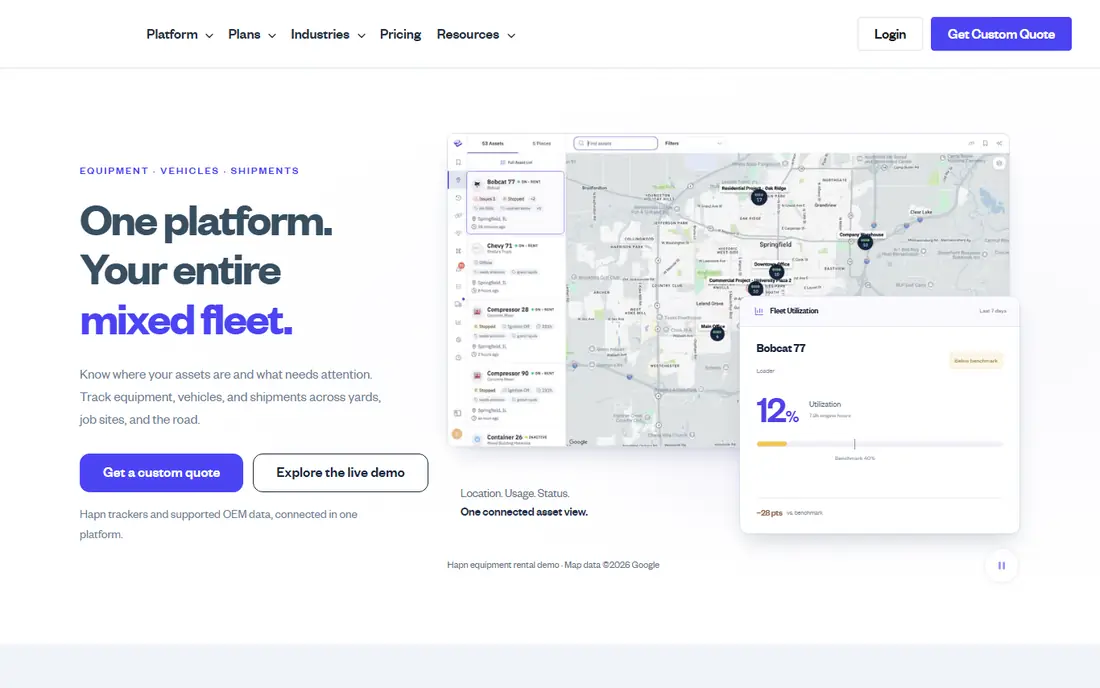
Hapn is built for construction fleets and covers powered heavy equipment, unpowered assets such as trailers and containers, and vehicles on one map. Equipment tracking starts at $13 per month per asset, with telematics at $18 and OEM data integration at $4 per asset. Geofencing and theft alerts help a contractor learn within minutes when a machine leaves a site, which matters when a single stolen excavator can stall a project.
The platform also pulls OEM machine data where available, so engine hours and diagnostics can sit beside location data. That mix helps with maintenance planning and rental decisions, since you can see which machines are idle and which are due for service. Smaller fleets should confirm hardware costs and coverage for remote sites before ordering, since cellular gaps affect any GPS tool.
- Construction-focused platform
- Powered and unpowered asset tracking
- No long-term contract stated
- Telematics plan costs more
- OEM data integration is a separate add-on

Geotab is a broad fleet platform that works well for construction firms running trucks, vans and heavy equipment together. Reporting covers location, fuel use, maintenance schedules and driver behavior, and benchmarking helps a fleet compare its performance with similar operations. At $10 per vehicle per month to start, it is one of the lowest published entry prices here.
The tradeoff is complexity. New users often find the map and navigation harder to learn than simpler tools, and support responses can be slow. Geotab suits a fleet with someone who will own the system, build reports and train drivers. A small contractor that only wants to see machines on a map may prefer Hapn or One Step GPS.
- Deep reporting and benchmarking
- Wide vehicle coverage
- EV and fuel tools
- Learning curve is steeper
- Support feedback is mixed
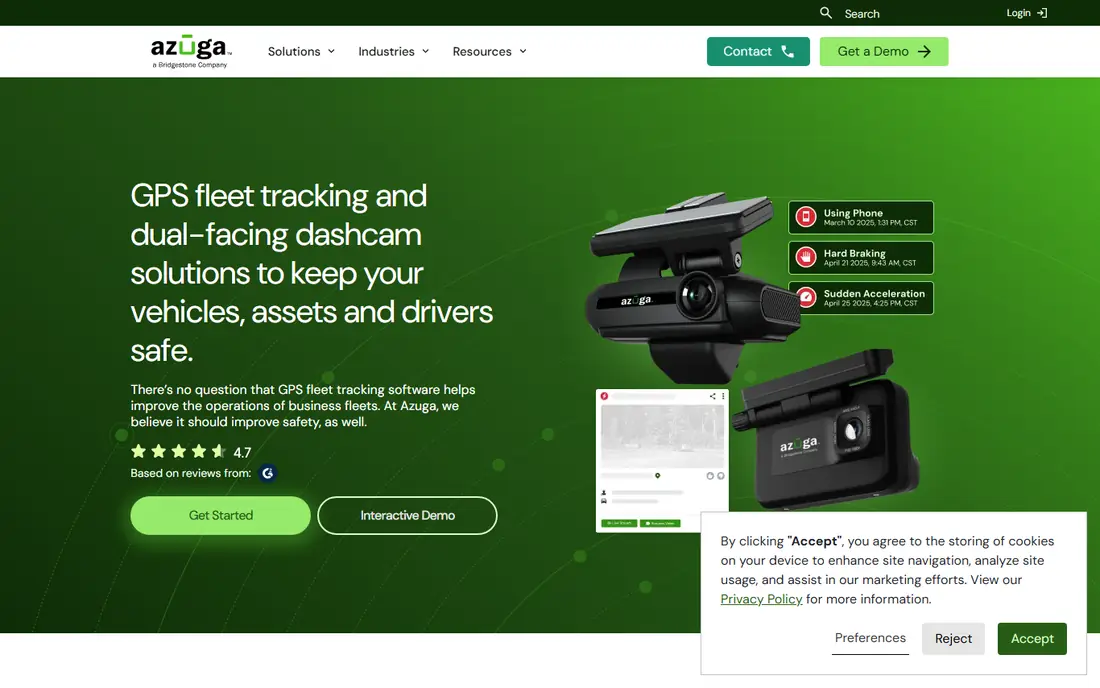
Azuga pairs GPS tracking with dashcams, driver safety scoring and field service management, which suits construction firms that also run service crews. Road-facing and in-cab camera views, event recording and safety thresholds help managers coach drivers and review incidents. Setup is generally quick, and the mobile app covers day-to-day checks well.
At $25 per vehicle per month to start, Azuga costs more than Geotab or Hapn, and some users report long-term contracts and slow hardware replacement. Firms that need camera evidence and job tracking in one system may still find it good value. Firms that only need location and geofencing should compare the cheaper options first.
- Dashcam options with in-cab views
- Field service tools
- Easy setup
- Higher starting price
- Long-term contracts reported by users
Samsara is a connected operations platform used by construction, logistics and field service fleets. It covers GPS tracking, telematics, dashcams, equipment monitoring and maintenance in one system, with integrations for common project and accounting tools. For a contractor that wants safety, maintenance and site operations in one place, that breadth is appealing.
Pricing is by quote, so a small fleet cannot compare Samsara directly with a $13 tool without a sales conversation. Hardware, installation and implementation can also add to the first-year cost. Samsara fits larger operations that will use most of the platform. Smaller fleets should ask for a written quote and check whether a simpler tool covers their real needs.
- Unified platform for vehicles and equipment
- Strong safety and maintenance tools
- Wide integrations
- Quote-only pricing
- Hardware and implementation costs add up
Verizon Connect serves large fleets with GPS tracking, telematics, routing and maintenance tools backed by a major carrier network. Reporting and compliance features suit firms with many vehicles, drivers and sites, and the platform scales across regions and divisions. For an enterprise contractor, that scale and support structure matter.
Small contractors will find Verizon Connect harder to evaluate, since pricing is by quote and the platform is built for larger operations. Implementation and training also take more effort than with a simple tracker. If your fleet is large and complex, request a quote and compare it with Samsara and Geotab. If it is small, start with a published-price tool.
- Large-scale fleet coverage
- Strong reporting
- Carrier-backed connectivity
- Quote-only pricing
- Enterprise focus may overwhelm small fleets
Linxup stands out for contractors already using Procore for project management, because its integration can log equipment usage into project daily logs without manual entry. That saves field staff time and keeps project records consistent. Month-to-month terms and a starting price of $20 per device per month make it easy to try without a long commitment.
Linxup is less deep on advanced telematics and analytics than Samsara or Geotab, so fleets that need rich diagnostics may want more. For a Procore-based contractor that mainly needs reliable location, geofencing and usage logging, Linxup is a practical and well-matched choice.
- Procore integration for daily logs
- Month-to-month terms
- Long track record
- Fewer advanced telematics features
- Price is mid-range
One Step GPS is the budget pick for fleets that want fast location updates without a contract. At $13.95 per device per month with no equipment fees stated and no long-term contract, it lowers the barrier for a small contractor to track every machine. Refresh rates of one to 30 seconds beat many rivals at two to three times the price, which helps when a machine moves between sites.
The platform is simpler than enterprise tools, with fewer integrations and less depth on maintenance and safety analytics. That is a fair trade for many small fleets, since the core job is knowing where machines are and when they move. Larger fleets with complex reporting needs should trial it against Geotab before committing the whole fleet.
- Low price with no contracts
- Fast GPS refresh rates
- 100-day money-back guarantee stated
- Fewer enterprise integrations
- Support is smaller than enterprise vendors
Fleet Chaser is built specifically for construction, with job site geofencing, equipment usage tracking and maintenance alerts at its core. Location updates every five seconds for active assets give managers a current view of machines across sites, and trackers store data when coverage drops and sync later. That offline handling matters on remote sites where cellular signal is weak.
Pricing is stated at $20 to $25 per vehicle per month, with dashcams at an extra $25 per vehicle, so a camera-equipped fleet costs notably more. The platform covers excavators, bulldozers, graders, pavers, trailers and similar equipment. For a contractor that wants construction-specific features without enterprise complexity, Fleet Chaser is a solid option.
- Built for construction
- Fast location updates
- Offline data storage
- Price range varies by setup
- Dashcam costs extra
How we picked these
We compared official product pages, pricing pages and current fleet comparisons for tools that track construction machines in October 2026, not only cars or delivery vans. We favored tools with GPS tracking, geofencing and maintenance or telematics features, plus published prices or clear quote models. Phone-only tracking apps without asset hardware support were left out.
What to check before you buy
Start with your asset mix. Powered machines can use wired telematics devices, while trailers, generators and containers need battery-powered trackers with long life. Check battery replacement, wiring, tamper resistance and whether the tracker works in areas with weak cellular coverage. A tracker that only works near a city will not help on a rural site.
Next, test geofencing and alerts with a real site. Set a boundary, move a machine, and see how fast the alert arrives and how clear it is. Check engine hours, idle time and maintenance alerts, since those features turn tracking into savings on fuel, rentals and repairs. Confirm who receives alerts at night and on weekends, when theft risk is highest.
Finally, price hardware, activation and contracts together. Ask about device costs, installation, activation fees, minimum terms and what happens if you reduce fleet size. A low monthly price with expensive hardware and a three-year term can cost more than a slightly higher monthly price with no contract. Get the full first-year cost in writing.
FAQ
How does construction machine tracking software work?
A GPS or telematics device on each machine sends location, engine hours and sometimes diagnostic data to a cloud platform. Managers view machines on a map, set geofences around job sites, and receive alerts when a machine moves, idles too long or needs service. Battery trackers suit unpowered assets, while wired devices suit powered machines.
Do I need a different tracker for trailers and small equipment?
Yes, in most cases. Powered machines can use wired telematics units that draw power from the machine. Trailers, generators and attachments need battery-powered trackers, since they have no engine power to draw on. Check battery life, weather resistance and mounting options before ordering for unpowered assets.
What is geofencing and why does it matter?
Geofencing is a virtual boundary drawn around a job site, yard or storage area. When a tracked machine crosses that boundary, the system sends an alert to managers. This helps catch unauthorized movement early, improves theft recovery, and creates a record of when machines arrive and leave each site.
How much does construction machine tracking cost?
Published starting prices here range from $10 to $25 per vehicle or asset per month, with dashcams and telematics often extra. Hardware, activation and installation can add upfront cost, and some vendors require contracts. Ask for the full first-year cost, including hardware and any add-ons, before comparing monthly prices alone.
Will GPS tracking work on remote job sites?
GPS itself works in remote areas, but most trackers need cellular coverage to send data live. Some tools store data when coverage drops and sync it later, while others use satellite links for very remote sites. Ask vendors how their trackers behave without cellular signal, and test one unit on your most remote site before a full rollout.