Best Compliance Platform for Money Transmitters in 2026: 9 Platforms Compared
Compare the best compliance platform for money transmitters in 2026, from Alloy and ComplyAdvantage to Unit21, Flagright and Socure, with AML tools today.

- Editor's choice
 Alloy
Identity and risk decisions
Starts atSee websiteVisit alloy.comFull review - Great alternative
 ComplyAdvantage
AML screening and monitoring
Starts atSee websiteVisit complyadvantage.comFull review - Also consider
 Unit21
No-code risk and compliance
Starts atSee websiteVisit unit21.aiFull review
TL;DR:
- Alloy and ComplyAdvantage suit money transmitters that need identity checks, sanctions screening, and transaction monitoring in one workflow.
- Unit21 and Flagright stand out for teams that want no-code rules and fast case handling without a large engineering project.
- Socure and Persona help with identity verification accuracy, which reduces false declines for legitimate senders.
- Licensing, recordkeeping, and state rules vary, so a platform should support your licensed states and reporting duties, not just screening.
- This is not legal advice. Money transmission rules are complex, so confirm licensing and AML duties with counsel before launch.
Quick comparison
| Tool | Best for | Starts at | Free plan? | |
|---|---|---|---|---|
| Alloy | Identity and risk decisions | See website | No | Visit |
| ComplyAdvantage | AML screening and monitoring | See website | Free trial | Visit |
| Unit21 | No-code risk and compliance | See website | No | Visit |
 Flagright | Real-time transaction monitoring | See website | Free trial | Visit |
 Socure | Identity verification accuracy | See website | No | Visit |
 Persona | Flexible identity verification | See website | Free trial | Visit |
 Chainalysis | Crypto transaction compliance | See website | No | Visit |
 LexisNexis Risk Solutions | Data and screening depth | See website | No | Visit |
 Hawk AI | AI transaction monitoring | See website | No | Visit |
The best compliance platform for money transmitters
Money transmitters face strict duties: verify senders, screen sanctions lists, monitor transactions, file reports, and keep records. The platforms below help with those duties, but they do not replace a compliance officer or legal advice. Teams should confirm that a platform supports their licensed states, corridors, and reporting needs.
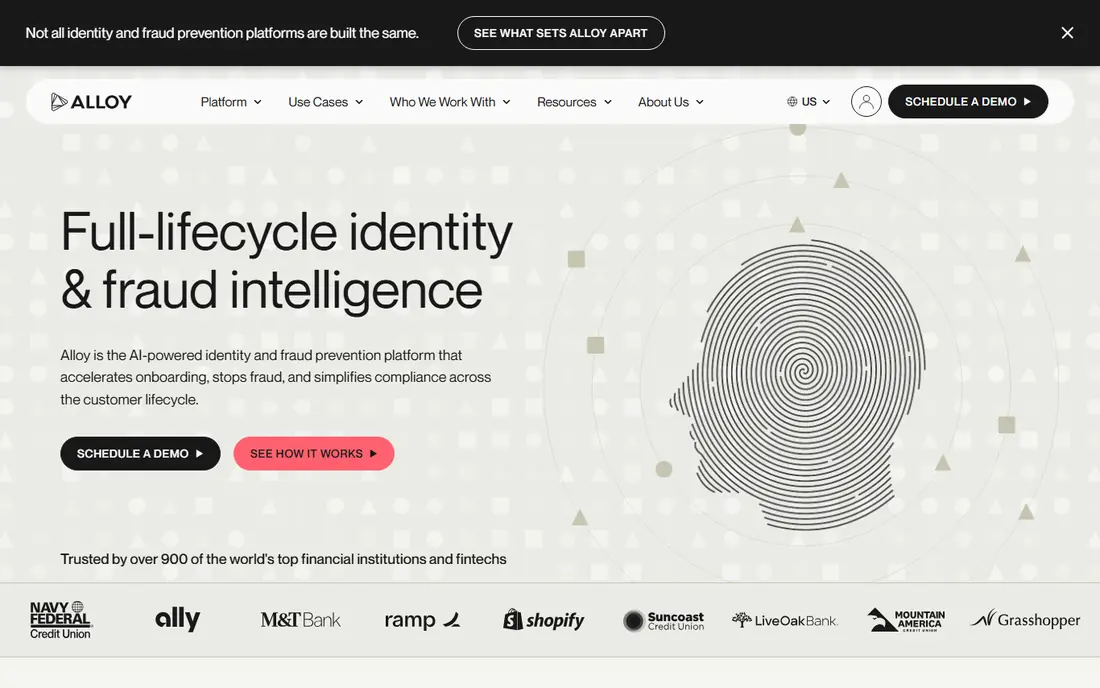
Alloy helps money transmitters build identity verification and risk decision workflows from many data sources. Teams can set rules for document checks, sanctions screening, device signals, and fraud indicators, then route cases for manual review when needed. That orchestration reduces the need to stitch together separate vendors for each check.
Pricing is quote-based and setup takes planning, especially for state licensing and recordkeeping rules. Smaller transmitters may find the platform more than they need at first. For licensed transmitters with meaningful volume and a need for consistent decisions across channels, Alloy offers a strong compliance core.
- Orchestrates many identity data sources
- Decision workflows
- Fraud and AML signals in one place
- Quote-based pricing
- Implementation needs data and policy planning

ComplyAdvantage focuses on anti-money laundering screening and monitoring. It screens customers and transactions against sanctions lists, politically exposed persons lists, and adverse media, then monitors activity for suspicious patterns. Case management tools help compliance teams review alerts, document decisions, and prepare for audits.
Alert volume is the main risk. Without tuning, teams can face many false positives that slow operations. Pricing also varies by screening volume and features. For money transmitters that need a dedicated AML screening and monitoring layer, ComplyAdvantage is a well-known option with broad data coverage.
- Sanctions, PEP, and adverse media screening
- Transaction monitoring
- Case management
- Screening quality depends on data tuning
- Pricing varies by volume

Unit21 gives compliance teams no-code tools to build rules, monitor transactions, and manage cases without waiting for engineering work. Teams can combine data from identity vendors, transaction systems, and third-party signals, then test rules before they go live. That speed helps transmitters respond to new fraud patterns or corridor risks.
As a smaller vendor, Unit21 relies on integrations for some data sources rather than owning all data itself. Pricing is quote-based. For teams that want control over rules and fast case handling, Unit21 offers flexibility that larger, more rigid platforms may not.
- No-code rules for fraud and AML
- Case management
- Data integrations
- Quote-based pricing
- Smaller vendor than large data providers
Flagright provides real-time transaction monitoring, risk scoring, and case management for money transmitters and other financial firms. Its no-code rules let compliance teams set thresholds, watchlists, and velocity checks, then review alerts in a shared case workspace. Tools for suspicious activity reporting support help teams document decisions.
Coverage and maturity should be checked against your corridors and volumes, since Flagright is newer than some rivals. Pricing depends on transaction volume. For transmitters that need real-time monitoring without a heavy engineering build, Flagright is a practical candidate for a trial.
- Real-time monitoring
- No-code rules
- Case and SAR support tools
- Newer vendor with evolving coverage
- Pricing depends on volume
Socure focuses on verifying identity and predicting fraud risk with high accuracy. It combines document verification, device signals, and data from a large network to decide whether a sender is who they claim to be. That accuracy matters for money transmitters, since false declines lose legitimate senders while missed fraud creates regulatory risk.
Socure is an identity layer, not a full AML suite, so teams usually pair it with screening and monitoring tools. Pricing is quote-based. For transmitters that struggle with onboarding friction or fraud at signup, Socure can improve approval rates while keeping controls strong.
- Strong identity verification and fraud prediction
- Large data network
- Document and device checks
- Quote-based pricing
- Best as part of a wider compliance stack
Persona lets teams build identity verification flows that fit different risk levels and corridors. Low-risk senders can pass with lighter checks, while higher-risk senders face document and selfie verification. Case review tools help compliance staff handle edge cases and keep an audit trail.
Persona does not replace transaction monitoring or sanctions screening on its own, so it works best as part of a compliance stack. Pricing scales with volume, which can grow with a successful launch. For transmitters that need flexible, user-friendly onboarding, Persona balances conversion and control well.
- Flexible verification flows
- Document and selfie checks
- Case review tools
- Pricing scales with verification volume
- Full AML monitoring needs other tools
Chainalysis is the leading compliance tool for crypto transactions. It traces funds across blockchains, scores wallet risk, screens sanctions-linked addresses, and helps teams investigate suspicious activity. Money transmitters that handle crypto, stablecoins, or crypto-to-fiat corridors rely on this kind of analysis to meet AML duties.
Fiat-only transmitters will need separate tools for bank and card transaction monitoring, since Chainalysis focuses on crypto. Pricing is quote-based and aimed at regulated firms. For transmitters with any crypto exposure, Chainalysis is a core compliance tool, not an optional extra.
- Deep crypto transaction analysis
- Sanctions and risk scoring
- Investigation tools
- Quote-based pricing
- Crypto focus means fiat-only transmitters need other tools
LexisNexis Risk Solutions offers deep data for identity verification, fraud detection, and AML screening, drawing on large public and proprietary data sets. Money transmitters can use it to verify senders, screen against risk lists, and assess fraud signals with a vendor that regulators and banks know well.
The product range is broad and enterprise-oriented, so pricing and contracting can feel heavy for a small transmitter. Teams should work with the vendor to select only the data products they need. For licensed transmitters that want data depth and a long-established vendor, LexisNexis is a strong foundation.
- Very deep identity and risk data
- Screening and fraud tools
- Established compliance vendor
- Pricing and contracts are enterprise-oriented
- Product range can feel complex
Hawk AI uses machine learning to monitor transactions, score risk, and surface suspicious patterns with explanations that compliance teams can review. Explainability matters for audits, since a team must be able to say why an alert was raised and how it was resolved. Case management tools support that documentation.
AI monitoring still needs human oversight, model tuning, and validation, especially for regulated reporting. Pricing is quote-based. For transmitters that face high alert volumes from rule-only systems, Hawk AI offers a more adaptive monitoring approach, provided the compliance team can govern the models.
- AI-driven transaction monitoring
- Explainable risk scoring
- Case management
- Quote-based pricing
- AI model tuning needs compliance oversight
How we picked these
We compared official product pages, feature lists, and compliance use cases for platforms that serve money transmitters or adjacent money movement firms. We favored tools with sanctions screening, identity verification, transaction monitoring, or case management, and we mixed full AML suites with specialist identity and crypto tools. Pricing is largely quote-based in this sector, so we used See website and recommend a demo with your own corridors, volumes, and licensed states.
What a money transmitter should test before buying
Start with your licensing map. List every state and corridor you serve, plus the reports you must file, and ask each vendor how it supports those duties. A platform that screens well but cannot support your recordkeeping, reporting workflow, or state-specific rules will leave gaps that a compliance team must fill by hand.
Next, test screening and monitoring with real patterns. Run known good senders, high-risk corridors, and edge cases such as name variations, shared devices, and rapid repeat sends. Measure false positive rates, review time per case, and whether alerts carry enough context to decide without opening five other systems.
Finally, check audit and integration readiness. Confirm how decisions are logged, how long records are kept, and how the platform connects to your core payment system. Ask for a sample audit export and a written list of data sources, update frequency for sanctions lists, and uptime terms. Compliance tools fail most often on integration and evidence, not on marketing claims.
FAQ
What does a compliance platform do for a money transmitter?
It verifies sender identity, screens sanctions and risk lists, monitors transactions for suspicious activity, manages cases, and helps document decisions for audits and reporting. It supports, but does not replace, a compliance program.
Do I still need a compliance officer if I buy a platform?
Yes, money transmitters need human compliance oversight, policies, training, and reporting decisions. A platform automates checks and evidence, while people own risk decisions and regulatory filings.
What is the difference between KYC and AML monitoring?
KYC verifies who a customer is at onboarding, while AML monitoring watches ongoing transactions for suspicious patterns. Money transmitters need both, plus sanctions screening and recordkeeping.
How much does compliance software cost for a money transmitter?
Most vendors price by quote based on volume, corridors, and features, so costs vary widely. Ask for pricing tied to your transaction volume, screening count, and user seats, and model total cost including data and implementation.
Can one platform cover crypto and fiat compliance?
Some suites cover both, but many teams pair a crypto tool such as Chainalysis with a fiat screening and monitoring platform. Check whether your corridors include crypto, stablecoins, or only fiat before choosing.
Is this article legal advice?
No, this is general information only, not legal advice. Money transmission licensing and AML rules vary by state and country, so confirm your duties with a qualified attorney and compliance adviser before launch.