Best Combined Expense and Corporate Card Platforms in 2026: 8 Platforms Compared
Compare the best combined expense and corporate card platform options for 2026, with cards, approvals, receipts and accounting sync explained clearly.

- Editor's choice
 Ramp
Free card and expense platform for growing companies
Starts atFreeVisit ramp.comFull review - Great alternative
 Brex
Venture-backed startups and mid-market companies
Starts atFreeVisit brex.comFull review - Also consider
 BILL Spend and Expense
Teams that already use BILL for payables
Starts atFreeVisit bill.comFull review
TL;DR:
- Ramp, Brex and BILL Spend and Expense all offer a free core tier, which makes them the cheapest starting point for card-based expense control.
- If your team travels often, Navan is the standout because travel booking and expense sit in the same system.
- Airbase and Spendesk suit larger finance teams that want procurement, purchase orders and approvals before money is spent.
- Expensify is the best fit when you want to keep your existing corporate cards and still automate expense reports.
- Check card eligibility early, since some platforms underwrite on company cash flow rather than personal credit.
Quick comparison
| Tool | Best for | Starts at | Free plan? | |
|---|---|---|---|---|
| Ramp | Free card and expense platform for growing companies | Free | Yes | Visit |
| Brex | Venture-backed startups and mid-market companies | Free | Yes | Visit |
| BILL Spend and Expense | Teams that already use BILL for payables | Free | Yes | Visit |
 Navan | Companies where travel and expense belong together | Free | Yes | Visit |
 Airbase | Mid-market companies that want procurement control | See website | No | Visit |
 Expensify | Teams that want to keep their existing corporate cards | $5 per month | Free trial | Visit |
 Mesh Payments | Global companies that need flexible card options | See website | No | Visit |
 Spendesk | European mid-market companies | See website | No | Visit |
The best combined expense and corporate card platforms
A combined platform puts the card, the expense report and the approval in one place, so finance stops chasing receipts after the fact. We compared official pricing pages, feature lists and public reviews to build this list.
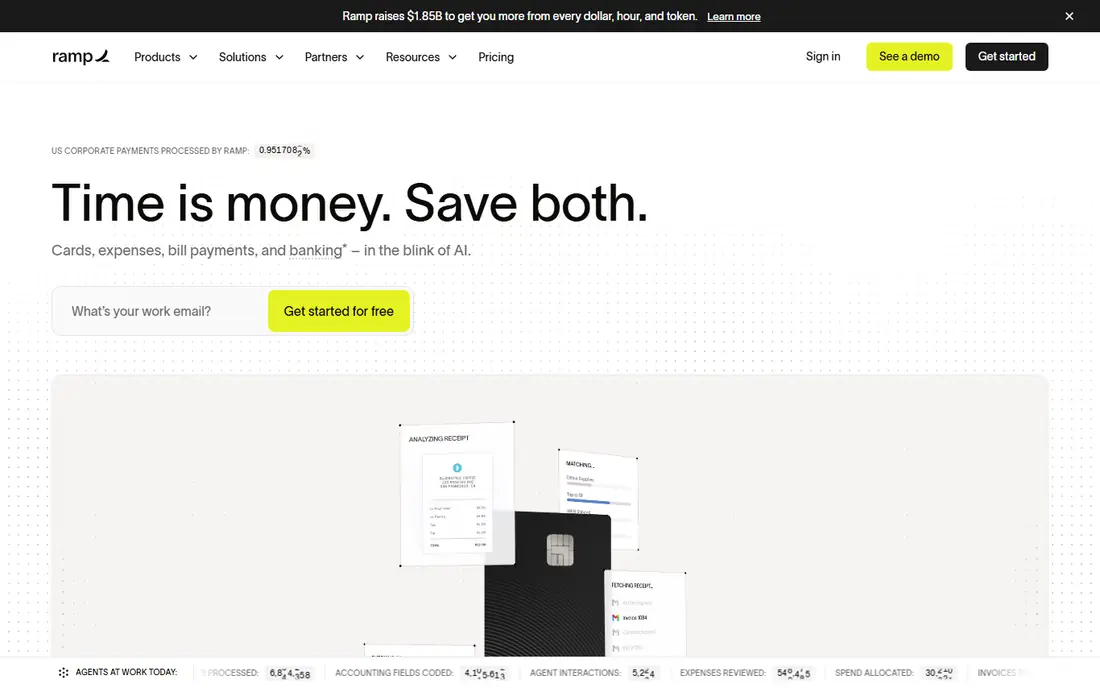
Ramp gives most small and mid-sized companies everything they need without a subscription. The free plan covers corporate cards, expense management, bill pay and travel booking, with unlimited virtual and physical cards. Receipts are matched to transactions automatically, and policies can block out-of-policy spend at the point of purchase.
The paid Plus plan, at $15 per user per month plus a platform fee, adds deeper ERP integrations, multi-entity support and procurement tools. That matters if you run NetSuite or a similar system, but teams on QuickBooks or Xero can often stay on the free plan. The main trade-off is that you must move spend onto Ramp cards, which means giving up rewards tied to a previous card program.
- Free core plan with unlimited cards
- Automatic receipt matching and policy checks
- Cashback on card purchases
- Advanced ERP integrations need the paid Plus plan
- Card approval depends on business finances
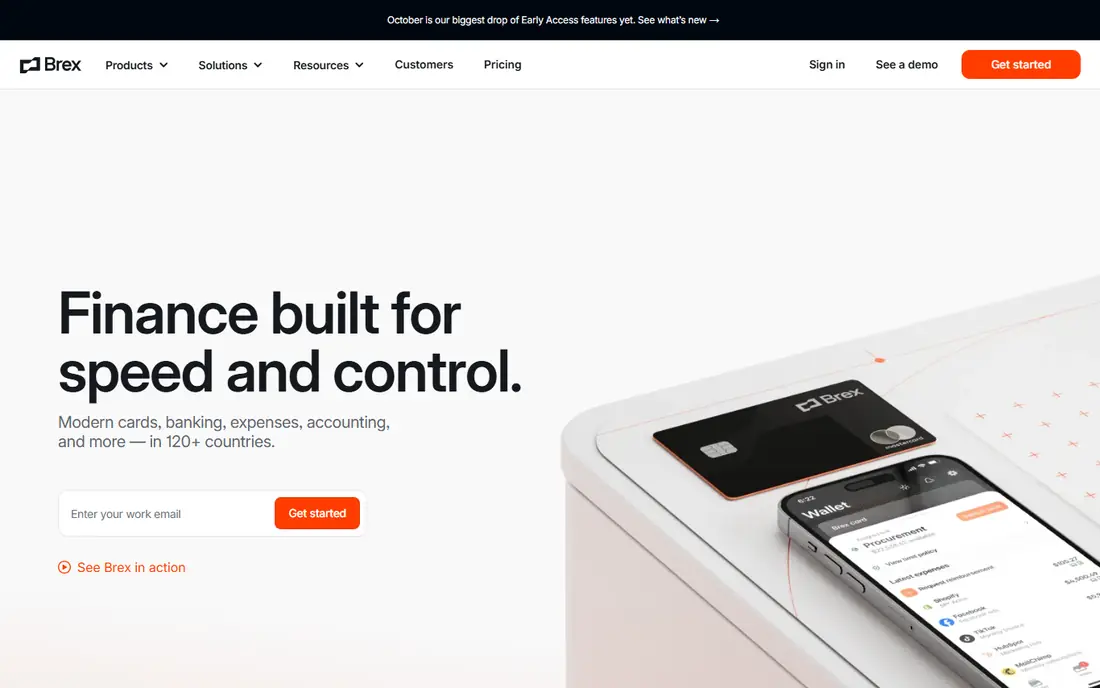
Brex built its name by underwriting on company financials instead of a founder personal credit check, which appealed to startups that had just raised funding. The Essentials plan is free and covers corporate cards, expense management, bill pay, reimbursements and accounting integrations. Premium, at $12 per user per month, adds advanced approval workflows, multi-entity support and custom ERP integrations.
Brex was acquired by Capital One in April 2026, which may reassure some buyers and worry others who liked its startup focus. For eligible companies, the free tier is genuinely useful rather than a thin demo. For traditional small businesses without venture funding, eligibility is the first question to settle before comparing features.
- Free Essentials plan with cards and expense tools
- Strong global card options on paid tiers
- No personal guarantee for eligible companies
- Eligibility can exclude smaller or non-venture-backed businesses
- Advanced multi-entity features need Premium
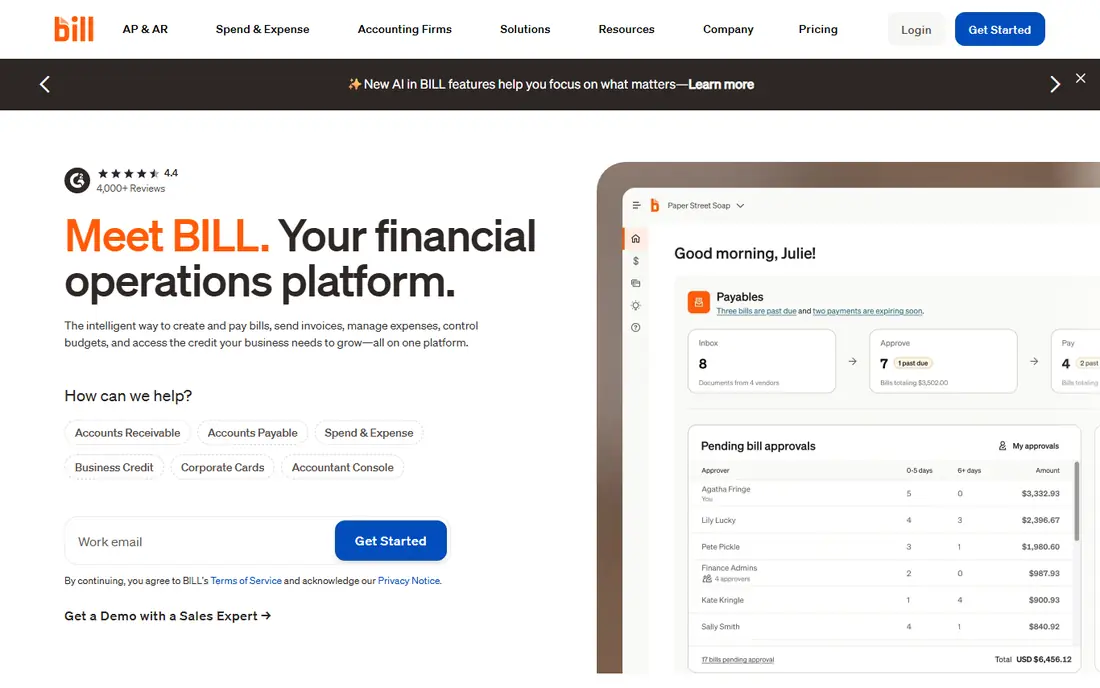
BILL Spend and Expense, formerly Divvy, is free at $0 per user per month for the card, budgets and expense tracking. That makes it an easy add-on for companies already running BILL for accounts payable, since expense data and bill payments live under one vendor. Managers set budgets by team or category, issue cards with limits, and watch spend in real time.
The catch is that the free label covers spend and expense only. BILL accounts payable plans are paid separately, and certain payment types carry fees. If you only need cards and expenses, the free tier is hard to argue with. If you want the full payables suite, price both products together before deciding.
- Free spend and expense software
- Budgets and card controls built in
- Pairs with BILL accounts payable
- BILL accounts payable is a separate paid product
- Some payment methods carry transaction fees
Navan, formerly TripActions, stands out because it treats travel as part of spend rather than a separate system. Employees book flights, hotels and cars in the same app where expenses are submitted, and travel policies are enforced at booking. Navan corporate cards are available, and Navan Connect can link existing Visa, Mastercard or American Express cards.
For companies with 300 or fewer employees, travel booking carries no software fee, and expense is free for the first 5 monthly expensing users, then $15 per user per month. That structure suits small teams that travel a lot. Teams with many expense submitters should model the per-user cost carefully, since it adds up faster than a flat free tier.
- Travel booking included for smaller companies
- Expense free for the first 5 users
- Cards or connected third-party cards
- Expense costs $15 per user per month after the first 5 users
- Larger companies need a custom enterprise quote
Airbase, now part of Paylocity, is built for finance teams that want control before spending happens, not just reports after it. Staff submit purchase requests, managers approve them through guided workflows, and the system issues a card or processes the payment with the approval attached. Accounts payable automation, expense reimbursements and corporate cards share the same data.
That depth comes with a heavier setup than a free card tool, and pricing is quoted per company. Smaller teams may find it more than they need. For mid-market companies juggling purchase orders, multiple subsidiaries and strict approval chains, the procure-to-pay structure is the reason to pay for it.
- Procurement, cards, expenses and payables in one system
- Strong approval workflows
- Real-time general ledger sync
- Pricing is quote-based
- Best suited to companies with 100 or more employees
Expensify takes a different approach from Ramp and Brex: it does not require you to adopt its card. It imports transactions from existing corporate cards, scans receipts, builds reports and syncs to accounting systems such as QuickBooks, NetSuite and Xero. The Collect plan starts at $5 per unique member per month, while Control is $9 per active member per month with an annual commitment when the Expensify Card covers at least half of US spending.
That card flexibility is valuable if your company has negotiated rewards, credit limits or banking relationships it does not want to lose. The trade-off is price: without the card condition, Control costs more. Companies that are happy to switch cards will often get a better deal elsewhere, while companies that are not should shortlist Expensify first.
- Works with cards from thousands of banks
- Strong receipt scanning and report automation
- No forced card switch
- Paid plans cost more without the Expensify Card
- Advanced controls sit on higher tiers
Mesh Payments is designed for companies whose spend does not fit a single card program. It can work with cards a company already holds as well as cards it issues, which helps global teams that operate across banks and currencies. Expenses, approvals and reporting sit in one dashboard, so finance can see spend without consolidating several bank feeds by hand.
Mesh is less visible in the US market than the leaders on this list, and pricing is quoted rather than published, so you will need a sales conversation to budget accurately. For a company with entities in several countries and a mix of card providers, that flexibility may be worth the extra step. For a single-country team, a free domestic platform is usually simpler.
- Supports existing cards alongside issued cards
- Multi-currency spend handling
- Approval workflows for global teams
- Pricing is quote-based
- Less well known in the US than Ramp or Brex
Spendesk is a European spend management platform that combines corporate cards, expense claims, invoice processing and budgets. It is a natural fit for companies with staff in France, Germany, the UK or other European markets, where VAT handling and local payment practices matter. Managers approve requests before payment, and finance gets a clean audit trail for each transaction.
US-only companies will find the card and expense features familiar but may prefer a US-first vendor with deeper domestic banking ties. Spendesk also prices by quote, so smaller teams cannot simply sign up and see a monthly figure. For a European headquarters with cross-border spend, it is one of the strongest options on this list.
- Cards, expenses, invoices and budgets in one platform
- Strong VAT and multi-currency handling
- Clear approval chains
- Pricing is quote-based
- US coverage is thinner than European coverage
How we picked these
We compared official pricing pages, product feature lists, accounting integrations and public user reviews for platforms that genuinely combine a corporate card (or card connection) with expense management. We kept only products that are available today, that issue or connect cards, and that handle approvals and reporting in the same system. We left out expense-only tools with no card link and bank card programs with no expense software, since neither matches the combined brief.
What to check before you choose a combined card and expense platform
Start with eligibility and card acceptance. Some platforms approve cards based on company bank balances and cash flow, while others work with cards you already hold. If your team cannot get approved, or cannot give up current rewards, the feature list does not matter.
Cards, controls and accounting
Decide how much control you need before spend happens. Simple teams do well with per-card limits and category rules. Larger teams may need purchase requests, multi-step approvals, budgets by department and purchase orders. Check the accounting sync too: confirm your general ledger system is supported on the plan you will actually buy, not just on the top tier.
Travel, procurement and global spend
If travel is a large share of spend, a platform with built-in booking saves a separate tool and a separate reconciliation step. If procurement matters more, look for intake forms and purchase orders. For global teams, confirm multi-currency cards, local issuance and VAT handling for the countries where staff actually spend.
Total cost, not just the headline price
A free plan can still carry costs in transaction fees, platform fees on paid tiers or lost rewards from switching cards. Add up per-user fees at your real headcount, any payables add-on, and the cost of moving cards. Ask each vendor what happens to limits, rewards and data if you leave, so the switch is reversible.
FAQ
Is a combined expense and corporate card platform really free?
Some are free at the core level because the vendor earns interchange income from card transactions. Ramp, Brex and BILL Spend and Expense all offer free core tiers. Paid tiers, payables add-ons and certain payment methods can still cost money, so read the pricing page for the plan you will use.
Do I have to switch corporate cards to use one of these platforms?
It depends on the platform. Ramp, Brex and BILL require their own cards for the free tier. Expensify and Mesh can work with cards you already hold, which suits companies that want to keep existing banking relationships and rewards.
Which platform is best for a small business?
For most small teams, Ramp or BILL Spend and Expense are the simplest starting points because the core product is free and setup is quick. Navan is a better pick if travel booking matters as much as expenses. Check card eligibility first, since approval rules differ.
Can these platforms sync with QuickBooks, Xero or NetSuite?
Most of them can, but the plan matters. Ramp includes QuickBooks and Xero sync on its free plan, with NetSuite and other ERPs on Plus. Other vendors may gate deeper ERP integrations behind paid tiers, so confirm your exact accounting system before you commit.
What is the difference between a corporate card platform and expense software?
Expense software records and approves spending after it happens. A combined platform also issues or connects the card, sets limits and enforces policy at the point of purchase. That earlier control is the main advantage, along with automatic receipt matching and cleaner accounting data.
Is my company data safe on these platforms?
Reputable vendors publish security pages covering encryption, access controls and compliance certifications. Check the vendor security page for your shortlist, confirm who can approve and view spend, and use single sign-on where it is offered. Keep card limits tight for new joiners until their spending pattern is clear.